Introduction
Zero Trust Network Access (ZTNA) is a modern security approach that replaces traditional VPN-based access with identity-driven, context-aware access control. Instead of trusting users inside a network perimeter, ZTNA enforces the principle of “never trust, always verify”, ensuring that every access request is authenticated, authorized, and continuously validated.
As organizations move toward cloud-first environments, remote work, and hybrid infrastructures, ZTNA has become a critical component of cybersecurity strategies. It helps secure access to applications, reduce attack surfaces, and prevent lateral movement within networks.
Common use cases include:
- Secure remote access for employees without VPNs
- Application-level access control for SaaS and internal apps
- Third-party and contractor access management
- Protecting sensitive systems from unauthorized access
- Enabling Zero Trust architecture across distributed environments
Key evaluation criteria:
- Identity and access management integration
- Device posture and risk assessment
- Application-level segmentation
- Performance and latency
- Deployment flexibility (cloud, hybrid)
- Scalability across users and apps
- Integration with security ecosystem
- Policy granularity and automation
Best for: Enterprises, mid-market companies, and security-conscious organizations managing remote workforces or multi-cloud environments.
Not ideal for: Very small teams with minimal remote access needs or organizations relying solely on traditional perimeter security.
Key Trends in Zero Trust Network Access (ZTNA)
- Shift from VPN to ZTNA-first architecture
- Integration with SSE and SASE platforms
- AI-driven access decisions and risk scoring
- Identity-first security replacing network-based trust
- Continuous authentication and session monitoring
- Agentless access for improved user experience
- Tighter integration with endpoint security tools
- Microsegmentation becoming standard
- Cloud-native deployment models dominating
- Increased focus on compliance and audit visibility
How We Evaluated Zero Trust Network Access (ZTNA) (Methodology)
- Analyzed market adoption and enterprise usage
- Evaluated core ZTNA capabilities and feature depth
- Considered performance, latency, and scalability
- Reviewed security posture and Zero Trust alignment
- Assessed integration ecosystem (IAM, SIEM, endpoint tools)
- Evaluated deployment flexibility (cloud, hybrid, agent-based)
- Considered ease of deployment and management
- Assessed fit across SMB, mid-market, and enterprise segments
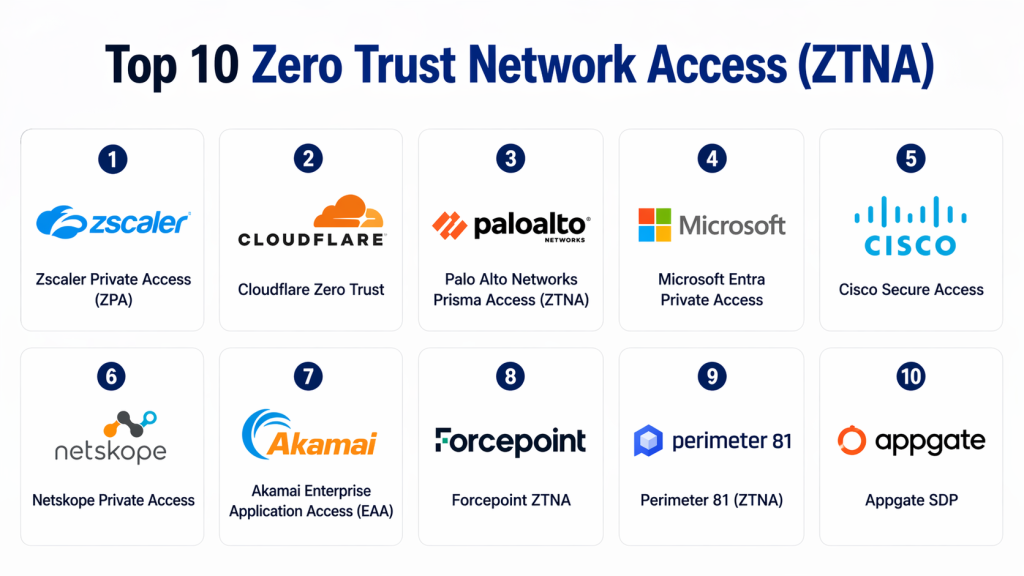
Top 10 Zero Trust Network Access (ZTNA)
#1 — Zscaler Private Access (ZPA)
Short description: A leading ZTNA solution delivering secure, seamless access to internal applications without exposing the network. Designed for large enterprises adopting Zero Trust. Eliminates the need for VPNs while improving user experience. Offers strong scalability and global infrastructure. Ideal for distributed organizations.
Key Features
- Application-level access control
- Zero Trust policy enforcement
- Continuous authentication
- Cloud-native architecture
- Microsegmentation
- Real-time monitoring
Pros
- Highly scalable global platform
- Strong Zero Trust implementation
Cons
- Premium pricing
- Complex setup for beginners
Platforms / Deployment
Cloud
Security & Compliance
SSO, MFA, encryption, audit logs (others not publicly stated)
Integrations & Ecosystem
Works well with enterprise identity and security tools.
- Identity providers
- SIEM tools
- Endpoint security
Support & Community
Enterprise-grade support with strong documentation.
#2 — Cloudflare Zero Trust
Short description: A cloud-native ZTNA platform providing secure access to applications and resources globally. Known for its performance and simplicity. Offers integrated security services including gateway and browser isolation. Ideal for modern cloud-first organizations. Strong developer-friendly capabilities.
Key Features
- Secure access gateway
- Identity-based policies
- Browser isolation
- DDoS protection integration
- Application protection
- Analytics dashboard
Pros
- Easy deployment
- High performance
Cons
- Limited advanced enterprise features
- Learning curve for configuration
Platforms / Deployment
Cloud
Security & Compliance
SSO, MFA, encryption (others not publicly stated)
Integrations & Ecosystem
- Identity providers
- Cloud platforms
- APIs
Support & Community
Good documentation and active community.
#3 — Palo Alto Networks Prisma Access (ZTNA)
Short description: A comprehensive ZTNA solution within Palo Alto’s SASE platform. Provides secure access to applications with strong policy enforcement. Designed for enterprises needing integrated security stack. Offers deep visibility and threat prevention. Ideal for large-scale deployments.
Key Features
- Application access control
- Threat prevention
- Zero Trust policies
- Cloud security integration
- User activity monitoring
Pros
- Strong security ecosystem
- Enterprise scalability
Cons
- Complex deployment
- Higher cost
Platforms / Deployment
Cloud
Security & Compliance
Encryption, audit logs, RBAC (others not publicly stated)
Integrations & Ecosystem
- Palo Alto ecosystem
- SIEM tools
- Identity platforms
Support & Community
Strong enterprise support.
#4 — Microsoft Entra Private Access
Short description: Microsoft’s ZTNA solution integrated with its identity platform. Provides secure access to applications using identity-based controls. Ideal for organizations using Microsoft ecosystem. Offers seamless integration with Azure services. Strong focus on identity-driven security.
Key Features
- Identity-based access control
- Conditional access policies
- Application protection
- Integration with Azure AD
- Risk-based authentication
Pros
- Deep Microsoft integration
- Easy for existing users
Cons
- Limited outside Microsoft ecosystem
- Dependency on Azure
Platforms / Deployment
Cloud
Security & Compliance
SSO, MFA, encryption, audit logs (others not publicly stated)
Integrations & Ecosystem
- Microsoft ecosystem
- Security tools
- APIs
Support & Community
Strong enterprise documentation and support.
#5 — Cisco Secure Access (ZTNA)
Short description: Cisco’s ZTNA offering combines secure access with network security. Provides identity-driven access to applications. Ideal for organizations already using Cisco infrastructure. Offers strong visibility and policy enforcement.
Key Features
- Identity-based access
- Application segmentation
- Threat detection
- Policy enforcement
- Analytics
Pros
- Strong networking integration
- Reliable performance
Cons
- Requires Cisco ecosystem
- Complex configuration
Platforms / Deployment
Cloud
Security & Compliance
Encryption, audit logs (others not publicly stated)
Integrations & Ecosystem
- Cisco tools
- Cloud apps
- Security stack
Support & Community
Enterprise-level support.
#6 — Netskope Private Access
Short description: Netskope’s ZTNA solution focuses on secure access and data protection. Provides application-level access with strong analytics. Ideal for organizations needing combined CASB + ZTNA capabilities. Offers real-time visibility.
Key Features
- Application access control
- Data protection
- User analytics
- Real-time enforcement
- Cloud-native
Pros
- Strong analytics
- Integrated CASB features
Cons
- Premium pricing
- Setup complexity
Platforms / Deployment
Cloud
Security & Compliance
Encryption, audit logs (others not publicly stated)
Integrations & Ecosystem
- SIEM tools
- Identity providers
- APIs
Support & Community
Enterprise support.
#7 — Akamai Enterprise Application Access (EAA)
Short description: A ZTNA solution designed for secure application access without VPNs. Provides identity-aware access control and strong performance. Ideal for distributed teams. Built on Akamai’s global network.
Key Features
- Identity-aware access
- Application protection
- Secure remote access
- Performance optimization
- Analytics
Pros
- Strong global network
- Reliable performance
Cons
- Limited SMB focus
- Configuration complexity
Platforms / Deployment
Cloud
Security & Compliance
Encryption, audit logs (others not publicly stated)
Integrations & Ecosystem
- Identity tools
- Cloud apps
- APIs
Support & Community
Good enterprise support.
#8 — Forcepoint ZTNA
Short description: Focuses on data-centric Zero Trust access. Provides secure application access with strong DLP capabilities. Ideal for compliance-heavy industries. Emphasizes insider threat protection.
Key Features
- Data-centric access control
- DLP integration
- Risk analytics
- Policy enforcement
- Monitoring
Pros
- Strong data protection
- Good compliance support
Cons
- Complex UI
- Limited SMB focus
Platforms / Deployment
Cloud
Security & Compliance
DLP, encryption, audit logs (others not publicly stated)
Integrations & Ecosystem
- Security tools
- Cloud apps
- APIs
Support & Community
Enterprise-focused support.
#9 — Perimeter 81 (ZTNA)
Short description: A user-friendly ZTNA platform designed for SMBs and mid-market companies. Offers secure access with simple deployment. Combines VPN and Zero Trust capabilities. Ideal for teams transitioning from VPN.
Key Features
- Secure access gateway
- Identity-based policies
- Network segmentation
- Easy deployment
- Analytics
Pros
- Easy to use
- Affordable
Cons
- Limited advanced features
- Not ideal for large enterprises
Platforms / Deployment
Cloud
Security & Compliance
Encryption, audit logs (others not publicly stated)
Integrations & Ecosystem
- Identity providers
- Cloud apps
- APIs
Support & Community
Good SMB-focused support.
#10 — Appgate SDP
Short description: A software-defined perimeter solution implementing Zero Trust principles. Provides secure access to applications with strong segmentation. Ideal for organizations needing flexible deployment. Offers agent-based and agentless options.
Key Features
- Software-defined perimeter
- Identity-based access
- Microsegmentation
- Risk-based policies
- Analytics
Pros
- Flexible deployment
- Strong segmentation
Cons
- Requires expertise
- Complex setup
Platforms / Deployment
Cloud / Hybrid
Security & Compliance
Encryption, audit logs (others not publicly stated)
Integrations & Ecosystem
- Identity tools
- Security stack
- APIs
Support & Community
Enterprise support with documentation.
Comparison Table (Top 10)
| Tool Name | Best For | Platform(s) | Deployment | Standout Feature | Public Rating |
|---|---|---|---|---|---|
| Zscaler ZPA | Enterprise | Web | Cloud | Zero Trust platform | N/A |
| Cloudflare ZT | SMB/Mid | Web | Cloud | Performance | N/A |
| Prisma Access | Enterprise | Web | Cloud | Integrated security | N/A |
| Microsoft Entra | Microsoft users | Web | Cloud | Identity integration | N/A |
| Cisco Secure Access | Cisco users | Web | Cloud | Network integration | N/A |
| Netskope | Data protection | Web | Cloud | CASB + ZTNA | N/A |
| Akamai EAA | Global teams | Web | Cloud | Performance | N/A |
| Forcepoint | Compliance | Web | Cloud | DLP focus | N/A |
| Perimeter 81 | SMB | Web | Cloud | Ease of use | N/A |
| Appgate SDP | Flexible | Web | Cloud/Hybrid | Segmentation | N/A |
Evaluation & Scoring of ZTNA
| Tool | Core | Ease | Integrations | Security | Performance | Support | Value | Total |
|---|---|---|---|---|---|---|---|---|
| Zscaler | 9 | 7 | 9 | 9 | 9 | 9 | 7 | 8.6 |
| Cloudflare | 8 | 9 | 7 | 8 | 9 | 8 | 9 | 8.5 |
| Prisma | 9 | 7 | 8 | 9 | 8 | 8 | 7 | 8.3 |
| Microsoft | 9 | 8 | 9 | 9 | 8 | 9 | 8 | 8.7 |
| Cisco | 8 | 7 | 8 | 8 | 8 | 8 | 7 | 7.9 |
| Netskope | 9 | 7 | 9 | 9 | 8 | 8 | 7 | 8.4 |
| Akamai | 8 | 7 | 7 | 8 | 9 | 8 | 7 | 7.9 |
| Forcepoint | 8 | 6 | 7 | 9 | 8 | 7 | 7 | 7.7 |
| Perimeter 81 | 7 | 9 | 6 | 7 | 7 | 7 | 9 | 7.8 |
| Appgate | 8 | 6 | 7 | 8 | 8 | 7 | 7 | 7.6 |
Interpretation:
Higher scores indicate stronger overall capabilities. Enterprise tools score higher in security and integrations, while SMB tools score better in ease of use and value.
Which ZTNA Is Right for You?
Solo / Freelancer
Not typically required unless handling sensitive systems.
SMB
Perimeter 81 or Cloudflare Zero Trust are good options.
Mid-Market
Netskope or Akamai provide balance.
Enterprise
Zscaler, Microsoft, Prisma are top choices.
Budget vs Premium
- Budget: Perimeter 81
- Premium: Zscaler
Feature Depth vs Ease
- Easy: Cloudflare
- Advanced: Netskope
Integrations & Scalability
- Best integrations: Microsoft, Prisma
Security & Compliance
- High compliance: Forcepoint, Zscaler
FAQs
1. What is ZTNA?
ZTNA is a security model that grants access based on identity and context rather than network location. It ensures users are verified before accessing resources. This reduces risk compared to traditional VPNs. It is widely used in modern cloud environments. It supports Zero Trust architecture.
2. How is ZTNA different from VPN?
ZTNA provides application-level access, while VPN provides network-level access. This reduces exposure. ZTNA is more secure and scalable. VPNs are being phased out in many organizations.
3. Is ZTNA secure?
Yes, ZTNA is considered highly secure. It uses identity-based authentication and continuous monitoring. It reduces attack surface significantly. However, it should be combined with other tools.
4. Can ZTNA replace VPN?
Yes, in most cases ZTNA can replace VPN. It provides better security and user experience. Many organizations are moving to ZTNA-first models.
5. How long does deployment take?
Deployment varies from days to weeks. Cloud-based ZTNA is faster. Larger enterprises take longer due to complexity.
6. Is ZTNA expensive?
Pricing varies by vendor and scale. Enterprise tools are costly. SMB tools are more affordable.
7. What integrations matter?
Identity providers, SIEM, and endpoint tools are critical. Good integrations improve security posture.
8. Does ZTNA support compliance?
Yes, most tools support compliance standards. However, details vary by vendor.
9. What are common mistakes?
Not defining policies clearly. Ignoring integration needs. Underestimating deployment complexity.
10. What alternatives exist?
Alternatives include VPN, SWG, and CASB. However, they do not fully replace ZTNA.
Conclusion
Zero Trust Network Access (ZTNA) is rapidly becoming the foundation of modern access security, replacing traditional VPN-based approaches with identity-driven, context-aware controls. As organizations adopt cloud-first strategies and remote work models, ZTNA ensures that access to applications remains secure, scalable, and tightly controlled. From reducing attack surfaces to enabling continuous authentication, ZTNA aligns perfectly with Zero Trust principles and modern cybersecurity demands.
Choosing the right ZTNA solution depends on your organization’s size, infrastructure, and security maturity. Enterprise environments may benefit from platforms like Zscaler or Microsoft Entra, while SMBs may find better value in simpler tools like Cloudflare Zero Trust or Perimeter 81. The best approach is to shortlist a few solutions, test them in real-world scenarios, and validate integration, performance, and policy enforcement capabilities before full deployment.
