Introduction
Secure Access Service Edge (SASE) is a modern cybersecurity framework that combines networking and security into a single cloud-delivered platform. It integrates technologies like SD-WAN, Secure Web Gateway (SWG), Cloud Access Security Broker (CASB), Zero Trust Network Access (ZTNA), and firewall capabilities to provide secure, optimized access to applications from anywhere.
As organizations embrace remote work, cloud adoption, and distributed infrastructure, traditional perimeter-based security models are no longer effective. SASE addresses this by delivering identity-driven, cloud-native security and networking, ensuring consistent protection regardless of user location.
Common use cases include:
- Securing remote workforce access to enterprise apps
- Replacing legacy VPN and MPLS networks
- Enabling Zero Trust access control
- Protecting SaaS and cloud workloads
- Optimizing network performance across global users
Key evaluation criteria:
- Integration of security services (SWG, CASB, ZTNA)
- SD-WAN capabilities
- Performance and global edge presence
- Identity-based access controls
- Ease of deployment and management
- Scalability and flexibility
- Integration with existing tools
- Cost efficiency
Best for: Enterprises, mid-market companies, and cloud-first organizations managing distributed users and applications.
Not ideal for: Small teams with minimal networking complexity or organizations not yet adopting cloud infrastructure.
Key Trends in SASE Platforms
- Convergence of networking and security into unified platforms
- Shift toward SSE (Security Service Edge) within SASE architecture
- AI-driven threat detection and traffic optimization
- Expansion of global edge networks for low latency
- Identity-first access control models
- Agentless and browser-based access gaining popularity
- Integration with Zero Trust frameworks
- Automation of policy enforcement and compliance
- Cloud-native architecture replacing hardware appliances
- Flexible subscription-based pricing models
How We Evaluated SASE Platforms (Methodology)
- Assessed market leadership and adoption trends
- Evaluated feature completeness (SD-WAN + security stack)
- Considered performance and global coverage
- Reviewed security capabilities and Zero Trust alignment
- Assessed integration ecosystem (IAM, SIEM, cloud platforms)
- Evaluated deployment flexibility (cloud, hybrid)
- Considered ease of management and automation
- Assessed fit for SMB, mid-market, and enterprise use cases
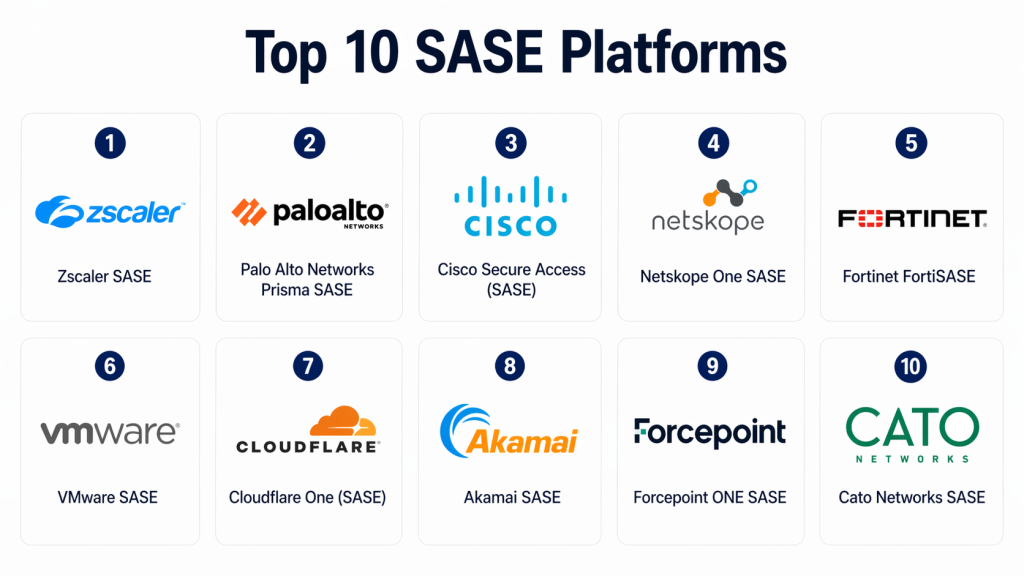
Top 10 SASE Platforms
#1 — Zscaler SASE
Short description: A leading cloud-native SASE platform delivering secure access and networking through a global Zero Trust architecture. It integrates SWG, CASB, and ZTNA into a unified solution. Designed for large enterprises with distributed workforces. Known for strong scalability and performance. Eliminates the need for traditional network appliances.
Key Features
- Zero Trust Network Access
- Secure Web Gateway
- CASB integration
- Cloud firewall
- Global edge network
- Traffic inspection
Pros
- Strong Zero Trust implementation
- High scalability
Cons
- Premium pricing
- Complex onboarding
Platforms / Deployment
Cloud
Security & Compliance
SSO, MFA, encryption, audit logs (others not publicly stated)
Integrations & Ecosystem
Works with enterprise security and identity platforms.
- SIEM tools
- Identity providers
- Endpoint security
Support & Community
Enterprise-level support and documentation.
#2 — Palo Alto Networks Prisma SASE
Short description: A comprehensive SASE platform combining networking and advanced threat protection. Offers integrated SD-WAN, ZTNA, and cloud security services. Ideal for enterprises needing deep security capabilities. Known for strong threat intelligence.
Key Features
- Integrated SD-WAN
- Threat prevention
- ZTNA access
- CASB capabilities
- Cloud firewall
Pros
- Advanced security features
- Strong ecosystem
Cons
- High cost
- Complex deployment
Platforms / Deployment
Cloud
Security & Compliance
Encryption, audit logs, RBAC (others not publicly stated)
Integrations & Ecosystem
- Palo Alto ecosystem
- SIEM tools
- Cloud platforms
Support & Community
Strong enterprise support.
#3 — Cisco SASE (Cisco Secure Access)
Short description: Cisco’s SASE solution integrates networking and security services across its ecosystem. Provides secure access and strong network performance. Ideal for organizations using Cisco infrastructure.
Key Features
- SD-WAN integration
- Secure access
- Threat detection
- Policy enforcement
- Analytics
Pros
- Strong networking capabilities
- Reliable performance
Cons
- Requires Cisco ecosystem
- Configuration complexity
Platforms / Deployment
Cloud
Security & Compliance
Encryption, audit logs (others not publicly stated)
Integrations & Ecosystem
- Cisco tools
- Security platforms
- Cloud services
Support & Community
Enterprise-grade support.
#4 — Netskope SASE
Short description: A cloud-native SASE platform focusing on data protection and secure access. Offers strong CASB and ZTNA capabilities. Known for real-time visibility and analytics.
Key Features
- CASB integration
- ZTNA access
- Data protection
- Real-time analytics
- Cloud-native
Pros
- Strong data protection
- High performance
Cons
- Premium pricing
- Learning curve
Platforms / Deployment
Cloud
Security & Compliance
Encryption, audit logs (others not publicly stated)
Integrations & Ecosystem
- SIEM tools
- Identity providers
- APIs
Support & Community
Enterprise support.
#5 — Fortinet SASE
Short description: Combines Fortinet’s networking and security solutions into a unified SASE platform. Offers strong SD-WAN and firewall capabilities. Ideal for hybrid environments.
Key Features
- SD-WAN
- Firewall integration
- Secure access
- Threat protection
- Analytics
Pros
- Strong networking performance
- Good value
Cons
- Complex setup
- UI limitations
Platforms / Deployment
Cloud / Hybrid
Security & Compliance
Encryption, audit logs (others not publicly stated)
Integrations & Ecosystem
- Fortinet ecosystem
- Cloud apps
- APIs
Support & Community
Good enterprise support.
#6 — VMware SASE (VMware Secure Access)
Short description: VMware’s SASE platform integrates networking and security for modern enterprises. Known for strong SD-WAN capabilities and cloud security integration.
Key Features
- SD-WAN
- Secure access
- Cloud security
- Analytics
- Policy management
Pros
- Strong SD-WAN
- Flexible deployment
Cons
- Complex integration
- Enterprise-focused
Platforms / Deployment
Cloud / Hybrid
Security & Compliance
Encryption, audit logs (others not publicly stated)
Integrations & Ecosystem
- VMware tools
- Cloud platforms
- APIs
Support & Community
Enterprise support.
#7 — Cloudflare One (SASE)
Short description: A cloud-native SASE platform offering secure access and networking through a global edge network. Known for performance and ease of use.
Key Features
- Global network
- ZTNA
- SWG
- DDoS protection
- Analytics
Pros
- High performance
- Easy deployment
Cons
- Limited enterprise depth
- Feature gaps
Platforms / Deployment
Cloud
Security & Compliance
SSO, MFA, encryption (others not publicly stated)
Integrations & Ecosystem
- Identity providers
- APIs
- Cloud apps
Support & Community
Strong documentation and community.
#8 — Akamai SASE
Short description: Built on Akamai’s global network, this platform offers secure access and performance optimization. Suitable for distributed enterprises.
Key Features
- Global edge network
- Secure access
- Threat detection
- Analytics
- Performance optimization
Pros
- Strong performance
- Global reach
Cons
- Limited SMB focus
- Complex setup
Platforms / Deployment
Cloud
Security & Compliance
Encryption, audit logs (others not publicly stated)
Integrations & Ecosystem
- Cloud platforms
- Security tools
- APIs
Support & Community
Enterprise-level support.
#9 — Forcepoint SASE
Short description: Focuses on data-centric security within SASE architecture. Provides strong DLP and insider threat protection.
Key Features
- Data protection
- ZTNA
- CASB
- Analytics
- Policy enforcement
Pros
- Strong DLP
- Compliance support
Cons
- Complex UI
- Limited SMB focus
Platforms / Deployment
Cloud
Security & Compliance
DLP, encryption, audit logs (others not publicly stated)
Integrations & Ecosystem
- Security tools
- APIs
- Cloud apps
Support & Community
Enterprise support.
#10 — Cato Networks SASE
Short description: A fully integrated SASE platform combining networking and security in a single cloud service. Known for simplicity and strong performance.
Key Features
- SD-WAN
- Secure access
- Threat protection
- Cloud-native
- Analytics
Pros
- Easy to deploy
- Good performance
Cons
- Limited advanced features
- Smaller ecosystem
Platforms / Deployment
Cloud
Security & Compliance
Encryption, audit logs (others not publicly stated)
Integrations & Ecosystem
- Cloud apps
- APIs
- Security tools
Support & Community
Good support with onboarding.
Comparison Table (Top 10)
| Tool Name | Best For | Platform(s) | Deployment | Standout Feature | Public Rating |
|---|---|---|---|---|---|
| Zscaler | Enterprise | Web | Cloud | Zero Trust | N/A |
| Prisma SASE | Enterprise | Web | Cloud | Threat prevention | N/A |
| Cisco | Cisco users | Web | Cloud | Networking | N/A |
| Netskope | Data security | Web | Cloud | CASB + ZTNA | N/A |
| Fortinet | Hybrid env | Web | Cloud/Hybrid | SD-WAN | N/A |
| VMware | Enterprise | Web | Cloud/Hybrid | SD-WAN | N/A |
| Cloudflare | SMB/Mid | Web | Cloud | Performance | N/A |
| Akamai | Global teams | Web | Cloud | Edge network | N/A |
| Forcepoint | Compliance | Web | Cloud | DLP | N/A |
| Cato | Simplicity | Web | Cloud | All-in-one | N/A |
Evaluation & Scoring of SASE Platforms
| Tool | Core | Ease | Integrations | Security | Performance | Support | Value | Total |
|---|---|---|---|---|---|---|---|---|
| Zscaler | 9 | 7 | 9 | 9 | 9 | 9 | 7 | 8.6 |
| Prisma | 9 | 7 | 8 | 9 | 8 | 8 | 7 | 8.3 |
| Cisco | 8 | 7 | 8 | 8 | 8 | 8 | 7 | 7.9 |
| Netskope | 9 | 7 | 9 | 9 | 8 | 8 | 7 | 8.4 |
| Fortinet | 8 | 7 | 8 | 8 | 8 | 8 | 8 | 8.0 |
| VMware | 8 | 7 | 8 | 8 | 8 | 8 | 7 | 7.9 |
| Cloudflare | 8 | 9 | 7 | 8 | 9 | 8 | 9 | 8.5 |
| Akamai | 8 | 7 | 7 | 8 | 9 | 8 | 7 | 7.9 |
| Forcepoint | 8 | 6 | 7 | 9 | 8 | 7 | 7 | 7.7 |
| Cato | 8 | 9 | 7 | 8 | 8 | 7 | 9 | 8.3 |
Interpretation:
Higher scores indicate stronger overall capabilities. Enterprise solutions typically score higher in security and integrations, while simpler platforms score better in ease of use and value.
Which SASE Platform Is Right for You?
Solo / Freelancer
SASE is usually not required unless handling sensitive distributed workloads.
SMB
Cloudflare One or Cato Networks are strong options.
Mid-Market
Netskope or Fortinet offer a balance of features and cost.
Enterprise
Zscaler, Prisma SASE, and Cisco are top choices.
Budget vs Premium
- Budget: Cato Networks
- Premium: Zscaler
Feature Depth vs Ease of Use
- Easy: Cloudflare, Cato
- Advanced: Prisma, Netskope
Integrations & Scalability
- Best integrations: Cisco, Prisma
Security & Compliance
- High compliance: Forcepoint, Zscaler
FAQs
1. What is SASE?
SASE is a cloud-delivered framework combining networking and security. It integrates multiple security functions into one platform. It helps secure users accessing applications from anywhere. It replaces traditional network security models. It is widely used in modern enterprises.
2. How is SASE different from traditional networking?
Traditional networking relies on hardware appliances and centralized control. SASE is cloud-native and distributed. It provides better scalability and flexibility. It also integrates security directly into networking.
3. Is SASE suitable for small businesses?
Yes, but only if they have distributed teams or cloud-heavy environments. Otherwise, simpler security solutions may be sufficient. SMB-focused SASE platforms are easier to deploy.
4. What components make up SASE?
SASE includes SD-WAN, CASB, SWG, ZTNA, and firewall capabilities. These work together to provide secure access and networking.
5. How long does deployment take?
Deployment varies from days to weeks depending on complexity. Cloud-native solutions are faster to deploy. Larger enterprises may take longer.
6. Is SASE expensive?
Pricing depends on features and scale. Enterprise platforms are more expensive. SMB solutions are more affordable.
7. What integrations should I consider?
Identity providers, SIEM tools, and cloud platforms are important. Strong integrations improve efficiency and security.
8. Does SASE support Zero Trust?
Yes, SASE integrates Zero Trust principles. It enforces identity-based access control.
9. What are common challenges?
Complex deployment, integration issues, and policy configuration are common challenges. Proper planning helps avoid these.
10. What are alternatives to SASE?
Alternatives include standalone tools like VPN, CASB, and SWG. However, they lack unified capabilities.
Conclusion
SASE platforms are transforming how organizations approach networking and security by delivering a unified, cloud-native architecture that supports modern, distributed environments. By combining multiple security functions like CASB, ZTNA, and SWG into a single platform, SASE reduces complexity while improving visibility, performance, and control. This makes it especially valuable for organizations adopting remote work, multi-cloud strategies, and Zero Trust frameworks.
Choosing the right SASE platform depends on your organization’s scale, infrastructure, and security requirements. Enterprise teams may prefer robust platforms like Zscaler or Prisma SASE, while SMBs may benefit from simpler solutions like Cloudflare One or Cato Networks. The best approach is to shortlist a few platforms, test them in real-world conditions, and validate integration, performance, and policy enforcement before full deployment.
