Introduction
Transaction Monitoring AML Systems help financial institutions and regulated businesses detect suspicious financial activity by analyzing transactions, customer behavior, account movement, payment patterns, and risk signals. In simple terms, these systems look for unusual activity that may indicate money laundering, terrorist financing, fraud, sanctions evasion, structuring, mule accounts, high-risk transfers, or other financial crime risks.
These systems matter because financial transactions are now faster, more digital, more cross-border, and more complex. Banks, fintech companies, payment providers, crypto platforms, insurers, lending firms, and marketplaces need stronger monitoring to identify suspicious behavior without overwhelming compliance teams with false alerts.
Real-world use cases include:
- Detecting unusual customer transaction patterns
- Monitoring high-risk payments and transfers
- Identifying structuring and suspicious cash-like activity
- Supporting suspicious activity investigation workflows
- Connecting AML alerts with KYC, sanctions, fraud, and case management
Buyers should evaluate:
- Rule-based and AI-based detection capabilities
- False-positive reduction
- Real-time and batch monitoring support
- Case management and investigation workflows
- Risk scoring and customer segmentation
- Data integration flexibility
- Alert explainability
- Regulatory reporting support
- Security and access controls
- Scalability across products, regions, and transaction volumes
Best for: Banks, fintechs, payment companies, crypto firms, credit unions, insurers, lenders, marketplaces, compliance teams, AML analysts, fraud teams, and risk teams that need structured financial crime monitoring.
Not ideal for: Very small businesses with low transaction volume, firms that only need simple customer checks, or teams without compliance resources to investigate alerts and maintain monitoring rules properly.
Key Trends in Transaction Monitoring AML Systems
- AI-assisted detection is becoming more common as firms try to identify hidden patterns, mule networks, account anomalies, and suspicious behavior more effectively.
- False-positive reduction is now a major buying priority because traditional AML rules can generate too many low-value alerts.
- Real-time monitoring is becoming more important for instant payments, digital wallets, crypto transfers, and high-speed fintech transactions.
- Behavior-based risk scoring is replacing static rule-only approaches by analyzing customer activity in context.
- Integrated fraud and AML workflows are growing because fraud, scams, mule accounts, and money laundering often overlap.
- Explainable models are becoming essential because compliance teams must understand why alerts were created and document investigation decisions.
- Cloud-native AML platforms are gaining adoption due to faster deployment, scalability, and easier updates.
- API-first monitoring is important for fintechs, embedded finance platforms, and payment companies that need flexible integrations.
- Graph analytics and network detection are expanding because suspicious activity often involves connected accounts, entities, devices, and counterparties.
- Continuous monitoring is becoming standard as customer risk can change after onboarding based on behavior, transactions, geography, and counterparties.
How We Evaluated Transaction Monitoring AML Systems
The following Top 10 systems were selected using practical AML and buyer-focused criteria:
- Market adoption and recognition among banks, fintechs, payment firms, credit unions, and regulated financial institutions.
- Core transaction monitoring capability, including scenario rules, behavioral analytics, alert generation, and suspicious activity detection.
- AI and machine learning depth, especially for anomaly detection, alert prioritization, false-positive reduction, and network analytics.
- Case management strength, including investigation workflows, audit trails, escalation, comments, evidence capture, and reporting support.
- Integration flexibility, including APIs, data feeds, customer databases, payment systems, core banking, fraud tools, sanctions tools, and KYC platforms.
- Scalability and performance, especially for real-time payments, large transaction volumes, and multi-region monitoring.
- Security posture signals, including role-based access, audit logs, encryption, user permissions, and enterprise administration.
- Regulatory and compliance fit, including support for AML programs, suspicious activity workflows, and risk-based monitoring.
- Usability for analysts, including alert review, dashboards, rule tuning, and operational efficiency.
- Customer fit across segments, including enterprise banks, fintechs, credit unions, payment firms, and digital asset businesses.
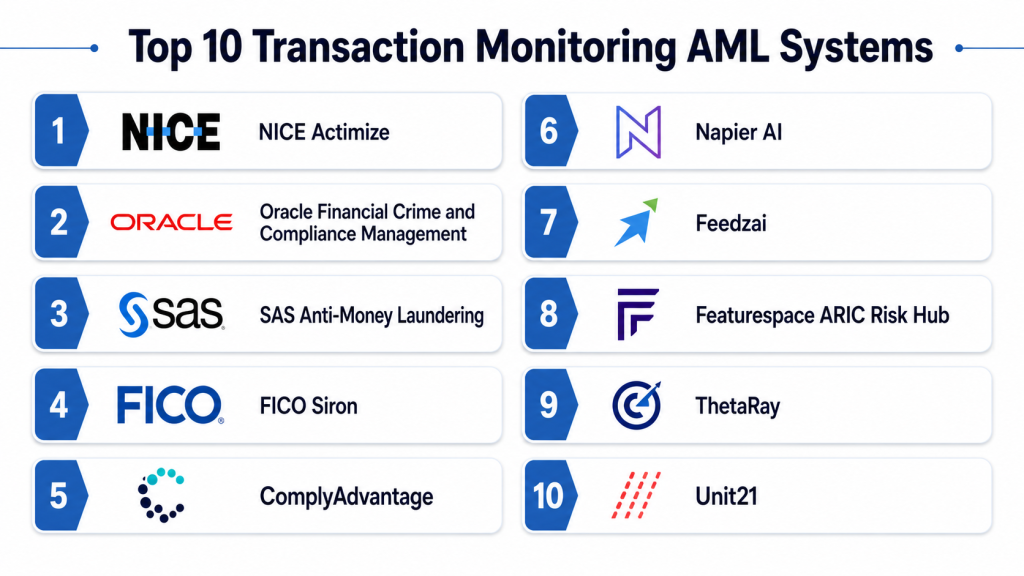
Top 10 Transaction Monitoring AML Systems
#1 — NICE Actimize
Short description: NICE Actimize is a widely recognized financial crime and compliance platform used by banks, financial institutions, payment firms, and regulated businesses.
Its AML transaction monitoring capabilities help organizations detect suspicious behavior, manage alerts, investigate cases, and support regulatory compliance workflows.
The platform is best suited for larger financial institutions and mature compliance teams that need broad financial crime coverage.
It can support transaction monitoring, sanctions screening, fraud detection, case management, and broader risk operations.
NICE Actimize is often considered when organizations need enterprise-grade AML infrastructure rather than a lightweight tool.
Its strength is the depth of financial crime functionality and its ability to support complex monitoring environments.
Implementation can require planning, data preparation, and configuration, but the platform can scale for demanding use cases.
It is a strong option for institutions with high transaction volumes and complex AML requirements.
Key Features
- AML transaction monitoring workflows
- Suspicious activity detection and alerting
- Case management and investigation support
- Customer risk scoring
- Rules and analytics-based monitoring
- Fraud and financial crime ecosystem alignment
- Enterprise reporting and audit trails
Pros
- Strong fit for large banks and regulated financial institutions.
- Broad financial crime coverage beyond AML transaction monitoring.
- Scalable for complex, high-volume monitoring environments.
Cons
- May be too complex for smaller firms.
- Implementation can require significant technical and compliance planning.
- Best value usually comes when used as part of a broader financial crime suite.
Platforms / Deployment
Cloud / Hosted / Enterprise deployment options vary
Security & Compliance
Enterprise access controls, audit workflows, permissions, and investigation controls are expected.
Specific certifications: Not publicly stated.
Integrations & Ecosystem
NICE Actimize fits into enterprise financial crime environments where transaction monitoring connects with fraud, sanctions, customer risk, and case management systems. It is most valuable when integrated into a broader compliance operating model.
- Core banking systems
- Payment platforms
- Fraud detection tools
- Sanctions screening systems
- KYC and customer onboarding workflows
- Enterprise case management
Support & Community
Support is vendor-led and enterprise-focused. Implementation, training, configuration, technical support, and customer success support vary by contract and deployment model.
#2 — Oracle Financial Crime and Compliance Management
Short description: Oracle Financial Crime and Compliance Management is an enterprise platform for AML, transaction monitoring, sanctions, fraud, risk scoring, and compliance case management.
It is best suited for large banks, insurers, financial institutions, and enterprises that need strong data handling and scalable compliance workflows. The platform helps organizations monitor customer transactions, detect suspicious patterns, and investigate financial crime alerts.
Key Features
- AML transaction monitoring
- Customer risk scoring
- Case management and investigation workflows
- Financial crime analytics
- Sanctions and fraud ecosystem support
- Enterprise data integration
- Regulatory reporting workflow support
Pros
- Strong enterprise scalability and data architecture.
- Useful for large financial institutions with complex compliance needs.
- Broad financial crime coverage beyond transaction monitoring.
Cons
- Implementation may be resource-intensive.
- Smaller firms may find the platform too heavy.
- Requires strong technical and compliance ownership.
Platforms / Deployment
Cloud / Enterprise deployment options vary
Security & Compliance
Enterprise-grade security controls, permissions, audit trails, and administrative controls are expected.
Specific certifications: Not publicly stated.
Integrations & Ecosystem
Oracle’s platform is designed to connect financial crime workflows with customer data, payment systems, enterprise databases, analytics tools, and compliance operations.
- Core banking systems
- Payment processing systems
- Customer data platforms
- Enterprise data warehouses
- AML and sanctions workflows
- Case management processes
Support & Community
Oracle support is enterprise-oriented and may include implementation partners, technical support, documentation, training, and account management depending on contract scope.
#3 — SAS Anti-Money Laundering
Short description: SAS Anti-Money Laundering is an analytics-driven AML solution designed for banks, financial institutions, and regulated businesses that need transaction monitoring and financial crime detection. It uses analytics, risk scoring, and monitoring logic to help identify suspicious customer and transaction behavior. The platform is especially relevant for institutions that value strong data analytics and risk modeling. SAS can support customer due diligence, transaction monitoring, alert management, and investigation workflows.
Key Features
- AML transaction monitoring
- Risk scoring and customer segmentation
- Alert generation and workflow support
- Advanced analytics and detection scenarios
- Case investigation support
- Data-driven financial crime monitoring
- Reporting and audit support
Pros
- Strong analytics and modeling capabilities.
- Good fit for institutions with mature data and compliance teams.
- Useful for complex AML monitoring scenarios.
Cons
- Can require skilled users and careful configuration.
- May be more complex than lightweight AML tools.
- Implementation effort depends on data quality and integration scope.
Platforms / Deployment
Cloud / Hosted / Enterprise deployment options vary
Security & Compliance
Enterprise access controls, audit workflows, and data security controls are expected.
Specific certifications: Not publicly stated.
Integrations & Ecosystem
SAS Anti-Money Laundering fits into data-heavy compliance environments where transaction data, customer data, and risk models need to work together.
- Core banking systems
- Customer databases
- Data warehouses
- Analytics environments
- Case management workflows
- Regulatory reporting processes
Support & Community
SAS provides enterprise support, documentation, training resources, implementation assistance, and partner support depending on the customer agreement.
#4 — FICO Siron
Short description: FICO Siron is a financial crime compliance platform that supports AML transaction monitoring, KYC, sanctions screening, customer due diligence, risk scoring, and case management.
It is used by banks, financial institutions, fintechs, insurers, and regulated businesses that need structured compliance workflows. The platform helps organizations detect suspicious transactions, manage alerts, and document investigation decisions. FICO Siron is especially useful for firms that want transaction monitoring connected with broader AML and customer risk processes.
Key Features
- AML transaction monitoring
- KYC and customer due diligence support
- Sanctions and watchlist screening alignment
- Customer risk scoring
- Case management workflows
- Investigation and review tools
- Compliance reporting support
Pros
- Combines AML monitoring with broader financial crime workflows.
- Good fit for banks and regulated financial businesses.
- Supports structured investigations and risk-based reviews.
Cons
- Configuration and tuning may require specialist knowledge.
- Smaller teams may not need the full platform depth.
- Deployment details can vary by customer and region.
Platforms / Deployment
Cloud / Hosted / Enterprise deployment options vary
Security & Compliance
Enterprise access controls, audit logs, and compliance workflow controls are expected.
Specific certifications: Not publicly stated.
Integrations & Ecosystem
FICO Siron works well in financial crime ecosystems where customer data, transaction data, screening alerts, and case workflows need to be connected.
- Core banking platforms
- Payment systems
- KYC and onboarding tools
- Sanctions screening workflows
- Case management systems
- Compliance reporting workflows
Support & Community
Support is vendor-led and typically includes implementation assistance, configuration guidance, technical support, and training depending on contract scope.
#5 — ComplyAdvantage
Short description: ComplyAdvantage is a modern financial crime compliance platform that supports AML transaction monitoring, sanctions screening, PEP screening, adverse media, and risk workflows.
It is especially popular among fintechs, payment companies, crypto firms, digital banks, and fast-growing regulated businesses. The platform is designed for API-first compliance operations where monitoring must connect directly with onboarding, payments, and customer systems.
Key Features
- AML transaction monitoring
- Sanctions, PEP, and adverse media support
- API-first workflows
- Risk scoring and alerting
- Customer monitoring
- Case management and review tools
- Configurable rules and monitoring logic
Pros
- Strong fit for fintechs, payments, and digital financial businesses.
- API-friendly design supports modern product workflows.
- Combines transaction monitoring with broader compliance data.
Cons
- Larger enterprises may require deeper customization and validation.
- Alert tuning is important to reduce false positives.
- Exact fit depends on region, business model, and transaction volume.
Platforms / Deployment
Cloud / Web / API-based deployment
Security & Compliance
Role-based access, audit workflows, and platform security controls are expected.
Specific certifications: Not publicly stated.
Integrations & Ecosystem
ComplyAdvantage is designed for teams that need AML controls embedded into digital onboarding, payments, and compliance workflows.
- Customer onboarding platforms
- Payment systems
- KYC and KYB workflows
- Sanctions screening
- APIs and webhooks
- Case management tools
Support & Community
Support may include onboarding, documentation, API guidance, customer success, and compliance workflow assistance depending on plan and customer size.
#6 — Napier AI
Short description: Napier AI provides financial crime compliance tools for transaction monitoring, screening, client activity review, and AML risk management. It is designed for banks, fintechs, payment companies, asset managers, and regulated businesses that need modern AML capabilities.
The platform helps compliance teams identify suspicious transaction activity, investigate alerts, and manage risk-based workflows.
Key Features
- AML transaction monitoring
- Client activity review
- Sanctions and screening workflow support
- Alert and case management
- Risk scoring and analytics
- Configurable monitoring rules
- Compliance dashboarding
Pros
- Modern platform approach for AML operations.
- Useful for teams seeking better analyst productivity.
- Supports transaction monitoring alongside broader financial crime workflows.
Cons
- Buyers should validate regional coverage and integration fit.
- AI-assisted workflows still require compliance analyst review.
- Data quality strongly affects alert performance.
Platforms / Deployment
Cloud / Web / Enterprise options vary
Security & Compliance
Enterprise security controls, permissions, and audit workflows are expected.
Specific certifications: Not publicly stated.
Integrations & Ecosystem
Napier AI is designed to connect AML monitoring with customer onboarding, transaction data, screening workflows, and investigation processes.
- Customer onboarding systems
- Payment platforms
- Transaction data feeds
- Screening workflows
- Case management tools
- AML reporting processes
Support & Community
Support is vendor-led and may include onboarding, implementation guidance, technical assistance, and compliance workflow support depending on customer agreement.
#7 — Feedzai
Short description: Feedzai is a financial crime and risk operations platform known for fraud prevention, risk scoring, payment protection, and transaction monitoring use cases. It is especially relevant for banks, payment providers, fintechs, and financial institutions that need real-time risk detection. The platform can help identify suspicious transaction behavior, fraud patterns, scams, mule activity, and financial crime risks.
Key Features
- Real-time transaction risk monitoring
- Machine learning-based detection
- Fraud and financial crime analytics
- Risk scoring and decisioning
- Alert and investigation workflows
- Payment and digital banking monitoring
- Behavioral pattern detection
Pros
- Strong real-time risk detection capabilities.
- Good fit for fraud and AML overlap scenarios.
- Useful for high-volume digital financial environments.
Cons
- Buyers should validate AML-specific compliance workflow depth.
- Implementation requires good transaction and customer data.
- Tuning models and rules requires ongoing governance.
Platforms / Deployment
Cloud / Hosted / Enterprise deployment options vary
Security & Compliance
Enterprise security, access controls, and audit workflows are expected.
Specific certifications: Not publicly stated.
Integrations & Ecosystem
Feedzai is designed to integrate with payment systems, banking platforms, fraud operations, and risk decisioning workflows.
- Payment processing systems
- Digital banking platforms
- Fraud management tools
- Customer risk data
- Transaction data streams
- Case review workflows
Support & Community
Support is vendor-led and enterprise-focused, typically including implementation help, technical support, customer success, and risk operations guidance.
#8 — Featurespace ARIC Risk Hub
Short description: Featurespace ARIC Risk Hub is a financial crime and fraud prevention platform known for adaptive behavioral analytics and real-time risk detection. It is used by financial institutions, payment firms, and regulated organizations that need to detect unusual activity across customers and transactions. The platform can support fraud detection, scams monitoring, AML-related risk signals, and suspicious transaction behavior analysis. Featurespace is especially relevant where customer behavior changes over time and static rules are not enough.
Key Features
- Adaptive behavioral analytics
- Real-time transaction monitoring
- Fraud and financial crime risk detection
- Risk scoring and alert prioritization
- Customer behavior modeling
- High-volume transaction analytics
- Investigation workflow support
Pros
- Strong behavioral analytics capability.
- Useful for reducing static-rule limitations.
- Good fit for high-volume digital banking and payments.
Cons
- AML-specific fit should be validated carefully.
- Advanced analytics require good data quality.
- Compliance teams must ensure alert explainability and documentation.
Platforms / Deployment
Cloud / Hosted / Enterprise options vary
Security & Compliance
Enterprise security controls and audit workflows are expected.
Specific certifications: Not publicly stated.
Integrations & Ecosystem
Featurespace fits into payment, banking, fraud, and financial crime risk environments where real-time transaction behavior matters.
- Payment systems
- Banking platforms
- Fraud operations tools
- Customer behavior data
- Transaction streams
- Risk dashboards
Support & Community
Support is enterprise-focused and typically includes implementation guidance, technical support, and risk analytics assistance depending on customer scope.
#9 — ThetaRay
Short description: ThetaRay is an AI-driven financial crime detection platform focused on transaction monitoring, cross-border payments, correspondent banking, and AML risk detection.
It is designed for banks, fintechs, payment firms, and financial institutions that need to detect suspicious patterns across complex transaction flows. The platform uses AI-based analytics to identify anomalies and hidden financial crime risks that may not be visible through simple rules. ThetaRay is especially relevant for cross-border payments and correspondent banking environments where transaction behavior can be complex.
Key Features
- AI-based AML transaction monitoring
- Anomaly detection
- Cross-border payment monitoring
- Correspondent banking risk detection
- Alert prioritization
- Financial crime analytics
- Investigation workflow support
Pros
- Strong fit for complex payment and cross-border monitoring.
- AI-driven detection can identify non-obvious suspicious patterns.
- Useful for firms seeking modern AML analytics.
Cons
- AI-based alerts require clear explainability for compliance teams.
- Data integration and tuning are important.
- Buyers should validate coverage for their exact product and region.
Platforms / Deployment
Cloud / Hosted / Enterprise options vary
Security & Compliance
Enterprise security, role controls, and audit workflows are expected.
Specific certifications: Not publicly stated.
Integrations & Ecosystem
ThetaRay fits AML environments where payment data, customer risk, and transaction behavior must be analyzed across complex networks.
- Cross-border payment systems
- Correspondent banking workflows
- Transaction data feeds
- Customer risk systems
- Case management tools
- AML reporting workflows
Support & Community
Support is vendor-led and usually includes implementation assistance, technical guidance, customer success, and AML workflow support.
#10 — Unit21
Short description: Unit21 is a risk and compliance operations platform used by fintechs, marketplaces, crypto firms, banks, and digital businesses for transaction monitoring, fraud detection, case management, and investigations. It is designed for teams that want flexible workflows, no-code or low-code rule configuration, and strong operational control. The platform can help organizations detect suspicious activity, manage alerts, review cases, and connect fraud and AML workflows. Unit21 is especially attractive for fast-moving digital businesses that need configurable monitoring without heavy legacy infrastructure.
Key Features
- Transaction monitoring workflows
- Fraud and AML case management
- No-code or low-code rule configuration
- Alert review and investigation tools
- Risk operations workflows
- Data ingestion and API support
- Team collaboration and audit trails
Pros
- Strong fit for fintechs, crypto firms, and digital businesses.
- Flexible workflow and rule configuration.
- Useful for teams combining fraud and AML operations.
Cons
- Enterprise banks may need to validate deeper regulatory workflows.
- Monitoring quality depends on data completeness and rule design.
- Advanced AML programs may require careful configuration.
Platforms / Deployment
Cloud / Web / API-based deployment
Security & Compliance
Role-based access, audit logs, and platform controls are expected.
Specific certifications: Not publicly stated.
Integrations & Ecosystem
Unit21 is designed for risk operations teams that need to connect transaction data, customer data, fraud signals, and compliance workflows into a single operational layer.
- APIs
- Customer onboarding systems
- Payment platforms
- Fraud tools
- Case management workflows
- Risk operations dashboards
Support & Community
Support is vendor-led and may include onboarding, documentation, implementation support, customer success, and technical guidance depending on plan and customer size.
Comparison Table
| Tool Name | Best For | Platform Supported | Deployment | Standout Feature | Public Rating |
|---|---|---|---|---|---|
| NICE Actimize | Large banks and regulated financial institutions | Enterprise platform | Cloud / Hosted / Enterprise | Broad financial crime compliance suite | N/A |
| Oracle Financial Crime and Compliance Management | Enterprise banks and insurers | Enterprise platform | Cloud / Enterprise | Scalable AML and financial crime infrastructure | N/A |
| SAS Anti-Money Laundering | Analytics-driven compliance teams | Enterprise platform | Cloud / Hosted / Enterprise | Advanced analytics and risk modeling | N/A |
| FICO Siron | Banks and regulated financial businesses | Enterprise platform | Cloud / Hosted / Enterprise | AML, KYC, screening, and case workflows | N/A |
| ComplyAdvantage | Fintechs, payments, and digital-first firms | Web / API | Cloud | API-first AML monitoring and screening | N/A |
| Napier AI | Modern AML compliance operations | Web / Enterprise platform | Cloud | Intelligent transaction monitoring workflows | N/A |
| Feedzai | Fraud and AML overlap scenarios | Enterprise platform | Cloud / Hosted / Enterprise | Real-time risk decisioning | N/A |
| Featurespace ARIC Risk Hub | Behavioral analytics and high-volume payments | Enterprise platform | Cloud / Hosted / Enterprise | Adaptive behavioral risk analytics | N/A |
| ThetaRay | Cross-border payments and correspondent banking | Enterprise platform | Cloud / Hosted / Enterprise | AI-led anomaly detection | N/A |
| Unit21 | Fintechs, crypto firms, and risk operations teams | Web / API | Cloud | Flexible no-code risk workflows | N/A |
Evaluation & Scoring of Transaction Monitoring AML Systems
| Tool Name | Core 25% | Ease 15% | Integrations 15% | Security 10% | Performance 10% | Support 10% | Value 15% | Weighted Total 0–10 |
|---|---|---|---|---|---|---|---|---|
| NICE Actimize | 10 | 7 | 9 | 9 | 9 | 9 | 7 | 8.55 |
| Oracle Financial Crime and Compliance Management | 9 | 6 | 9 | 9 | 9 | 9 | 6 | 8.00 |
| SAS Anti-Money Laundering | 9 | 7 | 8 | 9 | 9 | 8 | 7 | 8.10 |
| FICO Siron | 8 | 7 | 8 | 8 | 8 | 8 | 7 | 7.75 |
| ComplyAdvantage | 9 | 9 | 9 | 8 | 8 | 8 | 8 | 8.55 |
| Napier AI | 8 | 8 | 8 | 8 | 8 | 8 | 8 | 8.00 |
| Feedzai | 8 | 8 | 8 | 8 | 9 | 8 | 8 | 8.10 |
| Featurespace ARIC Risk Hub | 8 | 7 | 8 | 8 | 9 | 8 | 7 | 7.85 |
| ThetaRay | 8 | 8 | 8 | 8 | 8 | 8 | 7 | 7.85 |
| Unit21 | 8 | 9 | 8 | 8 | 8 | 8 | 9 | 8.25 |
The scoring is comparative and should be used to create a shortlist, not to select a universal winner. Enterprise platforms may score higher for depth and scalability but lower on ease of use or value for smaller teams. API-first platforms may be faster to deploy but should be tested for regulatory workflow depth. Buyers should validate data integration, alert quality, false-positive rates, analyst productivity, and reporting needs before final selection.
Which Transaction Monitoring AML System Is Right for You?
Solo / Freelancer
Solo consultants and very small firms usually do not need a full enterprise AML transaction monitoring system. If the transaction volume is low, manual review, basic risk checks, or lightweight compliance tools may be enough.
However, if a small firm handles regulated payments, crypto transactions, lending activity, or customer funds, it may need a focused AML system. Unit21, ComplyAdvantage, or Napier AI may be easier to evaluate than heavy enterprise suites.
SMB
Small and medium-sized financial businesses should prioritize ease of use, quick implementation, flexible rules, and practical case management. ComplyAdvantage, Napier AI, Unit21, and FICO Siron may fit depending on business model and transaction volume.
SMBs should avoid buying a tool that generates too many alerts without enough analyst capacity. The best system should reduce manual workload and help teams document decisions clearly.
Mid-Market
Mid-market institutions need better scalability, stronger integrations, customer risk scoring, case workflows, and more advanced detection. NICE Actimize, SAS, Feedzai, Featurespace, ThetaRay, Napier AI, and ComplyAdvantage may all be relevant depending on use case.
At this stage, transaction monitoring should connect with onboarding, sanctions screening, fraud tools, core systems, payment platforms, and regulatory reporting workflows.
Enterprise
Large banks, insurers, payment networks, and financial institutions should prioritize enterprise scalability, governance, auditability, security, and complex data integration. NICE Actimize, Oracle, SAS, FICO Siron, Feedzai, and Featurespace are strong candidates for enterprise evaluation.
Enterprise buyers should run proof-of-concept testing using real transaction scenarios. They should validate model explainability, alert outcomes, integration reliability, user permissions, and reporting workflows.
Budget vs Premium
Budget-conscious teams should focus on tools that match current volume and workflow maturity. Unit21, ComplyAdvantage, and Napier AI may be practical for digital-first teams that need flexibility without heavy infrastructure.
Premium platforms are better suited for complex institutions with multiple products, regions, high volume, and strict regulatory obligations. The value usually comes from scalability, control, advanced analytics, support, and long-term governance.
Feature Depth vs Ease of Use
Enterprise systems like NICE Actimize, Oracle, and SAS offer depth but may require more implementation effort. Modern platforms like ComplyAdvantage, Napier AI, and Unit21 may be easier for growing teams to adopt.
Buyers should not choose the deepest tool automatically. A simpler tool that analysts can use effectively may deliver better results than a complex system that is poorly configured.
Integrations & Scalability
AML transaction monitoring depends heavily on integrations. Important sources include customer profiles, transactions, payment systems, sanctions screening, fraud systems, KYC platforms, CRM systems, and core banking platforms.
Scalability matters because transaction volumes and regulatory expectations can grow quickly. Buyers should test batch and real-time performance, API quality, monitoring frequency, and data processing limits.
Security & Compliance Needs
Security is critical because AML systems handle sensitive customer, transaction, and investigation data. Buyers should evaluate role-based access, MFA, encryption, audit logs, permission controls, segregation of duties, and data retention.
Compliance teams should request security documentation directly from vendors if certifications are not publicly stated. They should also confirm that the platform supports audit-ready investigations and regulatory review requirements.
Frequently Asked Questions FAQs
1. What is a Transaction Monitoring AML System?
A Transaction Monitoring AML System reviews financial transactions to detect suspicious behavior that may indicate money laundering or financial crime.
It analyzes customer activity, payment patterns, transaction amounts, counterparties, locations, and risk signals.
The system generates alerts when activity matches suspicious scenarios or unusual patterns.
Compliance analysts then review alerts and decide whether further investigation is needed.
It is a key part of AML and financial crime compliance programs.
2. Who needs AML transaction monitoring software?
Banks, fintechs, payment companies, crypto firms, insurers, lenders, marketplaces, and other regulated businesses often need AML transaction monitoring software.
Any organization that handles customer funds, transfers, payments, or financial products may need monitoring.
The requirement depends on regulation, business model, geography, and transaction risk.
High-volume or cross-border firms usually need stronger monitoring controls.
Small firms should still evaluate risk if they deal with regulated financial activity.
3. How does transaction monitoring detect suspicious activity?
Transaction monitoring detects suspicious activity using rules, scenarios, thresholds, risk scoring, behavioral analytics, and sometimes machine learning.
Examples include unusual transaction spikes, rapid movement of funds, high-risk geographies, structuring, or activity inconsistent with customer profile.
Advanced tools compare behavior against historical patterns and peer groups.
Alerts are created when activity appears unusual or risky.
Human analysts review the alerts before making final decisions.
4. What is a false positive in AML monitoring?
A false positive is an alert that looks suspicious to the system but is not actually suspicious after review.
False positives are common when rules are too broad or customer context is incomplete.
Too many false positives can overwhelm compliance teams and delay investigations.
Good systems help reduce false positives through better segmentation, risk scoring, and tuning.
However, false positives cannot be removed completely without increasing the risk of missed activity.
5. What data is needed for AML transaction monitoring?
AML monitoring usually needs transaction data, customer profiles, account details, counterparty information, location data, product data, and risk ratings.
It may also use KYC data, sanctions results, device data, fraud signals, and historical behavior.
The quality of monitoring depends heavily on the quality of input data.
Incomplete or inconsistent data can create missed alerts or unnecessary false positives.
Good data governance is essential for effective AML monitoring.
6. Can AML transaction monitoring work in real time?
Yes, many modern systems can monitor transactions in real time or near real time.
Real-time monitoring is important for instant payments, digital wallets, crypto transfers, and high-risk payment flows.
It helps firms stop or review suspicious activity before completion.
However, real-time monitoring requires strong system performance and reliable integrations.
Buyers should test latency, throughput, and alert handling before deployment.
7. What is the difference between AML monitoring and fraud detection?
AML monitoring focuses on detecting money laundering, terrorist financing, suspicious movement of funds, and regulatory risk.
Fraud detection focuses on unauthorized activity, scams, account takeover, card fraud, and financial loss prevention.
The two areas often overlap because fraud proceeds may later move through laundering channels.
Many firms now connect fraud and AML signals for better detection.
The best approach depends on business model and risk exposure.
8. How much does an AML transaction monitoring system cost?
Pricing varies based on vendor, transaction volume, number of users, deployment model, modules, integrations, and support requirements.
Enterprise systems often use custom pricing rather than public fixed pricing.
Costs may include implementation, data mapping, rule tuning, training, support, and ongoing maintenance.
Buyers should calculate total cost of ownership, not only license fees.
If pricing is not public, it should be treated as Varies / N/A.
9. How long does implementation take?
Implementation time depends on data readiness, integration complexity, transaction volume, monitoring scenarios, and case workflow requirements.
A focused cloud deployment may be faster than an enterprise bank implementation.
Larger projects often require data mapping, rule configuration, user training, testing, and parallel runs.
Rushing implementation can lead to poor alerts and compliance gaps.
A phased rollout is often safer and easier to manage.
10. What are common mistakes when choosing AML monitoring software?
Common mistakes include choosing only by price, ignoring false-positive rates, and underestimating integration work.
Some firms also fail to involve compliance analysts early in configuration and testing.
Another mistake is relying only on AI without understanding alert explainability.
Buyers should test real transaction data before making a final decision.
The right system should fit both regulatory requirements and daily analyst workflows.
Conclusion
Transaction Monitoring AML Systems are essential for organizations that need to detect suspicious financial behavior, reduce compliance risk, investigate alerts, and maintain audit-ready financial crime workflows. NICE Actimize, Oracle Financial Crime and Compliance Management, SAS Anti-Money Laundering, FICO Siron, ComplyAdvantage, Napier AI, Feedzai, Featurespace ARIC Risk Hub, ThetaRay, and Unit21 each serve different buyer needs. Some are stronger for large banks and enterprise compliance teams, while others are better for fintechs, payments, crypto firms, and fast-moving digital businesses.
The best AML transaction monitoring system depends on transaction volume, risk exposure, business model, regulatory obligations, data quality, integrations, and analyst capacity. Buyers should shortlist two or three platforms, run a proof of concept with real transaction data, compare false-positive rates, validate case workflows, review security controls, and confirm that compliance teams can explain and document alert decisions. A strong AML monitoring system should not only generate alerts; it should help teams make faster, smarter, and more defensible compliance decisions.
