Introduction
KYB Know Your Business Tools help companies verify business customers, vendors, merchants, suppliers, partners, and corporate accounts before onboarding them. These platforms check company registration details, ownership records, directors, beneficial owners, sanctions exposure, PEP risk, adverse media, documents, and business legitimacy signals.
KYB matters because fake companies, shell entities, hidden ownership structures, risky merchants, and sanctioned businesses can create fraud, money laundering, compliance, and reputational risk. Manual business verification becomes difficult when companies operate across multiple regions, use layered ownership structures, or submit incomplete documents.
Real-world use cases include:
- Verifying merchants before payment processing.
- Screening business customers during onboarding.
- Checking suppliers and vendors before approval.
- Identifying beneficial owners, directors, and connected parties.
- Supporting AML, KYC, sanctions, and compliance workflows.
Buyers should evaluate:
- Business registry coverage.
- Beneficial ownership verification.
- KYB and KYC workflow support.
- Sanctions, PEP, and adverse media screening.
- Document collection and verification.
- Risk scoring and automated decisioning.
- Case management and audit trails.
- API quality and integration flexibility.
- Security controls such as SSO, MFA, RBAC, encryption, and audit logs.
- Global scalability and local data accuracy.
Best for: KYB Tools are best for banks, fintech companies, payment processors, marketplaces, crypto platforms, lenders, insurers, procurement teams, vendor risk teams, compliance teams, and regulated businesses that need reliable business verification and risk screening.
Not ideal for: Very small businesses with only a few low-risk partners may not need a full KYB platform. Manual company checks, basic document review, or lightweight vendor questionnaires may be enough until onboarding volume, fraud risk, or regulatory pressure increases.
Key Trends in KYB Know Your Business Tools
- Automated business verification: KYB platforms are replacing manual company checks with registry lookups, document automation, risk signals, and workflow rules.
- Beneficial ownership transparency: Buyers increasingly need tools that reveal ultimate beneficial owners, directors, shareholders, and connected entities.
- KYC plus KYB workflows: Business verification often includes individual verification for owners, directors, and authorized representatives.
- Continuous monitoring: KYB is moving beyond one-time onboarding into ongoing checks for ownership changes, sanctions updates, adverse media, and risk changes.
- API-first onboarding: Fintechs, marketplaces, and payment companies need KYB APIs that fit directly into digital onboarding journeys.
- Fraud detection for fake businesses: Tools are adding signals to detect shell entities, synthetic companies, suspicious addresses, and unusual business patterns.
- Document automation: AI-assisted document extraction and validation help reduce manual review time.
- Multi-region complexity: Global companies need KYB tools that handle different registries, languages, legal structures, and data quality levels.
- Security-first buying: SSO, MFA, RBAC, audit logs, encryption, and admin controls are now essential evaluation criteria.
- Better audit readiness: Compliance teams expect clear evidence, review history, approval records, and explainable risk decisions.
How We Selected KYB Know Your Business Tools
The Top 10 tools were selected using a practical buyer-focused evaluation method:
- Market adoption and recognition: Tools used across fintech, banking, payments, marketplaces, compliance, and regulated onboarding were prioritized.
- KYB feature depth: We evaluated business verification, document handling, ownership checks, screening, risk scoring, and case review capabilities.
- Global coverage: Tools with stronger business registry, identity, and jurisdiction support were considered more suitable for scaling teams.
- Workflow automation: API support, rule-based decisioning, manual review queues, and automated onboarding flows were important.
- Security posture: Access control, encryption, audit logs, permissions, admin governance, and enterprise readiness were considered.
- Integration ecosystem: Strong compatibility with CRM, payments, onboarding, AML, fraud, data, and compliance systems was evaluated.
- Fraud and AML support: Tools that combine KYB with sanctions, PEP, adverse media, fraud, and monitoring workflows scored better.
- Ease of use: Clear review screens, simple workflows, and practical analyst tools were important.
- Scalability: High-volume onboarding, API reliability, regional expansion, and workflow flexibility were considered.
- Customer fit: The final list balances API-first KYB platforms, compliance screening tools, identity verification suites, and enterprise onboarding systems.
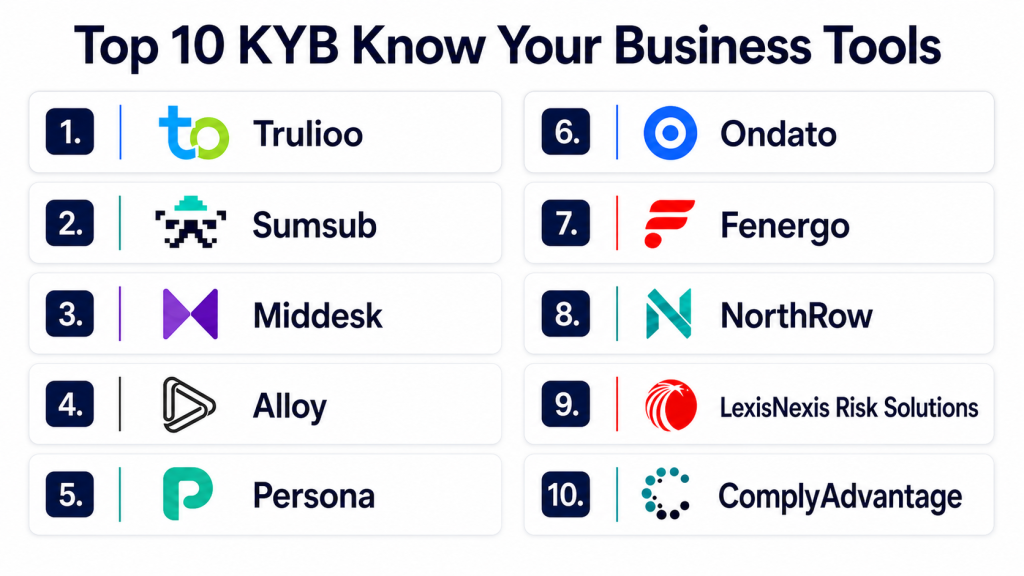
Top 10 KYB Know Your Business Tools
#1 — Trulioo
Short description:
Trulioo is a global identity and business verification platform used by fintechs, banks, payment companies, marketplaces, and digital platforms. It supports KYB workflows by helping organizations verify businesses, company representatives, owners, and related individuals. The platform is useful for teams that need verification across multiple countries and onboarding journeys.Trulioo can support business data checks, identity checks, document workflows, and compliance screening depending on configuration.
Key Features
- Business verification support.
- Global identity verification.
- KYB and KYC workflow support.
- Business owner and director verification.
- Sanctions and watchlist screening support.
- API-based onboarding.
- Document and data verification options.
Pros
- Strong fit for global digital onboarding.
- Useful when both KYC and KYB are required.
- API-friendly for fintech and marketplace workflows.
Cons
- Capabilities may vary by country and package.
- Advanced case management needs should be validated.
- Pricing and coverage may vary by region and volume.
Platforms / Deployment
Web / Cloud / API-based deployment.
Security & Compliance
Trulioo supports regulated identity and business verification workflows with enterprise data protection and access control capabilities. Specific certifications and compliance details should be verified directly with the vendor.
Integrations & Ecosystem
Trulioo integrates into onboarding, compliance, payment, and verification workflows. It is useful for businesses that need KYB inside digital customer journeys.
- KYC platforms.
- KYB workflows.
- Payment systems.
- Marketplace onboarding systems.
- Fintech platforms.
- APIs and SDKs.
Support & Community
Trulioo provides documentation, implementation support, customer success resources, and developer guidance. Its ecosystem is strongest among fintech, payments, marketplaces, compliance, and global identity verification teams.
#2 — Sumsub
Short description:
Sumsub is an identity verification and compliance platform that supports KYC, KYB, AML screening, fraud prevention, and ongoing monitoring. It is used by fintechs, crypto platforms, marketplaces, trading platforms, gaming platforms, and digital businesses. For KYB, Sumsub helps verify companies, collect business documents, check ownership information, and screen associated individuals.
Key Features
- KYB and company verification.
- KYC and identity verification.
- Business document collection.
- UBO and director verification support.
- Sanctions and AML screening.
- Fraud prevention workflows.
- API and SDK integration.
Pros
- Strong fit for digital onboarding.
- Combines KYB, KYC, AML, and fraud checks.
- Useful for fintech, crypto, marketplaces, and trading platforms.
Cons
- Coverage may vary by jurisdiction.
- Complex enterprise workflows may need careful setup.
- Buyers should test false positives and document handling.
Platforms / Deployment
Web / Cloud / API-based deployment.
Security & Compliance
Sumsub supports identity and compliance workflows with security controls such as user permissions and data protection features. Specific certifications and compliance details should be verified directly with the vendor.
Integrations & Ecosystem
Sumsub connects with digital onboarding, verification, payment, compliance, and risk workflows.
- KYC systems.
- KYB onboarding flows.
- Payment platforms.
- Crypto platforms.
- Marketplace systems.
- APIs and SDKs.
Support & Community
Sumsub provides documentation, developer resources, onboarding assistance, and customer support. Its community is strongest among fintech, crypto, marketplaces, gaming, trading, and digital onboarding teams.
#3 — Middesk
Short description:
Middesk is a business identity verification platform focused on helping companies verify business customers and reduce onboarding risk.
It is especially relevant for fintechs, banks, lenders, payment processors, marketplaces, and platforms that onboard businesses.
Middesk helps verify business legitimacy, registration status, addresses, tax identifiers, officers, and risk signals.
The platform is useful for companies that want automated business verification instead of manual document-heavy workflows.
It can support merchant onboarding, vendor verification, customer due diligence, and business risk checks.
Its strength is business identity verification with practical workflows for modern financial and platform businesses.
Buyers should validate coverage based on the countries and business types they support.
Middesk is best for companies that need reliable business verification and onboarding automation.
Key Features
- Business identity verification.
- Company registration checks.
- Business address and entity validation.
- Tax identifier verification support.
- Officer and ownership-related checks.
- Risk signals for business onboarding.
- API-based verification workflows.
Pros
- Strong focus on business verification.
- Useful for fintech, payments, and marketplace onboarding.
- Helps reduce manual business review work.
Cons
- Global coverage should be validated for each use case.
- Broader AML workflows may require additional tools.
- Complex ownership structures may need enhanced review.
Platforms / Deployment
Web / Cloud / API-based deployment.
Security & Compliance
Enterprise security capabilities may include access controls, encryption, user permissions, and audit-friendly workflows. Specific certifications and compliance details should be verified directly with the vendor.
Integrations & Ecosystem
Middesk is designed to connect with onboarding, fintech, payment, and business verification workflows.
- Payment platforms.
- Merchant onboarding systems.
- Fintech platforms.
- Banking workflows.
- CRM systems.
- APIs and webhooks.
Support & Community
Middesk provides product documentation, implementation support, developer resources, and customer assistance. Its ecosystem is strongest among fintech, embedded finance, payments, lending, and platform onboarding teams.
#4 — Alloy
Short description:
Alloy is an identity decisioning and risk platform used by banks, fintechs, lenders, and financial services companies.
It supports onboarding and risk workflows by connecting identity verification, fraud checks, KYC, KYB, AML, and decision rules.
For KYB, Alloy can help organizations orchestrate data sources, business verification checks, and compliance decisions.
The platform is especially useful when companies need a flexible decision engine across customer and business onboarding.
Alloy is not only a KYB data provider; it acts as an orchestration layer for multiple compliance and risk checks.
Its strength is workflow flexibility, decisioning, and integration with different data partners.
Buyers should confirm which KYB data sources and workflows are needed before implementation.
Alloy is best for financial institutions that need configurable onboarding and risk decisioning.
Key Features
- KYB and KYC orchestration.
- Identity and business verification workflows.
- Fraud and AML risk decisioning.
- Configurable rules engine.
- Case management and review workflows.
- Integration with data providers.
- Monitoring and decision analytics.
Pros
- Flexible decisioning for financial services.
- Strong fit for fintech onboarding workflows.
- Can orchestrate multiple compliance checks.
Cons
- Requires careful workflow design.
- KYB depth depends on connected data sources.
- May be more than simple onboarding teams need.
Platforms / Deployment
Web / Cloud / API-based deployment.
Security & Compliance
Alloy supports regulated onboarding and risk workflows with enterprise controls such as access management, permissions, and audit-oriented features. Specific certifications should be verified directly with the vendor.
Integrations & Ecosystem
Alloy works as a decisioning layer that connects with identity, fraud, AML, KYB, banking, and compliance systems.
- Identity verification providers.
- KYB data providers.
- Fraud tools.
- AML screening systems.
- Banking platforms.
- APIs and data connectors.
Support & Community
Alloy provides documentation, implementation support, customer success resources, and developer guidance. Its community is strongest among fintech, banking, lending, compliance, and risk operations teams.
#5 — Persona
Short description:
Persona is an identity verification and compliance platform that supports KYC, KYB, business verification workflows, document verification, and risk-based onboarding.
It is used by fintechs, marketplaces, digital platforms, workforce platforms, and regulated businesses.
For KYB, Persona can help verify businesses, collect required documents, screen associated individuals, and automate onboarding decisions.
The platform is useful when organizations need customizable onboarding flows across individuals and businesses.
Persona’s strength is flexibility, workflow design, and identity verification across different customer types.
It can be valuable for platforms that need both user verification and business verification in one environment.
Buyers should validate KYB data coverage and compliance workflow requirements for their target regions.
Persona is best for digital platforms that need configurable identity and business verification.
Key Features
- KYB workflow support.
- Identity and document verification.
- Business onboarding flows.
- Risk-based decisioning.
- Workflow automation.
- Case review and manual investigation.
- API and no-code configuration options.
Pros
- Flexible workflow design.
- Useful for platforms with mixed KYC and KYB needs.
- Good fit for digital onboarding journeys.
Cons
- KYB coverage may vary by region and configuration.
- Advanced compliance teams may need extra data integrations.
- Setup requires thoughtful workflow design.
Platforms / Deployment
Web / Cloud / API-based deployment.
Security & Compliance
Persona supports sensitive identity and verification workflows with security-focused controls. Specific certifications, compliance details, and plan-based security features should be verified directly with the vendor.
Integrations & Ecosystem
Persona integrates with onboarding, fraud, compliance, CRM, and platform workflows.
- KYC workflows.
- KYB onboarding systems.
- Fraud prevention tools.
- CRM systems.
- Marketplace platforms.
- APIs and webhooks.
Support & Community
Persona provides documentation, developer resources, onboarding help, and customer support options. Community strength is strongest among fintech, marketplaces, workforce platforms, and digital verification teams.
#6 — Ondato
Short description:
Ondato is an identity verification, KYC, KYB, AML, and compliance platform used by fintechs, crypto businesses, marketplaces, financial services companies, and digital platforms.
It helps organizations verify users and businesses, collect documents, screen risk, and manage onboarding workflows.
For KYB, Ondato can support company verification, business document review, ownership checks, and related AML screening.
The platform is useful when business verification must connect with identity verification and compliance operations.
Ondato can help reduce manual review through digital onboarding and automated compliance checks.
Its strength is combining identity verification, KYB, KYC, and AML workflows in one platform.
Buyers should validate data coverage, jurisdiction support, and business verification depth before selection.
Ondato is best for digital businesses that need KYB as part of broader compliance onboarding.
Key Features
- KYB and company verification.
- KYC and identity verification.
- Business document collection.
- AML and sanctions screening.
- Ongoing monitoring support.
- Customer risk scoring.
- API and workflow automation.
Pros
- Good fit for digital onboarding.
- Combines KYB, KYC, and AML workflows.
- Useful for fintech, crypto, and marketplace businesses.
Cons
- Screening depth may depend on selected modules.
- Jurisdiction coverage should be validated.
- Complex enterprise needs may require additional configuration.
Platforms / Deployment
Web / Cloud / API-based deployment.
Security & Compliance
Ondato supports compliance-focused onboarding and verification workflows. Specific security certifications, encryption details, and compliance documentation should be verified directly with the vendor.
Integrations & Ecosystem
Ondato integrates with digital onboarding, compliance, payment, and risk workflows.
- KYC systems.
- KYB workflows.
- CRM systems.
- Fintech platforms.
- Payment systems.
- APIs and webhooks.
Support & Community
Ondato provides onboarding support, documentation, implementation assistance, and customer support resources. Community strength is strongest among digital compliance, fintech onboarding, and identity verification teams.
#7 — Fenergo
Short description:
Fenergo is a client lifecycle management and compliance platform used by financial institutions for onboarding, KYC, KYB, AML, regulatory compliance, and client data management.
It is especially relevant for banks, wealth management firms, capital markets teams, and large financial institutions.
For KYB, Fenergo helps manage complex business clients, ownership structures, regulatory documents, and onboarding workflows.
The platform supports entity data management, due diligence, regulatory rules, document handling, and client lifecycle monitoring.
It is best suited for organizations with complex institutional clients and strict compliance requirements.
Its strength is enterprise-grade onboarding and client lifecycle governance.
Implementation can be significant because workflows, data, and controls are often complex.
Fenergo is best for financial institutions that need deep KYB and regulatory onboarding workflows.
Key Features
- Client lifecycle management.
- KYB and business onboarding workflows.
- KYC and AML compliance support.
- Entity data management.
- Regulatory rule workflows.
- Document collection and review.
- Ongoing customer lifecycle monitoring.
Pros
- Strong for enterprise financial services.
- Good fit for complex corporate client onboarding.
- Supports regulatory workflow standardization.
Cons
- May be too complex for small businesses.
- Implementation can require significant planning.
- Best suited for regulated financial institutions.
Platforms / Deployment
Web / Cloud / Deployment options may vary by customer configuration.
Security & Compliance
Fenergo supports enterprise compliance workflows and security-oriented controls such as permissions, auditability, and regulated data handling. Specific certifications and security details should be verified with the vendor.
Integrations & Ecosystem
Fenergo commonly integrates with customer onboarding, regulatory screening, document management, and banking operations systems.
- KYC data providers.
- Screening tools.
- CRM systems.
- Document management systems.
- Core banking systems.
- APIs and enterprise connectors.
Support & Community
Fenergo provides enterprise implementation support, documentation, onboarding services, training, and customer success resources. Community strength is strongest among financial services compliance, client onboarding, and regulatory operations teams.
#8 — NorthRow
Short description:
NorthRow is a compliance and onboarding platform that supports business verification, identity verification, AML screening, and customer due diligence workflows.
It is used by regulated businesses, financial services firms, property firms, professional services, and organizations that need to verify customers or businesses.
For KYB, NorthRow can help verify businesses, screen associated individuals, manage risk checks, and support compliance review.
The platform is useful for teams that need structured onboarding workflows with verification and monitoring capabilities.
It combines business checks, identity checks, and AML screening into practical compliance workflows.
Its strength is helping compliance teams digitize onboarding and reduce manual verification effort.
Buyers should validate country coverage, data sources, and integration requirements before selection.
NorthRow is best for businesses that need KYB, KYC, and AML workflows in a compliance-focused platform.
Key Features
- KYB and business verification support.
- KYC and identity verification.
- AML screening.
- Document collection and verification.
- Risk-based onboarding workflows.
- Ongoing monitoring support.
- Case review and compliance reporting.
Pros
- Good fit for regulated onboarding workflows.
- Combines business and individual verification.
- Useful for compliance teams moving away from manual checks.
Cons
- Coverage may vary by jurisdiction.
- Advanced enterprise use cases should be validated.
- Integration depth may depend on product configuration.
Platforms / Deployment
Web / Cloud / API options may vary.
Security & Compliance
NorthRow supports compliance-sensitive verification workflows with access controls and secure data handling features. Specific certifications and compliance details should be verified directly with the vendor.
Integrations & Ecosystem
NorthRow can connect with onboarding, compliance, CRM, risk, and verification workflows.
- KYC workflows.
- KYB systems.
- AML screening workflows.
- CRM platforms.
- Business onboarding systems.
- APIs and integrations.
Support & Community
NorthRow provides documentation, onboarding support, customer support, and compliance-focused resources. Community strength is most relevant among regulated onboarding, professional services, and compliance teams.
#9 — LexisNexis Risk Solutions
Short description:
LexisNexis Risk Solutions provides identity intelligence, business risk data, fraud detection, AML compliance, and due diligence solutions.
It is used by banks, fintech companies, insurers, government agencies, healthcare organizations, and regulated businesses.
For KYB, it can help organizations assess business risk, verify entities, support due diligence, and screen associated parties.
The platform is especially useful when business verification is connected with fraud prevention, identity intelligence, and compliance risk.
LexisNexis Risk Solutions has a broad product portfolio, so buyers should identify the exact products needed for KYB workflows.
Its strength is combining data, analytics, identity signals, and risk intelligence.
Implementation requirements can vary based on data sources, region, and integration needs.
It is best for organizations that need data-driven business risk and compliance verification.
Key Features
- Business and entity risk data.
- Identity verification and risk intelligence.
- Fraud detection signals.
- AML and sanctions screening support.
- Due diligence workflows.
- Risk scoring and analytics.
- API and data integration options.
Pros
- Strong data and risk intelligence capabilities.
- Useful for fraud, AML, and business due diligence.
- Broad fit across regulated industries.
Cons
- Product scope can be complex.
- Buyers must choose modules carefully.
- Implementation may require data and risk expertise.
Platforms / Deployment
Web / Cloud / API and data service options may vary by product.
Security & Compliance
LexisNexis Risk Solutions supports regulated risk and data workflows, but specific security controls and certifications should be validated for the selected product and contract.
Integrations & Ecosystem
LexisNexis Risk Solutions integrates with onboarding, fraud, compliance, payments, business verification, and risk workflows.
- KYC and onboarding systems.
- Fraud prevention systems.
- Payment platforms.
- Banking systems.
- Insurance systems.
- APIs and data feeds.
Support & Community
LexisNexis Risk Solutions provides enterprise support, documentation, data services, implementation assistance, and account management. Community strength is strong among fraud, identity, AML, KYB, and risk professionals.
#10 — ComplyAdvantage
Short description:
ComplyAdvantage is a financial crime risk platform that supports AML screening, sanctions screening, adverse media monitoring, PEP screening, transaction monitoring, and customer risk scoring.
While it is often known for AML and sanctions screening, it can support KYB workflows when business customers and associated individuals need to be screened.
It is used by fintechs, banks, payment companies, crypto platforms, lending businesses, and regulated firms.
For KYB, ComplyAdvantage can help screen businesses, beneficial owners, directors, and related parties for financial crime risk.
The platform is useful when KYB must connect with AML monitoring and ongoing risk alerts.
Its strength is risk data, adverse media, sanctions monitoring, and API-friendly compliance workflows.
Buyers should validate business verification depth if they need registry-based company verification.
ComplyAdvantage is best for organizations that need KYB-related screening as part of broader AML compliance.
Key Features
- Sanctions and watchlist screening.
- PEP and adverse media monitoring.
- Business and associated party screening support.
- Customer risk scoring.
- AML transaction monitoring.
- Ongoing monitoring.
- API-based compliance workflows.
Pros
- Strong for AML and financial crime screening.
- API-friendly for digital onboarding.
- Useful for ongoing monitoring of business risk.
Cons
- Registry-based KYB depth should be validated.
- Complex entity verification may need additional tools.
- Alert tuning may require compliance expertise.
Platforms / Deployment
Web / Cloud / API-based deployment.
Security & Compliance
ComplyAdvantage offers enterprise-oriented controls such as user permissions, encryption, access management, and audit-friendly workflows. Specific certifications should be verified directly with the vendor.
Integrations & Ecosystem
ComplyAdvantage integrates with onboarding, payment, AML, risk, and compliance operations systems.
- KYC and KYB workflows.
- Payment systems.
- CRM systems.
- Core banking systems.
- Case management tools.
- APIs and webhooks.
Support & Community
ComplyAdvantage provides documentation, support resources, onboarding assistance, and customer success options. Its ecosystem is strong among fintech, payments, banking, crypto, AML, and compliance teams.
Comparison Table Top 10
| Tool Name | Best For | Platform Supported | Deployment | Standout Feature | Public Rating |
|---|---|---|---|---|---|
| Trulioo | Global KYB and identity verification | Web / API | Cloud | Global business and identity verification | N/A |
| Sumsub | Digital onboarding with KYB, KYC, and AML | Web / API | Cloud | Unified verification and compliance workflows | N/A |
| Middesk | Business identity verification | Web / API | Cloud | Business verification for fintech and platforms | N/A |
| Alloy | KYB orchestration and decisioning | Web / API | Cloud | Flexible risk decisioning engine | N/A |
| Persona | Configurable identity and business verification | Web / API | Cloud | Customizable onboarding workflows | N/A |
| Ondato | KYB, KYC, and AML onboarding | Web / API | Cloud | Combined business and identity compliance | N/A |
| Fenergo | Enterprise financial services KYB | Web | Cloud varies | Client lifecycle and regulatory onboarding | N/A |
| NorthRow | Compliance-led business verification | Web / API | Cloud | KYB, KYC, and AML workflow support | N/A |
| LexisNexis Risk Solutions | Business risk data and due diligence | Web / API | Cloud varies | Data-driven business risk intelligence | N/A |
| ComplyAdvantage | KYB-related AML and risk screening | Web / API | Cloud | Sanctions, PEP, and adverse media monitoring | N/A |
Evaluation & Scoring of KYB Know Your Business Tools
| Tool Name | Core 25% | Ease 15% | Integrations 15% | Security 10% | Performance 10% | Support 10% | Value 15% | Weighted Total 0–10 |
|---|---|---|---|---|---|---|---|---|
| Trulioo | 9 | 8 | 9 | 8 | 8 | 8 | 8 | 8.35 |
| Sumsub | 9 | 8 | 9 | 8 | 8 | 8 | 9 | 8.50 |
| Middesk | 9 | 8 | 8 | 8 | 8 | 8 | 8 | 8.25 |
| Alloy | 8 | 8 | 9 | 8 | 8 | 8 | 8 | 8.15 |
| Persona | 8 | 9 | 8 | 8 | 8 | 8 | 8 | 8.15 |
| Ondato | 8 | 8 | 8 | 8 | 8 | 8 | 8 | 8.00 |
| Fenergo | 9 | 7 | 8 | 9 | 8 | 8 | 8 | 8.15 |
| NorthRow | 8 | 8 | 7 | 8 | 8 | 8 | 8 | 7.85 |
| LexisNexis Risk Solutions | 9 | 7 | 9 | 8 | 9 | 8 | 8 | 8.35 |
| ComplyAdvantage | 8 | 8 | 9 | 8 | 8 | 8 | 8 | 8.15 |
The scores are comparative and should be used as a shortlist guide, not as a universal ranking.
Tools with stronger business verification and registry coverage score higher for core KYB needs.
Platforms with strong API support score higher for fintech, marketplace, and digital onboarding use cases.
Enterprise platforms may score higher for governance, lifecycle management, and complex corporate onboarding.
Buyers should test coverage, match quality, document workflows, security controls, and integrations before final selection.
Which KYB Know Your Business Tool Is Right for You?
Solo / Freelancer
Solo professionals usually do not need a full KYB platform unless they provide compliance consulting, vendor due diligence, AML advisory, or business verification services. Basic business registry checks and manual document review may be enough for occasional use.
Choose a lightweight approach if you need:
- Small-volume business checks.
- Manual supplier verification.
- Basic company research.
- Simple due diligence.
- Occasional compliance review.
Avoid enterprise KYB tools unless you manage regulated onboarding or high-risk business verification at scale.
SMB
SMBs should prioritize simple setup, affordable pricing, practical onboarding workflows, and easy API integration. Sumsub, Ondato, Persona, NorthRow, Trulioo, and ComplyAdvantage may fit depending on requirements.
SMBs should evaluate:
- Business verification coverage.
- Document collection.
- Sanctions and adverse media screening.
- API usability.
- Case review simplicity.
- Ongoing monitoring.
- Cost predictability.
A small company should avoid overbuying a complex enterprise system unless compliance risk is high.
Mid-Market
Mid-market companies often need stronger onboarding workflows, better audit trails, more integrations, and scalable business verification. Trulioo, Sumsub, Middesk, Alloy, Persona, LexisNexis Risk Solutions, and ComplyAdvantage can fit different needs.
Mid-market buyers should focus on:
- Multi-region coverage.
- Beneficial ownership checks.
- Business document verification.
- Case management.
- Risk scoring.
- Identity provider integration.
- API performance.
- Reporting and audit readiness.
The right tool should reduce manual review while maintaining strong compliance evidence.
Enterprise
Enterprises should prioritize scalability, workflow governance, security, business data depth, global coverage, and integration with enterprise systems. Fenergo, LexisNexis Risk Solutions, Trulioo, Alloy, Sumsub, and ComplyAdvantage are strong candidates depending on the use case.
Enterprise buyers should validate:
- SSO and MFA.
- RBAC and audit logs.
- Data residency.
- Encryption.
- API scale.
- Business registry coverage.
- Beneficial ownership depth.
- Case workflow flexibility.
- Regulatory evidence.
- Support and implementation services.
Large organizations should pilot tools with real business customer data and complex ownership scenarios before committing.
Budget vs Premium
Budget-friendly KYB tools can work well for startups, marketplaces, and growing platforms with simpler onboarding workflows. Premium platforms are better when global coverage, enterprise governance, complex ownership, and strict compliance requirements matter.
Choose budget-friendly tools when:
- Business verification volume is moderate.
- Workflows are simple.
- You need fast onboarding.
- Your team is small.
- API-based checks are enough.
Choose premium tools when:
- You operate globally.
- You onboard complex businesses.
- You need deep ownership verification.
- Regulatory exposure is high.
- You require advanced case management.
- Audit readiness is critical.
Feature Depth vs Ease of Use
Feature depth is important for banks, lenders, payment processors, and regulated enterprises with complex KYB requirements. Ease of use is important for digital platforms that need quick onboarding and simple workflows.
Choose feature depth for:
- Complex ownership structures.
- Enhanced due diligence.
- Corporate banking onboarding.
- Regulated financial services.
- High-risk merchant onboarding.
- Multi-jurisdiction compliance.
Choose ease of use for:
- Startup onboarding flows.
- Marketplace seller verification.
- SMB merchant checks.
- Simple vendor verification.
- Fast digital onboarding.
- Low to moderate risk workflows.
Integrations & Scalability
KYB tools work best when integrated into onboarding, CRM, payments, compliance, vendor management, and case review systems. Poor integration creates manual work and slows approval decisions.
Important integrations include:
- CRM systems.
- Payment platforms.
- Merchant onboarding workflows.
- KYC systems.
- AML screening platforms.
- Case management tools.
- Vendor management systems.
- Identity providers.
- Data warehouses.
- APIs and webhooks.
Scalability should include screening volume, API reliability, business data coverage, user roles, case review capacity, regional expansion, and ongoing monitoring.
Security & Compliance Needs
KYB tools process sensitive business, ownership, identity, compliance, and risk data. Security review should be a required step before purchase and production deployment.
Validate:
- SSO and SAML support.
- MFA compatibility.
- Role-based access control.
- Audit logs.
- Encryption.
- Data retention controls.
- Admin permissions.
- API security.
- User provisioning and deprovisioning.
- Data residency options.
- Compliance documentation.
For Zero Trust environments, access should follow least-privilege principles, strong authentication, continuous monitoring, and clear administrative oversight.
Frequently Asked Questions FAQs
1. What is a KYB Tool?
A KYB Tool helps organizations verify businesses before onboarding them as customers, merchants, vendors, or partners. It checks company registration details, ownership information, directors, documents, sanctions exposure, and business risk.KYB tools are commonly used by banks, fintechs, payment firms, marketplaces, lenders, and regulated businesses.
2. How is KYB different from KYC?
KYC verifies individuals, while KYB verifies businesses and the people connected to those businesses.
KYB may include company registration checks, beneficial ownership verification, director checks, and document validation. KYC may still be part of KYB when beneficial owners or directors must be verified as individuals.
3. Why is KYB important for compliance?
KYB is important because businesses can be used for fraud, money laundering, sanctions evasion, tax abuse, and hidden ownership schemes. Regulated companies must understand who they are doing business with and who controls the company.KYB supports AML, CDD, EDD, sanctions screening, vendor risk, and merchant onboarding controls.
4. What pricing models are common for KYB Tools?
Most KYB tools use subscription pricing based on verification volume, API usage, users, regions, modules, or enterprise contracts. Some vendors charge separately for business checks, document verification, AML screening, monitoring, and data sources. Enterprise platforms may use custom pricing because workflows and scale vary widely.
5. How long does KYB implementation usually take?
Implementation time depends on workflow complexity, integration needs, countries covered, document requirements, and compliance policies. API-first tools may be implemented faster for simple onboarding flows. Enterprise KYB platforms may require data mapping, workflow design, user roles, case management setup, and testing.
6. What are common mistakes when choosing a KYB Tool?
A common mistake is choosing a KYB tool without checking country coverage and local registry data quality. Another mistake is ignoring beneficial ownership complexity and relying only on basic company registration checks. Some teams forget to test document workflows, false positives, sanctions screening, and case review usability.
7. Are KYB Tools secure?
Many KYB tools provide security features such as encryption, user permissions, role-based access, audit logs, and admin controls. However, security capabilities vary by vendor, plan, deployment model, and customer configuration. Because KYB platforms process sensitive business, ownership, and identity data, security review is essential.
8. Can KYB Tools verify beneficial owners?
Yes, many KYB tools can help identify and verify beneficial owners, directors, shareholders, and connected individuals.The depth of beneficial ownership verification depends on data sources, jurisdictions, and business structure complexity.Some ownership structures are simple, while others involve multiple companies, trusts, or cross-border entities.
9. What integrations should buyers look for?
Important integrations include CRM systems, payment platforms, merchant onboarding tools, KYC systems, AML tools, case management platforms, and identity providers.API integration is important for digital onboarding and automated business verification.Batch screening may be useful for reviewing existing business customers or vendors.
10. Can small businesses use KYB Tools?
Yes, small businesses can use KYB tools if they onboard vendors, merchants, partners, or business customers. However, they should choose lightweight tools that match their risk level and budget.
A small team may not need a large enterprise client lifecycle platform. Simple business verification, document collection, and sanctions screening may be enough at the beginning.
Conclusion
KYB Know Your Business Tools help organizations verify companies, identify beneficial owners, screen risk, reduce fraud, and support compliance workflows. Trulioo, Sumsub, Middesk, Alloy, Persona, Ondato, Fenergo, NorthRow, LexisNexis Risk Solutions, and ComplyAdvantage each serve different needs, from API-first digital onboarding to enterprise client lifecycle management and business risk intelligence.
The best KYB Tool depends on your industry, countries served, business customer volume, regulatory exposure, integration needs, and security expectations. A smart next step is to shortlist two or three tools, run a pilot with real business onboarding cases, validate ownership and registry coverage, test API and case workflows, review security controls, and confirm that the platform improves onboarding speed, compliance consistency, and audit readiness before scaling.
