Introduction
PEP Screening Tools help regulated organizations identify and monitor Politically Exposed Persons, their relatives, close associates, sanctioned entities, adverse media exposure, and other high-risk relationships. These tools are mainly used in AML compliance, KYC onboarding, customer due diligence, enhanced due diligence, transaction monitoring, and ongoing risk reviews.
PEP screening matters because politically exposed customers can create higher bribery, corruption, sanctions, money laundering, and reputational risks. Manual screening is difficult because names, aliases, jurisdictions, ownership structures, and risk relationships constantly change.
Real-world use cases include:
- Screening customers during onboarding.
- Monitoring existing customers for new PEP status.
- Identifying relatives and close associates.
- Supporting enhanced due diligence workflows.
- Reducing false positives in AML alerts.
Buyers should evaluate:
- PEP database coverage.
- Sanctions and adverse media coverage.
- Relatives and close associates detection.
- Name matching and fuzzy matching accuracy.
- Real-time and batch screening options.
- Case management and alert workflows.
- Audit logs and reporting.
- API and system integrations.
- Security controls such as SSO, MFA, RBAC, and encryption.
- Scalability for global compliance operations.
Best for: PEP Screening Tools are best for banks, fintech companies, crypto exchanges, payment providers, insurers, lenders, wealth management firms, legal teams, compliance teams, risk departments, and regulated enterprises that need strong customer risk screening and ongoing monitoring.
Not ideal for: Very small businesses with no regulated customer onboarding, no financial exposure, and low compliance risk may not need a dedicated PEP screening platform. In those cases, basic due diligence tools or manual checks may be enough until risk volume increases.
Key Trends in PEP Screening Tools
- Real-time monitoring: Compliance teams increasingly expect tools to detect changes in PEP status, sanctions exposure, and adverse media quickly.
- AI-assisted matching: Modern platforms use smarter name matching, transliteration, entity resolution, and risk scoring to reduce false positives.
- Relatives and close associates detection: Screening now goes beyond direct PEP names and includes family members, close business links, and connected entities.
- Unified AML screening: Buyers prefer platforms that combine PEP, sanctions, adverse media, watchlists, and customer risk scoring in one workflow.
- API-first onboarding: Fintechs and digital banks need screening APIs that work inside automated KYC and customer onboarding journeys.
- Audit-ready workflows: Regulators expect clear evidence, investigation history, approval trails, and decision explanations.
- Stronger identity and access controls: SSO, MFA, RBAC, admin controls, audit logs, and encryption are now important buyer requirements.
- Better false-positive management: Alert prioritization, configurable thresholds, and contextual risk data are becoming essential.
- Multi-jurisdiction coverage: Global businesses need reliable screening across regions, languages, scripts, and regulatory environments.
- Continuous risk review: PEP screening is moving from one-time onboarding checks to ongoing customer lifecycle monitoring.
How We Selected PEP Screening Tools
The Top 10 tools were selected using a practical compliance and buyer-focused evaluation approach:
- Market adoption and recognition: Tools with strong usage across banking, fintech, payments, crypto, insurance, and regulated businesses were prioritized.
- PEP and AML screening depth: Platforms were evaluated for PEP coverage, sanctions screening, adverse media monitoring, and watchlist support.
- Data quality and matching: Tools with strong risk data, entity matching, alias support, and false-positive management received stronger consideration.
- Workflow capability: Case management, alert review, audit logs, escalation, and investigation workflows were important.
- Integration ecosystem: API availability, batch screening, onboarding integrations, CRM connectivity, and KYC workflow support were evaluated.
- Security posture: Access control, user permissions, encryption, auditability, and enterprise governance were considered.
- Scalability: Platforms suitable for high-volume screening and global operations were prioritized.
- Customer fit: The final list balances enterprise risk intelligence platforms, AML screening tools, fintech-friendly APIs, and specialized RegTech solutions.
- Usability: Compliance teams need tools that simplify investigation, reduce noise, and support faster decisions.
- Long-term value: Tools were assessed for their ability to support onboarding, ongoing monitoring, risk reviews, and future compliance growth.
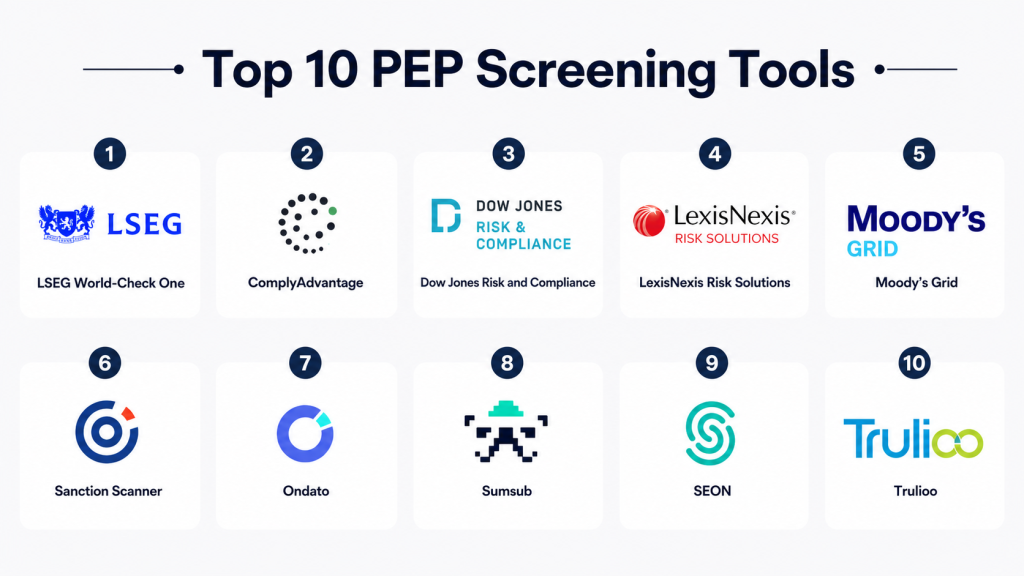
Top 10 PEP Screening Tools
#1 — LSEG World-Check One
Short description:
LSEG World-Check One is a widely recognized risk intelligence and screening platform used for PEP, sanctions, watchlist, and adverse media screening.
It helps organizations screen individuals and entities against global risk data to support KYC, AML, CFT, and enhanced due diligence workflows. The platform is especially useful for banks, fintechs, insurers, investment firms, legal teams, and compliance departments.
Key Features
- PEP screening and entity risk data.
- Sanctions and watchlist screening.
- Adverse media monitoring.
- Relatives and close associates visibility.
- Customer and entity risk intelligence.
- Screening workflow and alert review.
- Audit support for compliance teams.
Pros
- Strong global risk intelligence coverage.
- Suitable for enterprise and regulated financial services.
- Useful for KYC, AML, and enhanced due diligence.
Cons
- May require tuning to reduce false positives.
- Can be more advanced than small teams need.
- Pricing and packaging may vary by customer requirements.
Platforms / Deployment
Web / Cloud / API and data options may vary by customer configuration.
Security & Compliance
Enterprise security capabilities may include user permissions, encryption, audit trails, access controls, and administrative governance. Specific certifications and compliance details should be verified directly with the vendor.
Integrations & Ecosystem
LSEG World-Check One is often integrated into customer onboarding, AML, compliance, risk, and investigation workflows. It can support both manual analyst review and automated screening processes.
- KYC systems.
- AML platforms.
- Customer onboarding tools.
- Core banking systems.
- Case management workflows.
- Data feeds and APIs.
Support & Community
LSEG provides enterprise support, documentation, implementation assistance, account management, and risk intelligence resources. Community strength is high among compliance, AML, legal, and financial crime professionals.
#2 — ComplyAdvantage
Short description:
ComplyAdvantage is a financial crime risk platform that supports PEP screening, sanctions screening, adverse media monitoring, transaction monitoring, and customer risk scoring.
It is commonly used by fintechs, banks, payment providers, crypto platforms, lending businesses, and other regulated firms. The platform helps compliance teams identify risky customers, monitor changes, manage alerts, and investigate matches.
Key Features
- PEP and sanctions screening.
- Adverse media monitoring.
- Watchlist screening.
- Customer risk scoring.
- Ongoing monitoring.
- Case management and alert workflows.
- API-driven screening options.
Pros
- Strong fit for fintech and digital financial services.
- API-friendly for automated onboarding.
- Combines PEP, sanctions, and adverse media workflows.
Cons
- Alert tuning may require compliance expertise.
- Advanced enterprise needs may require additional configuration.
- Pricing may vary by usage and modules.
Platforms / Deployment
Web / Cloud / API-based deployment.
Security & Compliance
ComplyAdvantage offers enterprise-oriented controls such as user permissions, encryption, access management, and audit-friendly workflows. Specific certifications should be verified directly with the vendor.
Integrations & Ecosystem
ComplyAdvantage is designed to connect with onboarding, payments, AML, KYC, fraud, and compliance operations systems.
- KYC platforms.
- Payment systems.
- CRM systems.
- Core banking systems.
- Case management tools.
- APIs and webhooks.
Support & Community
ComplyAdvantage provides documentation, support resources, onboarding assistance, and customer success options. Its ecosystem is strong among fintech, payments, banking, crypto, and AML compliance teams.
#3 — Dow Jones Risk and Compliance
Short description:
Dow Jones Risk and Compliance provides screening data and tools for PEPs, sanctions, adverse media, state-owned companies, watchlists, and third-party risk. It is used by financial institutions, corporations, legal teams, compliance teams, and risk departments. The platform helps organizations screen customers, suppliers, partners, and entities against high-risk data sources.
Key Features
- PEP data and monitoring.
- Sanctions and watchlist screening.
- Adverse media intelligence.
- State-owned company data.
- Third-party risk intelligence.
- Due diligence support.
- Data feeds and screening integrations.
Pros
- Strong risk intelligence data.
- Useful for PEP, sanctions, and third-party risk.
- Good fit for regulated financial and corporate compliance teams.
Cons
- May require integration with workflow systems.
- Not always a complete end-to-end compliance operations platform.
- Product scope and pricing may vary by data package.
Platforms / Deployment
Web / Cloud / Data feeds and API options may vary.
Security & Compliance
Enterprise access controls, secure data delivery, and permissions may be available depending on product and contract. Specific certifications should be verified directly with the vendor.
Integrations & Ecosystem
Dow Jones Risk and Compliance is commonly used in screening, due diligence, onboarding, compliance, and third-party risk workflows.
- KYC systems.
- AML platforms.
- Third-party risk tools.
- Case management systems.
- Procurement systems.
- APIs and data feeds.
Support & Community
Dow Jones provides enterprise support, documentation, account management, onboarding assistance, and data support. Its ecosystem is strong among AML, legal, compliance, audit, and third-party risk teams.
#4 — LexisNexis Risk Solutions
Short description:
LexisNexis Risk Solutions provides identity intelligence, fraud prevention, AML compliance, sanctions screening, PEP screening, and risk data solutions. It is used by banks, fintech companies, insurers, government agencies, healthcare organizations, and other regulated enterprises. The platform helps organizations verify identity, assess customer risk, detect fraud, and monitor financial crime exposure.
.
Key Features
- PEP and sanctions screening support.
- Identity verification and risk assessment.
- Fraud detection signals.
- AML and financial crime compliance tools.
- Entity and customer risk monitoring.
- Risk scoring and analytics.
- APIs and data integration options.
Pros
- Strong identity and risk data capabilities.
- Useful for fraud, AML, and customer risk workflows.
- Broad fit across financial services and regulated industries.
Cons
- Product scope can be complex.
- Buyers must select modules carefully.
- Implementation may require data and compliance expertise.
Platforms / Deployment
Web / Cloud / API and data service options may vary by product.
Security & Compliance
LexisNexis Risk Solutions supports regulated risk and data workflows, but specific security controls and certifications should be validated for the selected product and contract.
Integrations & Ecosystem
LexisNexis Risk Solutions integrates with onboarding, identity, fraud, compliance, payments, and case management workflows.
- KYC and onboarding systems.
- Fraud prevention systems.
- Payment platforms.
- Banking systems.
- Insurance systems.
- Case management tools.
Support & Community
LexisNexis Risk Solutions provides enterprise support, documentation, data services, implementation assistance, and account management. Community strength is strong among fraud, identity, AML, and risk professionals.
#5 — Moody’s Grid
Short description:
Moody’s Grid is a risk and compliance screening platform used for sanctions, PEPs, adverse media, ownership risk, and customer due diligence workflows.
It helps organizations identify high-risk individuals, entities, beneficial owners, and connected parties.
The platform is useful for banks, fintechs, corporates, insurers, and compliance teams that need risk intelligence and screening capabilities. It can support customer onboarding, ongoing monitoring, enhanced due diligence, and third-party screening.
.
Key Features
- PEP and sanctions screening.
- Adverse media monitoring.
- Entity and ownership risk intelligence.
- Customer due diligence support.
- Ongoing monitoring.
- Risk scoring and screening workflows.
- Data integration options.
Pros
- Strong risk intelligence orientation.
- Useful for customer and entity due diligence.
- Good fit for regulated financial and corporate teams.
Cons
- Exact capabilities may vary by package.
- May require integration into existing compliance workflows.
- Pricing is usually custom or package-based.
Platforms / Deployment
Web / Cloud / Data and API options may vary.
Security & Compliance
Enterprise controls may include user permissions, access management, encryption, and audit-friendly capabilities. Specific compliance certifications should be verified directly with the vendor.
Integrations & Ecosystem
Moody’s Grid can support screening and risk workflows connected to onboarding, risk management, compliance, and due diligence systems.
- KYC systems.
- AML workflows.
- CRM systems.
- Third-party risk tools.
- Data platforms.
- APIs and data feeds.
Support & Community
Moody’s provides enterprise support, documentation, risk data expertise, implementation assistance, and customer success resources. Community strength is strongest among risk, compliance, credit, and financial services teams.
#6 — Sanction Scanner
Short description:
Sanction Scanner is a compliance screening platform that supports PEP screening, sanctions screening, adverse media monitoring, transaction monitoring, and AML workflows.
It is used by fintechs, financial institutions, payment firms, crypto businesses, and regulated companies.
The platform helps teams screen customers during onboarding and monitor them continuously for new risk signals.
Key Features
- PEP screening.
- Sanctions and watchlist screening.
- Adverse media monitoring.
- Transaction monitoring options.
- Risk scoring.
- Real-time and batch screening.
- API integration support.
Pros
- Practical screening tool for AML compliance.
- Useful for fintech and digital onboarding.
- Supports PEP, sanctions, and adverse media checks.
Cons
- Enterprise depth may vary by use case.
- Alert tuning may require compliance review.
- Buyers should verify coverage for required jurisdictions.
Platforms / Deployment
Web / Cloud / API-based deployment.
Security & Compliance
Security features may include user access controls, encrypted data handling, and audit-related workflow capabilities. Specific certifications should be verified directly with the vendor.
Integrations & Ecosystem
Sanction Scanner is commonly integrated into compliance, KYC, onboarding, payment, and risk workflows.
- KYC platforms.
- Payment systems.
- Fintech onboarding flows.
- CRM systems.
- AML workflows.
- APIs and webhooks.
Support & Community
Sanction Scanner provides product documentation, implementation assistance, and customer support options. Community strength is most relevant among fintech, AML, payment, and crypto compliance users.
#7 — Ondato
Short description:
Ondato is an identity verification, KYC, KYB, AML, and compliance platform that includes screening capabilities for sanctions, PEPs, and adverse media.
It is used by fintechs, marketplaces, crypto firms, financial services companies, and digital businesses that need customer onboarding and compliance workflows.
The platform helps organizations verify users, screen risk, monitor customers, and support regulatory onboarding requirements.
Key Features
- PEP and sanctions screening.
- Adverse media monitoring.
- KYC and identity verification.
- KYB and business verification.
- Customer risk scoring.
- Ongoing monitoring.
- API and workflow automation.
Pros
- Good fit for digital onboarding.
- Combines identity verification with AML screening.
- Useful for fintech, marketplaces, and crypto firms.
Cons
- Screening depth may depend on selected modules.
- May be more onboarding-focused than pure risk intelligence tools.
- Buyers should verify coverage for their regions and risk types.
Platforms / Deployment
Web / Cloud / API-based deployment.
Security & Compliance
Ondato supports compliance-focused onboarding and risk workflows. Specific security certifications, encryption details, and compliance documentation should be verified directly with the vendor.
Integrations & Ecosystem
Ondato integrates with digital onboarding, customer verification, compliance, and risk workflows.
- KYC workflows.
- KYB workflows.
- CRM systems.
- Fintech platforms.
- Payment systems.
- APIs and webhooks.
Support & Community
Ondato provides onboarding support, documentation, implementation assistance, and customer support resources. Community strength is strongest among digital compliance, fintech onboarding, and identity verification teams.
#8 — Sumsub
Short description:
Sumsub is an identity verification and compliance platform that supports KYC, KYB, AML screening, transaction monitoring, fraud prevention, and ongoing monitoring.
It is widely used by fintechs, crypto platforms, marketplaces, gaming platforms, trading platforms, and other digital businesses. The platform helps organizations verify customers, screen against PEP and sanctions lists, detect fraud, and manage compliance workflows.
Key Features
- PEP and sanctions screening.
- KYC and identity verification.
- KYB and business verification.
- Adverse media checks.
- Ongoing monitoring.
- Fraud prevention tools.
- API-based integration.
Pros
- Strong fit for digital onboarding and compliance.
- Useful for fintech, crypto, marketplaces, and trading platforms.
- Combines identity verification with AML screening.
Cons
- Pure enterprise risk intelligence depth may vary by use case.
- Requires configuration for optimal workflows.
- Buyers should validate regional and regulatory fit.
Platforms / Deployment
Web / Cloud / API-based deployment.
Security & Compliance
Sumsub supports compliance and identity verification workflows with security controls such as permissions and data protection features. Specific certifications and compliance details should be verified directly with the vendor.
Integrations & Ecosystem
Sumsub connects with onboarding, verification, compliance, payment, and platform workflows.
- KYC systems.
- KYB workflows.
- Payment platforms.
- Crypto platforms.
- Marketplace systems.
- APIs and SDKs.
Support & Community
Sumsub provides documentation, developer resources, onboarding assistance, and customer support. Its community is strongest among fintech, crypto, marketplace, and digital onboarding teams.
#9 — SEON
Short description:
SEON is a fraud prevention and AML-oriented risk platform used by fintechs, online businesses, gaming platforms, lenders, marketplaces, and digital services. It helps organizations detect fraud, assess customer risk, and support compliance screening workflows. SEON includes risk scoring, digital footprint analysis, fraud signals, and AML screening capabilities depending on configuration. For PEP screening, it can support customer risk workflows where fraud prevention and compliance checks intersect.
Key Features
- AML screening support.
- PEP and sanctions checks depending on configuration.
- Fraud risk scoring.
- Digital footprint analysis.
- Device and behavioral signals.
- Rules and automation.
- API-based workflows.
Pros
- Strong for fraud and digital risk signals.
- Useful for fast onboarding decisions.
- Good fit for digital businesses and fintechs.
Cons
- May not replace enterprise AML platforms.
- PEP screening depth should be validated for each use case.
- Compliance workflows may require additional tools.
Platforms / Deployment
Web / Cloud / API-based deployment.
Security & Compliance
SEON supports risk and fraud workflows with access controls and secure data handling features. Specific certifications and compliance details should be verified directly with the vendor.
Integrations & Ecosystem
SEON integrates with digital platforms, fraud stacks, onboarding systems, and risk workflows.
- Payment platforms.
- Fintech systems.
- Marketplace platforms.
- Fraud operations tools.
- CRM systems.
- APIs and webhooks.
Support & Community
SEON provides documentation, onboarding resources, customer support, and risk education materials. Its community is strongest among fraud prevention, fintech, marketplace, and digital risk teams.
#10 — Trulioo
Short description:
Trulioo is a global identity verification platform that supports KYC, KYB, business verification, AML screening, and customer onboarding workflows. It is used by fintechs, banks, marketplaces, crypto platforms, payment companies, and global digital businesses. The platform helps organizations verify people and businesses while supporting compliance checks such as sanctions and PEP screening. Trulioo is especially useful when global identity verification and compliance screening need to work together.
Key Features
- PEP and sanctions screening support.
- Global identity verification.
- Business verification.
- KYC and KYB workflows.
- Customer onboarding support.
- Risk and compliance checks.
- API-based integration.
Pros
- Strong for global customer onboarding.
- Combines identity verification with AML screening.
- Useful for fintech, payments, crypto, and marketplaces.
Cons
- Specialized PEP intelligence depth may depend on configuration.
- Compliance workflows may require additional tools.
- Pricing and coverage vary by region and product.
Platforms / Deployment
Web / Cloud / API-based deployment.
Security & Compliance
Trulioo supports regulated identity and compliance workflows with enterprise data protection and access control capabilities. Specific certifications and compliance details should be verified directly with the vendor.
Integrations & Ecosystem
Trulioo integrates into onboarding, verification, compliance, and risk workflows for digital businesses.
- KYC platforms.
- KYB workflows.
- Fintech systems.
- Payment platforms.
- Marketplace systems.
- APIs and SDKs.
Support & Community
Trulioo provides documentation, implementation support, customer success resources, and developer guidance. Its ecosystem is strongest among global identity verification, fintech, payments, and compliance teams.
Comparison Table
| Tool Name | Best For | Platform Supported | Deployment | Standout Feature | Public Rating |
|---|---|---|---|---|---|
| LSEG World-Check One | Enterprise PEP and risk intelligence | Web / API | Cloud varies | Global risk intelligence database | N/A |
| ComplyAdvantage | AML, PEP, sanctions, and adverse media screening | Web / API | Cloud | API-friendly financial crime screening | N/A |
| Dow Jones Risk and Compliance | PEP, sanctions, adverse media, and third-party risk data | Web / Data feeds | Cloud varies | High-quality risk intelligence data | N/A |
| LexisNexis Risk Solutions | Identity risk, fraud, AML, and compliance screening | Web / API | Cloud varies | Identity-led risk intelligence | N/A |
| Moody’s Grid | PEP, sanctions, ownership, and risk intelligence | Web / API | Cloud varies | Entity and ownership risk context | N/A |
| Sanction Scanner | AML screening for PEP, sanctions, and adverse media | Web / API | Cloud | Dedicated AML screening workflows | N/A |
| Ondato | KYC-led PEP and AML screening | Web / API | Cloud | Identity verification plus compliance checks | N/A |
| Sumsub | Digital onboarding with PEP and AML monitoring | Web / API | Cloud | KYC, KYB, fraud, and AML workflows | N/A |
| SEON | Fraud prevention with AML screening support | Web / API | Cloud | Fraud intelligence and digital risk scoring | N/A |
| Trulioo | Global identity verification and PEP screening | Web / API | Cloud | Global KYC and KYB coverage | N/A |
Evaluation & Scoring of PEP Screening Tools
| Tool Name | Core 25% | Ease 15% | Integrations 15% | Security 10% | Performance 10% | Support 10% | Value 15% | Weighted Total 0–10 |
|---|---|---|---|---|---|---|---|---|
| LSEG World-Check One | 10 | 7 | 9 | 9 | 9 | 9 | 8 | 8.75 |
| ComplyAdvantage | 9 | 8 | 9 | 8 | 8 | 8 | 9 | 8.50 |
| Dow Jones Risk and Compliance | 9 | 8 | 8 | 8 | 8 | 8 | 8 | 8.25 |
| LexisNexis Risk Solutions | 9 | 7 | 9 | 8 | 9 | 8 | 8 | 8.35 |
| Moody’s Grid | 8 | 8 | 8 | 8 | 8 | 8 | 8 | 8.00 |
| Sanction Scanner | 8 | 8 | 8 | 7 | 8 | 7 | 9 | 7.90 |
| Ondato | 8 | 8 | 8 | 8 | 8 | 8 | 8 | 8.00 |
| Sumsub | 8 | 8 | 9 | 8 | 8 | 8 | 8 | 8.15 |
| SEON | 7 | 8 | 8 | 7 | 8 | 8 | 9 | 7.75 |
| Trulioo | 8 | 8 | 8 | 8 | 8 | 8 | 8 | 8.00 |
The scores are comparative and should be used as a shortlist guide, not as a universal ranking.
Enterprise risk intelligence tools score higher for global coverage, screening depth, and mature AML workflows.
Digital onboarding tools score higher for API flexibility, speed, usability, and KYC integration.
Fraud-focused tools may be valuable when PEP checks are part of broader risk scoring, but they may not replace dedicated AML screening systems.
Buyers should test match accuracy, false positives, regional coverage, security controls, and case workflows before final selection.
Which PEP Screening Tool Is Right for You?
Solo / Freelancer
Solo professionals usually do not need a full PEP screening platform unless they provide compliance consulting, legal due diligence, AML advisory, or risk investigation services. A lightweight screening or research tool may be enough for occasional checks.
Choose a simple option if you need:
- Basic PEP lookup.
- Manual due diligence.
- Risk research.
- Client background checks.
- Small-volume screening.
Avoid enterprise-grade screening tools unless you manage regulated onboarding or high-risk customer reviews.
SMB
SMBs and startups should prioritize fast onboarding, API integration, clear pricing, simple workflows, and reliable screening coverage. ComplyAdvantage, Sanction Scanner, Ondato, Sumsub, SEON, and Trulioo may fit depending on the business model.
SMBs should evaluate:
- API documentation.
- KYC workflow fit.
- PEP and sanctions coverage.
- False-positive handling.
- Case review simplicity.
- Ongoing monitoring.
- Cost predictability.
A startup should avoid overbuying a complex enterprise system unless regulatory risk is high.
Mid-Market
Mid-market organizations often need stronger monitoring, better case management, more integrations, and more reliable audit trails. ComplyAdvantage, Dow Jones Risk and Compliance, LexisNexis Risk Solutions, Moody’s Grid, Sumsub, and Trulioo can fit different needs.
Mid-market buyers should focus on:
- Regional coverage.
- Batch and real-time screening.
- Alert management.
- User permissions.
- Investigation workflows.
- Reporting quality.
- Data integration.
- Support availability.
The right tool should support both onboarding and ongoing monitoring as customer volume grows.
Enterprise
Enterprises should prioritize global coverage, auditability, security, integration depth, data quality, and mature risk workflows. LSEG World-Check One, Dow Jones Risk and Compliance, LexisNexis Risk Solutions, Moody’s Grid, and ComplyAdvantage are strong candidates depending on use case.
Enterprise buyers should validate:
- SSO and MFA.
- RBAC and audit logs.
- Data residency.
- API performance.
- Batch screening scalability.
- False-positive reduction.
- Investigation workflows.
- Global PEP coverage.
- Model explainability.
- Support and onboarding.
Large organizations should test tools with real customer data, multiple jurisdictions, and high-volume screening scenarios.
Budget vs Premium
Budget-friendly PEP screening tools can work well for startups, small fintechs, and businesses with moderate screening volumes. Premium tools are better when risk exposure, jurisdictional complexity, and audit expectations are high.
Choose budget-friendly tools when:
- Screening volume is low.
- Onboarding workflows are simple.
- You need fast implementation.
- Your compliance team is small.
- API-based checks are enough.
Choose premium tools when:
- You operate globally.
- You need deep risk intelligence.
- You handle high-risk customers.
- You require advanced case management.
- You need strong audit evidence.
- Regulatory scrutiny is high.
Feature Depth vs Ease of Use
Feature depth is important for banks, insurers, wealth managers, and regulated firms with complex due diligence requirements. Ease of use is important for fintechs, marketplaces, and digital businesses that need fast onboarding.
Choose feature depth for:
- Enhanced due diligence.
- High-risk customer reviews.
- Complex ownership structures.
- Global PEP monitoring.
- Regulatory examination readiness.
- Audit-heavy workflows.
Choose ease of use for:
- Simple onboarding.
- Low-volume screening.
- Digital-first compliance.
- Fast customer approvals.
- Small compliance teams.
- Basic monitoring needs.
Integrations & Scalability
PEP screening works best when integrated into onboarding, KYC, AML, CRM, payments, and case management systems. Poor integration creates manual work and increases compliance risk.
Important integrations include:
- KYC platforms.
- KYB systems.
- CRM tools.
- Core banking systems.
- Payment systems.
- AML platforms.
- Case management tools.
- Identity providers.
- Data warehouses.
- APIs and webhooks.
Scalability should include screening volume, customer growth, batch processing, real-time checks, regional expansion, user roles, and alert handling.
Security & Compliance Needs
PEP screening tools process sensitive customer, identity, compliance, and investigation data. Security review should happen before purchase, not after implementation.
Validate:
- SSO and SAML support.
- MFA compatibility.
- Role-based access control.
- Audit logs.
- Encryption.
- Admin permissions.
- API security.
- User provisioning.
- Data retention controls.
- Data residency options.
- Compliance documentation.
For Zero Trust environments, access should follow least-privilege principles, strong authentication, continuous monitoring, and clear administrative oversight.
Frequently Asked Questions FAQs
1. What is a PEP Screening Tool?
A PEP Screening Tool helps organizations identify Politically Exposed Persons during customer onboarding and ongoing monitoring.
It checks individuals and entities against PEP databases, sanctions lists, watchlists, and sometimes adverse media sources.
The goal is to detect higher-risk customers and support AML compliance workflows.
These tools are commonly used by banks, fintechs, payment firms, crypto platforms, insurers, and regulated businesses.
They help compliance teams make better risk-based decisions.
2. What does PEP mean in compliance?
PEP stands for Politically Exposed Person.
A PEP is someone who holds or has held a prominent public role, or is closely connected to such a person.
PEPs are not automatically criminals, but they may carry higher corruption, bribery, sanctions, or money laundering risk.
Compliance teams usually apply enhanced due diligence when a customer is identified as a PEP.
The level of review depends on jurisdiction, business model, and risk policy.
3. Why is PEP screening important?
PEP screening is important because politically connected individuals can present higher financial crime and reputational risks.
Regulated organizations must understand whether customers have political exposure or close relationships with public officials.
Without screening, firms may miss high-risk customers during onboarding or ongoing reviews.
PEP screening also supports AML, KYC, enhanced due diligence, and audit readiness.
It helps organizations show that risk-based controls are in place.
4. What pricing models are common for PEP Screening Tools?
Most PEP screening tools use subscription pricing based on users, screening volume, API usage, data coverage, or modules.
Some vendors price separately for sanctions, PEPs, adverse media, transaction monitoring, or case management.
Enterprise platforms often use custom pricing based on scale, jurisdictional coverage, and integration needs.
Buyers should ask about onboarding, support, implementation, and overage costs.
If exact pricing is not public, it is safer to write “Varies / N/A.”
5. How long does implementation usually take?
Implementation depends on the tool, screening volume, data sources, workflow complexity, and integration requirements.
API-first tools may be deployed faster for basic onboarding checks.
Enterprise risk intelligence platforms may require more configuration, testing, data mapping, and user training.
Teams should test name matching, alert quality, role permissions, and case workflows before full rollout.
A phased implementation is usually safer than launching every capability at once.
6. What are common mistakes when choosing a PEP screening tool?
A common mistake is choosing a tool without testing false positives and match accuracy.
Another mistake is focusing only on price while ignoring data coverage, audit logs, and workflow quality.
Some teams forget to check relatives and close associates coverage, regional data, and adverse media support.
Others fail to involve compliance, IT, security, and legal teams early in the selection process.
The best approach is to run a pilot using realistic customer data and compliance scenarios.
7. Are PEP Screening Tools secure?
Many PEP screening tools offer security features such as encryption, user permissions, audit logs, role-based access, and admin controls.
However, security capabilities vary by vendor, plan, deployment model, and contract.
Because these tools handle sensitive identity and compliance data, security review is essential.
Buyers should validate SSO, MFA, API security, access control, data retention, and auditability.
Security teams should review the platform before production use.
8. Can PEP Screening Tools reduce false positives?
Yes, many modern tools reduce false positives through better matching logic, entity resolution, risk scoring, and configurable thresholds.
False positives are common because names may be duplicated, translated, abbreviated, or spelled differently across regions.
Good tools provide context such as date of birth, nationality, role, aliases, and relationship data.
However, no tool removes false positives completely, so analyst review is still important.
Buyers should test false-positive rates during a pilot.
9. What integrations should buyers look for?
Important integrations include KYC systems, KYB tools, CRM platforms, core banking systems, payment platforms, AML systems, and case management tools.
API support is especially important for digital onboarding and real-time screening.
Batch screening is useful for reviewing existing customer databases.
Identity provider integration may be needed for secure access control.
The best integrations reduce manual work and improve audit consistency.
10. Can small fintech companies use PEP Screening Tools?
Yes, small fintech companies can use PEP screening tools to support onboarding, AML compliance, and ongoing customer monitoring.
They should choose tools that are easy to integrate, scalable, and practical for their transaction and customer volume.
A startup may not need a heavy enterprise screening platform at the beginning.
However, it should select a tool that can grow as regulatory exposure increases.
Compliance policies and manual review procedures are still necessary.
Conclusion
PEP Screening Tools are essential for organizations that need to identify politically exposed customers, monitor sanctions and adverse media exposure, detect high-risk relationships, and support AML compliance workflows. LSEG World-Check One, ComplyAdvantage, Dow Jones Risk and Compliance, LexisNexis Risk Solutions, Moody’s Grid, Sanction Scanner, Ondato, Sumsub, SEON, and Trulioo each serve different buyer needs, from enterprise risk intelligence to API-first digital onboarding.
The best PEP Screening Tool depends on your customer risk profile, industry, jurisdictions, integration needs, budget, security expectations, and compliance maturity. A smart next step is to shortlist two or three tools, run a pilot with real customer data, test false positives, validate security and access controls, review API and case workflow fit, and confirm that the platform improves both compliance efficiency and audit readiness.
