Introduction
Time series database platforms are purpose-built systems designed to ingest, store, query, and analyze data points that are tied to time. In simple terms, they help teams handle timestamped information such as infrastructure metrics, sensor readings, machine telemetry, financial ticks, logs, events, and industrial measurements more efficiently than general-purpose databases. These platforms matter because modern businesses generate huge volumes of time-based data and need fast ingestion, compact storage, and quick analytical queries over recent and historical ranges.
Common real-world use cases include infrastructure monitoring, observability, IoT telemetry, industrial operations, market data analysis, application performance tracking, and alerting pipelines. Buyers should evaluate ingestion speed, query performance, retention controls, downsampling support, high availability, deployment flexibility, SQL or query-language maturity, integration breadth, security controls, and total operating cost.
Best for: DevOps teams, SREs, observability engineers, IoT platform teams, industrial data teams, fintech analytics groups, SaaS engineering organizations, and enterprises managing large volumes of timestamped operational data.
Not ideal for: workloads dominated by complex relational joins, document-first content systems, or lightweight projects where a general-purpose database is already sufficient.
Key Trends in Time Series Database Platforms
- Managed time series services are becoming more attractive because teams want scale and resilience without owning too much infrastructure overhead.
- Open-source platforms remain highly relevant because infrastructure teams still value control, portability, and cost efficiency.
- Hybrid storage and tiering are becoming core differentiators as buyers look for ways to keep recent data fast and older data cheaper.
- SQL-first time series platforms are gaining ground because teams want familiar query workflows for analytics and operations.
- Industrial and edge time series workloads are a major growth area with some vendors focusing heavily on Industry 4.0 and large-scale sensor environments.
- Observability-driven time series growth continues with metrics-heavy monitoring environments remaining a major adoption driver.
- Security expectations are rising with buyers now expecting encryption, access controls, private networking, backup, and enterprise resilience options in serious production deployments.
- Time series platforms are broadening into analytics and AI-adjacent use cases rather than serving only classic infrastructure monitoring.
How We Evaluate Time Series Database Platforms (Methodology)
We selected the top platforms in this category using a practical, production-oriented evaluation framework:
- Market adoption and mindshare across observability, IoT, analytics, and industrial data teams
- Core time series fit including ingest speed, retention handling, compression, and query efficiency
- Operational maturity for production workloads such as clustering, failover, replication, and backup
- Security posture based on clearly documented controls like encryption, IAM, private networking, and audit capabilities
- Deployment flexibility across self-hosted, managed cloud, hybrid, and containerized environments
- Query and analytics usability including SQL support, dashboard compatibility, and time-series functions
- Ecosystem depth across collectors, agents, visualization layers, APIs, and integrations
- Customer fit across segments from startups and SMBs to industrial and enterprise deployments
- Value relative to complexity because some teams need simple managed services while others need deep infrastructure control
- Long-term relevance for modern telemetry, operational analytics, and real-time decision systems
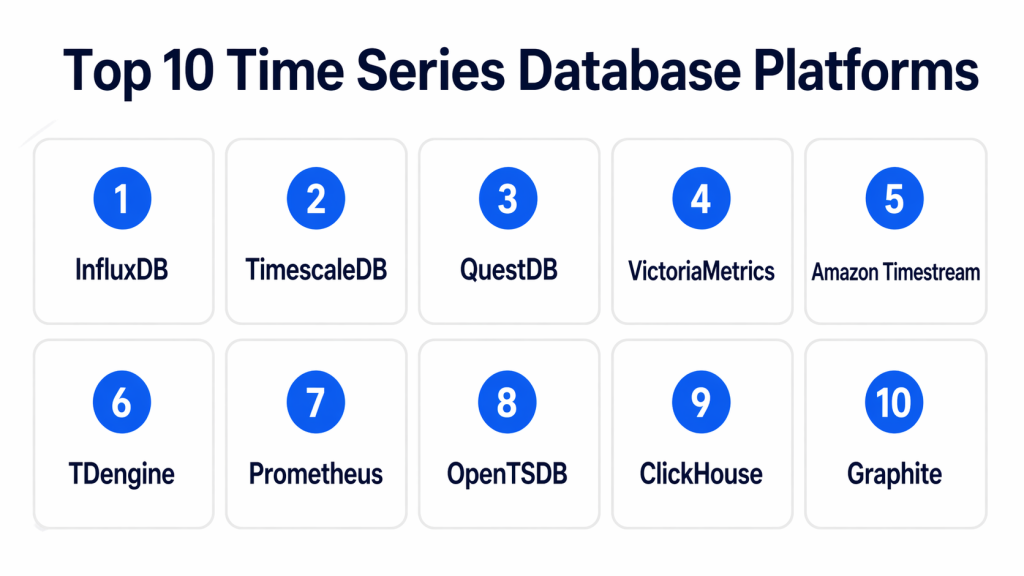
Top 10 Time Series Database Platforms
#1 — InfluxDB
Short description : InfluxDB is one of the best-known purpose-built time series database platforms and remains a leading choice for infrastructure metrics, IoT telemetry, real-time analytics, and monitoring workloads. It is positioned around high-speed ingest, real-time querying, broad ecosystem support, and a strong time-series-first architecture. It is a strong fit for teams that want a mature platform with both open and enterprise-oriented deployment paths. It works well across observability, sensor, and operational analytics use cases. It remains one of the safest default choices in this category.
Key Features
- Purpose-built engine for time series data
- High-throughput ingestion and real-time querying
- Recent-data optimization and columnar engine direction
- Broad client library support
- Strong Telegraf integration ecosystem
- Open, core, and enterprise-oriented deployment paths
- Useful for monitoring, telemetry, and analytics workloads
Pros
- Deep time series specialization with strong ecosystem depth
- Good fit for both observability and industrial telemetry use cases
- Strong community, tooling, and integration story
Cons
- Product lineup can feel more layered than simpler single-offering tools
- Enterprise-grade capabilities may require commercial adoption
- Teams should validate edition fit carefully before buying
Platforms / Deployment
- Web / Linux / Cloud / Containers
- Cloud / Self-hosted / Hybrid
Security & Compliance
Enterprise-oriented deployment paths include stronger operational security and management controls. Broad certification scope depends on edition and deployment.
Integrations & Ecosystem
InfluxDB has one of the richest ecosystems in the time series market and is especially strong where collection agents, APIs, and visualization workflows matter.
- Telegraf integration ecosystem
- Broad client library coverage
- Monitoring and telemetry pipeline compatibility
- Good fit for real-time analytics and alerting stacks
Support & Community
Documentation is extensive, community reach is broad, training resources exist, and commercial support is available through vendor offerings.
#2 — TimescaleDB
Short description : TimescaleDB is a PostgreSQL-based time series platform designed for teams that want time-series performance without leaving the Postgres ecosystem. The platform is positioned around live telemetry, automatic partitioning, row-columnar storage, tiered storage, and extensive time-series SQL functions. It is especially attractive for engineering teams that want SQL familiarity, relational flexibility, and strong time-series performance in one platform. It fits SaaS telemetry, event data, sensor workloads, and operational analytics. It is one of the strongest choices for teams that prefer Postgres-native workflows.
Key Features
- PostgreSQL-based time series architecture
- Automatic partitioning for time and key dimensions
- Time-series SQL functions
- Row and columnar storage patterns
- Tiered storage support
- Good fit for telemetry and event workloads
- Familiar Postgres ecosystem compatibility
Pros
- Strong balance of SQL familiarity and time-series specialization
- Attractive for teams already invested in PostgreSQL
- Good fit for operational analytics and live telemetry
Cons
- Best value depends on how much your team values Postgres compatibility
- Some advanced cloud capabilities are tied to the commercial platform
- May be more complex than simpler single-purpose TSDB tools for tiny teams
Platforms / Deployment
- Linux / macOS / Windows / Cloud
- Cloud / Self-hosted / Hybrid
Security & Compliance
Security posture depends on the deployment model and platform plan. Broad public compliance claims are not publicly stated.
Integrations & Ecosystem
TimescaleDB benefits from the broader PostgreSQL ecosystem, making it especially compelling when teams want standard SQL, familiar drivers, and compatibility with existing Postgres-oriented tooling.
- PostgreSQL ecosystem compatibility
- Strong fit for telemetry and event analytics
- Good integration potential with existing SQL-based workflows
- Useful for mixed transactional and time-series workloads
Support & Community
Community awareness is strong, open-source familiarity is high, and commercial support is available through the vendor platform.
#3 — QuestDB
Short description : QuestDB is a high-performance open-source time series database built for fast ingestion and fast SQL-based analytics, with a strong reputation in market data and real-time operational workloads. It is especially appealing to teams that care about SQL, throughput, hardware efficiency, and low-latency time-series analysis. QuestDB is a strong fit for trading data, telemetry, monitoring, and industrial-scale streaming scenarios. It is attractive to engineering-led organizations that want a purpose-built TSDB without abandoning familiar query patterns. It stands out as one of the strongest performance-oriented platforms in the category.
Key Features
- Purpose-built time-series SQL database
- High-ingest, low-latency query focus
- Open-source core with enterprise path
- Useful for market data and heavy telemetry
- Materialized views and TTL workflows
- Tiered storage in enterprise offering
- Cloud-native HA and failover in enterprise path
Pros
- Very strong fit for performance-sensitive time series workloads
- SQL-centric experience is attractive for analytics teams
- Good choice for market data and real-time streaming use cases
Cons
- Open-source edition is more limited for HA than enterprise editions
- Best value may require commercial adoption for mission-critical environments
- Narrower mainstream mindshare than InfluxDB or TimescaleDB
Platforms / Deployment
- Linux / Docker / Kubernetes / Cloud
- Self-hosted / Hybrid / Cloud
Security & Compliance
Enterprise deployment options include advanced security, high availability, automated snapshots, and disaster recovery features. Broader compliance certifications were not publicly stated.
Integrations & Ecosystem
QuestDB fits best in real-time analytics pipelines where SQL and streaming ingestion matter more than heavy multi-model data handling.
- Good fit for Grafana dashboards
- Useful in financial tick and telemetry pipelines
- Strong SQL analytics orientation
- Compatible with streaming and data ingestion workflows
Support & Community
Community adoption is healthy in performance-focused circles, documentation is solid, and enterprise support is available through commercial offerings.
#4 — VictoriaMetrics
Short description : VictoriaMetrics is a high-performance open-source time series database and monitoring solution that is especially popular in metrics-heavy observability environments. It is positioned around fast ingestion, easy operation, efficient resource usage, and long-term metrics storage. It is a strong fit for platform teams that care about monitoring scalability, simplicity, and cost control. It works especially well in modern infrastructure observability stacks. It is one of the most credible alternatives for large-scale metrics storage.
Key Features
- Fast, scalable time series database for monitoring
- High ingest and long-term metrics retention
- Strong resource efficiency claims
- Single-node and modular deployment approaches
- Good fit for observability stacks
- Open-source and enterprise options
- Run-anywhere positioning across on-prem and cloud
Pros
- Excellent choice for large-scale metrics monitoring
- Strong cost-efficiency and operational simplicity story
- Good fit for observability-led teams
Cons
- Best fit is metrics-heavy workloads rather than every TSDB use case
- Broader industrial and non-monitoring analytics fit may be narrower than some competitors
- Enterprise guidance may matter for advanced production governance
Platforms / Deployment
- Linux / Cloud / Containers
- Self-hosted / Hybrid / Cloud
Security & Compliance
Enterprise plans include stronger operational protections, guided onboarding, and resilience-oriented capabilities. Broader formal compliance scope depends on plan and deployment.
Integrations & Ecosystem
VictoriaMetrics is strongest in observability ecosystems where metrics collection, visualization, and long-term retention are central requirements.
- Strong monitoring ecosystem compatibility
- Good fit for Grafana-style operational analytics
- Useful for Prometheus-like metrics environments
- Flexible deployment for large observability estates
Support & Community
Open-source adoption is strong, documentation is extensive, and commercial plans add guided onboarding and expert resources.
#5 — Amazon Timestream
Short description : Amazon Timestream is a fully managed time series database service aimed at IoT, operational applications, and real-time analytics in AWS environments. It is positioned around serverless scale, high ingest rates, built-in analytics functions, availability targets, and strong security controls such as encryption and VPC endpoints. It is a compelling option for organizations that want managed time-series infrastructure and already operate heavily in AWS. It is especially strong where low operational overhead matters. It is best suited to cloud-first teams rather than infrastructure-control-first teams.
Key Features
- Fully managed time series database service
- Serverless scaling model
- Built-in time-series analytics functions
- Memory and magnetic or tiered storage patterns
- Strong AWS integration
- Encryption and KMS support
- Good fit for IoT and operational analytics
Pros
- Very low operational burden for AWS-native teams
- Strong security and networking controls
- Good fit for large managed telemetry workloads
Cons
- Best fit is closely tied to AWS ecosystems
- Service positioning has multiple variants, which can require careful evaluation
- Cost modeling should be validated for large-scale usage
Platforms / Deployment
- Web / Cloud
- Cloud
Security & Compliance
Supports encryption at rest and in transit, IAM authentication, private VPC endpoints, KMS support, and backup integration for supported paths.
Integrations & Ecosystem
Timestream integrates naturally with AWS services, making it appealing for cloud-native telemetry, IoT, and serverless application stacks.
- Deep AWS service integration
- Good fit for IoT pipelines
- Useful for operational analytics workloads
- Strong cloud-managed workflow alignment
Support & Community
Documentation is broad and enterprise support is available, though community mindshare is often strongest among AWS-first users.
#6 — TDengine
Short description : TDengine is a time series database platform strongly focused on industrial IoT, Industry 4.0, and large-scale sensor environments. It is positioned as an AI-powered data historian built on a high-performance TSDB with industrial data management capabilities. It is a strong fit for manufacturers, utilities, industrial operations teams, and organizations managing billions of sensor readings. TDengine is especially attractive when operational analytics, industrial context, and large-scale device data all matter together. It is one of the most specialized industrial TSDB platforms in the market.
Key Features
- High-performance time-series storage
- Built for industrial IoT and sensor data
- Petabyte-scale ingestion positioning
- Integrated stream-processing-oriented platform story
- AI agent positioning for forecasting and anomaly detection
- Good fit for industrial data pipelines
- Cloud-native and open-source options
Pros
- Excellent fit for industrial and sensor-heavy deployments
- Strong positioning around large-scale device data
- More specialized than many general-purpose TSDB competitors
Cons
- Industrial focus may be broader than some general SaaS teams need
- Vendor positioning may feel more complex than simpler TSDB products
- Best value depends on industrial data use cases
Platforms / Deployment
- Linux / Cloud / Containers
- Cloud / Self-hosted / Hybrid
Security & Compliance
Supports secure ingestion and storage practices in production deployments. Broad public compliance certifications were not publicly stated.
Integrations & Ecosystem
TDengine is strongest when used as part of industrial telemetry, historian modernization, or sensor data analysis workflows rather than generic app monitoring alone.
- Good fit for industrial data management
- Useful for sensor and device telemetry
- Strong IIoT application alignment
- Stream-processing-friendly architecture story
Support & Community
Documentation is solid, open-source paths exist, and vendor-backed support is available for enterprise and industrial customers.
#7 — Prometheus
Short description : Prometheus is one of the most widely adopted open-source monitoring systems and includes a highly influential time series database model for metrics collection and alerting. It is not a general-purpose TSDB for every time-series workload, but it remains extremely important for infrastructure metrics, cloud-native monitoring, and alert-driven operations. It is especially useful for engineering teams running Kubernetes and modern service environments. Prometheus is often the operational default for metrics-first observability. It remains one of the most credible time-series platforms in monitoring-centric use cases.
Key Features
- Metrics-first time series storage model
- Pull-based scraping approach
- Strong alerting ecosystem fit
- Excellent cloud-native monitoring alignment
- Broad exporter ecosystem
- Good for infrastructure and app metrics
- Open-source standard in many observability stacks
Pros
- Extremely strong fit for metrics monitoring
- Huge ecosystem and community adoption
- Excellent for Kubernetes and cloud-native operations
Cons
- Less suitable for broad industrial or analytics-heavy TSDB use cases
- Long-term storage often benefits from companion tools
- Not always the best fit for every timestamped data type
Platforms / Deployment
- Linux / Cloud / Containers
- Self-hosted / Hybrid
Security & Compliance
Security posture depends heavily on deployment, network design, and surrounding ecosystem components. Broad compliance certifications are not publicly stated.
Integrations & Ecosystem
Prometheus is strongest where metrics, exporters, dashboards, and alerting workflows are more important than generalized time-series analytics across many data types.
- Massive exporter ecosystem
- Strong Grafana compatibility
- Excellent fit for Kubernetes and cloud-native monitoring
- Often paired with long-term storage tools
Support & Community
Community strength is exceptional, documentation is mature, and adoption across cloud-native operations is extremely broad.
#8 — OpenTSDB
Short description : OpenTSDB is a long-standing open-source time series database platform built for scalable storage and analysis of time-stamped data. It remains a credible option for teams that want a flexible, highly configurable time-series system and are comfortable with a more infrastructure-heavy model. OpenTSDB is especially relevant in legacy large-scale monitoring or custom metrics deployments. It is less fashionable than some newer competitors, but still legitimate for certain environments. It fits technically mature teams more than convenience-first buyers.
Key Features
- Open-source time series platform
- Flexible configuration model
- Search and lookup capabilities
- Time-based functions and filters
- Strong scalability heritage
- Suitable for custom metrics deployments
- Good fit for infrastructure-controlled environments
Pros
- Credible for teams wanting flexible, open control
- Mature architecture with real operational history
- Useful in custom or legacy metrics estates
Cons
- Operational complexity is higher than many modern managed tools
- Smaller mindshare than newer TSDB leaders
- Onboarding is less friendly for general buyers
Platforms / Deployment
- Linux / JVM environments / Cloud-capable infrastructure
- Self-hosted / Hybrid
Security & Compliance
Security and compliance posture depend heavily on configuration and deployment architecture. Broad public certifications were not publicly stated.
Integrations & Ecosystem
OpenTSDB is best for organizations that value customizable time-series infrastructure and are willing to operate it themselves.
- Good fit for custom metrics pipelines
- Flexible search and filter behavior
- Suitable for infrastructure-controlled deployments
- Useful in established monitoring architectures
Support & Community
Documentation exists and the platform remains maintained, but ecosystem energy is lower than the category’s biggest modern names.
#9 — ClickHouse
Short description : ClickHouse is best known as a high-performance analytical database, but it is increasingly used for time-series-heavy real-time analytics, observability, and event workloads. It is especially strong when organizations need fast analytical reads over very large append-heavy datasets and want more than a classic metrics-only TSDB. It is a strong choice for security analytics, product analytics, log analytics, and real-time event pipelines with time-based querying patterns. It is not a pure TSDB in the narrowest sense, but it is highly relevant for modern time-series analytics platforms. It fits data-intensive engineering teams well.
Key Features
- High-performance analytical engine
- Strong fit for append-heavy time-oriented data
- Excellent compression and scan efficiency
- Good for real-time dashboards and observability analytics
- Useful materialized view patterns
- Strong SQL analytics capabilities
- Good scale for logs, metrics, and events
Pros
- Excellent for large-scale real-time analytics over time-based data
- Strong compression and query performance
- Broad fit across observability, security, and product telemetry
Cons
- Not a purpose-built TSDB in the narrow classic sense
- Operational design can be more demanding than simple managed TSDB tools
- Best fit is analytics-heavy environments
Platforms / Deployment
- Linux / Cloud / Containers
- Cloud / Self-hosted / Hybrid
Security & Compliance
Security posture depends on product edition and deployment model. Broad claims should be validated per offering.
Integrations & Ecosystem
ClickHouse is strongest when teams need time-series analytics combined with broader analytical flexibility, especially for logs, events, and observability data.
- Strong fit for real-time analytics dashboards
- Useful for logs and metrics analysis
- Broad BI and analytics integration potential
- Good for large event-driven platforms
Support & Community
Community visibility is strong, enterprise offerings are mature, and the platform is increasingly common in high-scale analytics environments.
#10 — Graphite
Short description : Graphite is one of the classic names in time-series monitoring and metrics storage. While it is older than many of the platforms on this list, it remains relevant in some infrastructure and performance-monitoring environments because of its straightforward metrics-centric model and long history in operational dashboards. It is most appropriate for teams already familiar with classic monitoring stacks or maintaining established metric systems. It is less compelling for greenfield buyers who want modern managed scale or industrial features. It still deserves mention as a historic and still-used TSDB platform.
Key Features
- Metrics-centric time series storage
- Long history in infrastructure monitoring
- Straightforward retention-oriented model
- Good fit for classic operational dashboards
- Established role in older monitoring stacks
- Useful for legacy metric environments
Pros
- Familiar and proven in traditional monitoring use cases
- Simple conceptual model for metrics storage
- Still relevant in some established environments
Cons
- More dated than modern cloud-native or industrial platforms
- Weaker fit for new large-scale greenfield deployments
- Ecosystem momentum is lower than leading alternatives
Platforms / Deployment
- Linux / Self-managed server environments
- Self-hosted / Hybrid
Security & Compliance
Security posture depends on deployment architecture and surrounding tooling. Broad public certifications are not publicly stated.
Integrations & Ecosystem
Graphite is most useful where a classic metrics pipeline already exists and replacing it is harder than maintaining it.
- Compatible with classic monitoring workflows
- Useful in legacy dashboard environments
- Fits older infrastructure monitoring setups
Support & Community
Community familiarity remains, but momentum is lower than with newer platforms such as InfluxDB, Prometheus, or VictoriaMetrics.
Comparison Table (Top 10)
| Tool Name | Best For | Platform(s) Supported | Deployment (Cloud/Self-hosted/Hybrid) | Standout Feature | Public Rating |
|---|---|---|---|---|---|
| InfluxDB | General-purpose time series workloads | Web, Linux, Cloud, Containers | Cloud / Self-hosted / Hybrid | Purpose-built time-series ecosystem | N/A |
| TimescaleDB | PostgreSQL-based telemetry and event workloads | Windows, macOS, Linux, Cloud | Cloud / Self-hosted / Hybrid | Postgres-native time-series performance | N/A |
| QuestDB | High-performance SQL time series analytics | Linux, Docker, Kubernetes, Cloud | Self-hosted / Hybrid / Cloud | Fast ingestion with SQL analytics | N/A |
| VictoriaMetrics | Metrics-heavy observability environments | Linux, Cloud, Containers | Self-hosted / Hybrid / Cloud | Efficient long-term metrics storage | N/A |
| Amazon Timestream | AWS-native managed telemetry and IoT | Web, Cloud | Cloud | Fully managed time-series service | N/A |
| TDengine | Industrial IoT and sensor-heavy environments | Linux, Cloud, Containers | Cloud / Self-hosted / Hybrid | Industrial and historian-oriented TSDB | N/A |
| Prometheus | Cloud-native metrics monitoring | Linux, Cloud, Containers | Self-hosted / Hybrid | Metrics-first monitoring standard | N/A |
| OpenTSDB | Flexible infrastructure-controlled time series setups | Linux, JVM, Cloud-capable infra | Self-hosted / Hybrid | Mature open configurability | N/A |
| ClickHouse | Real-time time-series analytics at scale | Linux, Cloud, Containers | Cloud / Self-hosted / Hybrid | Fast analytical reads over time data | N/A |
| Graphite | Legacy metrics monitoring environments | Linux, Server environments | Self-hosted / Hybrid | Classic metrics storage model | N/A |
Evaluation & Scoring of Time Series Database Platforms
| Tool Name | Core (25%) | Ease (15%) | Integrations (15%) | Security (10%) | Performance (10%) | Support (10%) | Value (15%) | Weighted Total (0–10) |
|---|---|---|---|---|---|---|---|---|
| InfluxDB | 9.3 | 8.3 | 9.2 | 8.4 | 9.0 | 8.8 | 8.0 | 8.74 |
| TimescaleDB | 9.0 | 8.0 | 8.8 | 7.8 | 8.7 | 8.5 | 8.4 | 8.49 |
| QuestDB | 8.9 | 7.5 | 7.8 | 7.8 | 9.4 | 8.0 | 8.5 | 8.34 |
| VictoriaMetrics | 8.8 | 8.2 | 8.3 | 7.8 | 9.1 | 8.2 | 9.0 | 8.49 |
| Amazon Timestream | 8.7 | 8.8 | 8.5 | 9.0 | 8.8 | 8.7 | 7.2 | 8.42 |
| TDengine | 8.6 | 7.4 | 7.8 | 7.8 | 8.9 | 8.0 | 8.5 | 8.11 |
| Prometheus | 8.5 | 8.4 | 9.3 | 6.8 | 8.3 | 9.0 | 9.2 | 8.50 |
| OpenTSDB | 8.0 | 6.5 | 7.0 | 6.8 | 8.2 | 7.2 | 8.3 | 7.52 |
| ClickHouse | 8.4 | 7.2 | 8.6 | 7.8 | 9.3 | 8.3 | 8.1 | 8.23 |
| Graphite | 7.2 | 7.0 | 7.0 | 6.2 | 7.0 | 6.8 | 8.0 | 7.16 |
These scores are comparative, not absolute. A higher weighted total means the platform looks stronger under this evaluation model, not that it is the best option for every workload. Metrics-first platforms often score well for observability, industrial platforms do better for IIoT, and SQL-centric systems do better where analytics usability matters. Managed services usually score higher on ease and security defaults, while open platforms often score better on value and control. Use the table to create a shortlist, then validate it with your own data volume, retention, and query needs.
Which Time Series Database Platform Is Right for You?
Solo / Freelancer
If you are building smaller monitoring setups, internal dashboards, or side projects, Prometheus, InfluxDB, and TimescaleDB are the most practical starting points. Prometheus is excellent for metrics-driven infrastructure visibility. InfluxDB is easier to justify when you want a broader purpose-built TSDB experience. TimescaleDB is a good choice if you already know PostgreSQL and want time-series capabilities without learning an entirely different stack.
SMB
For most SMBs, InfluxDB, TimescaleDB, Prometheus, and VictoriaMetrics offer the best mix of usability, flexibility, and cost control. Prometheus plus companion tooling works well for infrastructure monitoring. InfluxDB is attractive when you need broader telemetry and analytics. TimescaleDB is strong for app-centric teams already comfortable with SQL. VictoriaMetrics is a smart pick when long-term metrics retention and operational efficiency matter more.
Mid-Market
Mid-market teams usually need stronger retention controls, lower operations overhead, and better performance at growing scale. InfluxDB remains a strong general-purpose choice. VictoriaMetrics is especially compelling for observability-heavy environments. QuestDB works well for performance-sensitive analytics and streaming time-series workloads. Amazon Timestream is attractive for AWS-first organizations that want managed operations.
Enterprise
Enterprises should choose based on workload type, existing architecture, and governance needs. InfluxDB is strong for broad time-series use cases. TimescaleDB is excellent when SQL and PostgreSQL alignment matter. QuestDB is compelling for fast financial or streaming analytics. VictoriaMetrics is strong for large-scale metrics storage. TDengine is especially relevant for industrial and IIoT estates. Amazon Timestream makes the most sense for AWS-centric managed environments.
Budget vs Premium
If cost control is the top priority, Prometheus, VictoriaMetrics, TimescaleDB, QuestDB, and OpenTSDB are attractive because they give more infrastructure control and open deployment flexibility. Premium or managed options such as Amazon Timestream and higher-end enterprise editions of InfluxDB or QuestDB make more sense when operational simplicity, support, and resilience justify the spend.
Feature Depth vs Ease of Use
If you want the easiest broad purpose-built TSDB experience, InfluxDB is a strong default. If you want familiar SQL, choose TimescaleDB or QuestDB. If you want low-friction managed cloud operations, Amazon Timestream is appealing. If you want raw metrics-focused simplicity for observability, Prometheus and VictoriaMetrics are better fits.
Integrations & Scalability
For broad integrations, InfluxDB and Prometheus are especially strong. For scaling metrics retention, VictoriaMetrics is compelling. For industrial scale, TDengine is highly relevant. For analytical speed on large time-oriented datasets, QuestDB and ClickHouse are stronger choices. For hybrid SQL plus time-series workflows, TimescaleDB remains one of the safest bets.
Security & Compliance Needs
If security and compliance are central, managed services and enterprise editions often give you a clearer path. Amazon Timestream stands out for IAM, KMS, VPC endpoints, and backup integrations. Enterprise editions of InfluxDB and QuestDB also add stronger resilience and security-oriented capabilities. Open-source platforms can still be excellent, but the burden shifts more heavily to your deployment and operational discipline.
Frequently Asked Questions (FAQs)
1. What is a time series database platform?
A time series database platform is a system optimized for storing and querying data points that are associated with time. Examples include metrics, sensor readings, logs, telemetry streams, and financial ticks. These systems are designed to ingest large volumes quickly, compress timestamped data efficiently, and answer time-window queries fast. They differ from general-purpose databases because time-based patterns are their core design assumption. That makes them especially valuable for monitoring, IoT, and real-time analytics.
2. When should I choose a TSDB instead of a relational database?
Choose a TSDB when your workload is dominated by timestamped data, very high write volume, retention rules, downsampling, or time-range analytics. A relational database can still work for some time-based workloads, but it often becomes less efficient as data volume and query frequency grow. Purpose-built TSDBs handle ingestion, storage, and time-window queries more naturally. If your workload is mostly events, metrics, telemetry, or sensor streams, a TSDB is often the better fit. If you still need deep relational joins, a hybrid or PostgreSQL-based approach may be better.
3. Is Prometheus a real time series database?
Yes, Prometheus absolutely includes a time series database model and is one of the most important TSDB platforms in observability. It is optimized for metrics collection and alerting rather than every possible time-series workload. That means it is excellent for monitoring infrastructure and services, but less universal for industrial telemetry, financial analytics, or mixed analytical use cases. Many teams still treat it as their default TSDB for cloud-native metrics. It is highly credible, just specialized.
4. How is InfluxDB different from TimescaleDB?
InfluxDB is purpose-built specifically around time series data and has a broader classic TSDB identity. TimescaleDB extends PostgreSQL and is attractive when teams want time-series performance while staying in the Postgres and SQL ecosystem. InfluxDB often feels more specialized for telemetry and metrics pipelines. TimescaleDB often feels more natural where SQL familiarity and mixed workloads matter. The right choice depends on whether you value time-series specialization or PostgreSQL compatibility more.
5. Is Amazon Timestream a good choice for production use?
Yes, especially for AWS-first organizations that want managed operations and built-in security controls. It is attractive for IoT, operational analytics, and cloud-native telemetry workloads where low ops burden matters. The biggest consideration is ecosystem fit. If your organization is already deeply invested in AWS, Timestream can be very compelling. If you want more portability or self-hosted control, other TSDB platforms may be a better fit.
6. What is the biggest mistake buyers make with time series databases?
A major mistake is choosing only on raw ingest benchmarks without considering query patterns, retention, operations, and ecosystem fit. Another common mistake is confusing monitoring tools with general-purpose TSDB platforms or vice versa. Teams also underestimate security, storage tiering, and long-term retention cost. Some choose a complex industrial or distributed platform when a simpler metrics stack would be enough. Others pick a lightweight metrics tool and then expect it to handle every timestamped workload equally well.
7. Which TSDB is best for observability?
For pure cloud-native metrics observability, Prometheus and VictoriaMetrics are among the strongest options. InfluxDB is also excellent when you want a broader purpose-built TSDB with a strong ecosystem. If your observability workload extends into richer analytics, ClickHouse may also become attractive. The best answer depends on whether you need classic metrics and alerts, long-term retention, richer SQL analytics, or a fully managed deployment model. Observability is a broad use case, not a single database need.
8. Which TSDB is best for industrial IoT?
TDengine is one of the strongest specialized choices for industrial IoT, especially where sensor scale, historian-style use cases, and industrial data management matter. InfluxDB is also widely relevant for IoT and telemetry. Amazon Timestream can be attractive in cloud-managed IoT contexts, especially inside AWS. The best choice depends on whether your focus is industrial operations, edge connectivity, cloud analytics, or mixed enterprise telemetry. Industrial data requirements are often more specialized than standard monitoring.
9. Can a company use more than one time series database?
Yes, many organizations do. One team may use Prometheus for live infrastructure monitoring, another may use InfluxDB for IoT telemetry, and a data team may use ClickHouse or QuestDB for analytical time-series workloads. The key is being intentional. Too many overlapping tools increase complexity, but the right combination can be very effective. The best architecture matches each database to a clear workload.
10. How should teams shortlist time series platforms?
Start by identifying the dominant workload: metrics monitoring, industrial telemetry, event analytics, market data, or managed cloud telemetry. Then define retention requirements, security expectations, expected query patterns, and whether SQL matters. Shortlist two or three platforms that truly fit those needs. Run a pilot with realistic data volume, dashboard queries, and retention settings. That will tell you much more than feature lists alone.
Conclusion
Time series database platforms remain essential for organizations that need to ingest, store, and analyze timestamped data at scale. The strongest options in this category each solve a slightly different problem well. InfluxDB is a reliable all-around leader, TimescaleDB is excellent for PostgreSQL-oriented teams, QuestDB stands out for performance-focused SQL analytics, VictoriaMetrics and Prometheus are especially strong for observability, Amazon Timestream is compelling for managed AWS deployments, and TDengine is highly relevant for industrial telemetry.
The best platform depends on the kind of time-based data you handle, the level of control you want, and what your team can operate confidently. Start by shortlisting two or three realistic options, then test them against real ingest volume, retention needs, query patterns, and security requirements. That practical evaluation will lead to a better choice than chasing a single universal winner.
