Introduction
Graph database platforms are databases built to manage highly connected data. Instead of storing relationships indirectly through table joins, they treat relationships as first-class elements, which makes it easier to analyze patterns, paths, networks, and dependencies. That matters now because modern applications increasingly rely on connected context, whether for fraud detection, recommendation engines, cybersecurity analysis, knowledge graphs, or identity and access control modeling.
In practical terms, graph databases are often used for identity relationship mapping, Zero Trust policy analysis, attack-path discovery, recommendation systems, and AI knowledge graph projects. As organizations deal with more complex systems, more identities, more permissions, and more interconnected data, graph databases become more useful than traditional data models for certain workloads. Buyers should evaluate query language maturity, scalability, deployment flexibility, security controls, AI-readiness, integration patterns, operational simplicity, ecosystem quality, pricing model, and long-term maintainability before choosing a platform.
Best for: developers, data engineers, security teams, fraud teams, identity architects, and enterprises that need to model and query complex relationships. These tools are especially relevant for mid-market and enterprise environments in finance, telecom, retail, SaaS, healthcare, and public sector use cases.
Not ideal for: simple transactional apps, standard reporting workloads, or teams whose data is mostly tabular and not relationship-heavy. If your use case rarely depends on multi-hop relationships, a relational or document database may be a better fit.
Key Trends in Graph Database Platforms
- Graph plus AI is becoming a major buying factor. Many graph platforms now position themselves for GraphRAG, vector-aware retrieval, semantic search, and AI knowledge graph use cases.
- Managed cloud adoption is growing. Organizations increasingly prefer graph databases that reduce infrastructure overhead and simplify scaling, patching, and backups.
- Security expectations are rising. Buyers now expect encryption, role-based access control, auditability, and identity integration as table-stakes features.
- Identity and cybersecurity use cases are expanding fast. Graph databases are increasingly used for entitlement analysis, toxic access detection, attack path mapping, and Zero Trust architecture support.
- Multi-model platforms remain attractive. Some organizations prefer graph functionality inside broader document, search, or multi-model database platforms.
- Cloud-native operations are more important. Kubernetes support, automation, observability, and deployment flexibility are becoming stronger evaluation criteria.
- Open query standards and interoperability matter more. Buyers value support for Gremlin, Cypher-style workflows, SPARQL, and broader ecosystem compatibility.
- Cost predictability is under more scrutiny. Teams are paying closer attention to compute-heavy graph traversals, managed service premiums, and specialist skill requirements.
- Developer experience is improving. Better documentation, SDKs, APIs, and onboarding resources are making graph databases easier to adopt.
- Platform consolidation is influencing decisions. Many enterprises prefer graph capabilities that fit into their existing cloud, database, or analytics stack rather than adding another isolated system.
How We Graph Database Platforms (Methodology)
We selected the Top 10 graph database platforms using a practical, buyer-focused evaluation model:
- We prioritized market recognition and adoption, including broad industry awareness and production relevance.
- We looked at feature completeness, especially query capabilities, graph modeling depth, analytics support, and admin tooling.
- We considered performance and scalability positioning, particularly for large graphs and traversal-heavy workloads.
- We evaluated security posture signals, such as encryption, RBAC, SSO support, audit logging, and enterprise governance alignment.
- We reviewed integration and ecosystem strength, including APIs, drivers, developer tooling, and compatibility with broader data stacks.
- We included a mix of enterprise platforms, managed cloud services, open-source projects, and developer-first options.
- We considered customer fit across segments, from smaller engineering teams to enterprise platform groups.
- We factored in deployment flexibility, including cloud, self-hosted, and hybrid models.
- We emphasized modern relevance, including support for AI, knowledge graphs, security analytics, and cloud-native patterns.
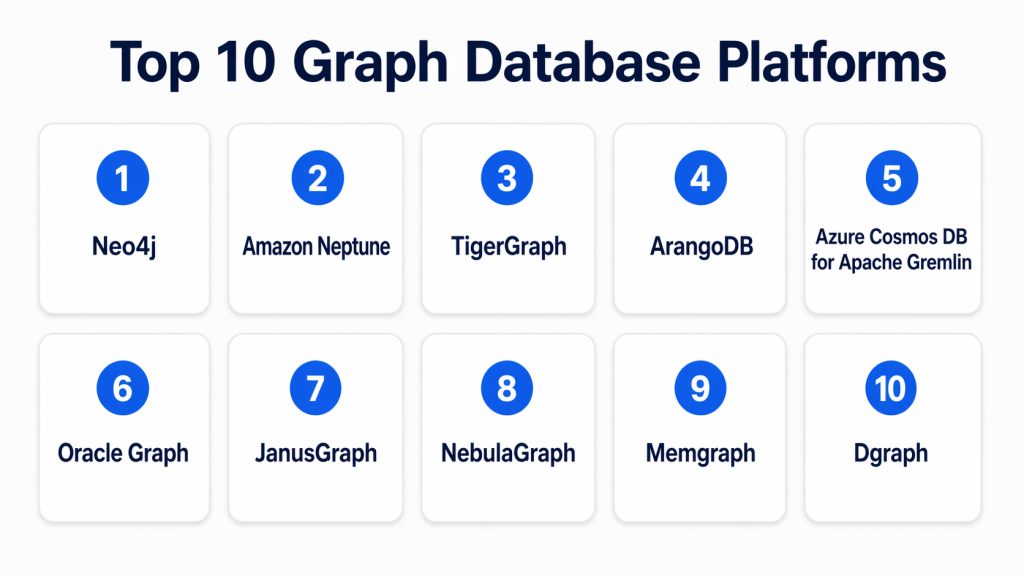
Top 10 Graph Database Platforms
#1 — Neo4j
Short description : Neo4j is the most recognizable graph database platform in the market and remains a strong choice for teams building relationship-heavy applications. It is widely used for fraud detection, recommendation engines, knowledge graphs, cybersecurity investigations, and identity relationship modeling. Its Cypher query language is mature and relatively approachable, which helps both developers and enterprise teams. The platform offers both self-managed and managed cloud options. Neo4j is often the default shortlist candidate when buyers want a graph-native platform with broad ecosystem maturity.
Key Features
- Native property graph database model
- Mature Cypher query language
- Managed cloud offering with Neo4j Aura
- Graph analytics and data science tooling
- Vector-aware and AI-related graph workflows
- Enterprise access control capabilities
- Broad language drivers and developer ecosystem
Pros
- Strong overall balance of usability and graph-native power
- Mature ecosystem for analytics, AI, and application development
- One of the safest default choices for production graph projects
Cons
- Enterprise capabilities can become expensive at scale
- Graph modeling still requires some specialist knowledge
- Advanced governance features vary by edition
Platforms / Deployment
Cloud / Self-hosted / Hybrid
Security & Compliance
Supports encryption, enterprise role-based access controls, and identity-related enterprise features. Broader compliance details vary by product tier and deployment model.
Integrations & Ecosystem
Neo4j has one of the deepest ecosystems in the graph database market. It integrates well with modern application stacks, graph analytics workflows, API layers, and AI-oriented pipelines. It is commonly used in environments where graph data needs to connect with broader engineering, analytics, and search systems.
- Drivers for major programming languages
- GraphQL-oriented tooling
- Graph Data Science ecosystem
- Developer procedures and extensions
- AI and knowledge graph use case support
Support & Community
Neo4j has one of the strongest communities in the category, along with solid documentation, training resources, and commercial support options. It is often easier to hire for than smaller graph platforms because of its broader market familiarity.
#2 — Amazon Neptune
Short description : Amazon Neptune is a fully managed graph database service designed for organizations already invested in AWS. It supports both property graph and RDF models, which makes it attractive for teams that need flexibility across graph styles. Neptune is commonly evaluated for fraud detection, knowledge graphs, identity relationship analysis, and recommendation systems. It is especially appealing to enterprises that want cloud-managed operations, strong infrastructure integration, and AWS-aligned security controls. For AWS-centric environments, it is one of the most practical managed graph choices.
Key Features
- Fully managed AWS graph database service
- Supports property graph and RDF workloads
- Gremlin, openCypher, and SPARQL support
- Automated backups and high availability options
- AWS-native networking and security integration
- Suitable for real-time and analytics-oriented graph workloads
- Good alignment with broader AWS architecture patterns
Pros
- Excellent fit for AWS-first organizations
- Reduces operational burden compared to self-managed graph systems
- Strong cloud security and infrastructure alignment
Cons
- Best experience depends on deeper AWS adoption
- Less portable than open-source self-managed alternatives
- Managed service costs can rise with scale
Platforms / Deployment
Cloud
Security & Compliance
Supports encryption, cloud-native access control patterns, and enterprise security integration within AWS environments. Exact compliance scope depends on service configuration and region.
Integrations & Ecosystem
Neptune integrates naturally with AWS services, which makes it appealing for teams standardizing on a single cloud platform. It fits especially well in environments where graph data needs to connect with cloud-native security, monitoring, analytics, and data movement services.
- AWS identity services
- Cloud monitoring services
- Managed key management
- VPC-based networking
- Open graph tooling compatibility
Support & Community
Support is strong for enterprises already using AWS support plans. Documentation is production-oriented and clear, although the independent graph practitioner community is smaller than Neo4j’s.
#3 — TigerGraph
Short description : TigerGraph is built for large-scale graph analytics and real-time graph workloads. It is often considered for fraud detection, supply chain analysis, access intelligence, customer relationship analysis, and security use cases where graph scale matters. TigerGraph emphasizes performance, enterprise administration, and advanced graph processing. It is typically a better fit for organizations that view graph as a strategic capability rather than a side project. For demanding enterprise use cases, it remains a strong contender.
Key Features
- Native parallel graph processing architecture
- Strong support for large-scale graph analytics
- Enterprise-focused admin and access controls
- Real-time graph query capabilities
- Visual tools and management interfaces
- Cloud and self-hosted deployment options
- Suited to complex multi-hop enterprise workloads
Pros
- Strong for performance-sensitive large graph workloads
- Good fit for fraud, security, and operational intelligence
- Enterprise-oriented feature set
Cons
- More complex than lighter-weight graph platforms
- Often better suited to larger teams and budgets
- Learning curve can be significant for new users
Platforms / Deployment
Cloud / Self-hosted / Hybrid
Security & Compliance
Supports enterprise identity and access patterns, including role-based controls and identity integration options. Broader certification details vary by offering.
Integrations & Ecosystem
TigerGraph fits well into enterprise analytics and operational intelligence environments. It is often evaluated where graph needs to work alongside data engineering pipelines, dashboards, and large-scale enterprise data platforms.
- Enterprise identity integration
- Visual graph tooling
- APIs and admin tooling
- Data pipeline compatibility
- Enterprise analytics workflows
Support & Community
TigerGraph offers solid commercial support and enterprise onboarding. Its community footprint is smaller than Neo4j’s, but its enterprise focus is stronger than many developer-first alternatives.
#4 — ArangoDB
Short description : ArangoDB is a multi-model database that combines graph, document, and search capabilities in one platform. This makes it attractive for teams that want graph features without adopting a graph-only database strategy. It is often used in applications where JSON-like data, search use cases, and connected relationships all matter together. ArangoDB works well for application development teams that value flexibility. It is a strong option when one platform must handle multiple data access patterns.
Key Features
- Multi-model support for graph, document, and search
- Flexible AQL query language across models
- Cloud and self-managed deployment options
- Good fit for mixed application workloads
- Operational support for modern deployment patterns
- Enterprise-focused auditing capabilities
- Suitable for custom application architectures
Pros
- Useful when teams want graph plus document and search in one engine
- Flexible for custom product and platform development
- Good balance of versatility and capability
Cons
- Less graph-specialized than graph-native leaders
- Query language learning curve can be noticeable
- Enterprise features vary by edition
Platforms / Deployment
Cloud / Self-hosted / Hybrid
Security & Compliance
Supports enterprise-oriented security features, including auditing and access controls depending on edition. Specific certification details are not always publicly stated.
Integrations & Ecosystem
ArangoDB is attractive for teams that want to reduce data sprawl and serve multiple application patterns from one database. It integrates well in engineering-led environments where API access, custom app logic, and multi-model flexibility matter.
- APIs for application integration
- Cloud deployment support
- Kubernetes-friendly workflows
- Mixed graph-document-search use cases
Support & Community
Documentation is practical and technically detailed. The community is smaller than the biggest graph-native platforms, but the product appeals strongly to teams looking for flexible architecture.
#5 — Azure Cosmos DB for Apache Gremlin
Short description : Azure Cosmos DB for Apache Gremlin is Microsoft’s managed graph offering for organizations that want graph functionality inside a broader cloud database platform. It is best suited to Azure-centric teams that prioritize managed operations, distributed scale, and enterprise cloud governance. While it is less graph-specialized than graph-native platforms, it is attractive for organizations focused on platform consolidation. It also benefits from Microsoft’s broader enterprise cloud ecosystem. For distributed cloud applications, it is a practical shortlist option.
Key Features
- Managed Gremlin-compatible graph service
- Global distribution and multi-region support
- Enterprise cloud security alignment
- Strong fit inside Azure application architectures
- Integrated operational tooling within the Microsoft ecosystem
- Suitable for distributed applications
- Broader platform value for Azure customers
Pros
- Good choice for Azure-first enterprises
- Strong global cloud scale positioning
- Useful when graph is part of a larger Microsoft cloud strategy
Cons
- Less graph-focused than specialist platforms
- Best value usually requires broader Azure adoption
- Query ergonomics may feel less natural for graph-first teams
Platforms / Deployment
Cloud
Security & Compliance
Supports enterprise cloud security controls, encryption, and access management aligned with Azure environments. Exact compliance applicability depends on service scope and configuration.
Integrations & Ecosystem
This platform works best for teams already using Microsoft cloud services, developer tools, and governance patterns. It is especially useful when graph data should live within a broader distributed application platform rather than a standalone graph stack.
- Azure-native integrations
- Microsoft identity ecosystem alignment
- Cloud governance tooling
- Monitoring and developer tool compatibility
Support & Community
Documentation is strong and enterprise support is solid. Community discussion is more active around the broader Cosmos DB platform than around its graph-specific capabilities.
#6 — Oracle Graph
Short description : Oracle Graph is a strong option for enterprises already invested in Oracle’s broader data platform. It enables graph capabilities inside Oracle Database environments and works well for organizations that want graph without introducing an entirely separate database stack. It is especially relevant for enterprises prioritizing governance, integration with existing Oracle systems, and data platform consolidation. Oracle Graph is less likely to be a first pick for greenfield developer startups. For existing Oracle shops, it can be very practical.
Key Features
- Graph support within Oracle Database environments
- Property graph capabilities
- Query and analytics support for graph workloads
- Enterprise data platform alignment
- Suitable for governance-heavy enterprise use cases
- Secure connection support
- Useful for Oracle-centric data architecture
Pros
- Strong fit for existing Oracle customers
- Helps reduce platform sprawl in Oracle-heavy environments
- Good governance alignment for large enterprises
Cons
- Less attractive outside Oracle ecosystems
- Can feel heavyweight for smaller teams
- More appealing for platform consolidation than developer experimentation
Platforms / Deployment
Cloud / Self-hosted / Hybrid
Security & Compliance
Supports enterprise-oriented database security controls and secure connection patterns. Specific graph-related certification details are not always separately stated.
Integrations & Ecosystem
Oracle Graph works best as part of a larger Oracle data strategy. It is especially relevant when graph data needs to sit close to existing Oracle systems, analytics environments, and enterprise data governance processes.
- Oracle Database integration
- Enterprise data architecture compatibility
- Analytics-oriented graph workflows
- Secure enterprise deployment patterns
Support & Community
Enterprise support is strong, but the broader community is more limited and enterprise-focused. Documentation is thorough, though often best suited to experienced Oracle teams.
#7 — JanusGraph
Short description : JanusGraph is an open-source distributed graph database designed for very large graphs and flexible backend architecture. It is often chosen by engineering teams that want open-source control, customizable storage options, and the ability to avoid vendor lock-in. JanusGraph is powerful, but it is not the easiest platform to operate. It is best suited to technically strong teams that are comfortable managing infrastructure complexity. For platform engineers, it remains a credible open-source graph option.
Key Features
- Open-source distributed graph database
- Designed for large-scale graph workloads
- Flexible storage backend options
- Strong fit for custom infrastructure architecture
- Open graph ecosystem compatibility
- Suitable for engineering-driven deployments
- Extensible through broader open-source tooling
Pros
- High degree of flexibility and control
- Good fit for organizations avoiding vendor lock-in
- Strong option for custom large-scale graph infrastructure
Cons
- Operational complexity is high
- Requires more infrastructure expertise than managed tools
- Enterprise support depends on partners and internal capability
Platforms / Deployment
Self-hosted / Hybrid
Security & Compliance
Security posture depends heavily on the underlying storage, index, and infrastructure choices. Unified enterprise compliance positioning is not publicly standardized in the same way as commercial managed platforms.
Integrations & Ecosystem
JanusGraph integrates through the broader open-source graph and backend ecosystem rather than through a single vendor-controlled platform. This gives flexibility, but it also means teams must own more of the integration design themselves.
- Open-source graph tooling compatibility
- Flexible backend integration
- Custom infrastructure support
- Community-driven deployment patterns
Support & Community
JanusGraph has meaningful open-source credibility, but onboarding is harder than with more polished commercial tools. It is a strong fit for teams that already know how to operate distributed infrastructure.
#8 — NebulaGraph
Short description : NebulaGraph is a distributed graph database focused on scale, performance, and cloud-native deployment patterns. It is often considered for large graph datasets and engineering-heavy environments that need distributed architecture. NebulaGraph is less mainstream than the biggest vendors, but it remains a valid option for teams that want a modern graph engine with scale-oriented design. It is best for technically ambitious teams rather than buyers looking for the easiest platform. It is especially relevant where cloud-native operations matter.
Key Features
- Distributed graph database architecture
- Designed for large graph scale
- Cloud-native operational support
- Cluster-friendly deployment model
- Role-based access model
- Suitable for engineering-led deployments
- Works well in infrastructure-oriented environments
Pros
- Strong scale-oriented positioning
- Good fit for cloud-native graph deployments
- Useful for technically capable platform teams
Cons
- Smaller ecosystem than category leaders
- Requires more hands-on engineering effort
- Governance maturity is lighter than top enterprise competitors
Platforms / Deployment
Self-hosted / Hybrid
Security & Compliance
Supports authentication and role-based controls. Detailed compliance and certification positioning is not always publicly stated.
Integrations & Ecosystem
NebulaGraph is strongest where distributed deployment, cluster operations, and engineering control matter more than polished enterprise ecosystem breadth. It is better suited to infrastructure-minded teams than non-technical buyers.
- Cluster deployment workflows
- Cloud-native operations support
- Role-based environment control
- Engineering-focused deployment model
Support & Community
Documentation is solid for technical teams, but community scale is smaller than more established graph leaders. Adoption tends to be more engineering-driven than business-led.
#9 — Memgraph
Short description : Memgraph is a developer-friendly graph database that emphasizes real-time graph use cases and fast iteration. It has become increasingly relevant for teams building graph-backed applications that need responsive performance and modern AI-related workflows. Memgraph is appealing for startups, developers, and product teams that want a graph system without immediately stepping into the heaviest enterprise options. It is especially interesting for real-time analytics and GraphRAG-style experimentation. For engineering-led teams, it is one of the more approachable emerging choices.
Key Features
- Developer-friendly graph platform
- Real-time graph processing orientation
- Strong fit for AI and GraphRAG experimentation
- Compatible with familiar graph development patterns
- Cloud and self-managed deployment options
- Security controls in enterprise contexts
- Good fit for modern application teams
Pros
- Attractive for fast-moving developer teams
- Good entry point for real-time graph applications
- Useful for AI-related graph exploration
Cons
- Smaller enterprise footprint than top leaders
- Compliance story is less visible publicly
- Ecosystem is still growing compared with more mature competitors
Platforms / Deployment
Cloud / Self-hosted / Hybrid
Security & Compliance
Supports encrypted cloud connectivity and enterprise-style access controls. Broader compliance details are not always publicly stated.
Integrations & Ecosystem
Memgraph is increasingly relevant in modern developer workflows, especially where graph needs to connect with streaming, AI experimentation, and application-layer logic. Its ecosystem is still maturing, but its momentum is notable.
- Developer-oriented APIs
- Real-time application support
- AI and GraphRAG workflow relevance
- Flexible deployment patterns
Support & Community
Documentation is approachable, and the developer community is growing. It is a better fit for hands-on product and engineering teams than for conservative procurement-led enterprise rollouts.
#10 — Dgraph
Short description : Dgraph is a graph database known for its GraphQL-friendly positioning and distributed architecture. It appeals to engineering teams that want graph capabilities tied closely to modern API development patterns. Dgraph is not as dominant in enterprise shortlists as Neo4j or Neptune, but it remains a credible choice for technically capable teams. Its documented access control and secure deployment options make it more governance-aware than some smaller open alternatives. It is best for developer-centric environments that want a modern graph architecture.
Key Features
- Distributed graph database design
- GraphQL-oriented platform positioning
- Access control support
- Secure communication options
- Suitable for modern application development
- Useful for engineering-driven deployments
- Flexible graph API patterns
Pros
- Interesting fit for GraphQL-centric teams
- Useful for modern distributed app architectures
- Security controls are clearer than in many smaller graph projects
Cons
- Smaller market visibility than top competitors
- Enterprise adoption is less established
- Success depends heavily on team expertise
Platforms / Deployment
Cloud / Self-hosted / Hybrid
Security & Compliance
Supports access control and secure deployment patterns. Broader certification details are not always publicly stated.
Integrations & Ecosystem
Dgraph fits best in engineering-led environments where GraphQL, API design, and distributed application architecture are core priorities. It is not the broadest enterprise ecosystem, but it is a credible technical option.
- GraphQL-oriented development workflows
- Access control support
- Distributed deployment options
- Developer-focused application patterns
Support & Community
Documentation is solid for technical users, though the community and commercial gravity are smaller than in the top-tier graph platforms. It is better suited to strong engineering teams than to less technical organizations.
Comparison Table (Top 10)
| Tool Name | Best For | Platform(s) Supported | Deployment | Standout Feature | Public Rating |
|---|---|---|---|---|---|
| Neo4j | General-purpose graph applications | Web, Windows, macOS, Linux, Cloud | Cloud / Self-hosted / Hybrid | Mature graph-native ecosystem with strong developer adoption | N/A |
| Amazon Neptune | AWS-centric enterprises | Web / Cloud | Cloud | Managed graph service supporting multiple graph models and query styles | N/A |
| TigerGraph | Large-scale enterprise graph analytics | Web, Linux, Cloud | Cloud / Self-hosted / Hybrid | High-performance graph analytics for complex enterprise workloads | N/A |
| ArangoDB | Multi-model applications | Web, Windows, macOS, Linux, Cloud | Cloud / Self-hosted / Hybrid | Graph, document, and search in one platform | N/A |
| Azure Cosmos DB for Apache Gremlin | Azure-centric distributed applications | Web / Cloud | Cloud | Managed graph capability within the larger Cosmos DB platform | N/A |
| Oracle Graph | Oracle-centric enterprise environments | Web, Linux, Cloud | Cloud / Self-hosted / Hybrid | Graph capabilities integrated with Oracle data architecture | N/A |
| JanusGraph | Open-source custom graph infrastructure | Linux | Self-hosted / Hybrid | Flexible distributed graph architecture with open backend choices | N/A |
| NebulaGraph | Cloud-native distributed graph teams | Linux / Cloud Infrastructure | Self-hosted / Hybrid | Scale-oriented distributed graph design | N/A |
| Memgraph | Real-time and developer-first graph projects | Linux, Cloud | Cloud / Self-hosted / Hybrid | Real-time graph positioning with modern AI relevance | N/A |
| Dgraph | GraphQL-centric engineering teams | Linux, Cloud | Cloud / Self-hosted / Hybrid | GraphQL-friendly distributed graph model | N/A |
Evaluation & Scoring of Graph Database Platforms
| Tool Name | Core (25%) | Ease (15%) | Integrations (15%) | Security (10%) | Performance (10%) | Support (10%) | Value (15%) | Weighted Total (0–10) |
|---|---|---|---|---|---|---|---|---|
| Neo4j | 9.5 | 8.5 | 9.0 | 8.5 | 8.8 | 9.0 | 7.8 | 8.75 |
| Amazon Neptune | 8.8 | 8.0 | 8.8 | 9.0 | 8.7 | 8.8 | 7.5 | 8.37 |
| TigerGraph | 9.0 | 7.2 | 8.0 | 8.6 | 9.2 | 8.2 | 7.0 | 8.16 |
| ArangoDB | 8.2 | 7.8 | 8.1 | 7.6 | 8.0 | 7.8 | 8.3 | 7.98 |
| Azure Cosmos DB for Apache Gremlin | 8.0 | 8.0 | 8.7 | 8.8 | 8.6 | 8.5 | 7.2 | 8.05 |
| Oracle Graph | 8.3 | 6.8 | 8.2 | 8.5 | 8.4 | 8.4 | 7.0 | 7.89 |
| JanusGraph | 8.4 | 5.8 | 7.6 | 6.8 | 8.5 | 6.8 | 8.2 | 7.41 |
| NebulaGraph | 8.1 | 6.4 | 7.0 | 6.9 | 8.6 | 6.7 | 8.0 | 7.42 |
| Memgraph | 8.0 | 7.8 | 7.5 | 7.3 | 8.4 | 7.2 | 8.4 | 7.82 |
| Dgraph | 7.7 | 7.0 | 7.2 | 7.5 | 8.0 | 6.8 | 8.1 | 7.49 |
These scores are comparative, not absolute. A lower-scoring tool may still be the right choice if it aligns better with your cloud strategy, internal skill set, operating model, or budget. Managed cloud services often score better on ease and operational simplicity, while open-source platforms may score better on flexibility and cost control. Enterprise-focused tools often perform well in security and support but may be heavier or more expensive. The goal of this table is to help buyers compare trade-offs rather than declare one universal winner.
Which Graph Database Platforms Is Right for You?
Solo / Freelancer
If you are building a prototype, experimenting with graph modeling, or adding a graph-backed feature to a product, Neo4j and Memgraph are usually the most approachable options. Neo4j has stronger community support and learning resources, while Memgraph is appealing for faster-moving, real-time-oriented development. Avoid heavyweight enterprise platforms unless you already know your graph workload will scale quickly or require strict governance from day one.
SMB
For SMBs, the best option usually depends on whether you want simplicity or flexibility. Neo4j remains a strong all-around choice. ArangoDB is attractive if you want graph plus document and search in one platform. Cloud-aligned SMBs may also consider Amazon Neptune or Azure Cosmos DB for Apache Gremlin if they are already standardized on AWS or Azure.
Mid-Market
Mid-market buyers should focus on staffing, scalability needs, and operational burden. Amazon Neptune works well for AWS-heavy organizations that want managed operations. Azure Cosmos DB for Apache Gremlin is a reasonable choice for Microsoft-first teams. TigerGraph becomes more compelling when graph analytics is becoming core to the business. ArangoDB is a good option when one database must support multiple workload types.
Enterprise
Enterprises should usually begin with Neo4j, Amazon Neptune, TigerGraph, and Oracle Graph. Neo4j is the strongest all-around graph-native platform. Neptune is a safe option for AWS-led governance and operations. TigerGraph is powerful for high-scale graph analytics. Oracle Graph makes the most sense when graph needs to live inside an Oracle-centric environment. Large enterprises should validate security controls, identity integration, auditability, and deployment governance early in the buying process.
Budget vs Premium
Budget-conscious teams may lean toward JanusGraph, NebulaGraph, Memgraph, or Dgraph, especially when open-source control and lower software cost matter. Premium buyers often prefer Neo4j, Amazon Neptune, TigerGraph, or Oracle Graph because support, admin tooling, and governance reduce risk. The real comparison should be total cost of ownership, not just subscription price.
Feature Depth vs Ease of Use
If you want the best balance of capability and usability, Neo4j is often the easiest recommendation. If your top priority is deep graph analytics and scale, TigerGraph may be worth the added complexity. If ease of operations matters more than graph-native purity, Amazon Neptune and Azure Cosmos DB for Apache Gremlin are practical choices.
Integrations & Scalability
Choose Amazon Neptune if AWS integration is central to your architecture. Choose Azure Cosmos DB for Apache Gremlin if you are heavily invested in Microsoft cloud services. Choose ArangoDB if you want graph plus broader data model flexibility. Choose JanusGraph if backend flexibility and open architecture matter. Choose Memgraph if you want a more modern developer-first approach with AI-related momentum.
Security & Compliance Needs
For IdentityManagement, CyberSecurity, ZeroTrust, and AccessControl use cases, prioritize graph platforms with documented encryption, access controls, and enterprise governance features. Neo4j, Amazon Neptune, TigerGraph, Azure Cosmos DB for Apache Gremlin, and Oracle Graph are usually the most practical starting points. Validate RBAC, SSO, audit visibility, encryption, and deployment isolation during your pilot phase.
Frequently Asked Questions (FAQs)
1. What is a graph database platform?
A graph database platform is a database designed to store and query connected data efficiently. It treats relationships as core elements rather than secondary references. This makes it especially useful for applications where paths, dependencies, networks, and connections are central to the analysis. Examples include fraud detection, recommendations, access modeling, and cybersecurity relationship mapping. It is different from a traditional database because relationships are modeled directly.
2. How is a graph database different from a relational database?
A relational database organizes data into tables and usually uses joins to connect records. A graph database stores nodes and relationships directly, which makes multi-hop queries more natural and often faster for connected data use cases. Relational systems are still excellent for structured transactions and tabular reporting. Graph databases are most valuable when the relationship itself is a major part of the workload. The right choice depends on how your data behaves.
3. Are graph databases useful for IdentityManagement and AccessControl?
Yes, graph databases are very well suited to identity and access use cases. They can model users, roles, groups, policies, permissions, and resource relationships in a way that exposes inherited access and hidden risks more clearly. This is especially useful for entitlement analysis, toxic combination detection, separation-of-duty checks, and access path mapping. In Zero Trust and CyberSecurity environments, graph structures often reveal issues that flat tables can hide.
4. Which graph database is best for CyberSecurity and ZeroTrust projects?
There is no single universal answer because the best option depends on architecture, scale, and team skills. Neo4j is a strong all-purpose choice for security graph projects. TigerGraph is attractive for large-scale analytics-heavy security workloads. Amazon Neptune works well in AWS-centric security environments. Oracle Graph and Azure Cosmos DB for Apache Gremlin can make sense when those ecosystems are already strategic.
5. Are graph database platforms expensive?
They can be, depending on the deployment model and workload. Managed services may charge for compute, storage, backup, or throughput, while enterprise subscriptions may add premium support and governance features. Open-source tools can reduce license cost but may require more internal engineering time. The smartest way to evaluate cost is by comparing total cost of ownership. Operational complexity can easily outweigh lower software pricing.
6. How hard is it to implement a graph database?
Implementation difficulty depends on the platform and your team’s experience. Managed cloud tools reduce operational overhead, but graph modeling still requires careful planning. Teams new to graph often underestimate the importance of designing nodes, relationships, and query paths properly. A successful rollout usually starts with one specific use case rather than an organization-wide migration. Pilots are especially important because graph value is highly workload-dependent.
7. What are common mistakes when choosing a graph database?
One common mistake is choosing graph technology because it sounds advanced rather than because the workload truly needs relationship-based modeling. Another is ignoring the learning curve for graph schemas and query languages. Some teams also underestimate integration requirements with identity, ETL, APIs, and monitoring. Others focus too much on raw performance and not enough on governance, security, and support. A realistic pilot prevents most of these mistakes.
8. Can graph databases scale for production workloads?
Yes, many graph platforms are designed for serious production use, but scalability depends on architecture and workload type. Some are optimized for managed cloud simplicity, while others focus on distributed scale and engineering control. Traversal-heavy workloads, real-time ingestion, and graph analytics can all behave differently at scale. Buyers should test with realistic graph sizes and real query patterns. Production readiness depends on design quality as much as vendor choice.
9. What should buyers evaluate before shortlisting graph database platforms?
Buyers should evaluate graph model fit, query language, deployment options, cloud alignment, security controls, scalability, documentation quality, ecosystem depth, and pricing structure. It is also important to review how well the platform fits your team’s skills and operating model. A very powerful tool may still be a poor fit if it is too hard to operate or hire for. The best shortlist combines technical fit with organizational fit.
10. Are graph databases useful for AI and knowledge graph projects?
Yes, graph databases are increasingly relevant in AI because they help structure entities, relationships, and context in a way that improves explainability and connected retrieval. They are often used for knowledge graphs, semantic relationships, GraphRAG workflows, and grounded AI applications. That said, not every AI project needs a graph database. They are most useful when relationships across concepts, users, entities, or permissions are central to the system’s value.
11. Should I choose a managed graph service or a self-hosted one?
Choose a managed service if you want faster onboarding, lower operational burden, and tighter integration with a cloud platform you already use. Choose self-hosted if control, data locality, custom architecture, or open-source flexibility matter more. Hybrid models can work when some workloads require strict internal control and others benefit from cloud agility. The right answer depends on governance, staffing, and long-term platform strategy.
12. What is the best way to evaluate graph database platforms?
Start with a real use case rather than a feature checklist. Shortlist two or three platforms that match your architecture, security expectations, and internal skill level. Then run a pilot using realistic data, real queries, and at least one important integration path. Measure usability, performance, governance fit, and operational complexity. That process will tell you far more than marketing language alone.
Conclusion
Graph database platforms are no longer niche products used only for specialized technical projects. They have become practical platforms for recommendation systems, fraud detection, identity relationship analysis, access control modeling, cybersecurity investigations, knowledge graphs, and AI-driven connected data use cases. The leading tools differ in where they shine: Neo4j stands out for balanced graph-native maturity, Amazon Neptune and Azure Cosmos DB for Apache Gremlin are strong for cloud alignment, TigerGraph is compelling for scale-intensive analytics, and ArangoDB, Oracle Graph, JanusGraph, NebulaGraph, Memgraph, and Dgraph each offer meaningful strengths for specific architectures.
The best graph database platform depends on your environment, team skills, data model, security requirements, and operating preferences. Instead of looking for one universal winner, shortlist two or three tools that fit your architecture and workload shape. Then run a focused pilot with real graph queries, integration checks, and governance validation. That approach will help you choose a platform you can not only deploy, but also operate, secure, and scale confidently.
