Introduction
Data warehouse platforms help organizations collect, organize, store, and analyze large volumes of structured and semi-structured business data for reporting, dashboards, planning, and decision-making. In simple terms, a data warehouse is where companies bring together sales, finance, operations, product, customer, and marketing data so teams can work from a more reliable version of the truth. Unlike transactional databases that support day-to-day app activity, data warehouses are built for analytics, performance at scale, and historical analysis.
This category matters even more now because modern organizations are dealing with larger data volumes, more SaaS tools, hybrid cloud environments, stricter governance expectations, and rising demand for AI-ready analytics. Today’s buyers are not just evaluating query speed. They are also looking at governance, semantic modeling, workload isolation, cost predictability, ecosystem fit, and how well a platform supports BI, machine learning, automation, and self-service analytics.
Common use cases include:
- Centralized BI and dashboarding
- Financial planning and reporting
- Customer and product analytics
- Operational reporting across multiple business systems
- AI and machine learning data preparation
Buyers should evaluate:
- Core warehouse performance
- Scalability and concurrency
- Ease of use for analysts and engineers
- Data ingestion and transformation support
- Security and governance controls
- Integration with BI and data ecosystems
- AI and advanced analytics readiness
- Deployment flexibility
- Cost model and workload efficiency
- Support quality and long-term maintainability
Best for: data teams, analytics engineers, BI teams, enterprise architects, finance teams, operations leaders, and companies that need a governed, scalable analytics foundation. These platforms are relevant across SMB, mid-market, and enterprise environments, but especially valuable for organizations running multiple systems and growing data complexity.
Not ideal for: very small teams with lightweight reporting needs, single-app startups with limited data complexity, or organizations that only need operational dashboards from one source system. In those cases, a simpler analytics database, lakehouse, or even embedded BI layer may be a better fit.
Key Trends in Data Warehouse Platforms
- AI is becoming a platform feature, not an add-on. Buyers increasingly expect natural-language analytics, AI assistants, embedded ML functions, and AI-ready pipelines.
- Lakehouse and warehouse boundaries are blurring. Many platforms now combine warehouse performance with open storage, Delta-style formats, or broader lakehouse capabilities.
- Cost control is a bigger buying factor. Organizations are paying more attention to workload isolation, serverless pricing, auto-suspend behavior, and storage versus compute separation.
- Governance is moving closer to the core platform. Access policies, auditability, semantic layers, cataloging, and lineage are becoming more important in warehouse decisions.
- Real-time and near-real-time analytics are becoming more common. Warehouses are increasingly expected to support fresher data and faster operational insights.
- Cross-cloud and ecosystem flexibility matter more. Buyers want to avoid lock-in where possible and prefer platforms that fit modern data stacks.
- Self-service analytics is influencing architecture. Business users expect easier querying, governed data products, and simpler exploration without deep technical dependence.
- Security expectations are rising. Encryption, RBAC, SSO integration, private networking, and enterprise controls are now baseline requirements.
- Semantic consistency is becoming strategic. Teams increasingly care about shared business definitions, governed metrics, and consistent reporting logic.
- Platform consolidation is shaping shortlists. Many buyers prefer tools that connect warehousing, engineering, governance, and analytics in one broader environment.
How We Chose These Data Warehouse Platforms (Methodology)
We selected the Top 10 using a practical evaluation framework focused on real buyer needs:
- We prioritized platforms with strong market recognition and credible production adoption.
- We looked for feature completeness across storage, compute, ingestion, transformation, query performance, and workload management.
- We considered ease of use for analysts, data engineers, and administrators.
- We reviewed ecosystem fit, including BI tools, transformation frameworks, APIs, connectors, and developer workflows.
- We factored in security posture signals such as encryption, RBAC, SSO, governance, and audit capabilities.
- We considered deployment flexibility, including cloud-native, serverless, managed, and hybrid-friendly models.
- We looked at platform relevance for both classic BI and modern AI-driven analytics.
- We included a mix of cloud-native leaders, enterprise warehouse vendors, and modern analytics platforms.
- We considered customer fit across SMB, mid-market, and enterprise segments.
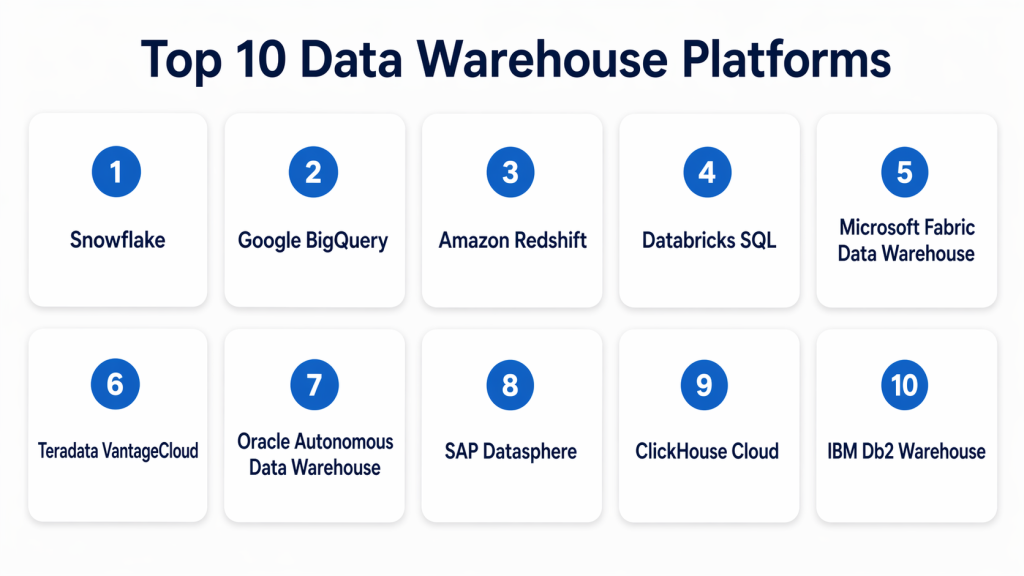
Top 10 Data Warehouse Platforms
#1 — Snowflake
Short description : Snowflake is one of the most widely recognized modern cloud data warehouse platforms and remains a top choice for analytics-heavy organizations. It is known for its separation of storage and compute, workload flexibility, and broad ecosystem compatibility. Snowflake works well for companies building centralized analytics, governed data sharing, and cross-functional reporting at scale. It is also increasingly positioned as an AI-ready data platform rather than only a warehouse. For many buyers, Snowflake is the safest modern shortlist option.
Key Features
- Cloud-native architecture with separate storage and compute
- Elastic virtual warehouses for workload isolation
- Strong support for structured and semi-structured data
- Data sharing and collaboration capabilities
- Broad support for analytics, engineering, and AI workflows
- Strong governance and administrative controls
- Mature multi-cloud positioning
Pros
- Excellent balance of performance, scale, and usability
- Strong ecosystem and partner support
- Good fit for both enterprise and fast-growing mid-market teams
Cons
- Costs can rise quickly without disciplined workload management
- Some advanced use cases may require careful architecture planning
- Premium positioning may be heavy for smaller teams
Platforms / Deployment
Cloud
Security & Compliance
Supports enterprise security controls such as encryption, role-based access control, and identity integration. Broader compliance coverage varies by edition, configuration, and region.
Integrations & Ecosystem
Snowflake has one of the strongest ecosystems in the category. It connects well with BI tools, transformation frameworks, data apps, AI workflows, and cross-cloud data architectures. It is commonly used as a central analytics layer in modern data stacks.
- BI and dashboard integrations
- Data transformation ecosystem compatibility
- Partner application marketplace
- API and connector support
- AI and analytics workflow support
Support & Community
Snowflake has strong documentation, broad partner availability, and a large community footprint. Commercial support and implementation resources are mature, making it easier to adopt at scale.
#2 — Google BigQuery
Short description : BigQuery is Google Cloud’s serverless enterprise data warehouse and one of the strongest choices for teams that want minimal infrastructure management. It is especially attractive for organizations that prioritize elasticity, managed operations, and integration with Google’s analytics and AI ecosystem. BigQuery is widely used for large-scale reporting, product analytics, data science preparation, and modern BI workloads. It works well for companies that want fast setup and fewer warehouse administration tasks. For cloud-native analytics teams, it is a very compelling option.
Key Features
- Serverless cloud data warehouse architecture
- Strong scalability for large analytical workloads
- GoogleSQL support and broad analytics functionality
- Native fit with Google Cloud data and AI services
- Flexible pricing approaches
- Support for near-real-time analytics patterns
- Minimal infrastructure administration
Pros
- Very easy to operate compared with more infrastructure-heavy tools
- Strong fit for cloud-native analytics and AI workflows
- Excellent elasticity and scalability
Cons
- Cost predictability can be tricky without query discipline
- Best fit often depends on broader Google Cloud adoption
- Some teams may want more explicit workload controls
Platforms / Deployment
Cloud
Security & Compliance
Supports cloud-native security controls, encryption, access management, and enterprise governance within Google Cloud environments. Exact compliance scope depends on service configuration and region.
Integrations & Ecosystem
BigQuery fits naturally with Google’s broader data, analytics, and AI stack. It is a strong choice for teams that want a managed warehouse with direct access to modern cloud services and minimal operations overhead.
- Native cloud data integrations
- BI and analytics compatibility
- AI and ML workflow alignment
- API and connector ecosystem
- Strong integration with broader Google Cloud services
Support & Community
Documentation is strong and adoption is broad. BigQuery has a large community among cloud-native analytics teams, and support quality is solid for organizations already invested in Google Cloud.
#3 — Amazon Redshift
Short description : Amazon Redshift is a long-established cloud data warehouse platform that remains highly relevant for AWS-centric organizations. It is designed for large-scale analytics, SQL-based reporting, and broad integration with the AWS ecosystem. Redshift now appeals not just to classic enterprise warehousing use cases but also to organizations building unified analytics across warehouse and lakehouse-style environments. It works best when AWS is already a core platform choice. For AWS-first data teams, it remains a very practical and mature option.
Key Features
- Fully managed cloud data warehouse
- Strong integration with AWS ecosystem
- Serverless and provisioned deployment models
- SQL analytics across broader data environments
- Scalable performance for enterprise workloads
- Mature workload management capabilities
- Suitable for BI, reporting, and advanced analytics
Pros
- Strong fit for AWS-aligned organizations
- Mature warehouse feature set and ecosystem integration
- Flexible deployment models for different workloads
Cons
- Best value often depends on broader AWS standardization
- Tuning and cost optimization can still require expertise
- Some buyers may prefer more modern serverless simplicity
Platforms / Deployment
Cloud
Security & Compliance
Supports encryption, access controls, private networking options, and AWS-native governance patterns. Broader compliance applicability depends on deployment specifics and AWS service coverage.
Integrations & Ecosystem
Redshift integrates well with the broader AWS stack and is a natural choice for teams standardizing around AWS storage, orchestration, analytics, and security tooling.
- AWS-native integrations
- BI and analytics tool compatibility
- Data lake and object storage workflows
- Security and monitoring ecosystem fit
- SQL-based application compatibility
Support & Community
Redshift benefits from AWS’s strong enterprise support structure and long market presence. Documentation is mature, though hands-on architecture skill still matters for optimal performance and cost control.
#4 — Databricks SQL
Short description ): Databricks SQL is a cloud data warehouse experience built on lakehouse architecture, making it attractive to teams that want analytics directly on their data lake foundation. It is particularly appealing for organizations that want to unify data engineering, BI, SQL analytics, and AI workflows in one broader platform. Databricks is not just a traditional warehouse vendor, but it has become a serious contender for warehousing use cases. It is especially strong where modern data engineering and AI are strategic. For lakehouse-first organizations, it belongs on every shortlist.
Key Features
- SQL analytics on lakehouse architecture
- Strong integration with data engineering and AI workflows
- Serverless SQL warehouse options in many environments
- AI-powered analytics and conversational capabilities
- ANSI SQL support with modern extensions
- Tight fit with Delta-based architectures
- Broad developer and platform relevance
Pros
- Excellent fit for organizations unifying analytics, engineering, and AI
- Strong modern architecture for data teams
- Attractive for lakehouse-first strategies
Cons
- Can be more complex than pure warehouse-only tools
- Best fit often assumes broader Databricks adoption
- Governance and cost models may require thoughtful setup
Platforms / Deployment
Cloud
Security & Compliance
Supports enterprise-grade security controls, managed access patterns, and broader governance within the Databricks environment. Specific certification coverage varies by cloud and offering.
Integrations & Ecosystem
Databricks SQL sits inside a larger platform, which is one of its biggest strengths. It works well when organizations want SQL analytics, engineering, machine learning, and AI development in one connected environment.
- Lakehouse-oriented integrations
- BI tool support
- Data engineering workflow alignment
- AI and ML ecosystem compatibility
- Modern API and platform extensibility
Support & Community
Databricks has strong momentum, a large practitioner community, and growing enterprise support maturity. It is especially popular among modern data platform teams and analytics engineers.
#5 — Microsoft Fabric Data Warehouse
Short description : Microsoft Fabric Data Warehouse is a fully managed warehouse experience built on a lake-based foundation and designed to work within Microsoft’s broader unified analytics platform. It is especially relevant for organizations that want strong integration across BI, governance, data engineering, and business reporting. Fabric is attractive to Microsoft-centric teams that want fewer disconnected tools and more platform consolidation. It is particularly well suited to companies already aligned with Power BI and the Microsoft ecosystem. For those buyers, it is rapidly becoming a serious warehouse option.
Key Features
- Fully managed scalable warehouse experience
- Built on open lake-based storage foundations
- Tight integration with Microsoft analytics ecosystem
- Strong fit with business intelligence workflows
- Unified platform positioning across multiple data workloads
- Governance and security alignment with Microsoft tools
- Enterprise data mart and semantic model support
Pros
- Excellent fit for Microsoft-first organizations
- Strong business intelligence and governance alignment
- Good option for platform consolidation
Cons
- Best value often depends on broader Microsoft adoption
- Still evolving compared with longer-established warehouse leaders
- Less neutral for organizations avoiding ecosystem concentration
Platforms / Deployment
Cloud
Security & Compliance
Supports enterprise security, federated governance, and broader Microsoft-aligned data protection controls. Exact compliance scope depends on configuration and service usage.
Integrations & Ecosystem
Fabric Data Warehouse is strongest when used as part of Microsoft’s wider analytics strategy. It is especially appealing for organizations that want warehouse, lake, BI, and governance experiences tied together more closely.
- Microsoft analytics ecosystem alignment
- Strong BI integration
- Governance tooling compatibility
- Enterprise semantic model support
- Unified data platform workflows
Support & Community
Microsoft’s enterprise reach is a major strength here. Documentation is improving quickly, and adoption is likely easiest for organizations already invested in Microsoft analytics tools.
#6 — Teradata VantageCloud
Short description : Teradata remains one of the most established names in enterprise data warehousing, and VantageCloud keeps it relevant in modern cloud analytics environments. It is particularly strong for large enterprises that need mixed workload management, governed analytics, and serious enterprise-scale performance. Teradata is less startup-friendly than newer cloud-native options, but it remains highly credible for complex enterprise data environments. It is often evaluated where workload diversity and enterprise governance are critical. For traditional large-scale warehousing, it is still a major contender.
Key Features
- Enterprise-scale warehouse and analytics platform
- Strong workload management and performance orientation
- Cloud-native and enterprise deployment flexibility
- Suitable for mixed workloads and large user bases
- Advanced analytics alignment
- Strong governance and administrative control
- Long enterprise warehousing heritage
Pros
- Excellent for large and complex enterprise environments
- Strong workload management capabilities
- Mature enterprise-grade governance and administration
Cons
- Less approachable for smaller or fast-moving teams
- Can feel heavyweight compared with modern cloud-native tools
- Premium enterprise orientation may increase complexity and cost
Platforms / Deployment
Cloud / Hybrid
Security & Compliance
Supports enterprise security and governance patterns suitable for large regulated environments. Exact certification details depend on service edition and deployment context.
Integrations & Ecosystem
Teradata fits best in large enterprise ecosystems where data warehousing is deeply connected to governance, advanced analytics, and long-term architectural planning.
- Enterprise analytics integrations
- Broad SQL and reporting compatibility
- Governance-oriented workflows
- Support for large mixed-workload environments
Support & Community
Teradata’s support model is strongest in enterprise settings. Community visibility is lower than some newer cloud-native players, but enterprise credibility remains high.
#7 — Oracle Autonomous Data Warehouse
Short description : Oracle Autonomous Data Warehouse is a managed cloud warehouse designed to automate many of the operational tasks involved in running a data warehouse. It is most attractive to organizations already invested in Oracle technology or those that value automated provisioning, tuning, patching, and scaling. It suits enterprise teams that want warehouse performance with reduced manual administration. Oracle positions it as a secure, highly available service for analytics and data warehousing. For Oracle-aligned enterprises, it is a practical choice.
Key Features
- Autonomous management for patching, tuning, and scaling
- Managed cloud warehouse service
- Strong fit for Oracle-centric environments
- High-availability enterprise positioning
- Support for analytics and warehouse workloads
- Reduced manual operational effort
- Suitable for secure enterprise deployments
Pros
- Attractive for organizations wanting more automation in warehouse operations
- Strong fit inside Oracle ecosystems
- Good enterprise governance and reliability posture
Cons
- Less attractive outside Oracle-centered environments
- Can feel heavyweight for smaller teams
- Platform value often depends on broader Oracle adoption
Platforms / Deployment
Cloud
Security & Compliance
Supports enterprise database security controls, automation-oriented patching, and managed operational safeguards. Broader compliance coverage depends on Oracle Cloud configuration and region.
Integrations & Ecosystem
Oracle Autonomous Data Warehouse works best when it is part of a broader Oracle data and enterprise architecture. It is particularly useful where warehouse, analytics, and operational database strategies overlap.
- Oracle ecosystem integration
- Enterprise analytics workflows
- Automated administration alignment
- Broad SQL and reporting support
Support & Community
Support is strong for enterprise customers, and Oracle documentation is detailed. Community accessibility is lower than in some cloud-native ecosystems, but enterprise support remains mature.
#8 — SAP Datasphere
Short description : SAP Datasphere is a modern data platform with strong relevance for warehousing, semantic modeling, virtualization, and governed business data access. It is especially attractive for organizations with a large SAP footprint that want to preserve business context while making data more broadly available. Datasphere is not just a classic warehouse, but it plays an important role in modern enterprise analytics strategies. It is particularly useful when business semantics and SAP data consistency matter. For SAP-centric enterprises, it can be very compelling.
Key Features
- Unified access to business data across SAP and non-SAP sources
- Data warehousing and semantic modeling support
- Strong business-context preservation
- Integration of data access, modeling, and governance
- Useful for enterprise reporting and analytics
- Scalable access to mission-critical data
- Suitable for governed BI environments
Pros
- Excellent fit for SAP-heavy organizations
- Strong semantic and business-context capabilities
- Useful for governed enterprise analytics
Cons
- Best value often depends on SAP ecosystem alignment
- Less attractive for non-SAP-first organizations
- Can be more complex than simpler warehouse-first tools
Platforms / Deployment
Cloud
Security & Compliance
Supports enterprise governance and secure access patterns within SAP-oriented environments. Exact certification details depend on subscription, cloud environment, and service scope.
Integrations & Ecosystem
SAP Datasphere is strongest where SAP data, semantic consistency, and governed access are strategic priorities. It is especially useful for enterprises trying to modernize reporting without losing business meaning in the data model.
- SAP ecosystem integration
- Enterprise semantic modeling
- Business data context preservation
- Analytics and warehousing workflows
- Governed enterprise access patterns
Support & Community
SAP provides strong enterprise support, and the product is most successful in organizations already familiar with SAP data architectures. Community strength is best in enterprise SAP circles.
#9 — ClickHouse Cloud
Short description : ClickHouse Cloud is best known for high-performance real-time analytics, but it is increasingly relevant for cloud data warehousing workloads as well. It is attractive to teams that need fast analytical queries, efficient cost performance, and strong SQL-based reporting on large datasets. While it is not a traditional enterprise warehouse in the same way as Snowflake or Teradata, it is a credible modern option for analytics-heavy environments. It is particularly strong where performance and efficiency matter. For engineering-led analytics teams, it deserves attention.
Key Features
- High-performance column-oriented analytics engine
- Serverless cloud deployment option
- Strong real-time query performance
- Efficient SQL analytics on large datasets
- Cost-conscious analytics positioning
- Suitable for reporting and time-sensitive workloads
- Open-source roots with managed cloud convenience
Pros
- Excellent speed for many analytical workloads
- Attractive price-performance profile
- Strong option for engineering-led analytics teams
Cons
- Less warehouse-traditional than some enterprise incumbents
- Governance and semantic-layer expectations may need external tooling
- Best fit depends on workload shape and team expertise
Platforms / Deployment
Cloud / Self-hosted / Hybrid
Security & Compliance
Supports enterprise cloud security controls, and the managed cloud offering publicly highlights strong security positioning. Broader compliance needs should still be validated for each use case.
Integrations & Ecosystem
ClickHouse Cloud is strongest in performance-sensitive analytics environments and increasingly relevant in telemetry, observability, product analytics, and warehouse-like cloud reporting use cases.
- SQL analytics compatibility
- Cloud and self-managed flexibility
- Real-time analytics workflows
- Broad integration potential with modern data stacks
Support & Community
ClickHouse has strong technical momentum, a growing community, and increasing enterprise interest. It is a good fit for technical teams that value performance and are comfortable with more hands-on architectural thinking.
#10 — IBM Db2 Warehouse
Short description : IBM Db2 Warehouse remains a credible option for enterprises that want a warehouse platform connected to IBM’s broader data and enterprise tooling portfolio. It is typically most relevant in large organizations with existing IBM investments, strong governance requirements, or long-standing enterprise data practices. Db2 Warehouse is not usually the first choice for cloud-native startups, but it can still be a practical solution for enterprise analytics. It is best considered in IBM-aligned environments. For those organizations, it remains a legitimate shortlist candidate.
Key Features
- Enterprise warehouse platform positioning
- Strong fit for governed enterprise analytics
- SQL-based analytics support
- Suitable for large-scale reporting environments
- Broad enterprise administration capabilities
- IBM ecosystem alignment
- Hybrid-friendly enterprise orientation
Pros
- Strong fit for IBM-centric enterprise customers
- Good governance and enterprise data management posture
- Useful for established enterprise analytics environments
Cons
- Lower mindshare than top cloud-native leaders
- Less attractive for smaller or modern startup-style teams
- Best value often depends on broader IBM ecosystem alignment
Platforms / Deployment
Cloud / Self-hosted / Hybrid
Security & Compliance
Supports enterprise-grade database security and governance controls. Exact compliance positioning varies by edition and deployment model.
Integrations & Ecosystem
Db2 Warehouse fits best as part of an IBM-oriented enterprise architecture rather than as a standalone modern data stack default. It is more relevant in environments where governance and legacy compatibility matter.
- IBM ecosystem compatibility
- SQL and analytics workflow support
- Enterprise administration alignment
- Hybrid deployment relevance
Support & Community
IBM support is strongest in enterprise contracts and established customer relationships. Community mindshare is lower than that of the most visible cloud-native warehouse vendors, but enterprise support remains solid.
Comparison Table (Top 10)
| Tool Name | Best For | Platform(s) Supported | Deployment | Standout Feature | Public Rating |
|---|---|---|---|---|---|
| Snowflake | Modern cloud data warehousing at scale | Web / Cloud | Cloud | Separate storage and compute with broad ecosystem strength | N/A |
| Google BigQuery | Serverless analytics in Google Cloud | Web / Cloud | Cloud | Serverless enterprise warehouse with strong AI alignment | N/A |
| Amazon Redshift | AWS-centric enterprise analytics | Web / Cloud | Cloud | Mature AWS-native warehouse with provisioned and serverless options | N/A |
| Databricks SQL | Lakehouse-first warehousing and AI analytics | Web / Cloud | Cloud | SQL warehouse experience on lakehouse architecture | N/A |
| Microsoft Fabric Data Warehouse | Microsoft-first unified analytics | Web / Cloud | Cloud | Warehouse on lake foundation with strong BI alignment | N/A |
| Teradata VantageCloud | Large enterprise mixed workloads | Web / Cloud | Cloud / Hybrid | Enterprise workload management and scalable analytics | N/A |
| Oracle Autonomous Data Warehouse | Automated enterprise warehousing | Web / Cloud | Cloud | Autonomous tuning, patching, and scaling | N/A |
| SAP Datasphere | SAP-centric governed analytics | Web / Cloud | Cloud | Semantic business data access with warehousing support | N/A |
| ClickHouse Cloud | High-performance analytical warehousing | Web / Cloud / Linux | Cloud / Self-hosted / Hybrid | Very strong speed and price-performance for analytics | N/A |
| IBM Db2 Warehouse | IBM-aligned enterprise data environments | Web / Cloud / Linux | Cloud / Self-hosted / Hybrid | Enterprise-grade governed warehousing in IBM ecosystem | N/A |
Evaluation & Scoring of Data Warehouse Platforms
| Tool Name | Core (25%) | Ease (15%) | Integrations (15%) | Security (10%) | Performance (10%) | Support (10%) | Value (15%) | Weighted Total (0–10) |
|---|---|---|---|---|---|---|---|---|
| Snowflake | 9.4 | 8.7 | 9.2 | 8.8 | 9.0 | 9.0 | 7.8 | 8.82 |
| Google BigQuery | 9.0 | 9.0 | 8.8 | 8.7 | 8.8 | 8.7 | 8.0 | 8.67 |
| Amazon Redshift | 8.9 | 8.1 | 8.8 | 8.8 | 8.7 | 8.7 | 7.9 | 8.50 |
| Databricks SQL | 9.0 | 7.9 | 9.0 | 8.5 | 8.9 | 8.5 | 8.0 | 8.49 |
| Microsoft Fabric Data Warehouse | 8.5 | 8.5 | 8.9 | 8.6 | 8.2 | 8.6 | 8.2 | 8.45 |
| Teradata VantageCloud | 9.1 | 6.9 | 8.2 | 8.9 | 9.1 | 8.7 | 7.1 | 8.26 |
| Oracle Autonomous Data Warehouse | 8.6 | 7.8 | 8.0 | 8.8 | 8.7 | 8.5 | 7.5 | 8.12 |
| SAP Datasphere | 8.1 | 7.5 | 8.6 | 8.5 | 7.9 | 8.3 | 7.6 | 8.01 |
| ClickHouse Cloud | 8.4 | 7.6 | 7.8 | 8.0 | 9.3 | 7.9 | 8.7 | 8.18 |
| IBM Db2 Warehouse | 8.0 | 6.8 | 7.7 | 8.6 | 8.2 | 8.3 | 7.2 | 7.81 |
These scores are comparative, not universal truths. A lower-scoring platform may still be the best fit if it aligns strongly with your existing cloud, team skills, governance model, or budget. Cloud-native leaders often score high on ease and flexibility, while enterprise incumbents often score higher in governance and workload control. Modern platforms may lead in AI readiness, but traditional enterprise tools can still be the safer option in regulated environments. Use the scoring table as a shortlist aid, not a final decision on its own.
Which Data Warehouse Platform Is Right for You?
Solo / Freelancer
If you are a solo analyst, consultant, or very small startup, simplicity matters more than massive feature depth. BigQuery is attractive if you want a serverless experience with minimal administration. ClickHouse Cloud can also be a smart choice if performance matters and you are comfortable being more hands-on. Snowflake can work well too, but it may be more platform than a solo user really needs unless the project is already scaling.
SMB
SMBs usually need a warehouse that is easy to adopt, integrates well with BI tools, and does not require a large platform team. Snowflake, BigQuery, and Microsoft Fabric Data Warehouse are often the strongest choices here. Databricks SQL can also work well for technically mature SMBs that are building a broader modern data platform. The right choice depends on whether you prioritize simplicity, ecosystem fit, or future AI and engineering flexibility.
Mid-Market
Mid-market organizations should think carefully about cost control, concurrency, and long-term architecture. Snowflake is often the most balanced option. BigQuery is strong for teams that want serverless scale and minimal administration. Amazon Redshift is a logical pick for AWS-heavy environments, while Microsoft Fabric Data Warehouse is appealing for Microsoft-first businesses. If data engineering and AI are already strategic, Databricks SQL deserves strong consideration.
Enterprise
Enterprises should usually start with Snowflake, BigQuery, Amazon Redshift, Databricks SQL, and Teradata VantageCloud. These platforms are strong for scale, governance, and broad analytics needs. Oracle Autonomous Data Warehouse, SAP Datasphere, and IBM Db2 Warehouse make more sense in organizations where those ecosystems are already deeply embedded. For large enterprises, the key is not just features but governance, identity integration, workload isolation, and cost discipline at scale.
Budget vs Premium
For budget-conscious teams, BigQuery and ClickHouse Cloud can be attractive depending on workload shape. Amazon Redshift may also offer good value in AWS-heavy environments when architecture is optimized carefully. Premium buyers often choose Snowflake, Databricks SQL, or Teradata VantageCloud because they value ecosystem strength, governance, and enterprise support. Always compare total cost of ownership rather than headline pricing.
Feature Depth vs Ease of Use
If you want the best overall balance, Snowflake remains one of the easiest recommendations. If you prioritize minimal operations, BigQuery is excellent. If you want the deepest alignment between warehousing, engineering, and AI, Databricks SQL is stronger. If you want heavy enterprise warehouse control, Teradata VantageCloud remains compelling.
Integrations & Scalability
Choose Amazon Redshift if AWS is central. Choose BigQuery for Google Cloud alignment. Choose Microsoft Fabric Data Warehouse if your BI and analytics world is Microsoft-centric. Choose SAP Datasphere or Oracle Autonomous Data Warehouse when those ecosystems drive broader architecture decisions. Choose Databricks SQL if your warehouse must scale alongside lakehouse, ML, and AI workloads.
Security & Compliance Needs
For stricter governance environments, prioritize Snowflake, Amazon Redshift, BigQuery, Teradata VantageCloud, and Oracle Autonomous Data Warehouse early in the shortlist. Microsoft and SAP options are also strong where enterprise governance is tied to their broader platforms. In all cases, validate encryption, RBAC, SSO, private connectivity, auditing, and data access controls before choosing.
Frequently Asked Questions (FAQs)
1. What is a data warehouse platform?
A data warehouse platform is a system designed to store and analyze large amounts of business data for reporting, dashboards, and analytics. It usually collects data from multiple sources and organizes it for faster querying and better decision-making. Unlike operational databases, it is built for analytical workloads rather than day-to-day transactions. Most modern warehouses also support governance, scaling, and integration with BI and AI workflows.
2. How is a data warehouse different from a database?
A standard operational database is designed to run applications and process transactions quickly, such as orders, logins, or account updates. A data warehouse is designed for analytics, reporting, and historical analysis across large datasets. Warehouses typically optimize for queries that scan lots of data and support business intelligence. They are not direct replacements for operational systems. Instead, they usually work alongside them.
3. Are data warehouse platforms still relevant in a lakehouse world?
Yes, very much so. The market has changed, but warehousing is still a core need for governed analytics, reporting consistency, semantic modeling, and performance at scale. What has changed is that many warehouse platforms now overlap with lakehouse capabilities. Buyers are no longer choosing between two completely separate worlds. They are choosing which architecture best fits their team, workloads, governance needs, and ecosystem.
4. Which data warehouse platform is best for AI use cases?
There is no single answer, because AI readiness depends on your broader stack. Snowflake, BigQuery, Databricks SQL, and Microsoft Fabric Data Warehouse are all strong choices for organizations that want modern analytics plus AI-related workflows. The best fit depends on whether you want classic warehousing, lakehouse integration, built-in AI assistants, or stronger engineering flexibility. AI features should be evaluated alongside governance and cost.
5. Is Snowflake better than BigQuery?
Not universally. Snowflake is often favored for its flexibility, workload isolation, and strong ecosystem neutrality across clouds. BigQuery is often favored for its serverless simplicity and strong fit inside Google Cloud. For some teams, BigQuery is easier to operate. For others, Snowflake offers better control and broader platform flexibility. The better option depends on your cloud strategy, workload patterns, and team preferences.
6. Is Databricks SQL a real data warehouse or more of a lakehouse tool?
It is both in practical terms. Databricks SQL offers a real warehouse-style SQL analytics experience, but it is built on lakehouse foundations rather than on a classic warehouse-only architecture. That makes it especially attractive for teams that want analytics, data engineering, and AI closely connected. It may feel more platform-oriented than a pure warehouse, but for many buyers that is exactly the appeal. It is a serious option, not a niche side tool.
7. What are the most common mistakes when choosing a data warehouse?
One common mistake is choosing based only on popularity instead of actual workload fit. Another is underestimating cost behavior, especially with serverless queries or poorly managed compute usage. Some teams also ignore governance, semantic consistency, and access control until late in the process. Others choose a platform that is too complex for their team’s maturity. A short pilot and realistic workload testing can prevent most of these mistakes.
8. How long does implementation usually take?
Implementation can range from a few days for a small proof of concept to several months for a full enterprise rollout. Much depends on data source complexity, governance requirements, modeling needs, and internal team readiness. The warehouse itself is often easy to provision. The harder part is building reliable pipelines, business definitions, access controls, and reporting standards. Success usually depends more on implementation discipline than on setup speed.
9. Are warehouse platforms secure enough for regulated industries?
Many of them are, but buyers must validate the exact controls and certifications they need. Most leading platforms support encryption, access control, and enterprise identity integration. However, regulated industries often need more than baseline features. They also need careful data classification, auditability, network isolation, and governance processes. Security should be assessed as part of architecture and operations, not just vendor marketing.
10. What is the best platform for Microsoft-heavy organizations?
For Microsoft-heavy organizations, Microsoft Fabric Data Warehouse is often the most natural place to start because of its tight relationship with Microsoft’s broader analytics environment. That said, Snowflake, Databricks SQL, and Amazon Redshift may still be viable depending on multi-cloud strategy or data team preference. The right answer depends on whether you want platform consolidation or more architectural neutrality. Existing BI workflows matter a lot here.
11. Can ClickHouse really be used for data warehousing?
Yes, in the right scenarios. ClickHouse is especially strong when query speed and efficiency matter, and it is increasingly used in analytics-heavy environments that overlap with warehouse workloads. However, buyers should think carefully about whether they need a classic governed warehouse experience or a more engineering-led analytics engine. ClickHouse can be excellent, but it is not always the simplest fit for every enterprise reporting environment. Workload shape matters.
12. How should I shortlist data warehouse platforms?
Start with your cloud preference, team maturity, BI stack, and governance needs. Then identify two or three platforms that align with those priorities instead of trying to compare every vendor equally. Run a focused pilot with realistic data, concurrency, cost tracking, and access controls. Test one or two important dashboards or analytics workflows. The best shortlist process is practical, not theoretical.
Conclusion
Data warehouse platforms remain a foundational layer for modern analytics, even as the market expands toward lakehouse, AI, and unified data platform models. The strongest choices differ in where they win. Snowflake stands out for balance and ecosystem breadth, BigQuery for serverless simplicity, Amazon Redshift for AWS alignment, Databricks SQL for lakehouse and AI convergence, and Microsoft Fabric Data Warehouse for Microsoft-first analytics consolidation. Enterprise-oriented options like Teradata, Oracle, SAP, and IBM still matter where governance, platform fit, and legacy alignment are strategic. ClickHouse Cloud adds a strong performance-driven alternative for analytics-heavy teams.
The best platform depends on your team, architecture, data maturity, governance requirements, and budget discipline. Instead of looking for one universal winner, shortlist two or three tools that fit your real operating model. Then run a pilot with representative datasets, real dashboards, cost monitoring, and security validation. That process will reveal far more than feature checklists alone and help you choose a warehouse platform you can actually scale with confidence.
