Introduction
Supplier Risk Scoring Tools help procurement, supply chain, compliance, finance, legal, security, and operations teams evaluate the risk level of suppliers before onboarding them and throughout the supplier relationship. In simple terms, these tools collect supplier information, monitor risk signals, assess compliance documents, track financial health, identify operational issues, and generate supplier risk scores that help teams make safer sourcing decisions.
Supplier risk scoring matters because modern businesses depend on large supplier networks across regions, industries, and service categories. A supplier can create risk through late delivery, poor quality, financial instability, cybersecurity weakness, regulatory violations, sanctions exposure, ESG concerns, labor issues, or operational disruption. Without a structured scoring process, supplier risk often stays hidden inside spreadsheets, emails, outdated questionnaires, and disconnected procurement systems.
Real-world use cases include:
- Supplier onboarding risk checks to evaluate new vendors before approval
- Financial health monitoring to identify suppliers at risk of business failure
- Cybersecurity supplier review for SaaS vendors, IT providers, and data processors
- ESG and sustainability assessment for responsible sourcing programs
- Compliance screening for sanctions, certifications, policies, and regulatory requirements
- Supply disruption monitoring for logistics, geopolitical, weather, and operational events
- Contractor and safety risk management for industries with field operations and workforce exposure
Evaluation Criteria for Buyers:
- Supplier risk scoring accuracy
- Financial risk intelligence
- Cybersecurity risk visibility
- ESG and sustainability coverage
- Compliance and sanctions screening
- Questionnaire automation
- Supplier monitoring and alerts
- Workflow approvals and remediation tracking
- Procurement and ERP integrations
- Audit trails and executive reporting
Best for: Supplier Risk Scoring Tools are best for procurement leaders, supply chain teams, vendor management offices, compliance teams, cybersecurity teams, ESG teams, manufacturers, retailers, banks, healthcare organizations, logistics companies, energy companies, and enterprises with large or high-risk supplier networks.
Not ideal for: Supplier Risk Scoring Tools may not be ideal for very small businesses with only a few low-risk local vendors, teams that only need basic supplier contact records, or organizations without formal procurement and compliance processes. In those cases, spreadsheets, simple vendor management tools, or basic procurement systems may be enough.
Key Trends in Supplier Risk Scoring Tools
- Continuous supplier monitoring is becoming more important than one-time supplier checks because supplier risk can change quickly after onboarding.
- AI-assisted risk detection is helping teams identify early warning signals from news, supplier behavior, risk intelligence, and external disruption data.
- Multi-dimensional supplier scoring is replacing simple checklists by combining financial, cyber, compliance, ESG, operational, and disruption risk.
- Procurement and risk workflow integration is becoming critical because supplier risk scores must guide sourcing, contracting, onboarding, and renewal decisions.
- ESG and sustainability risk scoring is becoming a regular part of supplier evaluation, especially for global brands and regulated industries.
- Cyber third-party risk scoring is growing because technology suppliers can expose businesses to data breaches, outages, and compliance failures.
- Supplier questionnaires are becoming more automated with reusable templates, evidence requests, approval workflows, and reminder logic.
- Multi-tier supply chain visibility is becoming more valuable because risks may come from indirect suppliers, not only direct vendors.
- Supplier risk dashboards are helping procurement and executive teams compare risk across categories, regions, and business units.
- Audit-ready supplier governance is becoming a core requirement for organizations that need clear documentation, approval history, and remediation records.
How We Selected These Tools
The tools in this list were selected based on their relevance to supplier risk scoring, supplier risk management, procurement risk, supply chain risk intelligence, third-party risk governance, ESG supplier assessment, and vendor cybersecurity review. The goal is not to present one universal winner, but to help buyers compare credible options by use case and business fit.
Selection factors include:
- Market recognition in supplier risk, procurement, or supply chain risk management
- Ability to score and monitor supplier risk across multiple dimensions
- Support for onboarding, assessments, approvals, remediation, and reporting
- Coverage for financial, operational, cyber, compliance, ESG, and disruption risk
- Integration with procurement, ERP, GRC, security, and supplier systems
- Suitability for enterprise, mid-market, and specialist supplier risk teams
- Strength of dashboards, alerts, workflow automation, and audit trails
- Ability to support large supplier networks and global supplier programs
- Security and governance signals relevant to supplier data
- Practical implementation support, documentation, and ecosystem maturity
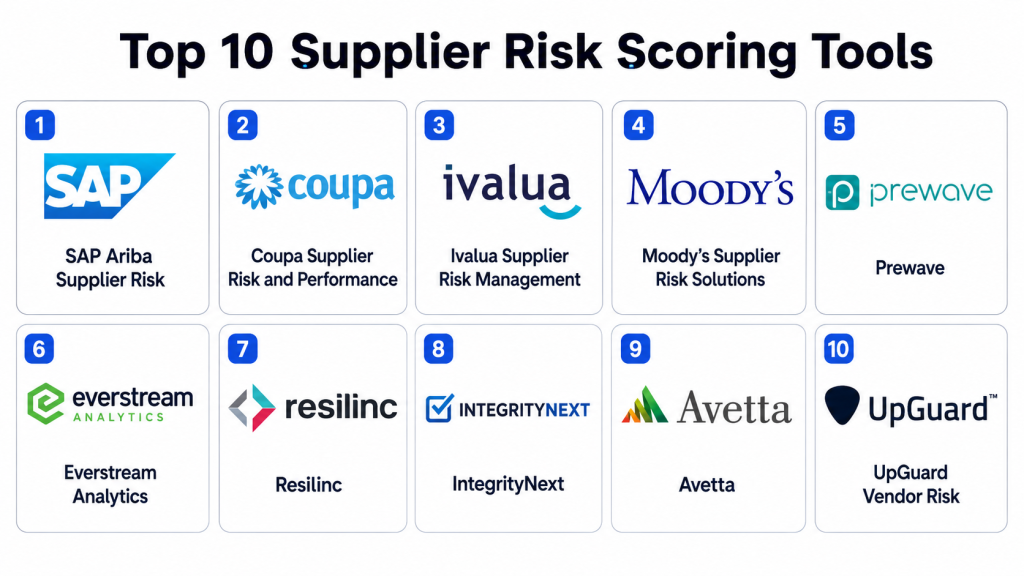
Top 10 Supplier Risk Scoring Tools
1- SAP Ariba Supplier Risk
Short description: SAP Ariba Supplier Risk helps organizations identify, assess, monitor, and manage supplier risk inside procurement and supplier lifecycle workflows. It is especially useful for enterprises that already use SAP procurement, sourcing, contracting, or supplier management systems.
Key Features
- Supplier risk assessment and monitoring
- Supplier risk alerts and intelligence
- Risk due diligence workflows
- Supplier onboarding risk visibility
- Compliance and operational risk tracking
- Remediation and disposition workflows
- Integration with procurement and supplier management processes
Pros
- Strong fit for enterprises using SAP procurement systems
- Helps connect supplier risk with sourcing and onboarding decisions
- Useful for structured risk monitoring and supplier governance
Cons
- Best value is usually achieved inside the SAP ecosystem
- Implementation may require configuration and process alignment
- Smaller teams may find it more complex than needed
Platforms / Deployment
Web / Cloud
Security & Compliance
SAP enterprise solutions commonly support access controls, authentication integration, user permissions, auditability, and governance features depending on deployment and configuration. Specific controls such as SSO, MFA, encryption, audit logs, and certifications should be verified directly with the vendor. Not publicly stated for every configuration.
Integrations & Ecosystem
SAP Ariba Supplier Risk works well when connected with SAP procurement, supplier lifecycle management, sourcing, contracts, spend management, and ERP workflows. It helps organizations bring supplier risk context into sourcing and procurement decisions.
Common integration areas include:
- SAP procurement systems
- Supplier lifecycle management
- Contract management workflows
- ERP and finance systems
- Spend analytics platforms
- Risk and compliance workflows
Support & Community
SAP provides enterprise support, product documentation, implementation partners, training resources, and a large global ecosystem. Support depth depends on product package, customer agreement, region, and implementation scope.
2- Coupa Supplier Risk and Performance
Short description: Coupa Supplier Risk and Performance helps organizations evaluate supplier risk, monitor supplier health, manage third-party risk workflows, and connect risk signals with spend management decisions. It is useful for procurement teams that want supplier risk visibility inside a broader business spend platform.
Key Features
- Supplier risk assessment workflows
- Supplier health monitoring
- Third-party risk detection
- Supplier performance tracking
- Risk alerts and dashboards
- Workflow approvals and review processes
- Integration with procurement and spend management
Pros
- Strong fit for companies using Coupa spend management
- Connects supplier risk with procurement and supplier performance
- Helps reduce manual supplier review and follow-up work
Cons
- Best suited for organizations aligned with Coupa workflows
- Advanced setup may require implementation support
- Some risk coverage details should be validated by use case
Platforms / Deployment
Web / Cloud
Security & Compliance
Coupa enterprise environments commonly include administrative permissions, access controls, governance workflows, and security features. Specific details such as SSO, MFA, encryption, audit logs, and certifications should be verified directly with the vendor. Not publicly stated for every configuration.
Integrations & Ecosystem
Coupa Supplier Risk and Performance integrates with Coupa procurement, supplier management, contracts, sourcing, and spend analytics workflows. It is useful when procurement teams want risk scoring to influence supplier decisions directly.
Common integration areas include:
- Coupa procurement
- Supplier information management
- Contract lifecycle management
- ERP and finance systems
- Spend analytics
- Third-party risk data sources
Support & Community
Coupa offers enterprise support, documentation, training, onboarding assistance, implementation partners, and a procurement-focused user ecosystem. Support levels vary by customer package and agreement.
3- Ivalua Supplier Risk Management
Short description: Ivalua Supplier Risk Management helps procurement teams assess, monitor, and mitigate supplier risk using qualitative and quantitative risk metrics. It is suitable for organizations that want supplier risk scoring embedded across source-to-pay and supplier lifecycle workflows.
Key Features
- Supplier risk scoring and monitoring
- Qualitative and quantitative risk metrics
- Supplier information management
- Supplier performance and compliance tracking
- Risk dashboards and alerts
- Configurable assessment workflows
- Source-to-pay process integration
Pros
- Strong fit for procurement transformation programs
- Flexible supplier risk workflow configuration
- Useful for combining supplier risk, performance, and compliance data
Cons
- May require careful configuration for complex risk models
- Best suited for organizations with mature procurement processes
- Implementation effort can vary based on scope
Platforms / Deployment
Web / Cloud
Security & Compliance
Ivalua supports enterprise procurement environments where access control, user permissions, auditability, and governance are important. Specific certifications, encryption, SSO, MFA, audit logs, and compliance coverage should be verified directly with the vendor. Not publicly stated for every deployment.
Integrations & Ecosystem
Ivalua connects supplier risk scoring with sourcing, contracts, procurement, supplier information management, spend analytics, and compliance workflows. It is useful for companies that want one supplier view across risk and procurement performance.
Common integration areas include:
- ERP systems
- Procurement workflows
- Supplier information management
- Contract management
- Spend analytics
- Compliance and risk intelligence sources
Support & Community
Ivalua provides enterprise support, documentation, training, implementation services, and partner support. Support quality depends on region, agreement, deployment scope, and internal implementation readiness.
4- Moody’s Supplier Risk Solutions
Short description: Moody’s Supplier Risk Solutions help organizations evaluate supplier risk through financial risk intelligence, disruption insights, supplier scoring, and risk prioritization. It is useful for companies that need strong external data to understand supplier stability and resilience.
Key Features
- Supplier risk scorecards
- Financial health and distress indicators
- Supplier disruption risk intelligence
- Risk prioritization and segmentation
- Supplier resilience analysis
- Data-driven mitigation support
- Analytics for procurement and risk teams
Pros
- Strong financial and risk intelligence orientation
- Useful for identifying supplier instability and disruption exposure
- Good fit for companies that need external supplier risk signals
Cons
- May need integration with procurement workflow systems
- Best value depends on supplier data coverage
- Product packaging and workflow depth may vary by solution
Platforms / Deployment
Web / Cloud / Varies by solution
Security & Compliance
Moody’s enterprise solutions are used in risk-sensitive environments. Specific controls such as SSO, MFA, encryption, audit logs, role-based access, and certifications should be verified directly with the vendor. Not publicly stated for every configuration.
Integrations & Ecosystem
Moody’s Supplier Risk Solutions can enrich internal supplier records with external risk intelligence. They are useful when procurement and risk teams need supplier financial health, disruption indicators, and risk scoring for decision support.
Common integration areas include:
- Supplier master data
- Procurement systems
- Data warehouses
- Risk dashboards
- Compliance workflows
- Third-party risk management platforms
Support & Community
Moody’s provides enterprise support, documentation, advisory services, data expertise, and implementation guidance. Support depth depends on product package, customer agreement, and use case complexity.
5- Prewave
Short description: Prewave is a supply chain risk intelligence platform that helps organizations monitor supplier risk using external signals, AI-driven insights, and supply chain visibility. It is useful for companies that need early warning alerts across global supplier networks.
Key Features
- AI-driven supplier risk monitoring
- Supply chain disruption alerts
- Multi-tier supplier visibility
- ESG and sustainability risk tracking
- External risk signal detection
- Risk intelligence dashboards
- Supplier network monitoring
Pros
- Strong focus on early warning supplier risk signals
- Useful for global supply chains and complex supplier networks
- Helps procurement and supply chain teams monitor external disruptions
Cons
- May need integration with procurement execution systems
- External signal relevance should be tested by industry and region
- Workflow depth may depend on configuration and use case
Platforms / Deployment
Web / Cloud
Security & Compliance
Security details should be verified directly with the vendor, including SSO, MFA, encryption, access controls, audit logs, and data protection practices. Not publicly stated for every configuration.
Integrations & Ecosystem
Prewave is useful when connected with supplier master data, procurement workflows, ESG programs, and supply chain risk processes. It enriches internal supplier records with external risk intelligence and event monitoring.
Common integration areas include:
- Supplier master data
- Procurement platforms
- ESG and sustainability workflows
- ERP systems
- Risk dashboards
- Supply chain mapping tools
Support & Community
Prewave provides customer support, onboarding, documentation, and implementation assistance for supply chain risk programs. Support depth varies by customer agreement, modules, and implementation scope.
6- Everstream Analytics
Short description: Everstream Analytics helps companies monitor supplier, logistics, and supply chain risk through predictive analytics, risk intelligence, and disruption alerts. It is suitable for organizations that need risk scoring connected to supply chain resilience and operational continuity.
Key Features
- Supplier risk monitoring
- Predictive supply chain risk analytics
- Disruption alerts and event intelligence
- Risk dashboards and reporting
- Multi-tier supply chain visibility
- Operational resilience support
- Risk-optimized procurement and planning insights
Pros
- Strong fit for complex global supply chains
- Useful for supplier disruption monitoring and predictive alerts
- Helps connect supplier risk with logistics and operations risk
Cons
- May be more supply chain focused than procurement workflow focused
- Implementation depends on supplier network complexity
- Buyers should validate signal quality for their category and region
Platforms / Deployment
Web / Cloud
Security & Compliance
Everstream serves enterprise supply chain environments where access control, data protection, and governance are important. Specific details such as SSO, MFA, encryption, audit logs, role-based access, and certifications should be verified directly with the vendor. Not publicly stated for every configuration.
Integrations & Ecosystem
Everstream Analytics connects supplier risk intelligence with procurement, planning, logistics, ERP, and business continuity workflows. It is useful for teams that want supplier risk scoring linked with operational disruption signals.
Common integration areas include:
- ERP systems
- Supply chain planning tools
- Logistics platforms
- Supplier data platforms
- Risk dashboards
- Business continuity workflows
Support & Community
Everstream provides enterprise support, onboarding, implementation guidance, documentation, and supply chain risk expertise. Support levels vary by contract, implementation size, and use case complexity.
7- Resilinc
Short description: Resilinc is a supply chain risk management platform focused on supplier mapping, disruption monitoring, supplier assessments, and resilience planning. It is useful for organizations that need visibility into direct and indirect supplier dependencies.
Key Features
- Supplier risk monitoring
- Multi-tier supplier mapping
- Event alerts and disruption tracking
- Supplier assessment workflows
- Business continuity support
- Supplier segmentation and scoring
- Supply chain resilience dashboards
Pros
- Strong fit for supply chain resilience programs
- Useful for mapping supplier dependencies and critical nodes
- Helps organizations respond faster to disruption events
Cons
- May require supplier participation and structured data collection
- Best suited for organizations with complex supplier networks
- Procurement workflow depth may depend on integrations
Platforms / Deployment
Web / Cloud
Security & Compliance
Security and compliance details should be verified directly with the vendor, including SSO, MFA, encryption, access controls, audit logs, and data protection controls. Not publicly stated for every deployment.
Integrations & Ecosystem
Resilinc works well when supplier mapping and disruption monitoring are connected with procurement, business continuity, and supply chain operations. It can help organizations identify hidden supplier dependencies and resilience gaps.
Common integration areas include:
- Supplier master data
- ERP systems
- Procurement platforms
- Business continuity tools
- Supply chain planning systems
- Risk management workflows
Support & Community
Resilinc provides customer support, onboarding, supplier network guidance, documentation, and resilience program assistance. Support scope varies by package, implementation size, and supplier network complexity.
8- IntegrityNext
Short description: IntegrityNext helps organizations assess supplier sustainability, ESG risk, compliance, and responsible sourcing practices. It is suitable for companies that need supplier risk scoring focused on environmental, social, governance, and regulatory expectations.
Key Features
- ESG supplier assessments
- Sustainability risk scoring
- Compliance screening
- Supplier questionnaire automation
- Responsible sourcing workflows
- Supplier monitoring dashboards
- Supplier evidence collection
Pros
- Strong fit for ESG and responsible sourcing programs
- Useful for supplier sustainability and compliance assessments
- Helps procurement teams collect structured supplier evidence
Cons
- May not replace broader supply disruption risk tools
- Financial and cyber risk depth should be validated
- Best suited when ESG and compliance are primary risk priorities
Platforms / Deployment
Web / Cloud
Security & Compliance
IntegrityNext supports supplier compliance and ESG workflows, but specific technical security controls such as SSO, MFA, encryption, audit logs, role-based access, and certifications should be verified directly with the vendor. Not publicly stated for every configuration.
Integrations & Ecosystem
IntegrityNext connects supplier ESG and compliance assessments with procurement and supplier management workflows. It is useful when sustainability data must be included in supplier qualification, approval, and monitoring processes.
Common integration areas include:
- Procurement systems
- Supplier information management
- ESG reporting workflows
- Compliance assessments
- ERP systems
- Supplier questionnaires
Support & Community
IntegrityNext provides customer support, onboarding, documentation, and sustainability-focused supplier risk guidance. Support depth depends on contract, region, implementation scope, and customer requirements.
9- Avetta
Short description: Avetta helps organizations manage supplier, contractor, safety, workforce, compliance, and operational risk. It is especially useful for industries where suppliers and contractors operate in safety-sensitive or heavily regulated environments.
Key Features
- Supplier and contractor risk management
- Prequalification and compliance workflows
- Safety and sustainability risk tracking
- Supplier document management
- Workforce and contractor compliance support
- Financial and operational risk visibility
- Risk dashboards and reporting
Pros
- Strong fit for contractor-heavy industries
- Useful for prequalification, safety, and compliance workflows
- Helps standardize supplier and contractor risk management
Cons
- May be more contractor-focused than traditional procurement-focused
- Best suited for operational and safety-sensitive industries
- Supplier participation and documentation may require effort
Platforms / Deployment
Web / Cloud
Security & Compliance
Avetta is used in supplier and contractor environments where governance, documentation, access control, and auditability matter. Specific details such as SSO, MFA, encryption, audit logs, role-based access, and certifications should be verified directly with the vendor. Not publicly stated for every configuration.
Integrations & Ecosystem
Avetta connects supplier risk, contractor qualification, safety documentation, workforce compliance, and operational risk information. It is valuable for organizations where supplier risk includes people, worksites, safety rules, and regulatory documentation.
Common integration areas include:
- Contractor management systems
- Procurement workflows
- Safety and compliance platforms
- ERP systems
- Supplier document repositories
- Workforce compliance systems
Support & Community
Avetta provides onboarding, support, documentation, supplier network assistance, and industry-focused guidance. Support levels vary by customer agreement, industry requirements, and implementation size.
10- UpGuard Vendor Risk
Short description: UpGuard Vendor Risk helps organizations assess and monitor third-party cybersecurity risk through vendor questionnaires, risk ratings, evidence collection, and continuous monitoring. It is useful for companies that need supplier risk scoring focused on technology, data, and cybersecurity exposure.
Key Features
- Vendor cyber risk scoring
- Security questionnaires and assessments
- Continuous third-party monitoring
- Evidence collection workflows
- Risk remediation tracking
- External attack surface visibility
- Vendor risk dashboards and reporting
Pros
- Strong fit for cybersecurity supplier risk scoring
- Useful for SaaS, IT, and data-processing vendor reviews
- Helps security, procurement, and compliance teams collaborate
Cons
- Less focused on physical supply chain disruption
- ESG and financial risk depth may require separate tools
- Best suited when cyber risk is a primary supplier concern
Platforms / Deployment
Web / Cloud
Security & Compliance
UpGuard is designed for cybersecurity and vendor risk use cases. Buyers should verify specific controls such as SSO, MFA, encryption, audit logs, role-based access, and compliance documentation directly with the vendor. Not publicly stated for every configuration.
Integrations & Ecosystem
UpGuard Vendor Risk fits into third-party risk, security, compliance, procurement, and GRC workflows. It helps convert supplier cybersecurity findings and questionnaire responses into action plans and risk decisions.
Common integration areas include:
- GRC systems
- Procurement workflows
- Vendor management platforms
- Security operations tools
- Ticketing systems
- Compliance reporting workflows
Support & Community
UpGuard provides customer support, documentation, onboarding resources, and cybersecurity-focused vendor risk guidance. Support depth varies by plan, customer agreement, and implementation scope.
Comparison Table
| Tool Name | Best For | Platform Supported | Deployment | Standout Feature | Public Rating |
|---|---|---|---|---|---|
| SAP Ariba Supplier Risk | Enterprises using SAP procurement | Web | Cloud | Supplier risk inside procurement workflows | N/A |
| Coupa Supplier Risk and Performance | Spend management and supplier health monitoring | Web | Cloud | Supplier risk connected with spend decisions | N/A |
| Ivalua Supplier Risk Management | Source-to-pay supplier risk workflows | Web | Cloud | Qualitative and quantitative supplier risk metrics | N/A |
| Moody’s Supplier Risk Solutions | Financial and disruption risk intelligence | Web | Cloud / Varies | Supplier risk scorecards and financial insight | N/A |
| Prewave | AI-driven supply chain risk alerts | Web | Cloud | External supplier risk signal monitoring | N/A |
| Everstream Analytics | Global supply chain disruption monitoring | Web | Cloud | Predictive supply chain risk analytics | N/A |
| Resilinc | Supplier mapping and resilience planning | Web | Cloud | Multi-tier supplier visibility | N/A |
| IntegrityNext | ESG and sustainability supplier risk | Web | Cloud | Supplier ESG assessment workflows | N/A |
| Avetta | Contractor and operational supplier risk | Web | Cloud | Contractor prequalification and safety risk | N/A |
| UpGuard Vendor Risk | Cybersecurity-focused supplier risk | Web | Cloud | Vendor cyber risk scoring | N/A |
Evaluation & Scoring of Supplier Risk Scoring Tools
The scoring below is comparative and buyer-oriented. It should be used for shortlisting, not as a final purchasing decision. A tool with a lower weighted total may still be the best fit if it matches your supplier base, risk priorities, industry requirements, and technology stack.
| Tool Name | Core 25% | Ease 15% | Integrations 15% | Security 10% | Performance 10% | Support 10% | Value 15% | Weighted Total |
| SAP Ariba Supplier Risk | 9 | 7 | 9 | 8 | 8 | 8 | 7 | 8.05 |
| Coupa Supplier Risk and Performance | 9 | 8 | 8 | 8 | 8 | 8 | 7 | 8.05 |
| Ivalua Supplier Risk Management | 8 | 8 | 8 | 8 | 8 | 8 | 8 | 8.00 |
| Moody’s Supplier Risk Solutions | 8 | 7 | 8 | 8 | 8 | 8 | 7 | 7.75 |
| Prewave | 8 | 8 | 7 | 7 | 8 | 7 | 8 | 7.65 |
| Everstream Analytics | 8 | 7 | 8 | 7 | 8 | 8 | 7 | 7.60 |
| Resilinc | 8 | 7 | 7 | 7 | 8 | 8 | 7 | 7.45 |
| IntegrityNext | 7 | 8 | 7 | 7 | 7 | 7 | 8 | 7.35 |
| Avetta | 7 | 7 | 7 | 7 | 8 | 8 | 7 | 7.35 |
| UpGuard Vendor Risk | 7 | 8 | 8 | 8 | 8 | 8 | 8 | 7.85 |
How to interpret the scores:
- Core score reflects supplier risk scoring depth, assessment quality, monitoring, workflow coverage, and multi-risk visibility.
- Ease score reflects usability, supplier onboarding, questionnaire simplicity, and adoption by procurement and risk teams.
- Integration score reflects fit with procurement, ERP, GRC, security, contract, and supplier information systems.
- Security score reflects visible governance signals and expected controls, not unverified certifications.
- Performance score reflects suitability for large supplier networks, continuous monitoring, and multi-region risk programs.
- Value score reflects practical fit relative to capability, complexity, implementation effort, and expected business impact.
Which Supplier Risk Scoring Tool Is Right for You?
Solo / Freelancer
Solo procurement consultants, independent risk advisors, and vendor management specialists usually need flexible templates, supplier questionnaires, risk scoring frameworks, and clean reporting. They may not need a full enterprise platform unless they are working inside a client environment.
For consulting projects, SAP Ariba, Coupa, Ivalua, Moody’s, Prewave, or UpGuard may appear depending on the client’s risk maturity. A solo advisor should focus on tools that support clear scoring logic, exportable reports, and repeatable review processes.
SMB
Small and mid-sized companies should prioritize ease of use, fast onboarding, practical dashboards, and simple supplier assessment workflows. UpGuard can be useful when cyber supplier risk is the main issue. IntegrityNext can be useful when ESG and compliance are priorities. Prewave may help companies that need external disruption signals.
SMBs should avoid buying a platform that is too complex for their supplier base. The best choice is usually the tool that solves the highest-priority supplier risk problem without creating heavy administrative work.
Mid-Market
Mid-market companies often need stronger workflow control, more supplier visibility, and better integration than small businesses. Coupa, Ivalua, Prewave, Everstream Analytics, Resilinc, and UpGuard can be strong options depending on whether the priority is procurement risk, disruption monitoring, resilience, or cybersecurity.
Mid-market buyers should evaluate automation, supplier coverage, questionnaire management, alert quality, and integration with procurement or ERP systems. A good platform should help teams move from reactive supplier review to ongoing supplier monitoring.
Enterprise
Large enterprises need supplier risk scoring across regions, categories, business units, and supplier tiers. SAP Ariba Supplier Risk, Coupa Supplier Risk and Performance, Ivalua, Moody’s Supplier Risk Solutions, Everstream Analytics, Resilinc, and Avetta can be strong enterprise candidates depending on the risk model.
Enterprise buyers should prioritize auditability, workflow governance, access controls, supplier network scale, risk data depth, remediation tracking, and executive reporting. The best platform is usually the one that fits the enterprise procurement and risk operating model.
Budget vs Premium
Budget-conscious teams should first define their primary supplier risk problem. If the main concern is cybersecurity, a cyber-focused vendor risk tool may be more efficient than a broad procurement suite. If the main concern is ESG, a sustainability-focused platform may deliver better value.
Premium platforms are more useful when organizations need multi-region supplier governance, procurement workflow integration, continuous monitoring, advanced scoring logic, supplier segmentation, remediation workflows, and audit-ready reporting.
Feature Depth vs Ease of Use
SAP Ariba, Coupa, and Ivalua provide strong procurement workflow depth. Moody’s adds strong risk intelligence and supplier scorecard value. Prewave, Everstream, and Resilinc are strong for supply chain disruption visibility and resilience planning.
IntegrityNext is well suited for ESG and responsible sourcing programs. Avetta is strong for contractor and operational risk. UpGuard is highly focused on cybersecurity supplier risk. Buyers should select depth based on the risk problem, not just the number of features.
Integrations & Scalability
Supplier risk scoring becomes more valuable when it connects with procurement systems, ERP platforms, GRC tools, cybersecurity systems, contract repositories, supplier master data, and reporting dashboards. Without integration, teams may still rely on manual data movement.
Large companies should evaluate APIs, user permissions, data synchronization, supplier matching, workflow automation, and reporting exports. Smaller teams should focus on clean setup, simple supplier communication, and clear dashboards.
Security & Compliance Needs
Supplier risk scoring platforms often process sensitive supplier information, contracts, security questionnaires, compliance documents, financial details, and internal risk decisions. Buyers should review SSO, MFA, encryption, audit logs, role-based access, data residency, and evidence management.
Security and compliance teams should be involved early, especially when the platform will assess technology suppliers, collect confidential documents, or integrate with procurement and GRC systems.
Frequently Asked Questions
1- What is a Supplier Risk Scoring Tool?
A Supplier Risk Scoring Tool helps organizations evaluate suppliers based on risk factors such as financial health, cybersecurity, compliance, ESG performance, operational stability, and disruption exposure. It assigns scores or risk levels so teams can prioritize supplier reviews and mitigation actions.
2- Why is supplier risk scoring important?
Supplier risk scoring is important because suppliers can directly affect product delivery, customer experience, compliance, security, cost, and reputation. A structured scoring process helps companies identify risky suppliers before problems become serious.
3- Who uses Supplier Risk Scoring Tools?
These tools are used by procurement teams, supply chain teams, vendor management offices, compliance teams, risk managers, cybersecurity teams, ESG teams, legal teams, and finance teams. They are especially useful for organizations with large supplier networks.
4- What types of supplier risks can these tools score?
Supplier Risk Scoring Tools can score financial risk, cyber risk, compliance risk, ESG risk, operational risk, safety risk, geopolitical risk, reputational risk, and supply disruption risk. Exact coverage depends on the vendor and available data sources.
5- How much do Supplier Risk Scoring Tools cost?
Pricing varies based on number of suppliers, users, modules, data sources, integrations, support level, and implementation scope. Many enterprise platforms use custom pricing. Buyers should compare software fees, onboarding costs, supplier participation costs, and renewal terms.
6- Can small businesses use Supplier Risk Scoring Tools?
Yes, small businesses can use these tools when supplier reliability, compliance, cybersecurity, or ESG risk matters. However, very small teams with only a few low-risk suppliers may start with simpler assessment templates or lightweight procurement tools.
7- What is the difference between supplier risk scoring and vendor risk management?
Supplier risk scoring focuses on evaluating and ranking suppliers based on defined risk criteria. Vendor risk management is broader and may include onboarding, contracts, compliance reviews, cybersecurity assessments, performance monitoring, remediation, and governance.
8- Do these tools replace supplier audits?
No, these tools usually support supplier audits rather than fully replace them. Risk scores help teams identify which suppliers need deeper review, site visits, documentation checks, corrective action plans, or executive attention.
9- What are common mistakes when choosing a supplier risk tool?
Common mistakes include choosing based only on dashboards, ignoring data quality, failing to define scoring criteria, and not involving procurement, compliance, security, and supply chain teams. Another mistake is buying a platform without testing integrations.
10- Do Supplier Risk Scoring Tools support ESG risk?
Many supplier risk platforms support ESG and sustainability assessments, but depth varies by vendor. Buyers should verify coverage for environmental practices, labor standards, governance, supplier questionnaires, evidence collection, and ESG reporting.
Conclusion
Supplier Risk Scoring Tools help organizations move from manual supplier review to structured, data-driven, and proactive supplier governance. The right platform depends on supplier network size, risk priorities, procurement maturity, industry requirements, and integration needs. SAP Ariba, Coupa, and Ivalua are strong choices for procurement-led supplier risk workflows, while Moody’s, Prewave, Everstream, and Resilinc are useful for risk intelligence and supply chain disruption monitoring. IntegrityNext is strong for ESG supplier risk, Avetta is practical for contractor and operational risk, and UpGuard is focused on cybersecurity supplier risk scoring. Buyers should shortlist two or three platforms, test them with real supplier data, validate scoring logic, review security controls, and confirm that the tool supports both day-to-day procurement decisions and long-term supplier resilience.
