Introduction
Contract Repository Tools help organizations store, organize, search, manage, and track contracts in one secure digital location. In simple words, these tools replace scattered folders, email attachments, shared drives, and manual spreadsheets with a centralized contract library. Teams can quickly find agreements, review key terms, monitor renewal dates, control access, and maintain a clear record of contract documents.
Contract Repository Tools matter because contracts contain important business obligations, pricing terms, supplier commitments, customer agreements, renewal clauses, compliance requirements, risk details, and approval histories. When contracts are difficult to find or poorly organized, companies may miss renewal deadlines, lose negotiation leverage, expose sensitive information, duplicate work, or fail audits. A strong contract repository improves visibility, reduces legal and procurement risk, supports better decision-making, and helps teams manage obligations more confidently.
Real-world use cases include:
- Centralized contract storage for legal, procurement, sales, finance, HR, and operations teams.
- Renewal and expiration tracking to avoid missed deadlines and unwanted auto-renewals.
- Contract search and retrieval for faster access to clauses, parties, dates, and obligations.
- Access control to protect sensitive customer, supplier, employee, and commercial agreements.
- Audit readiness by keeping documents, versions, approvals, and activity history organized.
- Supplier and customer contract management for better visibility into business relationships.
- Compliance support for policy reviews, obligation tracking, and contract governance.
Evaluation Criteria for Buyers:
- Centralized contract storage with structured folders, metadata, and document organization.
- Search capability across contract titles, parties, clauses, dates, tags, and uploaded files.
- Metadata extraction for renewal dates, contract value, owners, vendors, customers, and terms.
- Renewal alerts and reminders to prevent missed deadlines and auto-renewal risks.
- Access controls such as role-based permissions, user groups, and document-level restrictions.
- Version management for tracking contract updates, amendments, and document history.
- Workflow support for approvals, reviews, intake, and contract handoffs.
- Integration support with CRM, procurement, ERP, e-signature, storage, and productivity tools.
- Security and compliance controls including audit logs, encryption, SSO, and permission governance.
- Ease of adoption for legal, procurement, sales, finance, and business users.
Best for: Contract Repository Tools are best for legal teams, procurement departments, sales operations, finance teams, contract managers, vendor management teams, compliance officers, HR teams, and organizations that need a reliable place to store, search, and govern contract documents.
Not ideal for: Very small businesses with only a few simple agreements may not need a dedicated contract repository. If the company has limited contract volume and no complex renewal, approval, or compliance needs, basic cloud storage or document management may be enough until contract volume increases.
Key Trends in Contract Repository Tools
- AI-powered contract search is becoming more useful as teams want to find clauses, dates, obligations, and parties without manually reading every document.
- Automated metadata extraction is improving repository quality by reducing manual data entry for renewal dates, contract values, notice periods, and party names.
- Contract repositories are becoming part of broader CLM systems as organizations connect storage with drafting, approval, negotiation, e-signature, and obligation tracking.
- Renewal management is becoming a major priority because companies want to prevent unwanted renewals, missed cancellations, and lost negotiation windows.
- Access control and permission governance are becoming stronger buying criteria because contracts often contain sensitive commercial, legal, employee, and supplier data.
- Integration with e-signature tools is becoming expected so executed agreements can automatically return to the repository after signing.
- Procurement and vendor teams are using repositories more actively to track supplier terms, insurance documents, service commitments, and compliance obligations.
- Sales teams are connecting contract repositories with CRM systems to improve visibility into customer agreements, renewals, amendments, and pricing terms.
- Audit trails and version history are becoming essential for legal defensibility, internal controls, compliance reviews, and contract governance.
- Self-service contract access is growing as business teams need controlled access to approved contracts without depending on legal teams for every request.
How We Selected These Tools
The tools in this list were selected based on their relevance to contract repository management, contract search, document organization, metadata tracking, renewal alerts, access control, integrations, and fit across legal, procurement, sales, and finance teams.
Evaluation logic included:
- Repository strength for storing, organizing, tagging, searching, and retrieving contracts.
- Market recognition and adoption among legal operations, procurement, sales, and enterprise teams.
- Search and metadata capability for finding clauses, parties, dates, values, and obligations.
- Renewal and deadline tracking to help teams manage expirations, notice periods, and auto-renewals.
- Security and access control for protecting confidential contracts and sensitive business terms.
- Workflow and lifecycle support for teams that want repository features connected with CLM processes.
- Integration ecosystem with e-signature, CRM, procurement, ERP, storage, and productivity tools.
- Ease of use for legal users, business teams, procurement teams, sales teams, and administrators.
- Scalability for SMB, mid-market, and enterprise contract operations.
- Support and onboarding quality for setup, migration, training, and long-term adoption.
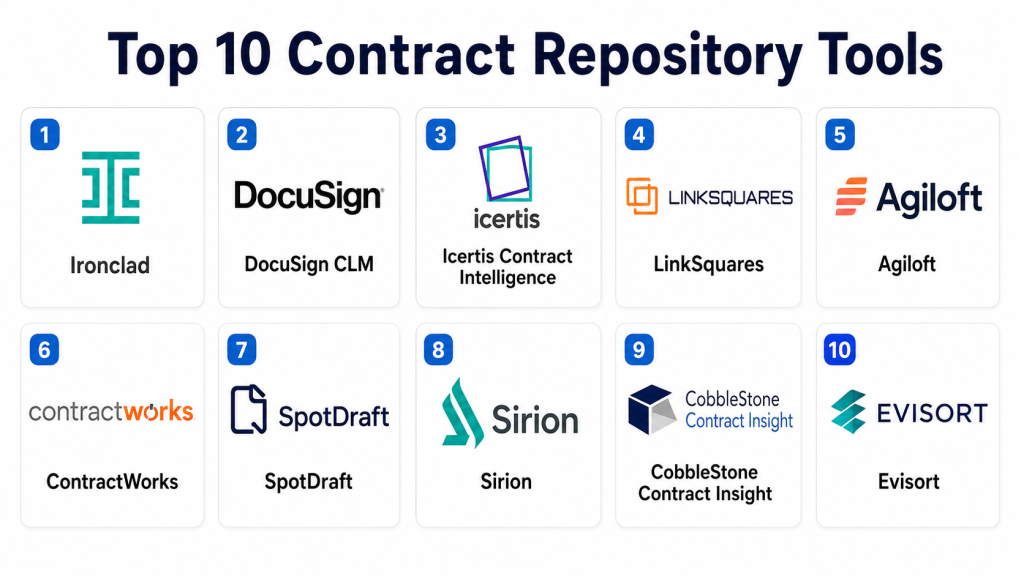
Top 10 Contract Repository Tools
1- Ironclad
Short description: Ironclad is a contract lifecycle management platform with strong contract repository, workflow, search, and collaboration capabilities. It is well suited for legal teams, sales teams, procurement teams, and enterprises that want contract storage connected with drafting, approvals, negotiation, and post-signature management.
Key Features
- Centralized contract repository with searchable contract records.
- Contract workflow automation for requests, reviews, and approvals.
- AI-assisted search and contract data visibility.
- Renewal and obligation tracking support.
- Integration with CRM, e-signature, storage, and business tools.
- Version history and contract activity tracking.
- Collaboration features for legal and business teams.
Pros
- Strong fit for legal operations teams managing high contract volume.
- Combines repository features with broader CLM workflows.
- Useful for sales, procurement, and legal collaboration.
Cons
- May be broader than needed for teams that only need storage.
- Implementation requires process planning and contract migration.
- Smaller businesses may find the platform more advanced than required.
Platforms / Deployment
Web / Cloud
Security & Compliance
Ironclad commonly supports enterprise access controls, permissions, audit trails, authentication options, and administrative security settings. Specific certifications and compliance requirements should be confirmed during vendor evaluation.
Integrations & Ecosystem
Ironclad connects contract workflows with sales, legal, procurement, and productivity systems. It is often used where contracts move across many teams before and after signature.
Common integration areas include:
- CRM systems.
- E-signature platforms.
- Cloud storage tools.
- Productivity suites.
- Workflow and collaboration tools.
- Business intelligence tools.
Support & Community
Ironclad provides documentation, onboarding resources, customer support, implementation guidance, and legal operations education. Its community is strong among legal operations, sales operations, procurement, and contract management professionals.
2- DocuSign CLM
Short description: DocuSign CLM helps organizations manage contract generation, review, approval, storage, and post-signature visibility. It is especially useful for companies that already use DocuSign for electronic signatures and want executed contracts connected with a structured repository.
Key Features
- Centralized contract storage and contract record management.
- Contract workflow automation for review and approval.
- E-signature ecosystem connection.
- Search and filtering across contract records.
- Template and clause management support.
- Renewal and milestone tracking.
- Integration with CRM and enterprise systems.
Pros
- Strong connection with DocuSign e-signature workflows.
- Useful for organizations that want contract execution and storage connected.
- Good fit for sales, legal, procurement, and operations teams.
Cons
- Repository value depends on proper metadata setup and process design.
- Advanced CLM configuration may require implementation support.
- May be more than needed for teams wanting only a simple archive.
Platforms / Deployment
Web / Cloud
Security & Compliance
DocuSign enterprise products commonly support access controls, authentication options, audit trails, encryption, and administrative governance. Specific certifications and compliance coverage should be verified during procurement.
Integrations & Ecosystem
DocuSign CLM integrates with e-signature, CRM, sales, legal, and productivity systems. It is useful for companies that want signed agreements automatically stored and tracked.
Common integration areas include:
- E-signature workflows.
- CRM systems.
- Document storage platforms.
- Productivity suites.
- ERP and finance systems.
- Workflow tools.
Support & Community
DocuSign provides documentation, training resources, support plans, onboarding services, and partner support. Its community is strong among sales, legal, procurement, and operations teams using electronic agreements.
3- Icertis Contract Intelligence
Short description: Icertis Contract Intelligence is an enterprise contract management platform designed for large organizations that need contract repository, obligation management, analytics, governance, and lifecycle control. It is best suited for enterprises with complex commercial, supplier, and regulatory contract needs.
Key Features
- Enterprise contract repository and contract data model.
- AI-assisted contract intelligence and analytics.
- Obligation, compliance, and risk tracking support.
- Contract workflow and lifecycle management.
- Search and metadata management across contract portfolios.
- Integration with ERP, CRM, procurement, and enterprise systems.
- Dashboards for legal, procurement, finance, and executive users.
Pros
- Strong fit for large enterprises with complex contract portfolios.
- Deep contract intelligence and governance capabilities.
- Useful for global teams needing contract visibility and control.
Cons
- Implementation can be more complex than lightweight repository tools.
- May require strong internal ownership and data migration planning.
- Smaller teams may not need the full enterprise feature set.
Platforms / Deployment
Web / Cloud
Security & Compliance
Icertis commonly supports enterprise security controls such as access permissions, audit logs, authentication options, and administrative governance. Specific certifications and regulatory requirements should be confirmed directly with the vendor.
Integrations & Ecosystem
Icertis connects contract data with enterprise business systems across legal, sales, procurement, finance, and operations.
Common integration areas include:
- ERP systems.
- CRM systems.
- Procurement platforms.
- E-signature tools.
- Finance systems.
- Business intelligence platforms.
Support & Community
Icertis provides enterprise support, implementation services, documentation, training, and customer success resources. Its community is strong among enterprise legal operations, procurement, finance, and contract transformation teams.
4- LinkSquares
Short description: LinkSquares is a contract management platform focused on contract repository, search, analytics, and legal team productivity. It is useful for legal teams that need fast contract visibility, post-signature analysis, and better access to key contract terms.
Key Features
- Centralized contract repository.
- AI-assisted search and contract analysis.
- Metadata extraction and contract data visibility.
- Renewal and deadline tracking.
- Reporting dashboards for contract insights.
- Contract workflow and review support.
- Search across agreements, clauses, parties, and terms.
Pros
- Strong repository and contract analytics capabilities.
- Useful for legal teams needing fast access to contract data.
- Helps reduce manual searching and spreadsheet tracking.
Cons
- Broader workflow needs may require configuration.
- Value depends on contract data quality and metadata accuracy.
- May be less suitable for companies needing highly complex enterprise CLM.
Platforms / Deployment
Web / Cloud
Security & Compliance
LinkSquares commonly supports enterprise access controls, permissions, auditability, and administrative security features. Specific certifications and compliance details should be confirmed during vendor evaluation.
Integrations & Ecosystem
LinkSquares connects contract repository and analytics workflows with legal, sales, business, and productivity systems.
Common integration areas include:
- E-signature platforms.
- CRM systems.
- Cloud storage tools.
- Productivity suites.
- Legal operations tools.
- Reporting systems.
Support & Community
LinkSquares provides documentation, onboarding support, customer success resources, and legal operations guidance. Its community is strong among legal teams, contract managers, and legal operations professionals.
5- Agiloft
Short description: Agiloft is a flexible contract lifecycle management platform with strong repository, workflow, approval, and contract tracking capabilities. It is suitable for organizations that need configurable contract processes across legal, procurement, sales, and operations.
Key Features
- Centralized contract repository and document management.
- Configurable workflows for contract requests, reviews, and approvals.
- Metadata tracking for dates, values, parties, and obligations.
- Renewal alerts and milestone management.
- Contract search and reporting capabilities.
- Integration with CRM, ERP, e-signature, and business tools.
- Support for no-code or low-code configuration.
Pros
- Highly configurable for different contract processes.
- Useful for teams with complex approval and tracking needs.
- Strong fit for organizations wanting flexible CLM workflows.
Cons
- Flexibility may require careful setup and administration.
- Implementation effort can vary depending on customization needs.
- Teams wanting only basic storage may not need the full platform.
Platforms / Deployment
Web / Cloud / Enterprise deployment options may vary
Security & Compliance
Agiloft commonly supports role-based permissions, audit trails, authentication options, and administrative controls. Specific certifications and compliance requirements should be confirmed directly.
Integrations & Ecosystem
Agiloft connects contract management with enterprise workflows across legal, procurement, sales, and finance.
Common integration areas include:
- CRM systems.
- ERP systems.
- E-signature platforms.
- Procurement systems.
- Productivity suites.
- Reporting and analytics tools.
Support & Community
Agiloft provides documentation, training, implementation support, customer success resources, and partner services. Its community is strong among contract managers, legal operations, procurement, and enterprise administrators.
6- ContractWorks
Short description: ContractWorks is a contract management platform focused on secure contract storage, search, reporting, alerts, and simple repository management. It is a practical choice for teams that want a straightforward contract repository without heavy lifecycle complexity.
Key Features
- Secure centralized contract repository.
- Search and tagging for contract organization.
- Renewal alerts and deadline reminders.
- Custom reporting and saved views.
- User permissions and access control.
- E-signature support through connected workflows.
- Simple contract document management.
Pros
- Easier to adopt than many large CLM platforms.
- Strong fit for teams needing repository, search, and alerts.
- Practical for legal and business teams with moderate contract volume.
Cons
- May not offer the same depth as enterprise CLM platforms.
- Advanced workflow automation may be limited compared with larger tools.
- Best suited for repository-first contract management.
Platforms / Deployment
Web / Cloud
Security & Compliance
ContractWorks commonly supports access controls, permissions, audit trails, and secure document handling. Specific certifications and compliance requirements should be confirmed with the vendor.
Integrations & Ecosystem
ContractWorks focuses on contract storage and repository workflows while connecting with related business tools where needed.
Common integration areas include:
- E-signature tools.
- Cloud storage systems.
- Productivity tools.
- Reporting workflows.
- Legal operations processes.
- Contract tracking workflows.
Support & Community
ContractWorks provides documentation, customer support, onboarding guidance, and training resources. Its community is strongest among legal teams, operations teams, and contract administrators seeking a simple repository-focused solution.
7- SpotDraft
Short description: SpotDraft is a contract lifecycle management platform that supports contract creation, review, collaboration, execution, storage, and repository management. It is especially useful for growing legal teams that want contract automation with a searchable repository.
Key Features
- Centralized contract repository and contract records.
- Contract workflow automation for review and approvals.
- Search and metadata tracking.
- Template and clause support.
- Renewal and obligation tracking.
- E-signature and business tool integrations.
- Collaboration tools for legal and business users.
Pros
- Good fit for growing legal teams and fast-moving businesses.
- Combines contract automation with repository management.
- Useful for improving contract turnaround and visibility.
Cons
- Enterprise complexity fit should be validated for very large organizations.
- Implementation may require process mapping and template setup.
- Advanced reporting needs may vary by configuration.
Platforms / Deployment
Web / Cloud
Security & Compliance
SpotDraft commonly supports access controls, permissions, audit trails, and administrative settings. Specific certifications and compliance details should be verified directly during vendor evaluation.
Integrations & Ecosystem
SpotDraft connects contract workflows with sales, legal, business operations, and collaboration systems.
Common integration areas include:
- CRM systems.
- E-signature tools.
- Productivity suites.
- Cloud storage tools.
- Communication tools.
- Workflow systems.
Support & Community
SpotDraft provides onboarding, customer support, documentation, and legal operations resources. Its community is growing among legal teams, startups, mid-market companies, and contract operations users.
8- Sirion
Short description: Sirion is a contract lifecycle and contract performance management platform designed for complex enterprise contracts, supplier agreements, customer agreements, and obligation tracking. It is useful for organizations that want repository capabilities connected with contract performance and relationship management.
Key Features
- Enterprise contract repository.
- Obligation and performance tracking.
- Contract analytics and risk visibility.
- Supplier and customer contract management.
- Workflow support for contract lifecycle processes.
- Search and metadata management.
- Integration with enterprise procurement, finance, and business systems.
Pros
- Strong fit for complex enterprise and supplier contracts.
- Useful for obligation tracking and contract performance management.
- Good option for organizations managing high-value agreements.
Cons
- May be more advanced than needed for simple repository needs.
- Implementation can require contract process and data preparation.
- Smaller teams may not need the full enterprise scope.
Platforms / Deployment
Web / Cloud
Security & Compliance
Sirion commonly supports enterprise access controls, permissions, audit logs, and administrative governance. Specific certifications and compliance coverage should be confirmed during procurement.
Integrations & Ecosystem
Sirion connects contract repository management with procurement, supplier management, finance, and enterprise operations workflows.
Common integration areas include:
- ERP systems.
- Procurement platforms.
- CRM systems.
- E-signature tools.
- Supplier management systems.
- Reporting platforms.
Support & Community
Sirion provides enterprise onboarding, documentation, implementation services, and customer support. Its community is strongest among enterprise legal, procurement, supplier management, and contract performance teams.
9- CobbleStone Contract Insight
Short description: CobbleStone Contract Insight is a contract management platform that supports repository management, workflow automation, alerts, approvals, search, reporting, and contract tracking. It is suitable for organizations that need structured contract control across departments.
Key Features
- Centralized contract repository.
- Search, tagging, and metadata management.
- Contract request, review, and approval workflows.
- Renewal alerts and milestone tracking.
- Reporting and dashboard capabilities.
- E-signature and document management support.
- User permissions and audit history.
Pros
- Strong contract repository and workflow feature set.
- Useful for legal, procurement, finance, and operations teams.
- Suitable for organizations seeking structured contract control.
Cons
- User experience and configuration should be tested during evaluation.
- Implementation can vary depending on workflow complexity.
- May require administrator training for best results.
Platforms / Deployment
Web / Cloud / Enterprise deployment options may vary
Security & Compliance
CobbleStone commonly supports access permissions, audit trails, workflow history, and administrative controls. Specific certifications and compliance details should be confirmed with the vendor.
Integrations & Ecosystem
CobbleStone Contract Insight connects contract workflows with enterprise tools used by legal, procurement, and business teams.
Common integration areas include:
- E-signature platforms.
- CRM systems.
- ERP systems.
- Document management tools.
- Productivity suites.
- Reporting systems.
Support & Community
CobbleStone provides documentation, customer support, implementation assistance, training resources, and product guidance. Its community is strongest among contract administrators, legal teams, procurement teams, and public-sector users.
10- Evisort
Short description: Evisort is a contract intelligence and lifecycle management platform that helps teams centralize contracts, search agreements, extract key terms, analyze obligations, and manage contract data. It is useful for legal, procurement, finance, and business teams that need AI-assisted contract visibility.
Key Features
- Centralized contract repository.
- AI-assisted contract search and metadata extraction.
- Clause, term, obligation, and date visibility.
- Renewal and milestone tracking support.
- Reporting and contract analytics.
- Workflow support for contract management.
- Integration with business and legal systems.
Pros
- Strong focus on contract intelligence and search.
- Useful for turning stored agreements into usable contract data.
- Good fit for teams dealing with large contract volumes.
Cons
- Value depends on contract data quality and extraction accuracy.
- Implementation may require migration planning and metadata review.
- Teams needing only simple storage may find it broader than necessary.
Platforms / Deployment
Web / Cloud
Security & Compliance
Evisort commonly supports enterprise access controls, permissions, auditability, and secure document management features. Specific certifications and compliance requirements should be confirmed during vendor evaluation.
Integrations & Ecosystem
Evisort connects contract repository and intelligence workflows with legal, procurement, sales, and enterprise systems.
Common integration areas include:
- CRM systems.
- E-signature platforms.
- Cloud storage systems.
- Procurement systems.
- Productivity suites.
- Reporting tools.
Support & Community
Evisort provides onboarding, documentation, customer support, and implementation guidance. Its community is strongest among legal operations, contract management, procurement, and enterprise contract analytics teams.
Comparison Table
| Tool Name | Best For | Platform Supported | Deployment | Standout Feature | Public Rating |
|---|---|---|---|---|---|
| Ironclad | Legal operations and workflow-heavy teams | Web | Cloud | Contract repository connected with workflow automation | N/A |
| DocuSign CLM | E-signature-centered contract operations | Web | Cloud | Strong connection with electronic agreement workflows | N/A |
| Icertis Contract Intelligence | Large enterprise contract governance | Web | Cloud | Enterprise contract intelligence and obligation visibility | N/A |
| LinkSquares | Legal teams needing contract search and analytics | Web | Cloud | AI-assisted repository search and contract insights | N/A |
| Agiloft | Configurable contract repository and CLM workflows | Web | Cloud / Enterprise | Flexible workflow and repository configuration | N/A |
| ContractWorks | Simple secure contract repository | Web | Cloud | Easy contract storage, alerts, and search | N/A |
| SpotDraft | Growing legal teams and fast-moving businesses | Web | Cloud | Contract automation with repository management | N/A |
| Sirion | Complex supplier and enterprise agreements | Web | Cloud | Obligation and contract performance tracking | N/A |
| CobbleStone Contract Insight | Structured contract control across departments | Web | Cloud / Enterprise | Repository, alerts, workflows, and reporting | N/A |
| Evisort | Contract intelligence and AI-assisted search | Web | Cloud | Contract data extraction and analytics | N/A |
Evaluation & Scoring of Contract Repository Tools
| Tool Name | Core 25% | Ease 15% | Integrations 15% | Security 10% | Performance 10% | Support 10% | Value 15% | Weighted Total |
| Ironclad | 9 | 8 | 9 | 8 | 9 | 8 | 7 | 8.25 |
| DocuSign CLM | 8 | 8 | 9 | 8 | 8 | 8 | 7 | 7.95 |
| Icertis Contract Intelligence | 9 | 7 | 9 | 9 | 9 | 8 | 7 | 8.25 |
| LinkSquares | 8 | 8 | 8 | 8 | 8 | 8 | 8 | 8.00 |
| Agiloft | 8 | 7 | 8 | 8 | 8 | 8 | 8 | 7.85 |
| ContractWorks | 7 | 9 | 7 | 8 | 8 | 8 | 9 | 8.00 |
| SpotDraft | 8 | 8 | 8 | 8 | 8 | 8 | 8 | 8.00 |
| Sirion | 9 | 7 | 8 | 8 | 9 | 8 | 7 | 8.00 |
| CobbleStone Contract Insight | 8 | 7 | 8 | 8 | 8 | 8 | 8 | 7.85 |
| Evisort | 8 | 8 | 8 | 8 | 8 | 8 | 8 | 8.00 |
The scoring is comparative and should be used as a practical starting point, not a final buying decision. Enterprise teams may value contract intelligence, integrations, obligation tracking, and security controls more than simplicity. Smaller teams may prioritize ease of setup, fast search, renewal alerts, and simple repository management. A tool with a slightly lower total score may still be the best fit if it matches your contract volume, workflow complexity, legal process, and budget. Buyers should test search quality, metadata accuracy, migration effort, permissions, and renewal tracking before making a final selection.
Which Contract Repository Tool Is Right for You?
Solo / Freelancer
Solo professionals, freelance legal consultants, and independent contract managers usually do not need a large enterprise CLM platform. A simple repository with secure storage, tags, search, and renewal reminders may be enough. ContractWorks can be a practical option for repository-first needs, while LinkSquares, Evisort, or SpotDraft may be useful when contract search and intelligence are more important.
For independent consultants managing contracts for clients, the best approach is to select tools based on client volume, document sensitivity, reporting needs, and approval complexity. If contracts are simple and low volume, structured cloud storage may be enough. If contracts are high value or renewal-sensitive, a dedicated repository becomes more useful.
SMB
SMBs should focus on simple setup, easy search, renewal alerts, permission control, and affordable scalability. ContractWorks, SpotDraft, LinkSquares, Evisort, and CobbleStone Contract Insight can be useful depending on whether the business needs basic repository control or broader contract workflow automation.
Small businesses should avoid overbuying a heavy enterprise platform before their contract process is mature. The right starting point is usually centralized storage, clear ownership, renewal reminders, contract tagging, and secure access control. Once volume grows, workflow automation and contract analytics become more important.
Mid-Market
Mid-market organizations often need stronger repository control because contracts are spread across sales, procurement, legal, HR, finance, and operations. Ironclad, LinkSquares, Agiloft, SpotDraft, ContractWorks, CobbleStone, and Evisort can all be relevant depending on workflow needs.
If the company needs repository plus workflow automation, Ironclad, Agiloft, SpotDraft, or CobbleStone may be strong choices. If the priority is contract search and analytics, LinkSquares or Evisort may be better. If the need is simple secure storage and alerts, ContractWorks may be a practical option.
Enterprise
Enterprises need scalable repositories, advanced permissions, contract intelligence, obligation tracking, integration depth, audit trails, and support for multiple teams and contract types. Icertis, Ironclad, DocuSign CLM, Sirion, Agiloft, Evisort, and LinkSquares are strong enterprise candidates.
Enterprise buyers should focus on contract migration, data model design, access governance, integration with CRM and procurement systems, e-signature flow, obligation tracking, reporting, and administrative scalability. The best tool is the one that fits existing legal, procurement, sales, and finance workflows.
Budget vs Premium
Budget-focused buyers should start with tools that solve the most urgent repository problems: finding contracts, tracking renewals, controlling access, and maintaining organized records. ContractWorks, SpotDraft, LinkSquares, CobbleStone, and Evisort may provide practical value depending on scope and size.
Premium buyers should consider Icertis, Ironclad, DocuSign CLM, Sirion, and Agiloft when contract governance is complex. These platforms are better suited for organizations that need workflow automation, contract intelligence, obligation tracking, enterprise integrations, and scalable compliance controls.
Feature Depth vs Ease of Use
Icertis, Ironclad, DocuSign CLM, Sirion, and Agiloft offer stronger feature depth for organizations that need repository management connected with the full contract lifecycle. They are useful when contracts move through request, drafting, negotiation, approval, signature, storage, and obligation management.
ContractWorks, LinkSquares, SpotDraft, Evisort, and CobbleStone can be easier to adopt depending on the use case. Buyers should choose feature depth when contract complexity is high and choose ease of use when the main need is fast search, secure storage, renewal alerts, and better visibility.
Integrations & Scalability
Contract repositories become more valuable when they connect with CRM, procurement, ERP, e-signature, document storage, finance, and productivity tools. For sales contracts, CRM integration is important. For supplier contracts, procurement and ERP integration matter. For signed agreements, e-signature integration helps keep executed contracts organized automatically.
Scalability also depends on contract volume, user roles, business units, metadata structure, and reporting needs. Large organizations should validate migration tools, API access, permission controls, audit logs, bulk upload options, and search performance before rollout.
Security & Compliance Needs
Contracts often contain confidential pricing, customer terms, supplier commitments, employee details, intellectual property, payment terms, and regulatory obligations. Buyers should review SSO, MFA, role-based access, document-level permissions, audit logs, encryption, retention settings, and administrative controls.
Highly regulated organizations should also evaluate data residency, user activity tracking, permission reviews, version history, approval evidence, and obligation reporting. A strong contract repository should make contracts easier to access for authorized users while protecting sensitive information from unnecessary exposure.
Frequently Asked Questions
1- What are Contract Repository Tools?
Contract Repository Tools are software platforms that help organizations store, organize, search, and manage contracts in one central location. They make it easier to find agreements, track renewals, control access, and maintain contract records.
2- Who should use Contract Repository Tools?
Legal teams, procurement teams, sales operations, finance departments, HR teams, compliance teams, and contract managers benefit most from these tools. Any organization with growing contract volume or renewal risk should consider a dedicated repository.
3- What is the difference between a contract repository and CLM software?
A contract repository focuses mainly on storing, searching, organizing, and tracking contracts. CLM software usually covers the full contract lifecycle, including request, drafting, review, approval, negotiation, signing, storage, and post-signature obligations.
4- What features are most important in a contract repository?
Important features include centralized storage, advanced search, metadata tracking, renewal alerts, permission control, version history, audit logs, reporting, and integrations with e-signature, CRM, procurement, and document tools.
5- How much do Contract Repository Tools cost?
Pricing varies by vendor, number of users, contract volume, storage needs, integrations, workflow features, support level, and enterprise requirements. Many vendors use custom pricing, so buyers should request quotes based on actual contract needs.
6- How long does implementation take?
Implementation depends on contract volume, migration quality, metadata needs, integrations, access rules, and user training. A simple repository can be deployed faster, while enterprise contract migration and workflow setup may require a phased rollout.
7- What are common mistakes when choosing a contract repository?
Common mistakes include ignoring migration effort, failing to define metadata fields, skipping permission planning, not setting renewal alerts, and choosing a tool without testing search quality. Buyers should test with real contracts before final selection.
8- Can Contract Repository Tools track renewals?
Yes, most contract repository tools can track renewal dates, expiration dates, notice periods, and important milestones. This helps teams avoid missed deadlines, unwanted auto-renewals, and lost negotiation opportunities.
9- Do Contract Repository Tools integrate with e-signature platforms?
Many contract repository tools integrate with e-signature platforms so signed agreements can be stored automatically after execution. Buyers should validate whether the integration supports metadata capture, document routing, and completed agreement storage.
10- Are Contract Repository Tools secure?
Most leading tools provide security features such as access controls, permissions, audit logs, authentication options, and secure document storage. Buyers should verify specific security controls, certifications, and compliance requirements during vendor evaluation.
Conclusion
Contract Repository Tools help organizations bring order, visibility, and security to their contract documents. The right platform can reduce search time, prevent missed renewals, improve access control, support audit readiness, and help legal, procurement, sales, and finance teams make better decisions from contract data. Ironclad, DocuSign CLM, Icertis, LinkSquares, Agiloft, ContractWorks, SpotDraft, Sirion, CobbleStone, and Evisort each serve different needs, from simple secure repositories to advanced enterprise contract intelligence. The best tool depends on your contract volume, workflow complexity, security needs, integrations, user roles, and budget. Start by shortlisting two or three tools, test them with real contracts, validate search and metadata quality, review permissions and security, and then scale once your teams trust the repository process.
