Introduction
CPQ for Manufacturing helps manufacturers configure complex products, calculate accurate pricing, and generate professional quotes faster. CPQ stands for configure, price, and quote. In manufacturing, this means sales teams, dealers, engineers, and distributors can select product options, validate technical rules, calculate costs, apply pricing logic, and create quotes without relying on slow manual spreadsheets or repeated engineering checks.
CPQ matters because manufacturing sales often includes configurable products, custom assemblies, dealer channels, long approval cycles, complex discounts, margin rules, engineering dependencies, and ERP data. A good CPQ platform reduces quote errors, improves sales speed, protects margins, and helps customers get accurate product options quickly. It also connects sales with engineering, production, finance, and operations so the quote is not just attractive but also buildable and profitable.
Real-world use cases include:
- Complex product configuration for machinery, equipment, parts, and assemblies
- Dealer and distributor quoting across multiple regions and price books
- Engineer-to-order and make-to-order quoting with technical validation
- Automated pricing and discount approvals for margin protection
- Bill of materials and routing support for production alignment
- Visual product configuration for customer-facing sales experiences
- ERP and CRM integration for quote-to-order accuracy
Evaluation Criteria for Buyers:
- Product configuration depth
- Pricing and discount control
- Manufacturing rule management
- BOM and ERP integration
- Visual configuration support
- Quote document automation
- Approval workflow flexibility
- Dealer and channel support
- Scalability for complex catalogs
- Ease of use for sales and engineering teams
Best for: CPQ for Manufacturing is best for industrial equipment manufacturers, machinery companies, component manufacturers, electronics manufacturers, automotive suppliers, medical device manufacturers, building product companies, distributors, and B2B manufacturers that sell configurable or custom products.
Not ideal for: CPQ for Manufacturing may not be ideal for companies with very simple product catalogs, fixed pricing, low quote volume, or no configuration complexity. In those cases, standard CRM quoting, ERP order entry, or simple proposal software may be enough.
Key Trends in CPQ for Manufacturing
- Visual configuration is becoming more important because buyers want to see customized products before approving a quote.
- Sales and engineering alignment is now a major CPQ priority because manufacturers need quotes that are both sellable and buildable.
- ERP integration is becoming essential as manufacturers want CPQ outputs to flow into orders, BOMs, inventory checks, and production systems.
- Guided selling helps sales reps and distributors recommend the right product options without depending on engineering for every quote.
- Margin protection is becoming more important because manufacturers need pricing rules, discount controls, and approval workflows.
- Dealer and partner quoting portals are growing as manufacturers expand indirect sales channels and need consistent pricing across regions.
- AI-assisted quoting is starting to support faster product recommendations, pricing suggestions, quote review, and sales workflow automation.
- Product rule management is becoming more business-user friendly so teams can update options, bundles, constraints, and pricing logic faster.
- Quote-to-order automation is reducing rework between sales, operations, and production teams.
- Customer self-service configuration is becoming more common for manufacturers that want digital buying experiences.
How We Selected These Tools
The tools in this list were selected based on their relevance to manufacturing CPQ, product configuration, complex pricing, quote automation, guided selling, ERP integration, and visual product experiences. The goal is not to name one universal winner, but to help manufacturers compare credible platforms by use case, complexity, and business fit.
Selection factors include:
- Market recognition in CPQ, manufacturing sales, and product configuration
- Ability to handle complex product rules and configurable products
- Support for pricing, discounting, approvals, and margin control
- Integration with CRM, ERP, PLM, CAD, and eCommerce systems
- Suitability for manufacturers, distributors, dealers, and enterprise sales teams
- Support for visual configuration, guided selling, and customer-facing quoting
- Workflow automation for quote creation, approval, and order handoff
- Scalability for large catalogs, multi-region pricing, and complex sales channels
- Security, governance, and administrative controls
- Implementation support, documentation, ecosystem maturity, and partner network
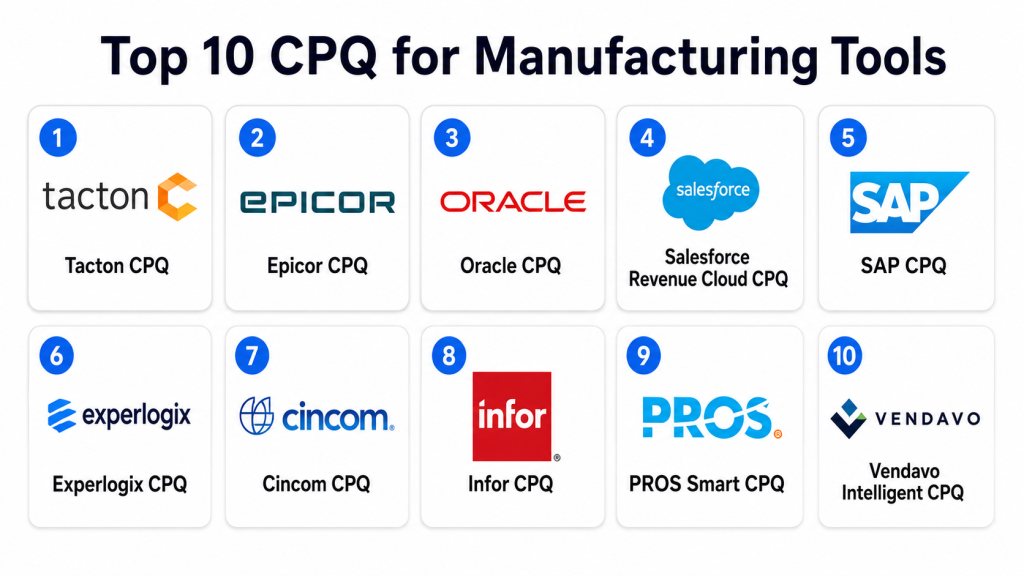
Top 10 CPQ for Manufacturing Tools
1- Tacton CPQ
Short description: Tacton CPQ is a manufacturing-focused CPQ platform built for complex industrial products, machinery, and configurable equipment. It is useful for manufacturers that need constraint-based configuration, guided selling, and accurate quoting for complex product structures.
Key Features
- Constraint-based product configuration
- Guided selling for complex manufacturing products
- Visual configuration and product experience support
- Pricing and quote automation
- ERP, CRM, PLM, and CAD integration support
- Dealer and channel sales enablement
- Quote-to-order workflow support
Pros
- Strong fit for complex industrial manufacturing
- Helps reduce invalid product configurations
- Useful for connecting sales, engineering, and operations
Cons
- May require detailed product rule setup
- Best suited for complex manufacturing, not simple quoting
- Implementation may need strong internal product knowledge
Platforms / Deployment
Web / Cloud
Security & Compliance
Tacton supports enterprise manufacturing environments where access control, data governance, and secure integrations are important. Specific details such as SSO, MFA, encryption, audit logs, and certifications should be verified directly with the vendor. Not publicly stated for every configuration.
Integrations & Ecosystem
Tacton CPQ is designed to connect with manufacturing systems across sales, engineering, and operations. It is especially useful when product configuration must align with CRM, ERP, PLM, CAD, and downstream order workflows.
Common integration areas include:
- CRM systems
- ERP platforms
- PLM systems
- CAD tools
- Dealer portals
- eCommerce platforms
Support & Community
Tacton provides implementation support, documentation, partner assistance, and manufacturing CPQ expertise. Support depth depends on customer agreement, project complexity, and deployment scope.
2- Epicor CPQ
Short description: Epicor CPQ is a visual CPQ and product configuration platform designed for manufacturers and distributors. It helps teams create interactive product experiences, configure complex products, generate quotes, and connect sales with production workflows.
Key Features
- Visual product configuration
- Guided selling workflows
- Quote and proposal automation
- Rule-based product configuration
- CAD and BOM automation support
- ERP and CRM integration
- Dealer and customer self-service options
Pros
- Strong visual CPQ experience for manufacturers
- Useful for configurable products and customer-facing selling
- Good fit for manufacturers using Epicor or ERP-driven workflows
Cons
- Advanced configuration may require implementation support
- May be more than needed for simple product catalogs
- CAD and ERP integration scope should be validated before purchase
Platforms / Deployment
Web / Cloud
Security & Compliance
Epicor enterprise products generally support business security requirements, but specific controls such as SSO, MFA, encryption, audit logs, role-based access, and certifications should be verified directly with the vendor. Not publicly stated for every configuration.
Integrations & Ecosystem
Epicor CPQ is useful when product configuration needs to connect with ERP, CAD, CRM, and ordering workflows. It supports manufacturers that want a smoother path from customer configuration to production-ready information.
Common integration areas include:
- Epicor ERP
- CRM systems
- CAD platforms
- Dealer portals
- eCommerce systems
- Manufacturing workflows
Support & Community
Epicor provides product support, documentation, implementation resources, and a manufacturing-focused ecosystem. Support quality depends on contract level, partner involvement, and deployment complexity.
3- Oracle CPQ
Short description: Oracle CPQ is an enterprise CPQ platform for complex quoting, pricing, approvals, and quote-to-order workflows. It is suitable for large manufacturers that need scalable CPQ connected with CRM, ERP, pricing, and commerce systems.
Key Features
- Complex product configuration
- Pricing and discount management
- Quote document generation
- Approval workflows
- Guided selling support
- CRM and ERP integration
- Enterprise quote-to-order automation
Pros
- Strong fit for large enterprise manufacturers
- Good support for complex quoting and approval workflows
- Works well in Oracle-centered technology environments
Cons
- Can require significant configuration and administration
- May feel complex for smaller manufacturing teams
- Implementation effort depends on product catalog and integration needs
Platforms / Deployment
Web / Cloud
Security & Compliance
Oracle enterprise cloud products commonly support identity management, access controls, encryption options, auditability, and administrative governance. Specific certifications and compliance coverage vary by service and region. Buyers should verify directly with Oracle.
Integrations & Ecosystem
Oracle CPQ integrates well with Oracle sales, commerce, ERP, and finance environments. It can also connect with external CRM, ERP, and pricing systems depending on architecture.
Common integration areas include:
- Oracle CRM and sales systems
- Oracle ERP
- Pricing systems
- Commerce platforms
- Contract workflows
- Approval and finance systems
Support & Community
Oracle provides enterprise support, documentation, implementation partners, consulting services, and a large technology ecosystem. Support experience depends on customer agreement and project scope.
4- Salesforce Revenue Cloud CPQ
Short description: Salesforce Revenue Cloud CPQ helps sales teams configure products, apply pricing rules, create quotes, and manage approvals inside the Salesforce ecosystem. It is useful for manufacturers that run sales operations in Salesforce and need CPQ connected with CRM workflows.
Key Features
- Product configuration and guided selling
- Pricing, discounting, and approval workflows
- Quote document generation
- CRM-native sales process integration
- Product bundles and rules
- Revenue workflow support
- Partner and sales team collaboration
Pros
- Strong fit for manufacturers using Salesforce CRM
- Helps sales teams quote faster inside familiar CRM workflows
- Large ecosystem of apps, partners, and implementation resources
Cons
- Manufacturing-specific depth may require configuration or add-ons
- Complex product rules can take time to design
- Best results depend on Salesforce data quality and process design
Platforms / Deployment
Web / Cloud
Security & Compliance
Salesforce enterprise products commonly support SSO, MFA, encryption options, role-based access, audit features, and administrative governance depending on edition and configuration. Specific compliance coverage should be verified directly with Salesforce. Not publicly stated for every configuration.
Integrations & Ecosystem
Salesforce Revenue Cloud CPQ works best in Salesforce-led sales environments. It can connect with ERP, billing, contract, eCommerce, partner, and analytics systems through native capabilities, APIs, and ecosystem tools.
Common integration areas include:
- Salesforce CRM
- ERP systems
- Billing platforms
- Contract lifecycle tools
- Partner portals
- Revenue analytics
Support & Community
Salesforce provides documentation, enterprise support, Trailhead training, implementation partners, and a very large user community. Support levels depend on contract and package.
5- SAP CPQ
Short description: SAP CPQ helps companies configure products, manage pricing, generate quotes, and support sales workflows across direct and indirect channels. It is suitable for manufacturers already using SAP ERP, SAP sales tools, or SAP commerce environments.
Key Features
- Product configuration and guided selling
- Pricing and discount management
- Quote generation and approval workflows
- Sales channel support
- SAP ERP and commerce integration
- Product catalog and rule management
- Quote-to-order workflow support
Pros
- Strong fit for SAP-centered manufacturing environments
- Helps connect CPQ with ERP and commerce workflows
- Useful for enterprise sales and dealer channels
Cons
- Best value often comes inside the SAP ecosystem
- Configuration and implementation may require SAP expertise
- Smaller teams may find it complex
Platforms / Deployment
Web / Cloud
Security & Compliance
SAP enterprise cloud solutions commonly support user access controls, authentication integration, permissions, auditability, and governance features depending on configuration. Specific certifications, encryption, SSO, MFA, and compliance coverage should be verified directly with SAP. Not publicly stated for every configuration.
Integrations & Ecosystem
SAP CPQ integrates well with SAP ERP, SAP commerce, SAP sales solutions, pricing systems, and order management workflows. It is useful for manufacturers that need CPQ connected to enterprise operations.
Common integration areas include:
- SAP ERP
- SAP commerce
- CRM systems
- Pricing tools
- Dealer portals
- Order management systems
Support & Community
SAP provides enterprise support, implementation partners, documentation, training, and a large global ecosystem. Support depth varies by contract, region, and product configuration.
6- Experlogix CPQ
Short description: Experlogix CPQ is a configure-price-quote platform used by manufacturers and sales teams that need product configuration, pricing logic, guided selling, and document generation. It is known for working with major CRM and ERP environments.
Key Features
- Product configuration rules
- Guided selling
- Quote and proposal automation
- Pricing and discount controls
- CRM and ERP integration
- Document generation
- Workflow and approval support
Pros
- Strong fit for manufacturers with complex products
- Works well for teams needing CRM and ERP-connected CPQ
- Flexible configuration for different sales processes
Cons
- Complex implementations need careful rule design
- May require technical setup for deeper ERP integration
- Visual configuration needs should be validated by use case
Platforms / Deployment
Web / Cloud / Varies by configuration
Security & Compliance
Experlogix supports business quoting environments where permissions, access control, and secure integrations matter. Specific security controls such as SSO, MFA, encryption, audit logs, and certifications should be verified directly with the vendor. Not publicly stated for every configuration.
Integrations & Ecosystem
Experlogix CPQ is often used with CRM and ERP systems to connect sales configuration with pricing, quote generation, and order workflows. It can support manufacturers that need CPQ across sales and operations.
Common integration areas include:
- CRM systems
- ERP platforms
- Document generation tools
- Pricing systems
- Approval workflows
- Sales portals
Support & Community
Experlogix provides product support, implementation assistance, documentation, and partner resources. Support levels vary by customer agreement and deployment scope.
7- Cincom CPQ
Short description: Cincom CPQ is designed for manufacturers that sell complex products and need guided configuration, pricing, proposal generation, and channel sales support. It is useful for organizations that want to simplify complex product selling across sales teams and dealers.
Key Features
- Complex product configuration
- Guided selling workflows
- Pricing and quote automation
- Proposal document generation
- Dealer and channel support
- CRM and ERP integration
- Rule-based product selection
Pros
- Strong fit for complex manufacturing sales
- Helps reduce quote errors and sales cycle friction
- Useful for dealer and distributor quoting environments
Cons
- May require detailed product rule modeling
- Best suited for complex products rather than simple catalogs
- Integration and customization needs should be reviewed carefully
Platforms / Deployment
Web / Cloud / Varies by configuration
Security & Compliance
Cincom serves enterprise manufacturing and sales environments where data protection and access control are important. Specific controls such as SSO, MFA, encryption, audit logs, and compliance documentation should be verified directly with the vendor. Not publicly stated for every configuration.
Integrations & Ecosystem
Cincom CPQ can connect sales, product configuration, pricing, and order workflows. It is useful for manufacturers that need CPQ connected with CRM, ERP, and dealer sales processes.
Common integration areas include:
- CRM systems
- ERP platforms
- Dealer portals
- Pricing systems
- Product catalogs
- Quote document tools
Support & Community
Cincom provides product support, implementation services, documentation, and domain guidance for complex quoting environments. Support depth varies by customer agreement and implementation complexity.
8- Infor CPQ
Short description: Infor CPQ helps manufacturers and distributors configure products, create accurate quotes, and deliver visual buying experiences. It is suitable for companies that want product configuration connected with ERP, sales, and customer-facing quoting workflows.
Key Features
- Visual CPQ and product configuration
- Guided selling for manufacturers
- Quote and proposal automation
- Product rule management
- ERP and CRM integration
- Dealer and distributor support
- Customer-facing configuration experiences
Pros
- Strong fit for manufacturers and distributors
- Useful visual configuration capabilities
- Good fit for companies using Infor ERP environments
Cons
- Best value may come inside the Infor ecosystem
- Complex rules and integrations require planning
- Smaller teams may need implementation support
Platforms / Deployment
Web / Cloud / Varies by configuration
Security & Compliance
Infor enterprise products commonly support role-based access, administrative controls, and enterprise security expectations depending on deployment. Specific certifications, SSO, MFA, encryption, audit logs, and compliance details should be verified directly with Infor. Not publicly stated for every configuration.
Integrations & Ecosystem
Infor CPQ connects product configuration with sales, ERP, and quoting workflows. It is useful for manufacturers that want fewer quote errors and stronger alignment between sales and operations.
Common integration areas include:
- Infor ERP
- CRM systems
- Dealer portals
- eCommerce systems
- Product catalogs
- Quote and proposal workflows
Support & Community
Infor provides enterprise support, documentation, implementation partners, and a manufacturing-focused ecosystem. Support experience depends on contract, product configuration, and implementation scope.
9- PROS Smart CPQ
Short description: PROS Smart CPQ helps companies configure offers, optimize pricing, and generate quotes using pricing science and automation. It is useful for manufacturers that need strong pricing intelligence along with CPQ workflows.
Key Features
- Configure, price, and quote workflows
- Pricing optimization support
- Sales guidance and deal recommendations
- Quote automation
- Approval workflows
- CRM and ERP integration
- Margin and revenue management support
Pros
- Strong fit for pricing-focused manufacturers
- Useful for margin protection and deal guidance
- Good option where pricing complexity is a major issue
Cons
- Product configuration depth should be validated for complex engineering use cases
- Best suited for organizations with pricing maturity
- Implementation may require pricing strategy alignment
Platforms / Deployment
Web / Cloud
Security & Compliance
PROS serves enterprise pricing and revenue environments where security and governance are important. Specific controls such as SSO, MFA, encryption, audit logs, role-based access, and certifications should be verified directly with the vendor. Not publicly stated for every configuration.
Integrations & Ecosystem
PROS Smart CPQ connects quoting with pricing, CRM, ERP, and revenue management workflows. It is especially useful when pricing optimization is as important as configuration.
Common integration areas include:
- CRM systems
- ERP platforms
- Pricing systems
- Revenue management tools
- Approval workflows
- Sales analytics platforms
Support & Community
PROS provides enterprise support, documentation, implementation guidance, and pricing expertise. Support levels depend on customer agreement and deployment scope.
10- Vendavo Intelligent CPQ
Short description: Vendavo Intelligent CPQ helps B2B companies configure products, manage complex pricing, generate quotes, and protect margins. It is suitable for manufacturers and distributors that need CPQ connected with pricing strategy and commercial excellence.
Key Features
- Configure, price, and quote automation
- Pricing guidance and margin controls
- Discount and approval workflows
- Quote generation
- Sales productivity support
- Integration with pricing and commercial tools
- Analytics for pricing and quoting decisions
Pros
- Strong fit for pricing-driven B2B manufacturers
- Useful for margin protection and quote consistency
- Supports commercial teams with pricing intelligence
Cons
- Product configuration depth should be validated for engineering-heavy products
- Best suited for teams with pricing and revenue focus
- Implementation may require commercial process alignment
Platforms / Deployment
Web / Cloud
Security & Compliance
Vendavo supports enterprise pricing and CPQ environments where secure access and governance matter. Specific details such as SSO, MFA, encryption, audit logs, role-based access, and certifications should be verified directly with the vendor. Not publicly stated for every configuration.
Integrations & Ecosystem
Vendavo Intelligent CPQ connects CPQ with pricing, revenue, sales, and business systems. It is useful for manufacturers that want quoting decisions aligned with pricing strategy and margin goals.
Common integration areas include:
- CRM systems
- ERP systems
- Pricing platforms
- Revenue management workflows
- Approval systems
- Sales analytics tools
Support & Community
Vendavo provides enterprise support, implementation assistance, documentation, and pricing-focused expertise. Support levels depend on contract, solution package, and implementation scope.
Comparison Table
| Tool Name | Best For | Platform Supported | Deployment | Standout Feature | Public Rating |
|---|---|---|---|---|---|
| Tacton CPQ | Complex industrial manufacturing | Web | Cloud | Constraint-based manufacturing configuration | N/A |
| Epicor CPQ | Visual product configuration | Web | Cloud | Visual CPQ with manufacturing workflows | N/A |
| Oracle CPQ | Large enterprise manufacturers | Web | Cloud | Scalable quote-to-order automation | N/A |
| Salesforce Revenue Cloud CPQ | Salesforce-based sales teams | Web | Cloud | CRM-native quoting and approvals | N/A |
| SAP CPQ | SAP-centered manufacturers | Web | Cloud | CPQ connected with SAP operations | N/A |
| Experlogix CPQ | CRM and ERP-connected manufacturers | Web | Cloud / Varies | Flexible product configuration | N/A |
| Cincom CPQ | Complex product and dealer sales | Web | Cloud / Varies | Guided selling for complex products | N/A |
| Infor CPQ | Manufacturers and distributors | Web | Cloud / Varies | Visual CPQ for manufacturing sales | N/A |
| PROS Smart CPQ | Pricing-focused manufacturers | Web | Cloud | Pricing optimization and quote guidance | N/A |
| Vendavo Intelligent CPQ | B2B manufacturing pricing teams | Web | Cloud | Margin-focused intelligent quoting | N/A |
Evaluation & Scoring of CPQ for Manufacturing
The scoring below is comparative and buyer-oriented. It should be used as a shortlisting guide, not as a final purchasing decision. A platform with a lower weighted total may still be the best fit if it matches your product complexity, ERP environment, sales channel model, and pricing strategy.
| Tool Name | Core 25% | Ease 15% | Integrations 15% | Security 10% | Performance 10% | Support 10% | Value 15% | Weighted Total |
| Tacton CPQ | 9 | 7 | 9 | 8 | 8 | 8 | 7 | 8.10 |
| Epicor CPQ | 9 | 8 | 8 | 8 | 8 | 8 | 8 | 8.25 |
| Oracle CPQ | 8 | 7 | 9 | 8 | 8 | 8 | 7 | 7.95 |
| Salesforce Revenue Cloud CPQ | 8 | 8 | 9 | 8 | 8 | 9 | 7 | 8.15 |
| SAP CPQ | 8 | 7 | 9 | 8 | 8 | 8 | 7 | 7.95 |
| Experlogix CPQ | 8 | 8 | 8 | 7 | 8 | 8 | 8 | 7.90 |
| Cincom CPQ | 8 | 7 | 8 | 7 | 8 | 8 | 7 | 7.60 |
| Infor CPQ | 8 | 8 | 8 | 7 | 8 | 8 | 8 | 7.90 |
| PROS Smart CPQ | 8 | 7 | 8 | 8 | 8 | 8 | 7 | 7.75 |
| Vendavo Intelligent CPQ | 8 | 7 | 8 | 8 | 8 | 8 | 7 | 7.75 |
How to interpret the scores:
- Core score reflects product configuration depth, pricing rules, quoting workflows, guided selling, and manufacturing fit.
- Ease score reflects usability for sales reps, dealers, product managers, and administrators.
- Integration score reflects fit with CRM, ERP, PLM, CAD, pricing, eCommerce, and order management systems.
- Security score reflects visible enterprise governance signals and expected controls, not unverified certifications.
- Performance score reflects suitability for complex catalogs, high quote volumes, and multi-channel sales.
- Value score reflects practical fit relative to capability, implementation effort, and expected business impact.
Which CPQ for Manufacturing Tool Is Right for You?
Solo / Freelancer
Solo consultants and independent manufacturing sales advisors usually do not need a full enterprise CPQ deployment for themselves. Instead, they often help clients document product rules, simplify quoting workflows, clean pricing logic, or prepare for CPQ implementation.
For independent advisory work, the best approach is to understand platforms like Tacton, Epicor CPQ, Salesforce Revenue Cloud CPQ, Oracle CPQ, SAP CPQ, and Experlogix because these appear often in manufacturing CPQ projects. A solo consultant should focus on tools that support clear rule modeling, exportable documentation, and integration readiness.
SMB
Small and mid-sized manufacturers should prioritize ease of use, implementation speed, sales adoption, and ERP compatibility. Epicor CPQ, Experlogix CPQ, Infor CPQ, and Cincom CPQ can be strong options when product configuration and quote accuracy are major needs.
SMBs should avoid overbuilding their CPQ system at the start. The first goal should be to reduce quote errors, standardize pricing, improve proposal speed, and connect quoting with basic ERP or order workflows.
Mid-Market
Mid-market manufacturers often need stronger product rules, dealer support, approval workflows, and integration with ERP or CRM systems. Tacton CPQ, Epicor CPQ, Experlogix CPQ, Infor CPQ, PROS Smart CPQ, and Vendavo Intelligent CPQ can be strong candidates depending on the business model.
Mid-market buyers should test how each tool handles real product rules, discounts, approvals, regional price lists, quote documents, and order handoff. A platform should support both sales speed and operational accuracy.
Enterprise
Large manufacturers need scalable CPQ systems that support complex catalogs, global pricing, multiple sales channels, approval governance, ERP integration, and product lifecycle complexity. Oracle CPQ, SAP CPQ, Salesforce Revenue Cloud CPQ, Tacton CPQ, PROS Smart CPQ, and Vendavo Intelligent CPQ are strong enterprise candidates depending on the existing technology stack.
Enterprise buyers should prioritize governance, integration depth, product rule scalability, performance, partner ecosystem, data security, and administrative control. The best enterprise platform is usually the one that fits the company’s CRM, ERP, pricing, PLM, and sales operations model.
Budget vs Premium
Budget-conscious manufacturers should first define the biggest quoting problem. If the issue is quote document speed, a lighter CPQ setup may be enough. If the issue is invalid configurations, engineering bottlenecks, or margin leakage, a more advanced CPQ platform may be worth the investment.
Premium CPQ platforms are better when manufacturers need complex rules, visual configuration, ERP integration, dealer portals, pricing optimization, guided selling, approval automation, and quote-to-order workflows.
Feature Depth vs Ease of Use
Tacton CPQ is strong for complex industrial configuration. Epicor CPQ and Infor CPQ are strong for visual manufacturing experiences. Oracle CPQ, SAP CPQ, and Salesforce Revenue Cloud CPQ are strong for enterprise workflow scale. Experlogix and Cincom are practical for manufacturers needing flexible configuration and quoting.
PROS and Vendavo are strong when pricing intelligence, margin protection, and commercial discipline are top priorities. Buyers should choose based on the actual bottleneck: configuration complexity, pricing control, quote speed, dealer enablement, or ERP handoff.
Integrations & Scalability
Manufacturing CPQ becomes powerful when it connects with CRM, ERP, PLM, CAD, pricing, inventory, product catalogs, contract tools, eCommerce, and dealer portals. Without integration, CPQ can become another disconnected quoting tool.
Buyers should test whether the platform can pass clean data from quote to order, generate accurate BOMs, support pricing updates, manage product changes, and reduce manual re-entry. Integration quality is often more important than the interface design.
Security & Compliance Needs
CPQ systems may contain sensitive pricing, discount rules, customer information, product logic, margin data, and contract terms. Buyers should evaluate SSO, MFA, encryption, audit logs, role-based access, approval history, admin controls, and data residency.
Manufacturers with dealer networks should also review partner access controls, quote visibility rules, regional pricing permissions, and document governance. Security review should include sales operations, IT, legal, finance, and procurement teams.
Frequently Asked Questions
1- What is CPQ for Manufacturing?
CPQ for Manufacturing is software that helps manufacturers configure products, calculate pricing, and generate accurate quotes. It is designed for complex products, custom options, dealer sales, approval workflows, and ERP-connected quoting processes.
2- Why do manufacturers need CPQ software?
Manufacturers need CPQ software because manual quoting can create errors, delays, pricing mistakes, and invalid configurations. CPQ helps sales teams quote faster while making sure selected products are buildable, priced correctly, and ready for order processing.
3- What is the difference between CPQ and product configurator software?
A product configurator focuses mainly on selecting product options and validating rules. CPQ includes configuration but also adds pricing, discounting, approvals, quote documents, and quote-to-order workflow support.
4- Can CPQ connect with ERP systems?
Yes, many CPQ platforms connect with ERP systems to exchange product data, pricing, customer records, BOMs, inventory details, and order information. Buyers should test ERP integration carefully because this is one of the most important manufacturing CPQ requirements.
5- Does CPQ support complex product rules?
Yes, manufacturing CPQ platforms often support product rules, constraints, dependencies, bundles, compatibility checks, and guided selling logic. The depth of rule management varies by vendor, so buyers should test real product examples during evaluation.
6- How much does CPQ for Manufacturing cost?
Pricing varies based on vendor, users, modules, integrations, product catalog complexity, deployment scope, and implementation services. Many enterprise CPQ platforms use custom pricing. Buyers should compare license fees, setup cost, training, support, and ongoing administration.
7- Can CPQ help reduce quote errors?
Yes, CPQ can reduce quote errors by using approved product rules, pricing logic, approval workflows, and standardized quote templates. It helps prevent sales teams from selling incompatible options or using outdated prices.
8- Is visual CPQ important for manufacturers?
Visual CPQ is important when buyers need to see product changes, layouts, finishes, dimensions, or configurations before purchase. It is especially useful for machinery, equipment, furniture, building products, and custom manufactured goods.
9- What are common mistakes when choosing CPQ software?
Common mistakes include ignoring ERP integration, underestimating product rule complexity, failing to involve engineering, and choosing a platform based only on demos. Buyers should test real configurations, pricing rules, approval flows, and quote documents before selection.
10- How long does CPQ implementation take?
Implementation time depends on product catalog complexity, pricing rules, integrations, quote templates, approvals, and data readiness. A simple rollout may be faster, while complex manufacturing CPQ projects require careful planning, testing, training, and governance.
Conclusion
CPQ for Manufacturing helps manufacturers turn complex product selling into a faster, more accurate, and more controlled quoting process. The right platform depends on product complexity, sales channels, pricing structure, ERP environment, visual configuration needs, and internal process maturity. Tacton CPQ is strong for complex industrial configuration, Epicor CPQ and Infor CPQ are useful for visual manufacturing experiences, while Oracle CPQ, SAP CPQ, and Salesforce Revenue Cloud CPQ are strong for enterprise-scale workflows. Experlogix and Cincom are practical for flexible manufacturing quoting, while PROS and Vendavo are strong when pricing intelligence and margin protection matter most. Buyers should shortlist two or three platforms, test them with real product rules, validate ERP integration, review security controls, and confirm that the selected tool improves both sales speed and manufacturing accuracy.
