Introduction
Sales Enablement Tools are platforms designed to help sales teams close deals faster by providing the right content, insights, and automation at every stage of the buyer journey. These tools bridge the gap between marketing and sales by organizing content, tracking engagement, and enabling personalized outreach at scale.
In today’s environment, where buyers are more informed and sales cycles are increasingly complex, sales enablement is no longer optional. Modern tools incorporate AI-driven recommendations, real-time analytics, and strong security controls aligned with Identity Management, CyberSecurity, Zero Trust, and Access Control frameworks. This ensures that sensitive sales data and customer interactions remain protected while maximizing productivity.
Real-world use cases:
- Delivering the right sales content at the right time
- Tracking buyer engagement with emails and documents
- Training and onboarding sales teams
- Automating outreach and follow-ups
- Aligning sales and marketing strategies
What buyers should evaluate:
- Content management and delivery capabilities
- Analytics and engagement tracking
- Ease of use and onboarding
- Integration with CRM and marketing tools
- Security and compliance features
- AI and automation capabilities
- Customization and scalability
- Pricing and ROI
Best for: Sales teams, revenue operations leaders, marketers, and enterprises that need structured content delivery, training, and analytics to improve sales performance.
Not ideal for: Very small teams with simple sales processes or organizations that do not rely on structured content or analytics in their sales workflow.
Key Trends in Sales Enablement Tools
- AI-powered content recommendations and personalization
- Integration with CRM and SFA platforms for unified workflows
- Real-time buyer engagement tracking and analytics
- Video-based selling and training platforms
- Mobile-first access for remote and field sales teams
- Stronger compliance and data governance features
- Zero Trust security models with granular access control
- Content lifecycle management and version control
- Sales coaching and performance analytics
- API-driven extensibility and integrations
How We Selected These Sales Enablement Tools (Methodology)
- Market adoption and industry recognition
- Feature completeness across content, analytics, and automation
- Reliability and performance in real-world use
- Security posture and compliance readiness
- Integration ecosystem and API support
- Flexibility across SMB and enterprise use cases
- Innovation in AI and sales intelligence
- Customer satisfaction trends and usability
- Scalability for growing organizations
- Balanced representation of leading vendors
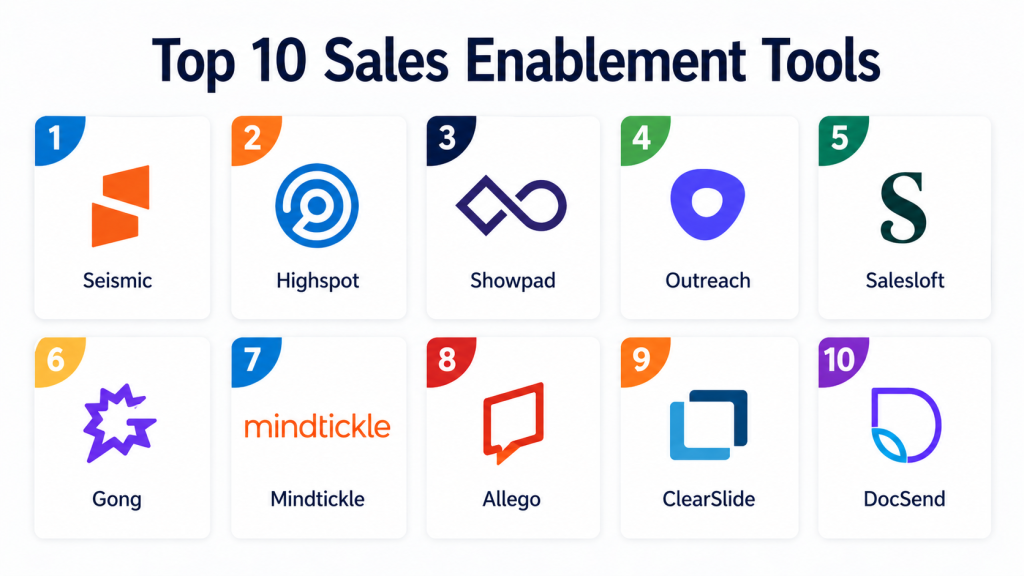
Top 10 Sales Enablement Tools
#1 — Seismic
Short description:
Seismic is an enterprise-grade sales enablement platform that helps organizations deliver personalized content and insights to sales teams. It centralizes content management, automates workflows, and provides analytics on buyer engagement. The platform is widely used by large enterprises with complex sales cycles. It supports training, coaching, and content governance. Seismic integrates deeply with CRM systems. It is best suited for organizations prioritizing scale and control.
Key Features
- Content management and distribution
- Buyer engagement tracking
- AI-driven recommendations
- Sales training and coaching
- Workflow automation
- Analytics dashboards
Pros
- Strong enterprise capabilities
- Advanced analytics and insights
Cons
- Complex implementation
- Higher cost for full features
Platforms / Deployment
Web / Mobile
Cloud
Security & Compliance
SSO, MFA, encryption, RBAC; compliance varies
Integrations & Ecosystem
Integrates with major CRM and marketing platforms.
- Salesforce integration
- Marketing automation tools
- APIs
Support & Community
Enterprise-level support with training resources
#2 — Highspot
Short description:
Highspot is a leading sales enablement platform focused on content management and analytics. It helps teams deliver relevant content to prospects and measure engagement. The platform offers AI-driven insights and sales coaching tools. It is widely used across industries for improving sales performance. Highspot emphasizes usability and strong reporting capabilities. It is suitable for mid-market and enterprise teams.
Key Features
- Content management
- Buyer engagement analytics
- Sales playbooks
- AI insights
- Training tools
Pros
- Strong analytics capabilities
- User-friendly interface
Cons
- Pricing may be high
- Customization can be limited
Platforms / Deployment
Web / Mobile
Cloud
Security & Compliance
Encryption, access control; compliance not publicly stated
Integrations & Ecosystem
Supports integrations with CRM and productivity tools.
- Salesforce
- Microsoft tools
- APIs
Support & Community
Good documentation and support
#3 — Showpad
Short description:
Showpad combines content management, sales training, and coaching into a single platform. It is designed to improve sales readiness and engagement. The platform offers AI-powered recommendations and analytics. It supports both marketing and sales alignment. Showpad is widely used by enterprises. It is ideal for teams focusing on training and performance improvement.
Key Features
- Content management
- Sales training
- Coaching tools
- Analytics and reporting
- AI recommendations
Pros
- Strong training capabilities
- Integrated platform
Cons
- Requires setup effort
- Can be expensive
Platforms / Deployment
Web / Mobile
Cloud
Security & Compliance
Encryption, access control; compliance varies
Integrations & Ecosystem
Integrates with CRM and marketing platforms.
- Salesforce
- Marketing tools
- APIs
Support & Community
Enterprise support and resources
#4 — Outreach
Short description:
Outreach is a sales engagement platform that automates outreach workflows and tracks engagement. It is designed to improve productivity and pipeline generation. The platform provides analytics and AI-driven insights. It is widely used by sales teams for outbound and inbound engagement. Outreach integrates with CRM systems. It is suitable for mid-market and enterprise teams.
Key Features
- Email and call automation
- Engagement tracking
- Workflow automation
- Analytics dashboards
- AI insights
Pros
- Strong automation capabilities
- Improves sales productivity
Cons
- Learning curve
- Requires integration setup
Platforms / Deployment
Web / Mobile
Cloud
Security & Compliance
SSO, encryption; compliance varies
Integrations & Ecosystem
Integrates with CRM and communication tools.
- Salesforce
- Email platforms
- APIs
Support & Community
Good support and onboarding
#5 — Salesloft
Short description:
Salesloft is a sales engagement platform focused on improving communication and pipeline management. It helps teams automate outreach and track engagement. The platform provides analytics and coaching tools. It is widely used by sales teams for prospecting and follow-ups. Salesloft integrates with CRM systems. It is suitable for growing teams.
Key Features
- Sales engagement tools
- Workflow automation
- Analytics
- Coaching features
- Pipeline tracking
Pros
- Easy to use
- Strong engagement tools
Cons
- Limited advanced customization
- Pricing may be high
Platforms / Deployment
Web / Mobile
Cloud
Security & Compliance
Encryption, access control; compliance varies
Integrations & Ecosystem
Supports CRM and communication integrations.
- Salesforce
- Email tools
- APIs
Support & Community
Good onboarding and support
#6 — Gong
Short description:
Gong is a revenue intelligence platform that analyzes sales conversations and interactions. It provides insights into customer behavior and sales performance. The platform uses AI to identify trends and improve outcomes. It is widely used by sales teams for coaching and forecasting. Gong integrates with CRM and communication tools. It is ideal for data-driven organizations.
Key Features
- Conversation analytics
- AI insights
- Sales coaching
- Forecasting tools
- Performance tracking
Pros
- Strong AI capabilities
- Deep insights
Cons
- Requires data integration
- Can be expensive
Platforms / Deployment
Web
Cloud
Security & Compliance
Encryption, access control; compliance varies
Integrations & Ecosystem
Integrates with CRM and communication tools.
- CRM systems
- Video platforms
- APIs
Support & Community
Strong support and training
#7 — Mindtickle
Short description:
Mindtickle is a sales readiness platform focused on training and coaching. It helps organizations improve sales performance through structured learning. The platform provides analytics and assessments. It is widely used for onboarding and continuous training. Mindtickle integrates with CRM and HR systems. It is suitable for enterprise teams.
Key Features
- Sales training
- Coaching tools
- Assessments
- Analytics
- Learning management
Pros
- Strong training focus
- Scalable platform
Cons
- Limited content management features
- Requires setup
Platforms / Deployment
Web / Mobile
Cloud
Security & Compliance
Encryption, access control; compliance varies
Integrations & Ecosystem
Integrates with CRM and HR tools.
- Salesforce
- HR systems
- APIs
Support & Community
Enterprise-level support
#8 — Allego
Short description:
Allego is a sales enablement platform focused on content sharing and video-based learning. It helps teams deliver content and training effectively. The platform provides analytics and engagement tracking. It is suitable for distributed teams. Allego integrates with CRM systems. It is ideal for organizations focusing on remote sales.
Key Features
- Content sharing
- Video training
- Analytics
- Engagement tracking
- Mobile access
Pros
- Strong mobile capabilities
- Video-based learning
Cons
- Limited advanced analytics
- Smaller ecosystem
Platforms / Deployment
Web / Mobile
Cloud
Security & Compliance
Encryption, access control; compliance varies
Integrations & Ecosystem
Supports CRM integrations.
- Salesforce
- Content tools
- APIs
Support & Community
Moderate support and resources
#9 — ClearSlide
Short description:
ClearSlide is a sales enablement platform focused on content management and engagement tracking. It helps teams share presentations and track interactions. The platform provides analytics and reporting tools. It is suitable for SMBs and mid-market teams. ClearSlide integrates with CRM systems. It is easy to use and deploy.
Key Features
- Content sharing
- Engagement tracking
- Analytics
- Reporting tools
- Workflow automation
Pros
- Easy to use
- Good content tracking
Cons
- Limited advanced features
- Smaller ecosystem
Platforms / Deployment
Web / Mobile
Cloud
Security & Compliance
Encryption, access control; compliance varies
Integrations & Ecosystem
Integrates with CRM tools.
- Salesforce
- Email platforms
- APIs
Support & Community
Basic support and documentation
#10 — DocSend
Short description:
DocSend is a document sharing and analytics platform designed for sales teams. It allows teams to track how prospects interact with documents. The platform provides insights into engagement and helps optimize sales content. It is easy to use and deploy. DocSend integrates with CRM and productivity tools. It is suitable for SMBs and startups.
Key Features
- Document sharing
- Engagement tracking
- Analytics
- Content control
- Reporting tools
Pros
- Simple and effective
- Strong document tracking
Cons
- Limited full SFA features
- Not ideal for large enterprises
Platforms / Deployment
Web
Cloud
Security & Compliance
Encryption, access control; compliance varies
Integrations & Ecosystem
Supports integrations with CRM and productivity tools.
- CRM systems
- File sharing tools
- APIs
Support & Community
Basic support and documentation
Comparison Table
| Tool Name | Best For | Platform(s) | Deployment | Standout Feature | Public Rating |
|---|---|---|---|---|---|
| Seismic | Enterprise | Web, Mobile | Cloud | Content intelligence | N/A |
| Highspot | Mid/Enterprise | Web, Mobile | Cloud | Analytics | N/A |
| Showpad | Enterprise | Web, Mobile | Cloud | Training + content | N/A |
| Outreach | Mid/Enterprise | Web, Mobile | Cloud | Sales engagement | N/A |
| Salesloft | SMB/Mid | Web, Mobile | Cloud | Outreach automation | N/A |
| Gong | Enterprise | Web | Cloud | Conversation AI | N/A |
| Mindtickle | Enterprise | Web, Mobile | Cloud | Sales training | N/A |
| Allego | SMB/Mid | Web, Mobile | Cloud | Video learning | N/A |
| ClearSlide | SMB/Mid | Web, Mobile | Cloud | Content tracking | N/A |
| DocSend | SMB | Web | Cloud | Document analytics | N/A |
Evaluation & Scoring of Sales Enablement Tools
| Tool | Core | Ease | Integrations | Security | Performance | Support | Value | Total |
|---|---|---|---|---|---|---|---|---|
| Seismic | 9 | 7 | 9 | 8 | 9 | 9 | 7 | 8.4 |
| Highspot | 8 | 8 | 8 | 8 | 8 | 8 | 7 | 8.0 |
| Showpad | 8 | 7 | 8 | 8 | 8 | 8 | 7 | 7.9 |
| Outreach | 8 | 7 | 9 | 8 | 8 | 8 | 7 | 8.0 |
| Salesloft | 8 | 8 | 8 | 7 | 8 | 8 | 7 | 7.9 |
| Gong | 9 | 7 | 8 | 8 | 9 | 8 | 6 | 8.1 |
| Mindtickle | 8 | 7 | 7 | 8 | 8 | 8 | 7 | 7.8 |
| Allego | 7 | 8 | 7 | 7 | 7 | 7 | 7 | 7.3 |
| ClearSlide | 7 | 8 | 7 | 7 | 7 | 7 | 7 | 7.3 |
| DocSend | 7 | 9 | 7 | 7 | 7 | 7 | 8 | 7.6 |
Interpretation:
Scores are relative comparisons based on weighted criteria. Higher scores indicate stronger overall capability. Enterprises may prioritize integration and security, while SMBs may value ease of use and pricing more.
Which Sales Enablement Tool Is Right for You?
Solo / Freelancer
DocSend or ClearSlide for simplicity and document tracking.
SMB
Salesloft, Allego, or HubSpot alternatives for affordability and ease.
Mid-Market
Highspot or Outreach for balanced features and scalability.
Enterprise
Seismic, Showpad, Gong, or Mindtickle for advanced capabilities.
Budget vs Premium
Budget: DocSend, ClearSlide
Premium: Seismic, Gong
Feature Depth vs Ease of Use
Depth: Seismic, Gong
Ease: DocSend, Salesloft
Integrations & Scalability
Best: Outreach, Seismic
Moderate: Allego, ClearSlide
Security & Compliance Needs
Enterprise-grade: Seismic, Gong
Basic: SMB-focused tools
Frequently Asked Questions (FAQs)
1. What are Sales Enablement Tools?
Sales enablement tools help sales teams access content, track engagement, and improve performance. They centralize sales materials and automate workflows. These tools also provide analytics and insights. Modern platforms include AI features. They improve alignment between sales and marketing.
2. How do these tools improve sales performance?
They provide data-driven insights and automate repetitive tasks. Sales teams can focus on closing deals. Engagement tracking helps refine strategies. Training features improve team readiness. Overall, productivity increases significantly.
3. Are these tools suitable for SMBs?
Yes, many tools offer SMB-friendly versions. They provide essential features without complexity. SMBs benefit from automation and insights. However, some enterprise tools may be too complex. Choosing the right fit is important.
4. What is the typical pricing model?
Most tools use subscription-based pricing. Costs vary by features and user count. Some offer tiered pricing plans. Enterprise solutions may require custom pricing. ROI depends on usage and scale.
5. How long does implementation take?
Implementation can range from days to months. Simple tools deploy quickly. Enterprise tools require integration and training. Planning and onboarding affect timelines. Proper setup ensures success.
6. Do these tools support integrations?
Yes, most tools integrate with CRM and marketing platforms. APIs allow custom integrations. Integration depth varies. Strong ecosystems enhance productivity. This is a key factor in selection.
7. What are common mistakes when choosing tools?
Choosing overly complex tools is common. Ignoring integration needs can cause issues. Not considering scalability is risky. Poor onboarding leads to low adoption. Proper evaluation avoids these problems.
8. Are these tools secure?
Most platforms offer encryption and access controls. Enterprise tools provide advanced security. Compliance varies by vendor. Security is increasingly aligned with Zero Trust models. Verification is essential.
9. Can I switch tools later?
Switching is possible but requires effort. Data migration and retraining are needed. Integration changes may also be required. Planning ahead reduces risks. Choosing scalable tools helps.
10. What are alternatives to these tools?
Alternatives include CRM-only tools or manual processes. However, they lack advanced automation. Some businesses use custom solutions. Sales enablement tools provide a comprehensive approach. They are ideal for structured sales operations.
Conclusion
Sales Enablement Tools have become essential for modern sales organizations aiming to improve efficiency, consistency, and revenue outcomes. From AI-driven insights to advanced content management and training capabilities, these platforms empower teams to deliver the right message at the right time. As sales cycles become more data-driven and customer expectations continue to rise, having a structured enablement strategy is critical for staying competitive.
Choosing the right tool depends on your organization’s size, complexity, and priorities. While enterprise platforms offer depth and scalability, SMB-focused tools provide simplicity and faster adoption. Start by identifying your core needs, shortlist a few tools, and run pilot programs to evaluate usability, integrations, and impact. This approach ensures you invest in a solution that delivers measurable and sustainable value.
