Introduction
Proposal and RFP (Request for Proposal) Management Tools are software platforms designed to help organizations create, manage, track, and submit business proposals efficiently. These tools streamline the entire proposal lifecycle—from content creation and collaboration to approval workflows and submission tracking.
In today’s competitive and fast-moving business environment, organizations must respond to RFPs quickly while maintaining accuracy, compliance, and personalization. Modern proposal tools now integrate with CRM systems, identity management solutions, and cybersecurity frameworks to ensure secure document handling and controlled access. This is especially critical when dealing with sensitive client data, pricing models, and contractual details.
Common use cases include:
- Creating and managing sales proposals at scale
- Responding to complex RFPs with structured workflows
- Centralizing reusable content libraries
- Collaborating across sales, legal, and finance teams
- Tracking proposal engagement and performance
Key evaluation criteria:
- Content management and reuse capabilities
- Collaboration and workflow automation
- Integration with CRM and document tools
- Security and access control features
- Ease of use and onboarding
- Customization and branding
- Analytics and tracking
- Pricing and scalability
Best for: Sales teams, proposal managers, consulting firms, SaaS companies, enterprises handling frequent RFPs.
Not ideal for: Small teams with low proposal volume or businesses using simple document workflows.
Key Trends in Proposal & RFP Management Tools
- AI-assisted proposal writing: Automated responses and content suggestions
- Centralized content libraries: Reusable templates and approved responses
- CRM integration: Seamless data flow from sales pipelines
- Collaboration-first workflows: Real-time editing and approvals
- Security-first design: Access control and document protection
- Analytics-driven insights: Track proposal engagement and win rates
- Automation of repetitive tasks: Reduces manual work
- Cloud-native platforms: Remote accessibility and scalability
- Compliance-ready systems: Support for regulated industries
How We Evaluated Proposal & RFP Management Tools (Methodology)
- Evaluated market adoption and popularity
- Assessed feature completeness (content, workflows, automation)
- Reviewed security and access control capabilities
- Measured integration ecosystem strength
- Considered ease of use and onboarding experience
- Analyzed performance and reliability
- Checked AI and automation features
- Compared pricing flexibility and value
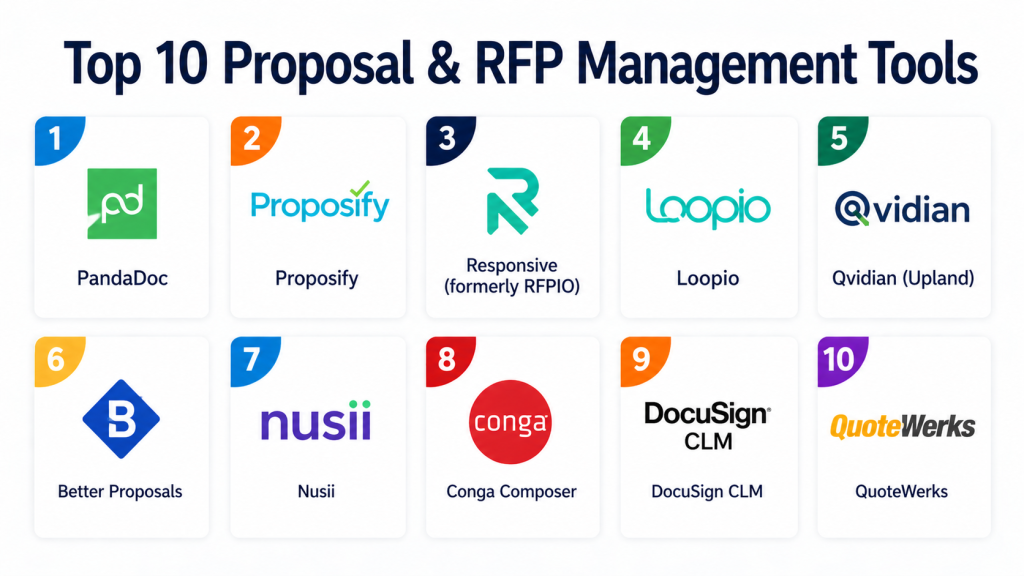
Top 10 Proposal & RFP Management Tools
#1 — PandaDoc
Short description: PandaDoc is a widely used proposal automation platform designed for sales teams and businesses of all sizes. It enables users to create, send, and track proposals efficiently. The platform offers strong document automation and e-signature capabilities. It is ideal for organizations that want to streamline sales workflows. PandaDoc also provides analytics on document engagement. It supports integrations with major CRM systems. It balances ease of use with functionality.
Key Features
- Proposal templates and content library
- E-signatures
- Workflow automation
- Real-time tracking
- CRM integrations
- Document analytics
Pros
- Easy to use and deploy
- Strong automation capabilities
Cons
- Limited advanced customization
- Pricing can increase with features
Platforms / Deployment
Web / iOS / Android
Cloud
Security & Compliance
Encryption, access controls, audit logs
Not publicly stated certifications
Integrations & Ecosystem
Integrates with major business tools and CRMs.
- Salesforce
- HubSpot
- Google Workspace
- API support
Support & Community
Good documentation, responsive support, growing community.
#2 — Proposify
Short description: Proposify is designed for teams that need professional, branded proposals. It focuses on design, workflow control, and approval processes. The platform is ideal for marketing agencies and sales teams. It includes content libraries and tracking features. Proposify emphasizes consistency and brand control. It is user-friendly but slightly limited in enterprise depth. It is strong for mid-market use.
Key Features
- Proposal design tools
- Content library
- Approval workflows
- Tracking and analytics
- Templates
Pros
- Strong design capabilities
- Easy collaboration
Cons
- Limited enterprise scalability
- Fewer integrations
Platforms / Deployment
Web
Cloud
Security & Compliance
Encryption, access control
Not publicly stated
Integrations & Ecosystem
Supports integrations with common tools.
- CRM systems
- Zapier
- APIs
Support & Community
Reliable support, moderate community.
#3 — RFPIO (Responsive)
Short description: RFPIO, now known as Responsive, is a dedicated RFP response management platform. It helps teams collaborate and automate responses. It includes AI-powered content suggestions. It is widely used by enterprises handling complex RFPs. The platform integrates deeply with CRMs and knowledge bases. It improves response accuracy and speed. It is best for high-volume RFP teams.
Key Features
- AI-powered response suggestions
- Content library
- Collaboration tools
- Workflow automation
- CRM integration
Pros
- Excellent for RFP-heavy teams
- Strong automation
Cons
- Learning curve
- Higher pricing
Platforms / Deployment
Web
Cloud
Security & Compliance
SSO, MFA, encryption
Supports enterprise security standards
Integrations & Ecosystem
Strong integration ecosystem.
- Salesforce
- Slack
- Google Drive
- APIs
Support & Community
Enterprise-level support, strong documentation.
#4 — Loopio
Short description: Loopio is a popular RFP and proposal management tool focused on collaboration and content reuse. It helps teams respond to RFPs efficiently. It includes a centralized knowledge base. The platform supports automation and analytics. It is suitable for mid-market and enterprise teams. It improves consistency and response speed. It is widely adopted in SaaS companies.
Key Features
- Knowledge base
- Automation workflows
- Collaboration tools
- Analytics
- Templates
Pros
- Strong content management
- Easy collaboration
Cons
- Pricing may be high
- Limited customization
Platforms / Deployment
Web
Cloud
Security & Compliance
SSO, encryption, RBAC
GDPR compliant
Integrations & Ecosystem
Integrates with key business tools.
- CRM systems
- Cloud storage
- APIs
Support & Community
Strong support and onboarding.
#5 — Qvidian (Upland)
Short description: Qvidian is an enterprise-grade proposal automation tool. It supports complex proposal workflows and content management. It is designed for large organizations. It includes advanced customization and reporting. It integrates with CRM and document systems. It is powerful but complex. Best suited for enterprise environments.
Key Features
- Advanced content library
- Workflow automation
- Proposal tracking
- Integration support
- Reporting
Pros
- Highly customizable
- Enterprise-ready
Cons
- Complex setup
- Requires training
Platforms / Deployment
Web / Windows
Cloud / On-premise
Security & Compliance
Encryption, RBAC
Supports enterprise compliance
Integrations & Ecosystem
Enterprise integrations available.
- Salesforce
- Microsoft tools
- APIs
Support & Community
Enterprise support, training required.
#6 — Better Proposals
Short description: Better Proposals is a simple and effective proposal tool for small businesses. It focuses on ease of use and fast proposal creation. It includes templates and tracking features. It supports e-signatures. It is ideal for freelancers and SMBs. It lacks deep enterprise features but excels in simplicity.
Key Features
- Proposal templates
- E-signatures
- Tracking
- Analytics
- Custom branding
Pros
- Very easy to use
- Affordable
Cons
- Limited advanced features
- Not scalable for enterprises
Platforms / Deployment
Web
Cloud
Security & Compliance
Encryption
Not publicly stated
Integrations & Ecosystem
Basic integrations available.
- CRM tools
- APIs
Support & Community
Good support for SMB users.
#7 — Nusii
Short description: Nusii is a proposal tool designed for freelancers and creative agencies. It focuses on simplicity and speed. It helps create visually appealing proposals. It includes templates and tracking. It is easy to use. It is best for small teams. It lacks enterprise capabilities.
Key Features
- Proposal templates
- Tracking
- Client notifications
- Custom branding
Pros
- Simple interface
- Quick setup
Cons
- Limited features
- Not suitable for large teams
Platforms / Deployment
Web
Cloud
Security & Compliance
Encryption
Not publicly stated
Integrations & Ecosystem
Limited integrations.
- Basic APIs
Support & Community
Small but helpful support team.
#8 — Conga Composer
Short description: Conga Composer is a document automation tool often used within Salesforce environments. It helps generate proposals and contracts. It is ideal for enterprises using Salesforce. It supports automation and customization. It improves document accuracy. It requires setup and expertise.
Key Features
- Document automation
- Salesforce integration
- Template management
- Workflow automation
Pros
- Strong Salesforce integration
- Automation capabilities
Cons
- Requires technical setup
- Limited standalone usage
Platforms / Deployment
Web
Cloud
Security & Compliance
SSO, encryption
Enterprise security standards
Integrations & Ecosystem
Deep Salesforce ecosystem integration.
- CRM
- APIs
Support & Community
Strong enterprise support.
#9 — DocuSign CLM (Proposal Use Cases)
Short description: DocuSign CLM extends beyond signatures to manage contracts and proposals. It automates document workflows. It is suitable for enterprises. It integrates with CRM systems. It ensures compliance and security. It is powerful but complex.
Key Features
- Document automation
- Workflow management
- E-signatures
- Integration support
Pros
- Strong compliance features
- End-to-end workflow
Cons
- Expensive
- Complex setup
Platforms / Deployment
Web
Cloud
Security & Compliance
SSO, MFA, encryption
Supports major compliance standards
Integrations & Ecosystem
Broad integration ecosystem.
- Salesforce
- Microsoft tools
- APIs
Support & Community
Enterprise-level support.
#10 — QuoteWerks
Short description: QuoteWerks is a quoting and proposal tool designed for sales teams. It helps create quotes and proposals quickly. It integrates with CRM systems. It supports automation. It is suitable for SMBs and mid-market teams. It focuses on efficiency.
Key Features
- Quote generation
- CRM integration
- Automation
- Reporting
Pros
- Efficient quoting
- Easy integration
Cons
- Outdated interface
- Limited advanced features
Platforms / Deployment
Windows / Web
Cloud / On-premise
Security & Compliance
Basic security features
Not publicly stated
Integrations & Ecosystem
Supports CRM integrations.
- Salesforce
- Accounting tools
- APIs
Support & Community
Reliable support, smaller community.
Comparison Table
| Tool Name | Best For | Platform(s) Supported | Deployment | Standout Feature | Public Rating |
|---|---|---|---|---|---|
| PandaDoc | SMB | Web, Mobile | Cloud | E-signatures | N/A |
| Proposify | Agencies | Web | Cloud | Design tools | N/A |
| RFPIO | Enterprise | Web | Cloud | AI RFP responses | N/A |
| Loopio | Mid-market | Web | Cloud | Knowledge base | N/A |
| Qvidian | Enterprise | Web, Windows | Hybrid | Custom workflows | N/A |
| Better Proposals | SMB | Web | Cloud | Simplicity | N/A |
| Nusii | Freelancers | Web | Cloud | Ease of use | N/A |
| Conga | Enterprise | Web | Cloud | Salesforce integration | N/A |
| DocuSign CLM | Enterprise | Web | Cloud | Compliance | N/A |
| QuoteWerks | SMB | Windows | Hybrid | Quoting | N/A |
Evaluation & Scoring of Proposal & RFP Management Tools
| Tool | Core | Ease | Integrations | Security | Performance | Support | Value | Total |
|---|---|---|---|---|---|---|---|---|
| PandaDoc | 9 | 9 | 8 | 8 | 8 | 8 | 8 | 8.5 |
| Proposify | 8 | 8 | 7 | 7 | 8 | 7 | 8 | 7.8 |
| RFPIO | 9 | 7 | 9 | 9 | 9 | 9 | 7 | 8.6 |
| Loopio | 8 | 8 | 8 | 8 | 8 | 8 | 7 | 8.0 |
| Qvidian | 9 | 6 | 9 | 9 | 9 | 8 | 6 | 8.2 |
| Better Proposals | 7 | 9 | 6 | 7 | 7 | 7 | 9 | 7.8 |
| Nusii | 6 | 9 | 5 | 6 | 7 | 6 | 8 | 7.0 |
| Conga | 8 | 6 | 9 | 8 | 8 | 8 | 6 | 7.9 |
| DocuSign CLM | 9 | 6 | 9 | 9 | 9 | 8 | 6 | 8.2 |
| QuoteWerks | 7 | 7 | 7 | 7 | 7 | 7 | 8 | 7.3 |
Scores are comparative and reflect weighted evaluation across features, usability, integrations, security, and value. Higher scores indicate stronger overall positioning.
Which Proposal & RFP Tool Is Right for You?
Solo / Freelancer
Choose Nusii or Better Proposals for simplicity and affordability.
SMB
PandaDoc and Proposify offer strong features with ease of use.
Mid-Market
Loopio and Fresh automation tools provide scalability and collaboration.
Enterprise
RFPIO, Qvidian, and DocuSign CLM offer advanced workflows and compliance.
Budget vs Premium
Budget: Nusii, Better Proposals
Premium: RFPIO, DocuSign CLM
Feature Depth vs Ease of Use
Depth: RFPIO, Qvidian
Ease: PandaDoc, Better Proposals
Integrations & Scalability
Best: RFPIO, Conga, DocuSign
Moderate: Proposify, Loopio
Security & Compliance Needs
High: DocuSign CLM, RFPIO
Basic: Nusii, Better Proposals
Frequently Asked Questions (FAQs)
1. What are Proposal & RFP management tools?
These tools help organizations create, manage, and submit proposals efficiently. They streamline workflows, improve collaboration, and ensure consistency. They also enable tracking and analytics. Modern tools include automation and AI features. They are essential for teams handling frequent RFPs.
2. How do these tools improve efficiency?
They automate repetitive tasks and centralize content. Teams can reuse templates and approved responses. Collaboration becomes faster and more structured. Approval workflows reduce delays. Overall, they significantly reduce manual effort.
3. Are these tools secure?
Most tools include encryption and access controls. Enterprise tools offer SSO and compliance features. Security depends on configuration. Organizations should evaluate vendor practices. Sensitive data handling is a key consideration.
4. Can they integrate with CRM systems?
Yes, most tools integrate with CRM platforms. This ensures seamless data flow. Integration improves efficiency. It reduces duplication. API support is common.
5. How long does implementation take?
Simple tools can be deployed quickly. Enterprise tools require planning. Training and customization add time. Implementation varies by complexity. Proper onboarding ensures success.
6. Are AI features important?
AI helps automate responses and improve accuracy. It speeds up proposal creation. It reduces errors. Many tools now include AI capabilities. Adoption is increasing.
7. What industries benefit most?
Consulting, SaaS, IT services, and agencies benefit greatly. Any organization responding to RFPs can use these tools. They are especially useful for high-volume environments. They improve win rates.
8. What are common mistakes when choosing tools?
Choosing based only on price is a mistake. Ignoring scalability can cause issues. Lack of training reduces adoption. Overlooking integrations limits value. Security should not be ignored.
9. Can small teams use these tools?
Yes, many tools are designed for SMBs. They offer simple interfaces. Pricing is often flexible. Small teams benefit from automation. It improves productivity.
10. How do you switch tools?
Switching involves migrating data and training teams. Planning is essential. Testing should be done before rollout. Gradual transition reduces risk. Vendors often provide support.
Conclusion
Proposal and RFP management tools have become essential for modern sales and business development teams. As organizations handle increasing volumes of proposals and require faster turnaround times, these platforms provide the structure, automation, and collaboration needed to stay competitive. From SMB-friendly tools like PandaDoc and Better Proposals to enterprise-grade platforms like RFPIO and DocuSign CLM, the market offers solutions for every business size and complexity.
Ultimately, the best tool depends on your workflow requirements, team size, and integration needs. Rather than choosing based on features alone, organizations should evaluate usability, scalability, and security alignment. A practical next step is to shortlist two or three tools, run pilot tests, and validate how well they integrate with your existing systems. This approach ensures you select a solution that delivers both immediate efficiency and long-term value.
