Introduction
Retail Category Management Tools are specialized software platforms that help retailers organize, analyze, and optimize product categories to maximize sales, profitability, and customer satisfaction. These tools enable businesses to manage assortments, pricing strategies, shelf placement, and supplier relationships using data-driven insights.
In today’s retail landscape, where omnichannel strategies, AI-driven personalization, and rapid demand shifts dominate, category management has become more critical than ever. Retailers must balance inventory, pricing, and customer expectations in real time while maintaining profitability.
Common use cases include:
- Assortment planning and SKU optimization
- Demand forecasting and inventory alignment
- Pricing and promotion strategy management
- Supplier collaboration and performance tracking
- Shelf space and planogram optimization
Key evaluation criteria:
- Data analytics and AI capabilities
- Integration with POS, ERP, and supply chain systems
- Ease of use and user interface
- Scalability across stores and regions
- Real-time reporting and dashboards
- Security and compliance features
- Vendor support and ecosystem
- Cost vs value
Best for: Retail chains, e-commerce platforms, merchandising teams, category managers, and supply chain leaders in mid-market to enterprise environments.
Not ideal for: Small retailers with limited SKUs or businesses that rely on manual inventory tracking or basic POS tools.
Key Trends in Retail Category Management Tools
- AI-driven assortment optimization enabling predictive category planning
- Real-time analytics dashboards for faster decision-making
- Integration with omnichannel retail systems including e-commerce and POS
- Cloud-native deployment models for scalability and flexibility
- Automation in pricing and promotions based on demand signals
- Supplier collaboration platforms for better negotiation and forecasting
- Advanced planogram tools using visual merchandising analytics
- Data democratization with self-service analytics for non-technical users
- Focus on sustainability metrics in product assortment decisions
- Embedded security features aligned with enterprise cybersecurity frameworks
How We Evaluated Retail Category Management Tools (Methodology)
- Assessed market adoption and brand credibility
- Evaluated feature completeness across category planning workflows
- Reviewed performance and reliability indicators
- Analyzed security posture and compliance signals
- Considered integration capabilities with retail ecosystems
- Checked AI and automation capabilities
- Reviewed ease of onboarding and usability
- Evaluated customer fit across SMB, mid-market, and enterprise segments
- Assessed vendor support and ecosystem maturity
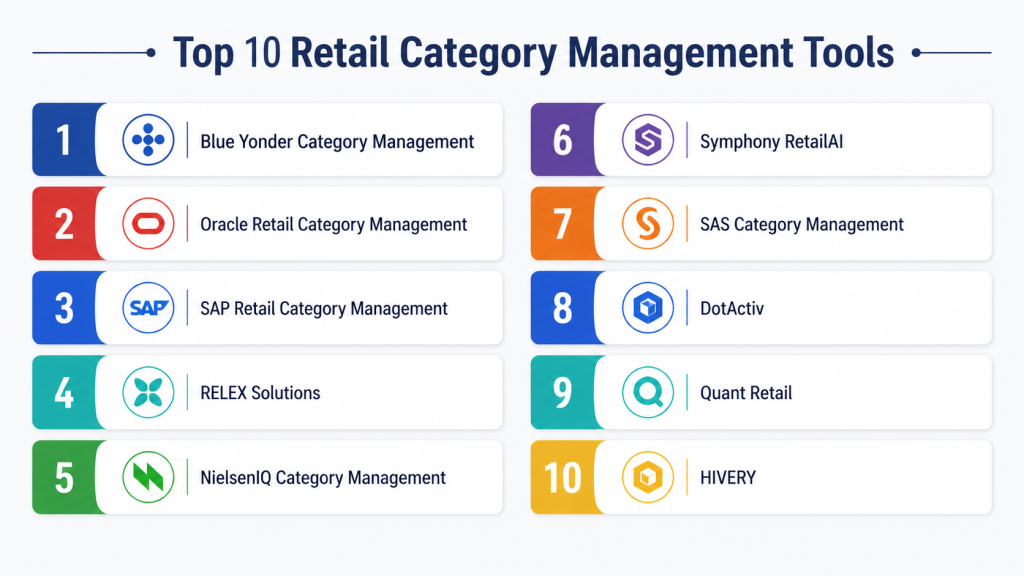
- Top 10 Retail Category Management Tools
#1 — Oracle Retail Category Management
Short description:
Oracle Retail Category Management is a comprehensive enterprise-grade solution designed for large retail organizations. It provides advanced analytics, assortment planning, and category optimization capabilities. The platform integrates deeply with Oracle’s retail ecosystem, making it ideal for companies already using Oracle solutions. It supports data-driven decision-making across merchandising and supply chain operations. With AI-powered insights, retailers can optimize pricing, promotions, and inventory strategies. It is widely used by global retail chains. Best suited for enterprise-scale deployments.
Key Features
- Advanced assortment planning
- AI-driven demand forecasting
- Integrated pricing optimization
- Supplier collaboration tools
- Real-time analytics dashboards
- Planogram management
- Multi-channel retail support
Pros
- Strong enterprise scalability
- Deep integration with Oracle ecosystem
Cons
- Complex implementation
- High cost for smaller businesses
Platforms / Deployment
Cloud / Hybrid
Security & Compliance
SSO, RBAC, audit logs; further certifications not publicly stated
Integrations & Ecosystem
Oracle ecosystem integration with ERP, POS, and supply chain systems.
- Oracle ERP
- Oracle SCM
- POS systems
- Data warehouses
Support & Community
Enterprise-level support with extensive documentation; strong partner ecosystem.
#2 — SAP Retail Assortment Planning
Short description:
SAP Retail Assortment Planning enables retailers to manage product categories with precision. It focuses on assortment optimization, forecasting, and inventory alignment. Built for large enterprises, it integrates seamlessly with SAP’s broader ERP and retail systems. The platform leverages analytics and automation to improve category performance. It is widely used in global retail operations. Offers robust scalability and compliance features. Ideal for SAP-centric organizations.
Key Features
- Assortment optimization tools
- Integrated forecasting
- Inventory alignment features
- Data-driven decision support
- Multi-location planning
- Advanced reporting
- Supplier collaboration
Pros
- Strong ERP integration
- Reliable enterprise performance
Cons
- Steep learning curve
- Requires SAP ecosystem
Platforms / Deployment
Cloud / On-premises
Security & Compliance
SSO, MFA, encryption; certifications vary
Integrations & Ecosystem
Deep SAP ecosystem integration.
- SAP ERP
- SAP S/4HANA
- Supply chain tools
- Analytics platforms
Support & Community
Extensive enterprise support; large global user community.
#3 — Blue Yonder Category Management
Short description:
Blue Yonder offers AI-powered category management solutions focused on demand forecasting and supply chain optimization. It helps retailers make real-time decisions based on predictive analytics. Known for its strong AI capabilities, it supports merchandising, pricing, and inventory planning. The platform is widely used by large retailers. It excels in handling complex retail operations. Ideal for data-driven organizations. Strong focus on automation and efficiency.
Key Features
- AI-based demand forecasting
- Real-time analytics
- Category performance insights
- Pricing optimization
- Supply chain integration
- Scenario planning
- Automation workflows
Pros
- Advanced AI capabilities
- Strong forecasting accuracy
Cons
- High implementation complexity
- Premium pricing
Platforms / Deployment
Cloud
Security & Compliance
Encryption, RBAC; details vary
Integrations & Ecosystem
Integrates with retail and supply chain systems.
- ERP platforms
- POS systems
- Data analytics tools
Support & Community
Strong enterprise support; partner-driven ecosystem.
#4 — NielsenIQ Spaceman
Short description:
NielsenIQ Spaceman is a leading planogram and category management tool focused on shelf optimization. It provides visual merchandising insights and data-driven recommendations. Retailers use it to optimize shelf layouts and improve product placement. It integrates with sales and consumer data sources. Widely used in FMCG and retail sectors. Ideal for merchandising teams. Strong analytics capabilities.
Key Features
- Planogram design tools
- Shelf optimization analytics
- Consumer behavior insights
- Visual merchandising tools
- Reporting dashboards
- Data integration
- Scenario analysis
Pros
- Strong visual analytics
- Industry-standard tool
Cons
- Limited beyond merchandising
- Requires training
Platforms / Deployment
Windows / Cloud
Security & Compliance
Not publicly stated
Integrations & Ecosystem
Connects with sales and analytics systems.
- Retail data sources
- POS systems
- BI tools
Support & Community
Good documentation; widely used in industry.
#5 — RELEX Solutions
Short description:
RELEX Solutions provides unified retail planning across category management, supply chain, and demand forecasting. It is known for its AI-driven approach and real-time analytics. Retailers use it to optimize inventory, pricing, and assortment decisions. The platform supports large-scale retail operations. It offers strong automation capabilities. Suitable for omnichannel retail environments. Focused on operational efficiency.
Key Features
- Unified planning platform
- AI-driven forecasting
- Inventory optimization
- Pricing analytics
- Real-time dashboards
- Automation tools
- Omnichannel support
Pros
- Strong AI and automation
- End-to-end planning
Cons
- Complex onboarding
- Enterprise-focused pricing
Platforms / Deployment
Cloud
Security & Compliance
Encryption, RBAC; further details not publicly stated
Integrations & Ecosystem
Integrates across retail systems.
- ERP
- POS
- Supply chain platforms
Support & Community
Enterprise support with onboarding services.
#6 — Symphony RetailAI
Short description:
Symphony RetailAI offers advanced category management powered by AI and analytics. It focuses on customer-centric merchandising strategies. The platform helps retailers optimize assortment, pricing, and promotions. It provides insights into shopper behavior. Used by global retail brands. Strong analytics capabilities. Ideal for data-driven decision-making.
Key Features
- AI-driven analytics
- Shopper insights
- Pricing optimization
- Promotion planning
- Category performance tracking
- Data visualization
- Forecasting tools
Pros
- Strong analytics
- Customer-focused insights
Cons
- Requires data maturity
- Implementation effort
Platforms / Deployment
Cloud
Security & Compliance
Not publicly stated
Integrations & Ecosystem
Works with retail analytics ecosystems.
- POS systems
- CRM platforms
- Data warehouses
Support & Community
Enterprise support; partner-led services.
#7 — Aptos Merchandising
Short description:
Aptos Merchandising provides retail planning and category management tools for modern retailers. It focuses on merchandising, assortment planning, and inventory optimization. The platform supports omnichannel retail strategies. It offers flexible deployment options. Known for its usability compared to other enterprise tools. Suitable for mid-market and enterprise retailers.
Key Features
- Assortment planning
- Inventory optimization
- Merchandising tools
- Omnichannel support
- Reporting dashboards
- Forecasting tools
- Workflow automation
Pros
- User-friendly interface
- Flexible deployment
Cons
- Limited AI compared to competitors
- Integration setup required
Platforms / Deployment
Cloud / On-premises
Security & Compliance
SSO, RBAC; details vary
Integrations & Ecosystem
Integrates with retail systems.
- ERP
- POS
- E-commerce platforms
Support & Community
Good support; growing ecosystem.
#8 — SAS Category Management
Short description:
SAS Category Management leverages advanced analytics and data science for retail optimization. It provides deep insights into category performance and customer behavior. The platform is ideal for analytics-driven organizations. It supports complex data modeling. Known for its strong analytics capabilities. Suitable for large enterprises. Focus on data-driven decision-making.
Key Features
- Advanced analytics
- Predictive modeling
- Category performance insights
- Data visualization
- Customer behavior analysis
- Reporting tools
- Integration capabilities
Pros
- Best-in-class analytics
- Strong data science capabilities
Cons
- Requires expertise
- Higher cost
Platforms / Deployment
Cloud / On-premises
Security & Compliance
Encryption, RBAC; certifications vary
Integrations & Ecosystem
Integrates with data platforms.
- Data warehouses
- BI tools
- ERP systems
Support & Community
Strong enterprise support; active user base.
#9 — Retail Insights (RI)
Short description:
Retail Insights offers category management and analytics tools focused on improving retail performance. It provides actionable insights for merchandising and supply chain decisions. The platform is designed for scalability. It supports data-driven retail strategies. Suitable for mid-market and enterprise retailers. Focus on analytics and reporting. Easy integration capabilities.
Key Features
- Retail analytics
- Category performance tracking
- Reporting dashboards
- Forecasting tools
- Data integration
- Workflow automation
- Insights generation
Pros
- Strong analytics
- Easy integration
Cons
- Limited global presence
- Fewer advanced AI features
Platforms / Deployment
Cloud
Security & Compliance
Not publicly stated
Integrations & Ecosystem
Connects with retail systems.
- POS
- ERP
- Analytics tools
Support & Community
Moderate support; improving ecosystem.
#10 — JDA Category Management (Legacy / Blue Yonder)
Short description:
JDA Category Management, now part of Blue Yonder, is a legacy solution widely used in retail. It provides tools for category planning, assortment optimization, and analytics. Known for its reliability and scalability. It supports large retail operations. Still used by many enterprises. Offers strong functionality but evolving with modern platforms. Suitable for existing users.
Key Features
- Category planning
- Assortment optimization
- Analytics tools
- Reporting dashboards
- Forecasting
- Integration capabilities
- Workflow management
Pros
- Proven reliability
- Strong enterprise adoption
Cons
- Legacy interface
- Modernization required
Platforms / Deployment
On-premises / Cloud
Security & Compliance
Varies / Not publicly stated
Integrations & Ecosystem
Integrates with enterprise systems.
- ERP
- POS
- Supply chain tools
Support & Community
Legacy support with transition to modern platforms.
Comparison Table (Top 10)
| Tool Name | Best For | Platform(s) | Deployment | Standout Feature | Public Rating |
|---|---|---|---|---|---|
| Oracle Retail | Enterprise retail | Web | Cloud/Hybrid | Deep ERP integration | N/A |
| SAP Assortment | SAP users | Web | Cloud/On-prem | ERP alignment | N/A |
| Blue Yonder | AI-driven retail | Web | Cloud | Predictive analytics | N/A |
| NielsenIQ Spaceman | Merchandising | Windows | Cloud | Planogram tools | N/A |
| RELEX | Omnichannel planning | Web | Cloud | Real-time optimization | N/A |
| Symphony RetailAI | Shopper insights | Web | Cloud | Customer analytics | N/A |
| Aptos | Mid-market retail | Web | Hybrid | Usability | N/A |
| SAS | Data analytics | Web | Hybrid | Advanced modeling | N/A |
| Retail Insights | Analytics | Web | Cloud | Reporting | N/A |
| JDA | Legacy enterprise | Web | Hybrid | Proven reliability | N/A |
Evaluation & Scoring of Retail Category Management Tools
| Tool Name | Core | Ease | Integrations | Security | Performance | Support | Value | Weighted Total |
|---|---|---|---|---|---|---|---|---|
| Oracle Retail | 9 | 6 | 9 | 8 | 9 | 8 | 6 | 8.0 |
| SAP | 9 | 6 | 9 | 8 | 9 | 8 | 6 | 8.0 |
| Blue Yonder | 9 | 7 | 8 | 8 | 9 | 8 | 6 | 8.1 |
| NielsenIQ | 8 | 7 | 7 | 6 | 8 | 7 | 7 | 7.4 |
| RELEX | 9 | 7 | 8 | 8 | 9 | 8 | 7 | 8.3 |
| Symphony | 8 | 7 | 7 | 7 | 8 | 7 | 7 | 7.6 |
| Aptos | 8 | 8 | 7 | 7 | 8 | 7 | 8 | 7.8 |
| SAS | 9 | 6 | 8 | 8 | 9 | 8 | 6 | 8.0 |
| Retail Insights | 7 | 8 | 7 | 6 | 7 | 6 | 8 | 7.2 |
| JDA | 8 | 6 | 8 | 7 | 8 | 7 | 7 | 7.6 |
How to interpret scores:
- Scores are comparative across tools, not absolute benchmarks.
- Higher “Core” reflects stronger feature depth.
- “Ease” highlights usability and onboarding effort.
- “Value” balances pricing with capabilities.
- Use weighted totals as a shortlist guide, not final decision criteria.
Which Retail Category Management Tools Is Right for You?
Solo / Freelancer
Basic tools or spreadsheets may suffice; full platforms are often unnecessary.
SMB
Choose tools like Aptos or Retail Insights for affordability and usability.
Mid-Market
RELEX or Symphony RetailAI offer balance between features and scalability.
Enterprise
Oracle, SAP, and Blue Yonder provide full-scale capabilities and integrations.
Budget vs Premium
- Budget: Retail Insights, Aptos
- Premium: Oracle, SAP, Blue Yonder
Feature Depth vs Ease of Use
- Deep features: SAS, Oracle
- Easy to use: Aptos, Retail Insights
Integrations & Scalability
Enterprise tools provide better ecosystem integration and global scalability.
Security & Compliance Needs
Large enterprises should prioritize platforms with SSO, RBAC, and audit logs.
Frequently Asked Questions (FAQs)
1. What are Retail Category Management Tools?
These tools help retailers organize products into categories and optimize pricing, assortment, and placement. They provide analytics to improve sales and margins. Businesses use them to make data-driven decisions. They integrate with POS and ERP systems. They are essential for modern retail operations.
2. How much do these tools cost?
Pricing varies widely based on features and scale. Enterprise tools can be expensive. SMB tools are more affordable. Some vendors offer subscription models. Others use custom pricing. Always evaluate ROI before choosing.
3. How long does implementation take?
Implementation can take weeks to months. It depends on data complexity and integrations. Enterprise deployments take longer. SMB tools are quicker to set up. Proper planning reduces delays.
4. Are these tools secure?
Most tools include security features like encryption and access control. Enterprise tools offer advanced compliance. Always verify certifications. Security depends on vendor implementation. Evaluate before purchase.
5. Can these tools integrate with existing systems?
Yes, most tools integrate with ERP, POS, and analytics platforms. Integration capabilities vary. APIs are commonly available. Enterprise tools offer deeper integrations. Always check compatibility.
6. What are common mistakes when choosing tools?
Choosing based only on price is a mistake. Ignoring integration needs can cause issues. Lack of training affects adoption. Not considering scalability limits growth. Evaluate all factors carefully.
7. Do these tools support AI features?
Many modern tools include AI capabilities. These include forecasting and pricing optimization. AI improves decision-making. Adoption is increasing rapidly. Not all tools offer advanced AI.
8. Can small retailers use these tools?
Yes, but simpler tools are recommended. Large platforms may be overkill. SMB-focused tools provide better value. Evaluate needs before investing. Start small and scale.
9. How do I switch from one tool to another?
Switching requires data migration and planning. Ensure compatibility with new systems. Test integrations before full deployment. Train teams during transition. Gradual rollout reduces risks.
10. Are there alternatives to category management tools?
Yes, spreadsheets and basic POS systems can be alternatives. However, they lack advanced analytics. Large retailers need specialized tools. Alternatives work for small operations. Evaluate based on complexity.
Conclusion
Retail Category Management Tools have evolved into essential platforms for modern retail operations, enabling data-driven decisions across assortment planning, pricing, and inventory optimization. As retail becomes increasingly complex with omnichannel demands and AI-driven personalization, these tools provide the structure and intelligence needed to stay competitive. From enterprise giants like Oracle and SAP to flexible solutions like Aptos and RELEX, the market offers a wide range of options tailored to different business sizes and needs.
Choosing the right tool depends heavily on your organization’s scale, technical ecosystem, and strategic priorities. Enterprises may prioritize deep integrations and advanced analytics, while mid-market and SMB retailers often look for usability and cost efficiency. Security, scalability, and integration capabilities should remain top considerations, especially as retail systems become more interconnected with broader IT and cybersecurity frameworks.
The best approach is to shortlist two or three tools that align with your requirements, run pilot implementations, and validate their performance in real-world scenarios. Focus on how well they integrate with your existing systems, support your team’s workflows, and deliver measurable ROI. Ultimately, the “best” tool is the one that fits your operational context and helps you make smarter, faster retail decisions.
