Introduction
Retail Pricing Optimization Tools are advanced software solutions that help retailers set, adjust, and manage product prices based on demand, competition, customer behavior, and market conditions. These tools go beyond manual pricing strategies by using data analytics, machine learning, and AI to recommend optimal prices that maximize revenue and profitability.
In today’s competitive retail landscape, pricing is one of the most powerful levers for growth. Even small pricing changes can significantly impact sales volume, margins, and customer perception. Modern pricing optimization tools allow retailers to respond quickly to market changes, run dynamic pricing strategies, and improve overall financial performance.
Common use cases include:
- Dynamic pricing based on demand and competition
- Markdown optimization for seasonal products
- Promotional pricing strategy planning
- Revenue and margin optimization
- Price elasticity analysis
What buyers should evaluate:
- AI-driven pricing capabilities
- Real-time data processing
- Competitive price monitoring
- Integration with POS and ERP systems
- Scenario planning and simulations
- Scalability for large product catalogs
- Reporting and analytics depth
- Ease of use and automation level
- Security and data governance
Best for: Retail chains, e-commerce businesses, supermarkets, fashion brands, and multi-category retailers.
Not ideal for: Very small retailers with fixed pricing models or businesses without structured product data.
Key Trends in Retail Pricing Optimization Tools
- AI-powered dynamic pricing engines
- Real-time competitor price tracking
- Predictive demand forecasting for pricing decisions
- Personalized pricing strategies based on customer behavior
- Automated markdown and clearance optimization
- Omnichannel pricing consistency across stores and online platforms
- Integration with POS, ERP, and e-commerce platforms
- Cloud-based pricing platforms for scalability
- Advanced elasticity modeling for profit optimization
- Scenario-based pricing simulations for decision-making
How We Evaluate Pricing Optimization Tools (Methodology)
- Market adoption and retail industry usage
- AI and automation capabilities
- Pricing strategy flexibility and accuracy
- Integration ecosystem (POS, ERP, e-commerce)
- Real-time analytics and responsiveness
- Scalability for large retail environments
- Security and compliance readiness
- Ease of implementation and usability
- Value for money and ROI impact
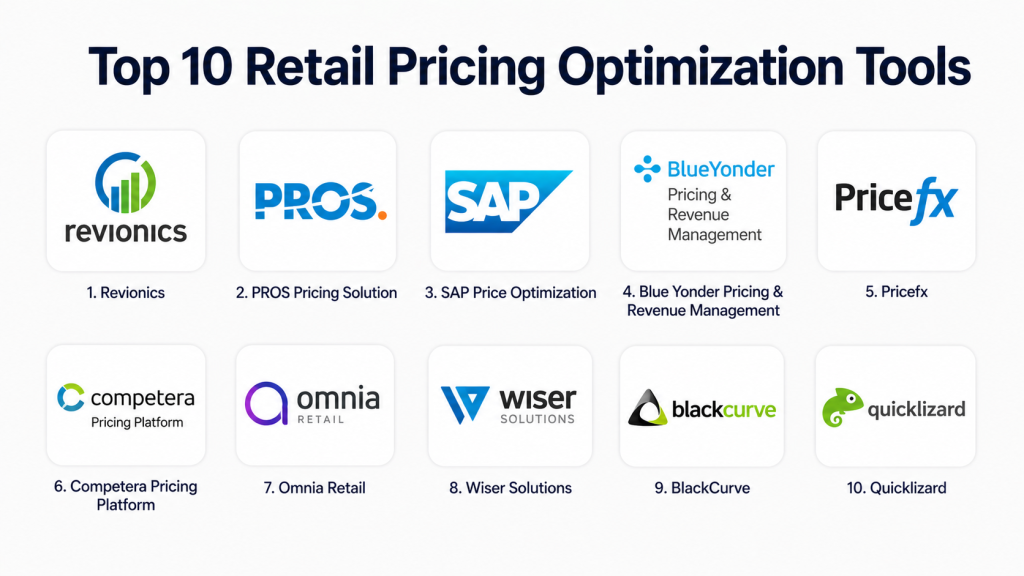
- Top 10 Retail Pricing Optimization Tools
#1 — Revionics (by Aptos)
Short description:
Revionics is one of the most widely used AI-driven pricing optimization platforms in retail. It helps businesses optimize pricing strategies across products, promotions, and markdowns. The platform uses advanced analytics to improve margins and competitiveness. It is widely adopted by large retail chains. Revionics focuses on data-driven pricing decisions.
Key Features
- AI-based price optimization
- Competitive pricing analysis
- Markdown optimization
- Demand forecasting
- Promotion planning
Pros
- Strong AI capabilities
- Excellent for large retailers
Cons
- Complex setup
- Enterprise pricing
Platforms / Deployment
Cloud
Security & Compliance
Enterprise-grade security controls
Integrations & Ecosystem
- ERP systems
- Retail analytics tools
Support & Community
Enterprise support
#2 — PROS Pricing Solution
Short description:
PROS provides AI-powered pricing optimization solutions designed for dynamic and competitive markets. It helps retailers and enterprises adjust prices in real time based on demand signals. The platform is known for its advanced machine learning models. It improves revenue and margin performance. PROS is widely used in retail and B2B pricing.
Key Features
- Dynamic pricing optimization
- AI-driven recommendations
- Revenue management
- Price elasticity modeling
- Real-time analytics
Pros
- Strong AI engine
- High accuracy in pricing models
Cons
- High complexity
- Expensive for SMBs
Platforms / Deployment
Cloud
Security & Compliance
Enterprise security standards
Integrations & Ecosystem
- ERP systems
- CRM platforms
Support & Community
Enterprise-level support
#3 — SAP Price Optimization
Short description:
SAP Price Optimization is part of SAP’s retail and commerce suite. It enables retailers to manage pricing strategies across channels. The platform uses analytics to optimize pricing decisions. It is widely used in global retail enterprises. SAP ensures strong integration with enterprise systems.
Key Features
- Price optimization
- Demand forecasting
- Promotion management
- Margin analysis
- Scenario planning
Pros
- Strong ERP integration
- Reliable enterprise solution
Cons
- Complex implementation
- High cost
Platforms / Deployment
Cloud / On-premise
Security & Compliance
SAP enterprise security framework
Integrations & Ecosystem
- SAP ERP
- SAP Commerce Cloud
Support & Community
Global enterprise support
#4 — Blue Yonder Pricing & Revenue Management
Short description:
Blue Yonder offers AI-driven pricing and revenue optimization tools for retailers. It helps businesses adjust prices dynamically based on demand patterns and competition. The platform is widely used in large retail chains. It improves profitability through predictive analytics. Blue Yonder is strong in supply chain and pricing synergy.
Key Features
- Dynamic pricing
- Demand forecasting
- Markdown optimization
- Revenue management
- AI analytics
Pros
- Strong AI capabilities
- Real-time optimization
Cons
- Complex setup
- Enterprise focus
Platforms / Deployment
Cloud
Security & Compliance
Enterprise-grade compliance
Integrations & Ecosystem
- ERP systems
- Retail platforms
Support & Community
Enterprise support
#5 — Pricefx
Short description:
Pricefx is a cloud-based pricing optimization platform that supports retail and manufacturing industries. It provides flexible pricing strategies and real-time analytics. The platform is known for its configurability. It helps businesses optimize margins and pricing structures. Pricefx is widely used in mid to large enterprises.
Key Features
- Price optimization
- Margin management
- Promotion planning
- Analytics dashboards
- Scenario modeling
Pros
- Highly flexible
- Cloud-native architecture
Cons
- Learning curve
- Customization complexity
Platforms / Deployment
Cloud
Security & Compliance
RBAC, encryption
Integrations & Ecosystem
- ERP systems
- CRM tools
Support & Community
Strong vendor support
#6 — Competera Pricing Platform
Short description:
Competera is an AI-powered pricing optimization tool focused on retail price intelligence. It helps retailers set competitive and profitable pricing strategies. The platform uses machine learning for price recommendations. It is suitable for large retail and e-commerce businesses. Competera improves pricing accuracy.
Key Features
- AI price optimization
- Competitive pricing analysis
- Demand forecasting
- Price elasticity modeling
Pros
- Strong AI capabilities
- Good retail focus
Cons
- Limited SMB suitability
- Requires data maturity
Platforms / Deployment
Cloud
Security & Compliance
Standard enterprise security
Integrations & Ecosystem
- E-commerce platforms
- Retail analytics tools
Support & Community
Vendor support
#7 — Omnia Retail
Short description:
Omnia Retail provides automated pricing optimization for omnichannel retailers. It enables real-time price adjustments based on competitor and demand data. The platform is widely used in European retail markets. It supports dynamic pricing strategies. Omnia improves profitability and competitiveness.
Key Features
- Dynamic pricing
- Competitor tracking
- Promotion optimization
- Omnichannel pricing
Pros
- Strong automation
- Real-time updates
Cons
- Limited enterprise presence
- Regional focus
Platforms / Deployment
Cloud
Security & Compliance
GDPR compliant
Integrations & Ecosystem
- E-commerce platforms
- Retail systems
Support & Community
Good support availability
#8 — Wiser Solutions
Short description:
Wiser Solutions focuses on retail intelligence and pricing optimization. It provides competitive price tracking and analytics. The platform helps retailers optimize pricing strategies in real time. It is widely used in e-commerce and retail sectors. Wiser improves pricing visibility.
Key Features
- Price intelligence
- Competitive tracking
- Market analytics
- Pricing optimization
Pros
- Strong data insights
- Easy to use
Cons
- Limited advanced AI features
- Focused more on intelligence than automation
Platforms / Deployment
Cloud
Security & Compliance
Standard compliance features
Integrations & Ecosystem
- Retail analytics platforms
- E-commerce systems
Support & Community
Vendor support
#9 — BlackCurve
Short description:
BlackCurve is a pricing optimization platform designed for e-commerce and retail businesses. It focuses on automated pricing strategies and profit optimization. The platform helps businesses increase margins. It is suitable for growing retailers. BlackCurve simplifies pricing decisions.
Key Features
- Automated pricing
- Competitor monitoring
- Profit optimization
- Pricing rules engine
Pros
- Easy automation
- Strong focus on profitability
Cons
- Limited enterprise scale
- Fewer integrations
Platforms / Deployment
Cloud
Security & Compliance
Not publicly stated
Integrations & Ecosystem
- Shopify
- E-commerce tools
Support & Community
Standard support
#10 — Quicklizard
Short description:
Quicklizard is an AI-based pricing optimization platform designed for retail and e-commerce. It helps businesses automate pricing decisions using real-time data. The platform supports dynamic and rule-based pricing strategies. It improves revenue optimization. Quicklizard is suitable for mid to large retailers.
Key Features
- AI pricing engine
- Dynamic pricing
- Competitive analysis
- Rule-based pricing automation
Pros
- Strong automation
- AI-driven insights
Cons
- Learning curve
- Enterprise-focused pricing
Platforms / Deployment
Cloud
Security & Compliance
Enterprise security standards
Integrations & Ecosystem
- ERP systems
- Retail platforms
Support & Community
Vendor support
Comparison Table
| Tool Name | Best For | Platform(s) | Deployment | Standout Feature | Public Rating |
|---|---|---|---|---|---|
| Revionics | Enterprise retail | Web | Cloud | AI pricing | N/A |
| PROS | Dynamic pricing | Web | Cloud | Revenue optimization | N/A |
| SAP Price Optimization | Global retail | Web | Hybrid | ERP integration | N/A |
| Blue Yonder | Large retail | Web | Cloud | AI forecasting | N/A |
| Pricefx | Mid-large retail | Web | Cloud | Flexibility | N/A |
| Competera | E-commerce | Web | Cloud | Price intelligence | N/A |
| Omnia Retail | Omnichannel retail | Web | Cloud | Real-time pricing | N/A |
| Wiser Solutions | Retail analytics | Web | Cloud | Price intelligence | N/A |
| BlackCurve | SMB e-commerce | Web | Cloud | Profit optimization | N/A |
| Quicklizard | Retail enterprises | Web | Cloud | AI automation | N/A |
Evaluation & Scoring of Pricing Optimization Tools
| Tool | Core | Ease | Integrations | Security | Performance | Support | Value | Total |
|---|---|---|---|---|---|---|---|---|
| Revionics | 10 | 7 | 9 | 9 | 9 | 9 | 7 | 8.6 |
| PROS | 10 | 7 | 9 | 9 | 9 | 9 | 6 | 8.5 |
| SAP Price Opt | 10 | 6 | 10 | 10 | 9 | 9 | 6 | 8.6 |
| Blue Yonder | 9 | 7 | 9 | 9 | 9 | 9 | 7 | 8.4 |
| Pricefx | 9 | 7 | 8 | 8 | 8 | 8 | 7 | 8.0 |
| Competera | 9 | 7 | 8 | 8 | 8 | 8 | 7 | 7.9 |
| Omnia Retail | 8 | 8 | 7 | 8 | 8 | 8 | 8 | 7.9 |
| Wiser Solutions | 8 | 8 | 7 | 7 | 8 | 8 | 8 | 7.7 |
| BlackCurve | 8 | 8 | 7 | 7 | 7 | 7 | 8 | 7.5 |
| Quicklizard | 9 | 7 | 8 | 8 | 8 | 8 | 7 | 8.0 |
Which Pricing Optimization Tool Is Right for You?
SMB Retailers
BlackCurve and Omnia Retail are ideal due to simplicity and affordability.
Mid-Market Retail
Pricefx and Competera offer strong balance of features and scalability.
Enterprise Retail
Revionics, SAP, and Blue Yonder are best for complex pricing operations.
E-commerce Businesses
Competera and BlackCurve work well for online pricing strategies.
Budget vs Premium
Budget tools focus on basic automation, while enterprise tools provide AI-driven optimization.
Feature Depth vs Ease of Use
Simple tools are easier to deploy; advanced tools offer deeper analytics and control.
Integrations & Scalability
Choose tools that integrate with ERP, POS, and e-commerce platforms.
Security & Compliance
Enterprise tools offer strong governance, RBAC, and compliance support.
Frequently Asked Questions (FAQs)
1. What are retail pricing optimization tools?
These tools help retailers set optimal product prices using data and AI. They analyze demand, competition, and customer behavior. They improve profitability. They automate pricing decisions. They are widely used in modern retail.
2. Why are pricing optimization tools important?
They help maximize revenue and margins. They reduce manual pricing errors. They enable dynamic pricing strategies. They improve competitiveness. They support data-driven decisions.
3. Do these tools use AI?
Yes, most modern tools use AI and machine learning. AI helps predict demand and optimize pricing. It improves accuracy. It enables real-time adjustments. AI is a core feature.
4. Are these tools only for large retailers?
No, SMB-focused tools also exist. However, enterprise tools are more common. Small retailers may use simpler solutions. Complexity depends on scale. Use case matters.
5. Can they integrate with POS systems?
Yes, most tools integrate with POS and ERP systems. This ensures real-time data synchronization. It improves pricing accuracy. It supports omnichannel retail. Integration is critical.
6. Are pricing optimization tools expensive?
Enterprise tools are expensive. SMB tools are more affordable. Pricing depends on features and scale. Subscription models are common. ROI is typically high.
7. Do they support e-commerce pricing?
Yes, they are widely used in e-commerce. They optimize online pricing dynamically. They track competitor prices. They improve conversion rates. They are essential for online retail.
8. How do they improve profits?
They optimize prices based on demand and competition. They reduce over-discounting. They improve margin control. They increase sales efficiency. They support better decisions.
9. Are these tools secure?
Yes, enterprise tools follow strict security standards. They include RBAC and encryption. Compliance varies by vendor. Security is important for retail data. Proper configuration is required.
10. What are alternatives?
Alternatives include manual pricing and spreadsheets. However, they lack automation. They are less accurate. Pricing tools provide better efficiency. They are recommended for modern retail.
Conclusion
Retail pricing optimization tools are essential for businesses looking to stay competitive in a data-driven retail environment. They enable dynamic pricing, improve profitability, and help retailers respond quickly to market changes. With AI and automation becoming standard, these tools are now a critical part of modern retail strategy.
Choosing the right tool depends on your business size, pricing complexity, and integration needs. While enterprise platforms offer deep analytics and automation, mid-market tools provide a balance of usability and functionality. A well-selected pricing optimization tool can significantly improve revenue performance and long-term business growth.
