Introduction
Responsible AI Tooling refers to platforms and software that help organizations build, monitor, and govern AI models in a safe, ethical, and compliant manner. These tools provide capabilities for bias detection, fairness evaluation, explainability, transparency, and regulatory compliance, ensuring AI systems align with ethical standards and organizational policies.
With the increasing adoption of AI in critical areas like healthcare, finance, HR, and law enforcement, Responsible AI Tooling is essential for mitigating risks, ensuring accountability, and fostering trust in AI-driven decisions.
Real-world use cases include
- Detecting and mitigating bias in ML models
- Monitoring AI models for fairness and performance drift
- Providing explainable AI outputs for stakeholders and regulators
- Ensuring compliance with ethical guidelines and regulations
- Auditing AI pipelines for governance and accountability
What buyers should evaluate
- Model interpretability and explainability features
- Bias and fairness detection capabilities
- Compliance and governance support
- Monitoring and reporting tools
- Integration with ML pipelines and MLOps platforms
- Scalability for large models and datasets
- Deployment flexibility (cloud, on-prem, hybrid)
- AI ethics and policy enforcement
- Automation for responsible AI workflows
- Cost and licensing structure
Best for: AI ethics teams, ML engineers, data scientists, compliance officers, and enterprises deploying AI in regulated environments
Not ideal for: Teams using only experimental or small-scale AI projects without high-stakes decisions
Key Trends in Responsible AI Tooling
- AI model explainability and interpretability becoming standard
- Automated bias detection for datasets and model outputs
- Integration with MLOps pipelines for continuous responsible AI monitoring
- Regulatory compliance support for GDPR, AI Act, and sector-specific rules
- Transparency dashboards for stakeholders and auditors
- Low-code tools for business users to monitor fairness and ethics
- Multi-modal evaluation for NLP, computer vision, and other AI types
- Collaboration features for cross-functional AI governance
- Real-time monitoring for model drift and performance
- Embedding ethical AI policies directly into development workflows
How We Selected These Tools
- Coverage of bias, fairness, and interpretability features
- Integration with ML frameworks and AI pipelines
- Scalability for enterprise-scale models
- Monitoring and governance capabilities
- Automation of responsible AI processes
- Security and compliance readiness
- Usability for both technical and non-technical users
- Support for multi-modal AI evaluation
- Vendor reputation and community adoption
- Practical relevance for enterprise AI deployments
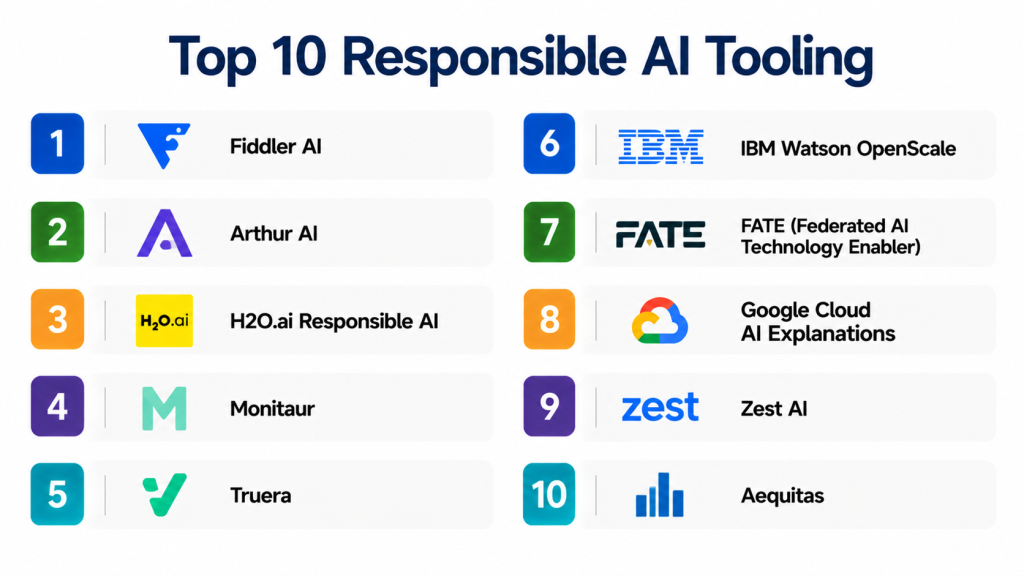
Top 10 Responsible AI Tooling
1- Fiddler AI
Short description: Fiddler AI provides a platform for explainable AI, model monitoring, and bias detection across ML pipelines.
Key Features
- Model explainability and interpretability
- Bias and fairness detection
- Performance monitoring and drift detection
- Regulatory compliance reporting
- API and SDK integration
- Multi-model support (NLP, CV, tabular)
- Dashboards and alerting
Pros
- Strong explainability tools
- Scalable monitoring
- Real-time alerts and insights
Cons
- Cloud-first, limited on-prem support
- Enterprise pricing
Platforms / Deployment
- Cloud
Security & Compliance
- Not publicly stated
Integrations & Ecosystem
- TensorFlow, PyTorch, Scikit-learn
- MLOps pipelines (Kubeflow, MLflow)
- REST APIs
Support & Community
Enterprise support with active technical resources
2- Arthur AI
Short description: Arthur AI is a responsible AI platform focusing on monitoring, bias detection, and model explainability for enterprise ML models.
Key Features
- Bias and fairness assessment
- Performance monitoring across deployments
- Explainable AI and feature attribution
- Automated alerts for model drift
- Integration with ML pipelines
- Multi-modal model support
- Reporting dashboards
Pros
- Easy integration with existing pipelines
- Scalable for large datasets
- Real-time model monitoring
Cons
- Cloud-only deployment
- Cost scales with enterprise usage
Platforms / Deployment
- Cloud
Security & Compliance
- Not publicly stated
Integrations & Ecosystem
- Python SDKs, REST APIs
- TensorFlow, PyTorch
- MLOps integration
Support & Community
Enterprise support with documentation
3- H2O.ai Responsible AI
Short description: H2O.ai provides tools for explainability, bias detection, and governance integrated with their AI platform.
Key Features
- Model interpretability and SHAP-based explanations
- Fairness and bias evaluation
- Regulatory compliance workflows
- Automated monitoring for model drift
- API integration
- Multi-modal AI support
- Analytics dashboards
Pros
- Integrated with H2O.ai ML platform
- Strong interpretability features
- Scalable enterprise-ready
Cons
- Best used with H2O models
- Enterprise features may require subscription
Platforms / Deployment
- Cloud / Self-hosted / Hybrid
Security & Compliance
- Not publicly stated
Integrations & Ecosystem
- H2O.ai framework, Python SDK
- REST APIs
- ML pipelines
Support & Community
Enterprise support and active community
4- Monitaur
Short description: Monitaur is a responsible AI monitoring platform designed for bias detection, fairness evaluation, and governance.
Key Features
- Bias detection across datasets and models
- Model explainability
- Governance dashboards
- Monitoring for performance drift
- API and SDK integration
- Multi-modal model support
- Collaboration features
Pros
- Focused on fairness and ethics
- Real-time monitoring
- Collaboration across teams
Cons
- Less known than larger vendors
- Cloud-focused
Platforms / Deployment
- Cloud
Security & Compliance
- Not publicly stated
Integrations & Ecosystem
- Python, REST APIs
- AI/ML frameworks
- MLOps pipelines
Support & Community
Vendor support with technical documentation
5- Truera
Key Features
Short description: Truera provides a platform for explainable AI, bias detection, and model risk governance, suitable for enterprise ML models.
- Explainable AI and model interpretability
- Bias and fairness detection
- Performance monitoring
- Governance and compliance reporting
- API integration
- Multi-modal AI support
- Analytics dashboards
Pros
- Enterprise-grade responsible AI
- Multi-model support
- Scalable monitoring
Cons
- Cloud-first deployment
- Cost may be high for small teams
Platforms / Deployment
- Cloud
Security & Compliance
- Not publicly stated
Integrations & Ecosystem
- TensorFlow, PyTorch
- Python SDK, REST APIs
- ML pipelines
Support & Community
Enterprise support and documentation
6- IBM Watson OpenScale
Short description: IBM Watson OpenScale provides responsible AI tooling for monitoring fairness, explainability, and model performance in enterprise AI.
Key Features
- Model explainability and interpretability
- Bias detection and fairness metrics
- Drift and performance monitoring
- Regulatory compliance tracking
- Integration with Watson AI models
- Dashboard and alerting
- API and SDK support
Pros
- Strong enterprise support
- Integrated with IBM AI services
- Scalable for large deployments
Cons
- Best for IBM ecosystem users
- Enterprise pricing
Platforms / Deployment
- Cloud / Hybrid
Security & Compliance
- Enterprise-grade encryption and access control
Integrations & Ecosystem
- IBM Watson AI
- Python SDKs, REST APIs
- ML pipelines and MLOps frameworks
Support & Community
Enterprise support with documentation
7- FATE (Federated AI Technology Enabler)
Short description: FATE is an open-source responsible AI framework for federated learning with fairness and explainability capabilities.
Key Features
- Federated learning with privacy-preserving methods
- Bias detection and fairness evaluation
- Model interpretability
- Multi-party collaboration
- API integration
- Multi-modal AI support
- Monitoring dashboards
Pros
- Open-source and privacy-focused
- Supports federated learning
- Scalable for distributed environments
Cons
- Requires technical expertise
- Less user-friendly UI
Platforms / Deployment
- Cloud / Self-hosted / Hybrid
Security & Compliance
- Not publicly stated
Integrations & Ecosystem
- Python SDK, REST APIs
- AI/ML pipelines
- Kubernetes deployment
Support & Community
Active open-source community
8- Google Cloud AI Explanations
Short description: Google Cloud provides explainability and responsible AI features integrated into its AI platform.
Key Features
- Model interpretability for ML models
- Bias detection and fairness evaluation
- Integration with AutoML and Vertex AI
- Drift monitoring and reporting
- API access for programmatic use
- Multi-modal support
- Analytics dashboards
Pros
- Cloud-native and fully managed
- Strong integration with GCP AI services
- Scalable for enterprise AI
Cons
- GCP lock-in
- Limited on-prem deployment
Platforms / Deployment
- Cloud (GCP)
Security & Compliance
- Google enterprise security standards
Integrations & Ecosystem
- TensorFlow, Vertex AI, AutoML
- REST APIs
- MLOps pipelines
Support & Community
Google enterprise support and documentation
9- Zest AI
Short description: Zest AI provides responsible AI solutions for bias detection, explainability, and ethical AI deployment, primarily in finance.
Key Features
- Explainable AI for credit models
- Fairness and bias detection
- Model monitoring and governance
- API and SDK integration
- Multi-modal AI support
- Reporting dashboards
- Compliance tracking
Pros
- Strong compliance and governance focus
- Finance industry expertise
- Scalable enterprise-ready solution
Cons
- Limited outside financial services
- Cloud-based only
Platforms / Deployment
- Cloud
Security & Compliance
- Not publicly stated
Integrations & Ecosystem
- Python SDKs, REST APIs
- Integration with ML pipelines
Support & Community
Vendor support and training resources
10- Aequitas
Short description: Aequitas is an open-source fairness and bias auditing tool for AI models, enabling evaluation and mitigation of ethical risks.
Key Features
- Bias detection and fairness auditing
- Metrics for model evaluation
- Multi-modal AI support
- Python-based APIs
- Reporting and dashboards
- Integration with ML pipelines
- Model monitoring
Pros
- Open-source and customizable
- Focused on fairness and ethics
- Lightweight and developer-friendly
Cons
- Limited UI for non-technical users
- Self-hosting required
Platforms / Deployment
- Cloud / Self-hosted
Security & Compliance
- Not publicly stated
Integrations & Ecosystem
- Python SDKs
- Integration with AI/ML frameworks
Support & Community
Open-source community with technical resources
Comparison Table
| Tool | Best For | Platform(s) | Deployment | Standout Feature | Public Rating |
|---|---|---|---|---|---|
| Fiddler AI | Explainable AI | Cloud | Cloud | Real-time monitoring | N/A |
| Arthur AI | Enterprise ML | Cloud | Cloud | Bias detection | N/A |
| H2O.ai Responsible AI | ML explainability | Cloud/Hybrid | Hybrid | SHAP-based interpretability | N/A |
| Monitaur | Bias/fairness monitoring | Cloud | Cloud | Ethics-focused dashboards | N/A |
| Truera | Enterprise AI governance | Cloud | Cloud | Model risk management | N/A |
| IBM Watson OpenScale | Enterprise ML | Cloud/Hybrid | Hybrid | Governance & explainability | N/A |
| FATE | Federated learning | Cloud/Self-hosted | Hybrid | Privacy-preserving federated AI | N/A |
| Google Cloud AI Explanations | Cloud AI models | Cloud (GCP) | Cloud | Model interpretability | N/A |
| Zest AI | Finance AI | Cloud | Cloud | Fairness and compliance | N/A |
| Aequitas | Bias auditing | Cloud/Self-hosted | Hybrid | Open-source fairness metrics | N/A |
Evaluation & Scoring of Responsible AI Tooling
| Tool | Core (25%) | Ease (15%) | Integrations (15%) | Security (10%) | Performance (10%) | Support (10%) | Value (15%) | Weighted Total |
|---|---|---|---|---|---|---|---|---|
| Fiddler AI | 9 | 8 | 8 | 8 | 8 | 8 | 8 | 8.3 |
| Arthur AI | 8 | 8 | 8 | 7 | 8 | 7 | 8 | 7.9 |
| H2O.ai | 8 | 7 | 8 | 7 | 8 | 7 | 8 | 7.8 |
| Monitaur | 8 | 7 | 7 | 7 | 8 | 7 | 7 | 7.6 |
| Truera | 8 | 7 | 8 | 7 | 8 | 7 | 8 | 7.8 |
| IBM Watson OpenScale | 8 | 7 | 8 | 8 | 8 | 7 | 8 | 7.9 |
| FATE | 8 | 6 | 7 | 7 | 8 | 7 | 7 | 7.5 |
| Google Cloud AI Explanations | 8 | 8 | 8 | 8 | 8 | 7 | 8 | 7.9 |
| Zest AI | 8 | 7 | 7 | 7 | 8 | 7 | 7 | 7.6 |
| Aequitas | 7 | 7 | 7 | 7 | 7 | 7 | 7 | 7.0 |
Which Responsible AI Tool Is Right for You?
Solo / Freelancer
- Aequitas, FATE
Open-source tools for evaluating fairness and bias
SMB
- Fiddler AI, Monitaur, Arthur AI
Scalable AI monitoring with dashboards and pipelines
Mid-Market
- Truera, IBM Watson OpenScale
Enterprise AI governance and monitoring
Enterprise
- H2O.ai Responsible AI, Google Cloud AI Explanations, Zest AI
High-scale explainability, bias mitigation, and compliance
Budget vs Premium
- Budget: Aequitas, FATE
- Premium: Fiddler AI, Truera, IBM OpenScale
Feature Depth vs Ease of Use
- Ease: Fiddler AI, Google Cloud AI Explanations
- Depth: Truera, IBM Watson OpenScale, H2O.ai
Integrations & Scalability
- Best: Fiddler AI, Truera, IBM OpenScale
Security & Compliance Needs
- Enterprise-ready: IBM Watson OpenScale, Zest AI, H2O.ai
Frequently Asked Questions
1- What is responsible AI tooling?
Platforms to monitor, explain, and govern AI models for fairness, bias, and compliance.
2- Do these tools support multiple AI model types?
Yes, most support tabular, NLP, computer vision, and multi-modal models.
3- Can they detect bias in datasets?
Yes, bias and fairness detection is a core feature.
4- Are AI-assisted insights included?
Yes, many provide automated explanations and alerting for model issues.
5- Do these tools integrate with ML pipelines?
Yes, via APIs and SDKs for seamless MLOps integration.
6- Are there open-source options?
FATE and Aequitas are open-source for developers and researchers.
7- Are these tools suitable for small projects?
Some are enterprise-focused; smaller teams can use open-source or cloud SaaS solutions.
8- How is compliance handled?
Platforms include audit dashboards and alignment with GDPR, AI Act, or enterprise policies.
9- Can they monitor model drift?
Yes, most offer real-time drift detection and alerts for performance degradation.
10- How do I choose the right responsible AI tool?
Evaluate model types, deployment, integration, monitoring needs, and scale. Pilot 2–3 tools before adoption.
Conclusion
Responsible AI Tooling is essential for ethical, transparent, and compliant AI deployment. These platforms enable organizations to detect bias, monitor performance, and provide explainable outputs for stakeholders and regulators.
Choosing the right tool depends on AI model complexity, deployment scale, integration needs, and compliance requirements. A practical approach is to shortlist platforms, pilot with models, and validate fairness, explainability, and performance before full-scale enterprise adoption.
