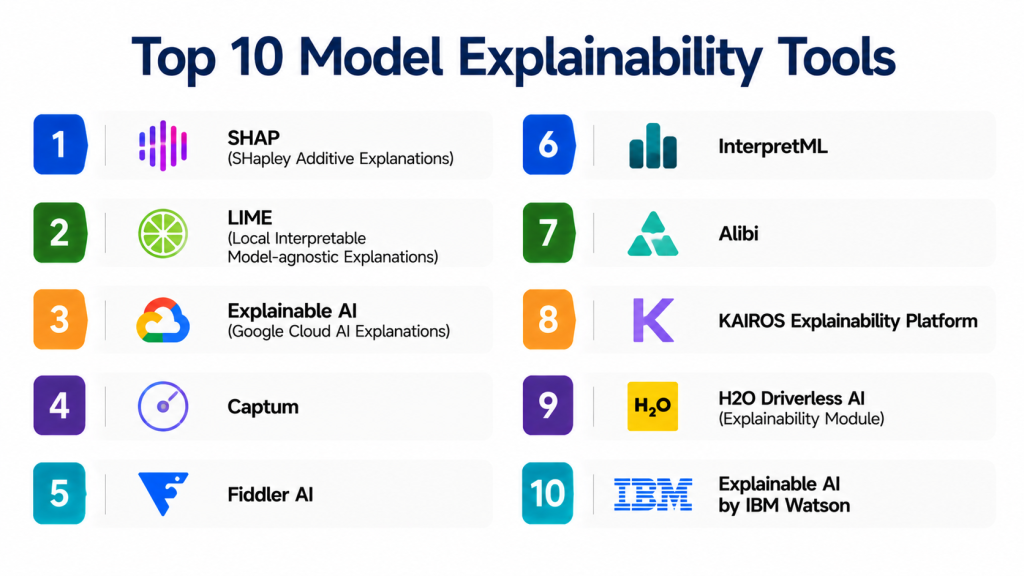
Introduction
Model Explainability Tools are platforms and frameworks that provide insights into how AI and machine learning models make decisions. They help interpret complex models, identify potential biases, and ensure transparency for stakeholders, regulators, and end-users. Explainability is crucial for building trust in AI systems, especially in high-stakes domains like healthcare, finance, and autonomous systems.
In AI adoption accelerates across industries, regulatory compliance, ethical AI practices, and transparency requirements make model explainability indispensable. These tools allow teams to interpret predictions, visualize model behavior, and provide actionable insights to improve model performance and fairness.
Real-world use cases include: interpreting predictions in credit scoring models, validating recommendations in e-commerce AI, understanding feature importance in healthcare diagnostics, ensuring fairness in hiring algorithms, auditing risk models in finance, and debugging complex neural networks.
Buyers evaluating Model Explainability Tools should consider:
- Support for multiple model types (tree-based, deep learning, NLP)
- Global and local explainability methods
- Visualization and reporting features
- Integration with ML pipelines
- Real-time and batch interpretability
- Bias detection and fairness metrics
- Model debugging and testing
- API and framework compatibility
- Regulatory compliance support
- Ease of deployment and usability
Best for: AI/ML engineers, data scientists, enterprise AI teams, auditors, regulatory compliance teams, and organizations deploying high-stakes AI models.
Not ideal for: Projects using simple or interpretable models where explainability is inherently transparent, such as linear regression or small-scale decision trees.
Key Trends in Model Explainability Tools
- Integration with automated machine learning (AutoML) pipelines
- Multi-framework support for scikit-learn, TensorFlow, PyTorch, XGBoost
- Real-time explainability for online predictions
- Bias detection and fairness auditing
- Visual dashboards for feature importance and SHAP/LIME interpretations
- Hybrid global and local explanation methods
- AI-assisted interpretability suggestions
- Support for regulatory compliance and reporting
- Explainable AI for NLP, computer vision, and structured data
- Open-source and enterprise-grade deployment options
How We Selected These Tools (Methodology)
- Support for diverse ML model types and frameworks
- Accuracy and reliability of explanations
- Visualization and interpretability features
- Integration with ML pipelines and data platforms
- Bias detection and fairness evaluation
- Deployment flexibility (cloud, on-prem, hybrid)
- Compliance and audit-ready reporting
- Ease of use and collaboration features
- Documentation, community, and vendor support
- Scalability for enterprise-grade models
Top 10 Model Explainability Tools
1- SHAP (SHapley Additive Explanations)
Short description:
SHAP is an open-source framework for interpreting predictions from any machine learning model using Shapley values to explain feature contributions.
Key Features
- Local and global model explainability
- Supports tree-based, linear, and deep models
- Feature importance visualization
- Integration with Python ML frameworks
- Model-agnostic explanations
- Summary plots and dependence plots
- Open-source and extensible
Pros
- Theoretically grounded explanations
- Works with multiple model types
- Strong open-source community
Cons
- Can be computationally intensive
- Requires Python knowledge
- Limited GUI for non-technical users
Platforms / Deployment
Linux / macOS / Windows / Cloud / On-prem
Security & Compliance
Varies / Not publicly stated
Integrations & Ecosystem
- scikit-learn, XGBoost, LightGBM, TensorFlow, PyTorch
- Python data visualization libraries
- Jupyter notebooks
Support & Community
Active open-source community, extensive documentation
2- LIME (Local Interpretable Model-agnostic Explanations)
Short description:
LIME is an open-source tool that provides local interpretability by approximating complex models with interpretable surrogate models.
Key Features
- Local explanation of individual predictions
- Model-agnostic
- Works with tabular, text, and image data
- Feature contribution visualization
- Integration with Python ML frameworks
- Extensible for custom models
- Open-source
Pros
- Easy to understand local explanations
- Flexible across model types
- Well-established in research and industry
Cons
- Approximate explanations may vary
- Computational overhead for large datasets
- Limited enterprise GUI
Platforms / Deployment
Linux / macOS / Windows / Cloud / On-prem
Security & Compliance
Varies / Not publicly stated
Integrations & Ecosystem
- Python ML frameworks
- Jupyter notebooks
- Visualization libraries
Support & Community
Open-source community and documentation
3- Explainable AI (Google Cloud AI Explanations)
Short description:
Google Cloud AI Explanations provides model interpretability features for models deployed on Google Cloud AI Platform, including tabular, image, and text data.
Key Features
- Global and local explanations
- Integration with Vertex AI
- Feature attribution and importance
- Visualization dashboards
- Bias detection metrics
- Cloud-native deployment
- Model monitoring integration
Pros
- Seamless integration with Google Cloud ML pipelines
- Scalable for production models
- Built-in visualization
Cons
- Google Cloud dependency
- Cloud-only solution
- Enterprise pricing
Platforms / Deployment
Cloud / Google Cloud
Security & Compliance
RBAC, IAM, audit logs, encryption
Integrations & Ecosystem
- Vertex AI
- BigQuery and Cloud Storage
- AI/ML pipelines
Support & Community
Google Cloud enterprise support
4- Captum
Short description:
Captum is an open-source PyTorch library for model interpretability, providing feature attribution and explanation methods for deep learning models.
Key Features
- Supports PyTorch models
- Attribution methods (Integrated Gradients, DeepLIFT, etc.)
- Visualization of explanations
- Model debugging and interpretability
- API for integration with ML pipelines
- Open-source and extensible
Pros
- Strong support for deep learning models
- Multiple attribution methods
- Open-source with active community
Cons
- PyTorch-only
- Requires technical expertise
- Limited GUI for non-technical users
Platforms / Deployment
Linux / macOS / Windows / Cloud / On-prem
Security & Compliance
Varies / Not publicly stated
Integrations & Ecosystem
- PyTorch ML frameworks
- Visualization libraries
- Jupyter notebooks
Support & Community
Open-source community and documentation
5- Fiddler AI
Short description:
Fiddler AI is an enterprise platform offering model explainability, monitoring, and performance analysis for AI and ML models.
Key Features
- Global and local explanations
- Feature importance visualization
- Model performance monitoring
- Bias detection and fairness metrics
- Integration with AI/ML pipelines
- Regulatory compliance support
- Cloud and hybrid deployment
Pros
- Enterprise-ready with compliance features
- Supports multiple model frameworks
- User-friendly dashboards
Cons
- Enterprise pricing
- Cloud-dependent
- Complexity for small teams
Platforms / Deployment
Cloud / Hybrid
Security & Compliance
RBAC, encryption, audit logging, GDPR, SOC 2
Integrations & Ecosystem
- ML frameworks (TensorFlow, PyTorch, XGBoost)
- Cloud storage
- BI and analytics pipelines
Support & Community
Enterprise vendor support
6- InterpretML
Short description:
InterpretML is an open-source toolkit for interpretable machine learning, supporting glass-box models and post-hoc explanation methods.
Key Features
- Supports interpretable models and black-box explanations
- SHAP and LIME integration
- Global and local explainability
- Visualization and dashboards
- Python-based integration
- Open-source
Pros
- Flexible and framework-agnostic
- Open-source and well-documented
- Combines glass-box and post-hoc methods
Cons
- Requires Python expertise
- Limited enterprise support
- Less GUI support for non-technical users
Platforms / Deployment
Linux / macOS / Windows / Cloud / On-prem
Security & Compliance
Varies / Not publicly stated
Integrations & Ecosystem
- scikit-learn, XGBoost, PyTorch
- Jupyter notebooks
- Visualization libraries
Support & Community
Active open-source community
7- Alibi
Short description:
Alibi is an open-source Python library for machine learning model explanation, offering multiple explainers and visualization tools.
Key Features
- Global and local explanation methods
- Supports tabular, image, and text models
- SHAP, anchor, and counterfactual explainers
- Visualization tools
- Integration with Python ML frameworks
- Open-source
Pros
- Flexible multi-model support
- Multiple explainability methods
- Open-source and extensible
Cons
- Python-only
- Limited enterprise-grade features
- Requires coding knowledge
Platforms / Deployment
Linux / macOS / Windows / Cloud / On-prem
Security & Compliance
Varies / Not publicly stated
Integrations & Ecosystem
- scikit-learn, TensorFlow, PyTorch
- Jupyter notebooks
- Visualization libraries
Support & Community
Open-source community
8- KAIROS Explainability Platform
Short description:
KAIROS provides enterprise-grade model explainability for AI/ML pipelines with dashboards and bias detection.
Key Features
- Global and local explainability
- Bias and fairness metrics
- Feature importance visualization
- API access for ML pipelines
- Cloud and hybrid deployment
- Monitoring dashboards
- Regulatory compliance support
Pros
- Enterprise-ready with compliance features
- Integrates with multiple ML frameworks
- User-friendly dashboards
Cons
- Enterprise pricing
- Cloud-dependent
- Limited open-source community
Platforms / Deployment
Cloud / Hybrid
Security & Compliance
RBAC, encryption, audit logging, SOC 2, GDPR
Integrations & Ecosystem
- TensorFlow, PyTorch, XGBoost
- Cloud storage
- AI pipelines and analytics
Support & Community
Enterprise vendor support
9- H2O Driverless AI (Explainability Module)
Short description:
H2O Driverless AI provides automated model building with built-in explainability features for AI and ML models.
Key Features
- Feature importance
- SHAP-based explanations
- Partial dependence plots
- Model interpretation dashboards
- Bias and fairness analysis
- Integration with H2O AutoML pipelines
Pros
- Built-in explainability for automated models
- Easy-to-use dashboards
- Integrates with H2O AI platform
Cons
- Tied to H2O ecosystem
- Enterprise pricing
- Limited customization outside H2O
Platforms / Deployment
Cloud / On-prem / Hybrid
Security & Compliance
RBAC, encryption, audit logging
Integrations & Ecosystem
- H2O AutoML pipelines
- ML frameworks
- Cloud storage
Support & Community
Enterprise support available
10- Explainable AI by IBM Watson
Short description:
IBM Watson Explainable AI provides global and local model interpretations for models deployed on Watson ML services.
Key Features
- SHAP and LIME-based explanations
- Model performance monitoring
- Bias detection
- Visualization dashboards
- Integration with Watson ML pipelines
- Regulatory compliance support
- Cloud-native deployment
Pros
- Enterprise-grade explainability
- Integrated with IBM AI ecosystem
- Scalable and cloud-native
Cons
- IBM ecosystem dependency
- Enterprise pricing
- Cloud-only solution
Platforms / Deployment
Cloud / IBM Cloud
Security & Compliance
RBAC, encryption, audit logging, GDPR, SOC 2
Integrations & Ecosystem
- Watson ML pipelines
- IBM Cloud storage
- AI and analytics platforms
Support & Community
IBM enterprise support
Comparison Table
| Tool Name | Best For | Platform(s) Supported | Deployment | Standout Feature | Public Rating |
|---|---|---|---|---|---|
| SHAP | Open-source ML explainability | Linux/macOS/Windows | Cloud/On-prem | Shapley-based attribution | N/A |
| LIME | Local model explanations | Linux/macOS/Windows | Cloud/On-prem | Model-agnostic local explainability | N/A |
| Google Cloud AI Explanations | Cloud AI models | Cloud | Google Cloud | Vertex AI integration | N/A |
| Captum | Deep learning PyTorch models | Linux/macOS/Windows | Cloud/On-prem | Multiple attribution methods | N/A |
| Fiddler AI | Enterprise ML pipelines | Cloud/Hybrid | Cloud/Hybrid | Model monitoring & bias detection | N/A |
| InterpretML | Interpretable ML toolkit | Linux/macOS/Windows | Cloud/On-prem | Combines glass-box & post-hoc | N/A |
| Alibi | Multi-model explainability | Linux/macOS/Windows | Cloud/On-prem | Multiple explanation methods | N/A |
| KAIROS | Enterprise AI explainability | Cloud/Hybrid | Cloud/Hybrid | Bias & fairness metrics | N/A |
| H2O Driverless AI | Automated ML models | Cloud/On-prem/Hybrid | Cloud/On-prem/Hybrid | Built-in explainability module | N/A |
| IBM Watson Explainable AI | Enterprise AI models | Cloud | IBM Cloud | Watson ML integration | N/A |
Evaluation & Scoring
| Tool | Core (25%) | Ease (15%) | Integrations (15%) | Security (10%) | Performance (10%) | Support (10%) | Value (15%) | Weighted Total |
|---|---|---|---|---|---|---|---|---|
| SHAP | 9.5 | 8.0 | 9.0 | 8.5 | 9.2 | 8.8 | 8.5 | 8.97 |
| LIME | 9.0 | 8.2 | 8.8 | 8.3 | 8.9 | 8.5 | 8.4 | 8.68 |
| Google AI Explanations | 9.2 | 8.3 | 8.9 | 8.7 | 9.0 | 8.8 | 8.5 | 8.83 |
| Captum | 9.1 | 8.0 | 8.8 | 8.5 | 8.9 | 8.6 | 8.4 | 8.71 |
| Fiddler AI | 9.3 | 8.2 | 8.9 | 8.7 | 9.1 | 8.7 | 8.5 | 8.84 |
| InterpretML | 8.9 | 8.1 | 8.7 | 8.5 | 8.7 | 8.5 | 8.4 | 8.59 |
| Alibi | 8.8 | 8.0 | 8.6 | 8.4 | 8.6 | 8.4 | 8.3 | 8.50 |
| KAIROS | 9.0 | 8.2 | 8.8 | 8.7 | 8.9 | 8.6 | 8.5 | 8.69 |
| H2O Driverless AI | 9.1 | 8.1 | 8.9 | 8.6 | 8.9 | 8.6 | 8.5 | 8.74 |
| IBM Watson Explainable AI | 9.2 | 8.3 | 8.9 | 8.7 | 9.0 | 8.8 | 8.5 | 8.83 |
Which Model Explainability Tool Is Right for You?
Solo / Freelancer
SHAP or LIME for small-scale interpretability projects and research
SMB
Captum or InterpretML for local and global explanations in ML pipelines
Mid-Market
Fiddler AI, Alibi, or KAIROS for enterprise-scale model interpretability and monitoring
Enterprise
IBM Watson Explainable AI, H2O Driverless AI, and Google Cloud AI Explanations for regulated and large-scale AI systems
Budget vs Premium
Open-source SHAP, LIME, Captum, and Alibi for budget-friendly projects; enterprise Fiddler, H2O, and Watson for premium pipelines
Feature Depth vs Ease of Use
Enterprise platforms offer dashboards and compliance; open-source tools provide flexibility and detailed analysis
Integrations & Scalability
Fiddler AI, H2O, and Google AI integrate with cloud ML pipelines and scale for large datasets
Security & Compliance Needs
Enterprise platforms provide RBAC, SSO, encryption, audit logs, and regulatory compliance features
Frequently Asked Questions
1- What is a model explainability tool?
A platform or framework that provides insights into how AI/ML models make predictions, enabling interpretability and transparency.
2- Can these tools handle deep learning models?
Yes, Captum, Alibi, and H2O Driverless AI provide deep learning support.
3- Are there open-source explainability tools?
Yes, SHAP, LIME, Captum, InterpretML, and Alibi are open-source.
4- Can these tools integrate with ML pipelines?
Most provide APIs or SDKs for integration with AI/ML workflows.
5- Do they provide global and local explanations?
Yes, tools like SHAP, LIME, Fiddler, and KAIROS offer both global and local interpretability.
6- Which industries use model explainability tools?
Finance, healthcare, autonomous vehicles, retail, and AI research.
7- Do they support bias detection?
Enterprise platforms like Fiddler, KAIROS, and Watson provide bias and fairness metrics.
8- Are these tools cloud-native?
Some are cloud-native (Fiddler, Google AI Explanations, IBM Watson), while open-source tools can run on-prem or cloud.
9- How complex is deployment?
Open-source tools require Python expertise; enterprise platforms provide dashboards and managed services.
10- What should guide tool selection?
Model complexity, dataset size, deployment environment, compliance needs, and team expertise.
Conclusion
Model Explainability Tools are critical for understanding and trusting AI and ML models. Open-source tools like SHAP, LIME, Captum, and InterpretML provide flexible, low-cost interpretability, while enterprise platforms like Fiddler AI, H2O Driverless AI, and IBM Watson Explainable AI deliver compliance-ready, scalable, and monitored solutions. Organizations should assess model types, deployment scale, integration needs, and regulatory requirements before selecting a tool. Piloting 2–3 tools ensures model explanations meet performance, transparency, and compliance objectives.
#ModelExplainability,#XAI,#AIMLInterpretability,#TrustworthyAI,#AITransparency
