Introduction
Bias & Fairness Testing Tools are software solutions designed to detect, measure, and mitigate bias in machine learning models and AI systems. These platforms help organizations ensure that their AI outputs are equitable, transparent, and compliant with ethical standards. By analyzing model predictions, training data, and feature distributions, these tools identify potential biases across demographic groups, protected attributes, and other sensitive categories. bias and fairness testing has become critical as AI adoption expands across finance, healthcare, hiring, law enforcement, and customer service. Organizations use these tools to build responsible AI, comply with regulations, and maintain user trust. Tooling also supports model audits, fairness metrics computation, and mitigation strategies.
Real World Use Cases
- Detecting bias in hiring or recruitment AI
- Evaluating fairness in loan approval models
- Monitoring AI-driven healthcare diagnostics
- Auditing recommendation systems for demographic fairness
- Mitigating bias in NLP models and chatbots
- Regulatory compliance reporting
- Continuous monitoring of deployed AI systems
- Model transparency and explainability
Evaluation Criteria for Buyers
- Support for multiple fairness and bias metrics
- Compatibility with popular ML frameworks
- Ability to analyze both model predictions and training data
- Automated reporting and visualization
- Mitigation recommendations and tools
- Scalability to large datasets
- Multi-language and multi-modal support
- Integration with MLOps pipelines
- Reproducibility and audit support
- Security and access control
Best for: AI teams, data scientists, MLOps engineers, compliance officers, and organizations deploying AI in regulated industries.
Not ideal for: Teams with minimal AI adoption or projects where fairness evaluation is not required.
Key Trends in Bias & Fairness Testing Tools
- Increasing regulatory focus on AI fairness and transparency
- Integration with MLOps and CI/CD pipelines for continuous evaluation
- Expansion of bias metrics for multi-modal and multi-language models
- Automated mitigation suggestions and fairness interventions
- Visualization dashboards for model audits
- Open-source adoption for reproducibility and transparency
- AI explainability and interpretability integration
- Cloud-native bias testing services
- Human-in-the-loop evaluation for ethical oversight
- Standardization of fairness and bias measurement metrics
How We Selected These Tools (Methodology)
- Adoption in AI/ML and compliance workflows
- Support for fairness metrics and bias detection
- Multi-framework and multi-modal compatibility
- Integration with ML pipelines and MLOps workflows
- Reporting, visualization, and auditing capabilities
- Scalability for large datasets
- Automated mitigation strategies
- Ease of use for data scientists and compliance teams
- Open-source vs enterprise availability
- Vendor support and community resources
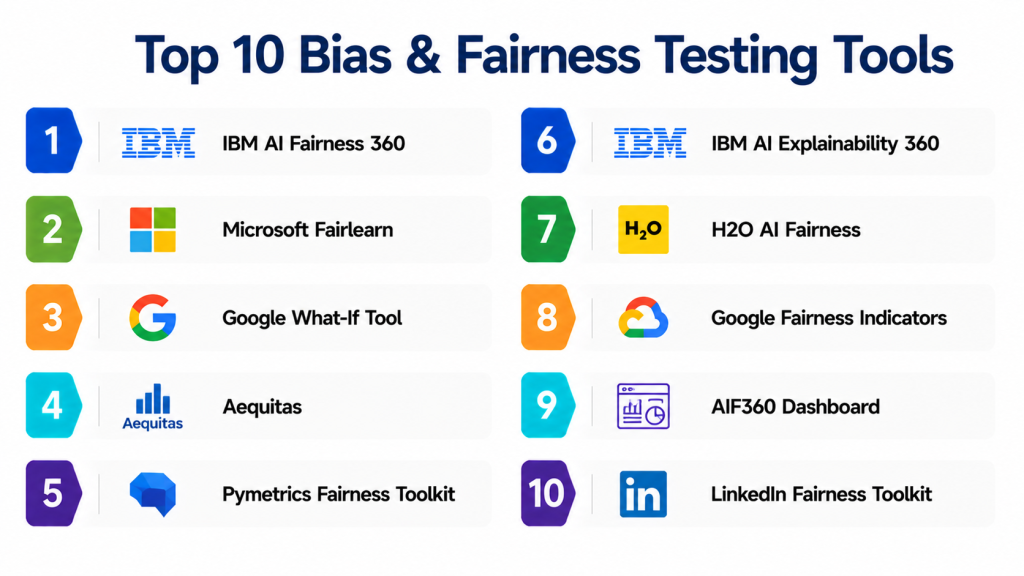
Top 10 Bias & Fairness Testing Tools
1- IBM AI Fairness 360
Short Description:
IBM AI Fairness 360 is an open-source toolkit that provides metrics, bias detection, and mitigation algorithms for machine learning models.
Key Features
- Pre-processing, in-processing, post-processing bias mitigation
- Multiple fairness metrics (e.g., demographic parity, equal opportunity)
- Support for Python ML frameworks
- Dataset and model analysis
- Visualization and reporting
- Open-source SDK
- Integration with MLOps pipelines
Pros
- Comprehensive fairness metrics
- Open-source and flexible
- Supports multiple mitigation techniques
Cons
- Requires Python knowledge
- Learning curve for advanced mitigation
Platforms / Deployment
Cloud, On-premise, Hybrid
Security & Compliance
Not publicly stated
Integrations & Ecosystem
- TensorFlow, PyTorch, scikit-learn
- Jupyter notebooks
- ML pipelines
Support & Community
Active open-source community, IBM documentation
2- Microsoft Fairlearn
Short Description:
Fairlearn is an open-source toolkit for assessing and improving fairness in AI models, supporting evaluation and mitigation strategies.
Key Features
- Fairness metrics and visualization
- Mitigation algorithms
- Integration with Python ML frameworks
- Model assessment for sensitive attributes
- Dashboard for bias analysis
- Post-processing and reweighting
- Continuous monitoring support
Pros
- Open-source and developer-friendly
- Supports multiple mitigation approaches
- Good visualization capabilities
Cons
- Focused on Python ecosystem
- Limited multi-modal support
Platforms / Deployment
Cloud, On-premise
Security & Compliance
Not publicly stated
Integrations & Ecosystem
- scikit-learn
- TensorFlow, PyTorch
- Python ML pipelines
Support & Community
Open-source support and community
3- Google What-If Tool
Short Description:
The What-If Tool provides a visual interface for exploring ML models, evaluating fairness, and testing counterfactuals.
Key Features
- Model evaluation and comparison
- Bias and fairness assessment
- Feature influence analysis
- Interactive visualizations
- Counterfactual testing
- Integration with TensorFlow and Jupyter
- Easy dataset exploration
Pros
- Interactive visualization
- Intuitive for non-coders
- Integrates with TensorFlow easily
Cons
- Limited to TensorFlow models
- Not full mitigation toolkit
Platforms / Deployment
Cloud, On-premise
Security & Compliance
Not publicly stated
Integrations & Ecosystem
- TensorFlow
- Jupyter notebooks
- ML pipelines
Support & Community
Open-source community
4- Aequitas
Short Description:
Aequitas is an open-source bias and fairness audit toolkit for ML models, providing a broad set of fairness metrics.
Key Features
- Comprehensive fairness metrics
- Group-level and global bias analysis
- Visualizations and dashboards
- Python SDK for integration
- Batch evaluation support
- Supports multiple model types
- Reporting for audits
Pros
- Easy to use
- Open-source and flexible
- Strong visualization for fairness metrics
Cons
- Python-only
- No active mitigation algorithms
Platforms / Deployment
Cloud, On-premise
Security & Compliance
Not publicly stated
Integrations & Ecosystem
- scikit-learn
- ML pipelines
- Python notebooks
Support & Community
Open-source support
5- Pymetrics Fairness Toolkit
Short Description:
Pymetrics provides tools for evaluating fairness in hiring AI systems, including bias detection and mitigation workflows.
Key Features
- Bias assessment for recruitment models
- Fairness dashboards and metrics
- Multi-attribute evaluation
- Mitigation suggestions
- Cloud-based evaluation
- Human-in-the-loop review
- Integration with HR and AI pipelines
Pros
- Specialized for HR/AI
- Cloud-ready
- Mitigation suggestions included
Cons
- Focused on recruitment AI
- Limited multi-domain support
Platforms / Deployment
Cloud
Security & Compliance
Encryption, access control
Integrations & Ecosystem
- HR platforms
- ML pipelines
- Dashboarding tools
Support & Community
Enterprise support
6- IBM AI Explainability 360
Short Description:
Complementary to AI Fairness 360, AI Explainability 360 provides explainability methods and fairness assessments for AI models.
Key Features
- Model interpretability methods
- Bias and fairness assessment
- Multiple explainability algorithms
- Python SDK integration
- Visualization dashboards
- MLOps integration
- Dataset analysis
Pros
- Combines explainability and fairness
- Open-source
- Multiple algorithms
Cons
- Requires expertise in ML explainability
- Python ecosystem focus
Platforms / Deployment
Cloud, On-premise, Hybrid
Security & Compliance
Not publicly stated
Integrations & Ecosystem
- TensorFlow, PyTorch, scikit-learn
- ML pipelines
Support & Community
IBM documentation and community
7- H2O AI Fairness
Short Description:
H2O.ai provides a fairness toolkit as part of its machine learning platform, enabling bias evaluation and mitigation.
Key Features
- Fairness metrics computation
- Model audit reports
- Bias mitigation algorithms
- Integration with H2O models
- Visualization dashboards
- Scalable evaluation
- Cloud and on-prem deployment
Pros
- Integrated with H2O platform
- Easy evaluation of H2O models
- Supports mitigation
Cons
- Limited to H2O models
- Less flexible outside H2O ecosystem
Platforms / Deployment
Cloud, On-premise
Security & Compliance
Encryption, access control
Integrations & Ecosystem
- H2O.ai ML models
- Python pipelines
Support & Community
H2O support and documentation
8- Google Fairness Indicators
Short Description:
Fairness Indicators is an open-source tool for evaluating fairness across classification models and dataset slices.
Key Features
- Evaluation of binary and multi-class models
- Metrics across sensitive groups
- Integration with TensorFlow and TFX
- Visualization of fairness metrics
- Slice-based evaluation
- Scalable for large datasets
- Supports CI/CD evaluation
Pros
- Easy to use
- Integrates with ML pipelines
- Open-source
Cons
- TensorFlow focus
- Limited mitigation
Platforms / Deployment
Cloud, On-premise
Security & Compliance
Not publicly stated
Integrations & Ecosystem
- TensorFlow
- TFX pipelines
- Python workflows
Support & Community
Open-source support
9- AIF360 Dashboard
Short Description:
AIF360 Dashboard provides an interactive interface for IBM AI Fairness 360 metrics and mitigation methods.
Key Features
- Visualization of bias metrics
- Interactive fairness assessment
- Mitigation strategy suggestions
- Multi-model evaluation
- Reporting and dashboards
- Human-in-the-loop annotation
- Cloud and on-premise deployment
Pros
- Interactive interface
- Supports multiple models
- Mitigation recommendations
Cons
- Dependent on AIF360
- Learning curve for advanced features
Platforms / Deployment
Cloud, On-premise, Hybrid
Security & Compliance
Not publicly stated
Integrations & Ecosystem
- IBM AIF360
- ML pipelines
Support & Community
IBM documentation and enterprise support
10- LinkedIn Fairness Toolkit
Short Description:
LinkedIn Fairness Toolkit is designed for evaluating fairness and bias in recommender systems and ranking models.
Key Features
- Bias metrics for recommendations
- Ranking fairness evaluation
- Multi-attribute analysis
- Visualization dashboards
- API and SDK integration
- Scalable evaluation for large datasets
- Human-in-the-loop options
Pros
- Specialized for recommendation systems
- Scalable for large datasets
- Enterprise-focused
Cons
- Limited public availability
- Focused on LinkedIn use cases
Platforms / Deployment
Cloud, On-premise
Security & Compliance
Not publicly stated
Integrations & Ecosystem
- ML pipelines
- Recommendation frameworks
Support & Community
Enterprise support
Comparison Table
| Tool Name | Best For | Platforms Supported | Deployment | Standout Feature | Public Rating |
|---|---|---|---|---|---|
| IBM AI Fairness 360 | Enterprise fairness | Cloud, On-prem, Hybrid | Multi-metric evaluation | Mitigation algorithms | N/A |
| Fairlearn | Python ML models | Cloud, On-prem | Fairness assessment | Dashboard & mitigation | N/A |
| Google What-If Tool | TensorFlow models | Cloud, On-prem | Interactive evaluation | Counterfactuals | N/A |
| Aequitas | Multi-model evaluation | Cloud, On-prem | Batch evaluation | Visualization | N/A |
| Pymetrics | HR AI | Cloud | Recruitment fairness | Bias detection & mitigation | N/A |
| AI Explainability 360 | Enterprise AI | Cloud, On-prem, Hybrid | Explainability + fairness | Multiple algorithms | N/A |
| H2O AI Fairness | H2O ML | Cloud, On-prem | Model audit | Metrics + mitigation | N/A |
| Fairness Indicators | Classification models | Cloud, On-prem | Slice-based evaluation | Visualization | N/A |
| AIF360 Dashboard | IBM AIF360 | Cloud, On-prem, Hybrid | Interactive fairness | Mitigation suggestions | N/A |
| LinkedIn Fairness Toolkit | Recommender systems | Cloud, On-prem | Bias detection | Ranking fairness | N/A |
Evaluation & Scoring Table
| Tool Name | Core | Ease | Integrations | Security | Performance | Support | Value | Weighted Total |
|---|---|---|---|---|---|---|---|---|
| IBM AI Fairness 360 | 9.3 | 8.5 | 9.1 | 8.8 | 9.0 | 8.9 | 8.7 | 8.95 |
| Fairlearn | 9.0 | 8.6 | 8.9 | 8.7 | 8.9 | 8.7 | 8.6 | 8.77 |
| Google What-If Tool | 8.8 | 8.7 | 8.6 | 8.7 | 8.8 | 8.6 | 8.5 | 8.65 |
| Aequitas | 8.9 | 8.5 | 8.7 | 8.6 | 8.8 | 8.5 | 8.5 | 8.61 |
| Pymetrics | 9.0 | 8.4 | 8.8 | 8.7 | 8.9 | 8.6 | 8.5 | 8.70 |
| AI Explainability 360 | 9.1 | 8.5 | 8.9 | 8.8 | 9.0 | 8.7 | 8.6 | 8.84 |
| H2O AI Fairness | 8.9 | 8.3 | 8.7 | 8.6 | 8.8 | 8.5 | 8.5 | 8.61 |
| Fairness Indicators | 8.8 | 8.4 | 8.6 | 8.5 | 8.7 | 8.5 | 8.4 | 8.55 |
| AIF360 Dashboard | 9.0 | 8.5 | 8.9 | 8.8 | 9.0 | 8.7 | 8.6 | 8.81 |
| LinkedIn Fairness Toolkit | 8.9 | 8.4 | 8.7 | 8.7 | 8.8 | 8.6 | 8.5 | 8.65 |
Which Active Learning Toolkit Is Right for You?
Solo / Freelancer
Google What-If Tool and Aequitas are simple, open-source options for small projects or academic use.
SMB
Fairlearn and H2O AI Fairness provide usability and integration with existing ML pipelines.
Mid-Market
IBM AI Fairness 360, AIF360 Dashboard, and Pymetrics support multiple models and fairness evaluation at scale.
Enterprise
IBM AI Fairness 360, LinkedIn Fairness Toolkit, and AI Explainability 360 provide enterprise-grade metrics, mitigation, and monitoring.
Budget vs Premium
Open-source tools like Aequitas, Fairlearn, and Google What-If Tool are cost-efficient; enterprise platforms provide enhanced support and dashboards.
Feature Depth vs Ease of Use
IBM AI Fairness 360 and AI Explainability 360 offer advanced features; Google What-If Tool and Fairlearn prioritize usability.
Integrations & Scalability
Enterprise solutions integrate with pipelines, cloud services, and MLOps workflows for large-scale evaluation.
Security & Compliance Needs
Enterprise platforms provide RBAC, encryption, auditing, and SSO/SAML for regulated AI deployments.
Frequently Asked Questions
1- What is a bias and fairness testing tool?
Software to measure, detect, and mitigate bias in AI models and ensure equitable outcomes.
2- Why is it important?
To ensure AI decisions are ethical, equitable, and comply with regulatory standards.
3- Which domains use these tools?
Finance, healthcare, HR, e-commerce, legal, and AI research.
4- Do these tools provide mitigation strategies?
Some include mitigation algorithms, others focus on evaluation metrics.
5- Are there open-source options?
Yes, IBM AI Fairness 360, Fairlearn, and Google What-If Tool are open-source.
6- Can they integrate with ML pipelines?
Yes, Python SDKs and APIs enable integration with AI workflows.
7- Do they support multi-modal models?
Enterprise tools increasingly support multi-modal fairness evaluation.
8- Can they evaluate real-time models?
Some tools support continuous monitoring for deployed AI models.
9- Are these tools secure?
Enterprise solutions provide encryption, RBAC, and audit logging.
10- How complex is setup?
Open-source tools may require coding; managed enterprise platforms provide dashboards and automated workflows.
Conclusion
Bias & Fairness Testing Tools are essential for responsible AI deployment. IBM AI Fairness 360, AI Explainability 360, and Pymetrics provide enterprise-grade evaluation and mitigation, while Fairlearn and Google What-If Tool are developer-friendly open-source options. Choosing the right toolkit depends on model complexity, domain, regulatory requirements, and integration needs. Pilot evaluation across multiple tools is recommended to ensure accurate bias detection and effective mitigation strategies.
