Introduction
Radiology Information Systems (RIS) are specialized healthcare software platforms designed to manage the administrative and workflow aspects of radiology departments. In simple terms, RIS helps hospitals and diagnostic centers schedule imaging procedures, track patient records, manage reports, and streamline communication between radiologists, technicians, and clinicians.
In the current healthcare landscape, RIS has become more critical due to increasing imaging volumes, regulatory pressure, and the need for faster diagnosis. Modern RIS platforms now integrate with AI tools, PACS (Picture Archiving and Communication Systems), and EHRs to create a unified diagnostic ecosystem. This shift supports faster clinical decisions, improved patient outcomes, and operational efficiency.
Real-world use cases:
- Managing radiology scheduling and patient workflows
- Generating and distributing diagnostic reports
- Integrating imaging data with hospital EHR systems
- Supporting billing, compliance, and audit processes
- Enabling teleradiology and remote diagnostics
What buyers should evaluate:
- Workflow automation and scheduling capabilities
- Integration with PACS, EHR, and AI tools
- Data security and compliance (HIPAA, GDPR, etc.)
- Reporting and analytics capabilities
- Scalability for growing imaging volumes
- User interface and ease of use
- Deployment model (cloud vs on-premise)
- Vendor support and training
- Customization and extensibility
Best for: Hospitals, diagnostic imaging centers, radiology groups, and healthcare IT teams managing high imaging volumes and compliance requirements.
Not ideal for: Small clinics with minimal imaging needs or organizations that rely entirely on external radiology service providers.
Key Trends in Radiology Information Systems (RIS)
- AI-powered reporting and diagnostics improving radiologist productivity
- Cloud-native RIS platforms replacing legacy on-premise systems
- Integration with Zero Trust and cybersecurity frameworks for patient data protection
- Automation of scheduling, billing, and workflow orchestration
- Interoperability standards (HL7, FHIR) enabling seamless data exchange
- Rise of teleradiology and remote collaboration tools
- Embedded analytics and operational dashboards for decision-making
- Mobile access and clinician-friendly interfaces
- Subscription-based pricing models (SaaS) gaining traction
- Stronger identity and access management (IAM) controls in RIS systems
How We Selected These Radiology Information Systems (RIS)
- Evaluated market adoption and industry reputation
- Assessed feature completeness across workflows and reporting
- Reviewed performance, uptime, and scalability indicators
- Considered security posture and compliance readiness
- Examined integration ecosystem (PACS, EHR, AI tools)
- Evaluated usability and clinician experience
- Considered deployment flexibility (cloud vs on-premise)
- Reviewed vendor support, onboarding, and documentation
- Assessed fit across SMB, mid-market, and enterprise healthcare providers
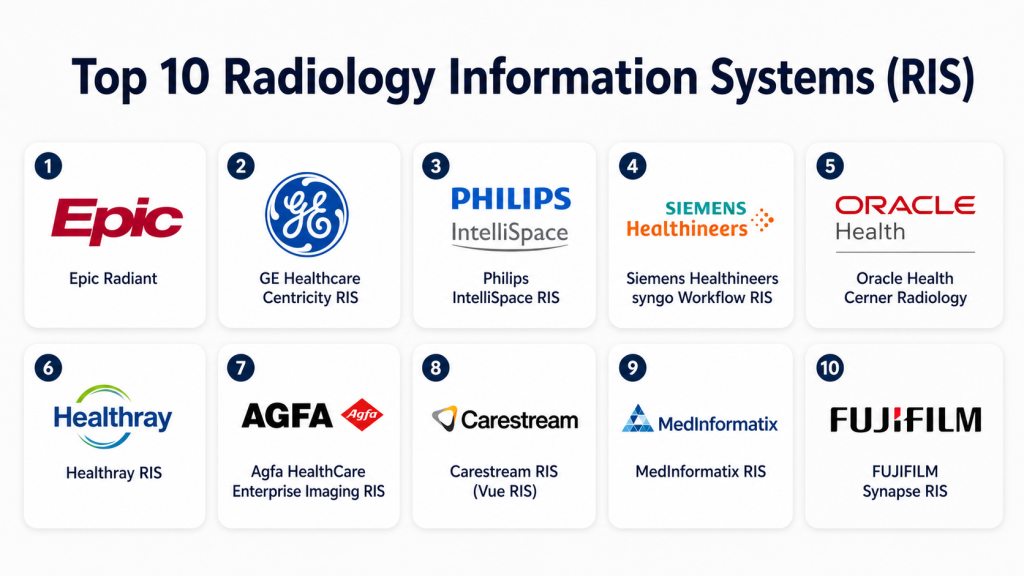
Top 10 Radiology Information Systems (RIS)
#1 — GE Healthcare Centricity RIS
Short description:
A widely adopted enterprise-grade RIS platform designed for large hospitals and imaging networks. It supports end-to-end radiology workflows, from scheduling to reporting and billing. Known for deep integration with GE imaging systems, it enables efficient data handling and diagnostics. Its scalability makes it suitable for high-volume environments. The platform also emphasizes compliance and structured reporting. It is commonly used in enterprise healthcare systems.
Key Features
- Advanced scheduling and workflow management
- Integrated reporting tools
- PACS integration
- Billing and coding automation
- Analytics dashboards
- Multi-site support
Pros
- Strong enterprise scalability
- Deep imaging system integration
Cons
- Complex implementation
- High cost for smaller organizations
Platforms / Deployment
Web / Windows
Cloud / On-premise / Hybrid
Security & Compliance
RBAC, audit logs, encryption; HIPAA (commonly supported)
Integrations & Ecosystem
Integrates with PACS, EHR systems, and imaging hardware.
- HL7 support
- FHIR interoperability
- Third-party analytics tools
Support & Community
Enterprise-level support with structured onboarding; documentation available.
#2 — Philips IntelliSpace RIS
Short description:
A comprehensive RIS solution designed for enterprise radiology departments. It focuses on workflow automation and clinical collaboration. The platform integrates tightly with Philips imaging ecosystem and PACS solutions. It enhances reporting efficiency and supports real-time communication. Known for reliability and scalability in large hospital environments.
Key Features
- Workflow automation
- Real-time collaboration tools
- Advanced reporting
- Scheduling optimization
- Integration with Philips PACS
Pros
- Strong interoperability
- Reliable enterprise performance
Cons
- Vendor lock-in risk
- Complex customization
Platforms / Deployment
Web / Windows
Cloud / Hybrid
Security & Compliance
Encryption, RBAC, audit logs; compliance varies
Integrations & Ecosystem
Works well with Philips ecosystem and external EHR systems.
- HL7 integration
- API support
- Imaging system connectivity
Support & Community
Enterprise support with training programs; global presence.
#3 — Siemens Healthineers syngo Workflow RIS
Short description:
A modern RIS solution designed to streamline radiology workflows. It offers seamless integration with Siemens imaging systems and PACS. The platform focuses on automation, reporting efficiency, and patient management. Suitable for medium to large healthcare organizations. It enhances collaboration across departments.
Key Features
- Workflow orchestration
- Integrated reporting
- Patient management tools
- Imaging system integration
- Analytics
Pros
- Efficient workflow automation
- Strong imaging integration
Cons
- Limited flexibility outside Siemens ecosystem
- Higher implementation complexity
Platforms / Deployment
Web / Windows
Cloud / On-premise
Security & Compliance
RBAC, encryption; compliance varies
Integrations & Ecosystem
Strong integration with Siemens products and EHR systems.
- HL7 support
- PACS connectivity
- API integrations
Support & Community
Vendor-driven support; enterprise onboarding available.
#4 — Cerner Radiology (Oracle Health)
Short description:
A robust RIS solution integrated within the broader Cerner healthcare ecosystem. It provides comprehensive radiology workflow management and reporting capabilities. Known for strong EHR integration, it enables seamless data sharing. Suitable for large healthcare networks.
Key Features
- Integrated RIS and EHR workflows
- Scheduling and reporting
- Billing support
- Analytics tools
- Workflow automation
Pros
- Deep EHR integration
- Scalable platform
Cons
- Complex UI for new users
- Implementation overhead
Platforms / Deployment
Web
Cloud / On-premise
Security & Compliance
SSO, audit logs, encryption; compliance varies
Integrations & Ecosystem
Strong integration within Oracle Health ecosystem.
- HL7/FHIR support
- API-based integrations
- Third-party systems
Support & Community
Large enterprise support network; training resources available.
#5 — Epic Radiant RIS
Short description:
Epic Radiant is a widely used RIS module within the Epic EHR system. It provides comprehensive radiology workflow and reporting capabilities. Known for seamless integration with Epic’s ecosystem. Suitable for large hospitals and integrated health systems.
Key Features
- Unified EHR and RIS workflows
- Advanced reporting
- Scheduling tools
- Billing integration
- Patient data management
Pros
- Seamless Epic integration
- Strong usability for existing Epic users
Cons
- Limited outside Epic ecosystem
- High cost
Platforms / Deployment
Web
Cloud / On-premise
Security & Compliance
SSO, RBAC, audit logs; compliance varies
Integrations & Ecosystem
Primarily within Epic ecosystem with external integrations.
- HL7/FHIR support
- API connectivity
- Third-party apps
Support & Community
Extensive support and community network.
#6 — Carestream RIS
Short description:
A flexible RIS solution designed for mid-sized imaging centers and hospitals. It provides workflow automation and reporting tools. Known for ease of use and customization options. Suitable for organizations seeking balance between cost and features.
Key Features
- Scheduling and workflow tools
- Reporting capabilities
- PACS integration
- Billing management
- Analytics
Pros
- User-friendly interface
- Flexible deployment
Cons
- Limited enterprise features
- Smaller ecosystem
Platforms / Deployment
Web / Windows
Cloud / On-premise
Security & Compliance
Encryption, RBAC; compliance varies
Integrations & Ecosystem
Integrates with PACS and EHR systems.
- HL7 support
- API integrations
Support & Community
Moderate support; documentation available.
#7 — McKesson Radiology RIS (Change Healthcare)
Short description:
A mature RIS platform designed for healthcare providers. It supports scheduling, reporting, and billing workflows. Known for reliability and legacy system compatibility. Suitable for organizations upgrading from older RIS systems.
Key Features
- Workflow management
- Reporting tools
- Billing integration
- Scheduling
- Legacy system support
Pros
- Stable platform
- Good for legacy migration
Cons
- Older UI
- Limited modern features
Platforms / Deployment
Windows / Web
On-premise / Hybrid
Security & Compliance
Not publicly stated
Integrations & Ecosystem
Supports integration with legacy systems and EHRs.
- HL7 support
- PACS integration
Support & Community
Varies; legacy-focused support.
#8 — MedInformatix RIS
Short description:
A RIS platform tailored for outpatient imaging centers. It provides scheduling, reporting, and billing features. Known for ease of use and affordability. Suitable for SMB healthcare providers.
Key Features
- Patient scheduling
- Reporting tools
- Billing integration
- Workflow automation
- Customizable templates
Pros
- Cost-effective
- Easy to implement
Cons
- Limited scalability
- Fewer advanced features
Platforms / Deployment
Web / Windows
Cloud / On-premise
Security & Compliance
Not publicly stated
Integrations & Ecosystem
Supports basic integrations with EHR and PACS systems.
- HL7 connectivity
- API support
Support & Community
SMB-focused support; onboarding assistance available.
#9 — RISynergy
Short description:
A specialized RIS solution designed for imaging centers. It focuses on workflow efficiency and reporting. Known for customizable features and ease of deployment. Suitable for mid-sized organizations.
Key Features
- Workflow management
- Reporting tools
- Scheduling
- Billing integration
- Custom workflows
Pros
- Customizable
- Easy deployment
Cons
- Limited enterprise capabilities
- Smaller ecosystem
Platforms / Deployment
Web
Cloud / On-premise
Security & Compliance
Not publicly stated
Integrations & Ecosystem
Integrates with PACS and EHR systems.
- HL7 support
- API integrations
Support & Community
Varies; smaller vendor support.
#10 — Nova RIS
Short description:
A lightweight RIS platform designed for smaller imaging centers. It offers essential workflow and reporting capabilities. Known for simplicity and affordability. Suitable for small practices.
Key Features
- Scheduling tools
- Reporting
- Billing support
- Workflow management
- Basic analytics
Pros
- Affordable
- Easy to use
Cons
- Limited features
- Not suitable for large enterprises
Platforms / Deployment
Web
Cloud
Security & Compliance
Not publicly stated
Integrations & Ecosystem
Basic integration capabilities with imaging systems.
- HL7 support
- Limited API support
Support & Community
Basic support; limited community.
Comparison Table (Top 10)
| Tool Name | Best For | Platform(s) | Deployment | Standout Feature | Public Rating |
|---|---|---|---|---|---|
| GE Centricity RIS | Enterprise hospitals | Web/Windows | Hybrid | Imaging integration | N/A |
| Philips IntelliSpace RIS | Large healthcare systems | Web/Windows | Hybrid | Workflow automation | N/A |
| Siemens syngo RIS | Imaging-heavy hospitals | Web/Windows | Hybrid | Workflow orchestration | N/A |
| Cerner Radiology | EHR-integrated systems | Web | Hybrid | EHR integration | N/A |
| Epic Radiant | Epic users | Web | Hybrid | Unified workflows | N/A |
| Carestream RIS | Mid-sized centers | Web/Windows | Hybrid | Ease of use | N/A |
| McKesson RIS | Legacy systems | Windows/Web | Hybrid | Legacy compatibility | N/A |
| MedInformatix RIS | SMB imaging centers | Web/Windows | Hybrid | Affordability | N/A |
| RISynergy | Mid-market | Web | Hybrid | Custom workflows | N/A |
| Nova RIS | Small practices | Web | Cloud | Simplicity | N/A |
Evaluation & Scoring of Radiology Information Systems (RIS)
| Tool | Core | Ease | Integrations | Security | Performance | Support | Value | Weighted Total |
|---|---|---|---|---|---|---|---|---|
| GE Centricity | 9 | 7 | 9 | 8 | 9 | 8 | 7 | 8.4 |
| Philips IntelliSpace | 9 | 7 | 8 | 8 | 9 | 8 | 7 | 8.2 |
| Siemens syngo | 8 | 7 | 8 | 8 | 8 | 7 | 7 | 7.8 |
| Cerner Radiology | 9 | 6 | 9 | 8 | 8 | 8 | 7 | 8.1 |
| Epic Radiant | 9 | 7 | 9 | 9 | 9 | 9 | 7 | 8.6 |
| Carestream RIS | 7 | 8 | 7 | 7 | 7 | 7 | 8 | 7.4 |
| McKesson RIS | 7 | 6 | 7 | 6 | 7 | 6 | 7 | 6.8 |
| MedInformatix | 7 | 8 | 6 | 6 | 7 | 7 | 8 | 7.2 |
| RISynergy | 7 | 7 | 6 | 6 | 7 | 6 | 7 | 6.9 |
| Nova RIS | 6 | 8 | 5 | 5 | 6 | 6 | 8 | 6.5 |
How to interpret scores:
These scores are comparative across the selected tools, not absolute benchmarks. A higher score reflects stronger overall balance across features, usability, integrations, and value. Enterprise tools often score higher in core features and integrations but may have lower value scores due to cost. SMB-focused tools score better in ease and value but may lack depth. Buyers should prioritize categories aligned with their operational needs.
Which Radiology Information Systems (RIS) Is Right for You?
Solo / Freelancer
Small clinics or solo radiologists should prioritize affordability and ease of use. Tools like Nova RIS or MedInformatix provide essential features without complexity.
SMB
Mid-sized imaging centers benefit from solutions like Carestream RIS or RISynergy. These offer a balance between features and cost.
Mid-Market
Organizations scaling operations should consider Siemens syngo or Philips IntelliSpace for workflow automation and integration capabilities.
Enterprise
Large hospitals and healthcare systems should choose Epic Radiant, GE Centricity, or Cerner Radiology for full ecosystem integration and scalability.
Budget vs Premium
Budget tools offer essential functionality, while premium solutions provide deep integrations, automation, and analytics.
Feature Depth vs Ease of Use
Advanced platforms may require training but offer greater control. Simpler tools prioritize usability but may lack customization.
Integrations & Scalability
Ensure compatibility with PACS, EHR, and AI tools. Scalable platforms support long-term growth.
Security & Compliance Needs
Healthcare organizations must prioritize compliance, audit logs, and identity management capabilities.
Frequently Asked Questions (FAQs)
1. What is a Radiology Information System (RIS)?
RIS is software that manages radiology workflows, including scheduling, reporting, and billing. It helps streamline imaging operations and improve efficiency. It integrates with PACS and EHR systems for better data sharing. Modern RIS also supports automation and analytics. It is essential for hospitals and imaging centers.
2. How much does RIS software cost?
Pricing varies widely based on deployment, features, and organization size. Enterprise solutions can be expensive, while SMB tools are more affordable. Subscription models are becoming common. Custom pricing is often required. Always request vendor quotes.
3. How long does implementation take?
Implementation can take weeks to months depending on complexity. Enterprise deployments take longer due to integrations. SMB tools may deploy faster. Proper training and onboarding are critical. Planning is essential for success.
4. Does RIS integrate with PACS and EHR?
Yes, most RIS platforms integrate with PACS and EHR systems. Integration ensures seamless data flow. Standards like HL7 and FHIR are commonly used. This improves workflow efficiency. It also reduces manual data entry.
5. What security features should RIS have?
RIS should include encryption, RBAC, audit logs, and MFA. Compliance with healthcare regulations is critical. Secure access control is essential. Data protection should be a priority. Always verify vendor security posture.
6. Can RIS support teleradiology?
Yes, modern RIS platforms support remote workflows. Radiologists can access data from anywhere. This enables faster diagnosis and collaboration. It is essential for distributed healthcare teams. Cloud deployment enhances this capability.
7. What are common mistakes when choosing RIS?
Choosing based only on cost is a mistake. Ignoring integration needs can cause issues. Underestimating training requirements is risky. Not evaluating scalability can limit growth. Always assess long-term needs.
8. Is cloud-based RIS better than on-premise?
Cloud RIS offers flexibility and scalability. It reduces infrastructure costs. On-premise may offer more control. Choice depends on organization needs. Many vendors offer hybrid options.
9. How scalable are RIS platforms?
Most modern RIS platforms are highly scalable. Enterprise solutions support multi-site operations. SMB tools may have limitations. Always check scalability before choosing. Growth planning is important.
10. Can RIS be customized?
Yes, many RIS platforms allow customization. This includes workflows, reports, and integrations. Enterprise tools offer deeper customization. SMB tools may have limited options. Always confirm customization capabilities.
Conclusion
Radiology Information Systems have evolved from basic scheduling tools into comprehensive platforms that integrate imaging workflows, AI diagnostics, and healthcare data ecosystems. As imaging volumes grow and compliance requirements tighten, selecting the right RIS becomes a strategic decision rather than just an IT purchase. Enterprise platforms like Epic Radiant and GE Centricity deliver deep integration and scalability, while tools like Carestream and MedInformatix provide flexibility and affordability for smaller organizations.
The “best” RIS ultimately depends on your organization’s size, workflow complexity, and integration needs. Start by shortlisting 2–3 tools that match your requirements, run a pilot to evaluate usability and performance, and validate integration capabilities and security posture before making a final decision.
