Introduction
Contract Lifecycle Management (CLM) tools help organizations manage the entire lifecycle of contracts—from creation and negotiation to execution, compliance, and renewal. Instead of relying on manual processes and scattered documents, CLM platforms centralize contract data, automate workflows, and ensure better visibility and control.
In today’s environment, where compliance, security, and operational efficiency are critical, CLM tools have evolved significantly. Modern platforms integrate with Identity Management, CyberSecurity, Zero Trust, and Access Control frameworks to ensure that sensitive contract data is protected. They also incorporate AI for contract analysis, risk detection, and automation, making them essential for legal, procurement, and sales teams.
Real-world use cases:
- Automating contract creation and approvals
- Managing compliance and audit readiness
- Tracking contract obligations and renewals
- Reducing legal and operational risks
- Improving collaboration between legal and business teams
What buyers should evaluate:
- Contract authoring and template management
- Workflow automation and approvals
- Integration with CRM, ERP, and procurement tools
- Security and compliance capabilities
- AI-driven analytics and risk detection
- Ease of use and onboarding
- Scalability and customization
- Reporting and audit features
Best for: Legal teams, procurement teams, enterprises, and growing businesses that handle high volumes of contracts and require automation and compliance.
Not ideal for: Very small businesses with minimal contract needs or organizations that rely on simple document management without structured workflows.
Key Trends in Contract Lifecycle Management (CLM)
- AI-powered contract analysis and clause extraction
- Automated workflows for approvals and renewals
- Integration with CRM, ERP, and procurement systems
- Zero Trust security and granular access control
- Cloud-first deployment models
- Digital signature integration and automation
- Real-time analytics and reporting dashboards
- Compliance-focused features and audit trails
- API-driven extensibility
- Low-code customization for workflows
How We Selected These CLM Tools (Methodology)
- Market adoption and industry recognition
- Feature completeness across contract lifecycle stages
- Reliability and performance in production environments
- Security and compliance capabilities
- Integration ecosystem and API support
- Flexibility across SMB and enterprise use cases
- Innovation in AI and automation
- Customer feedback trends and usability
- Scalability and long-term viability
- Balanced mix of leading vendors
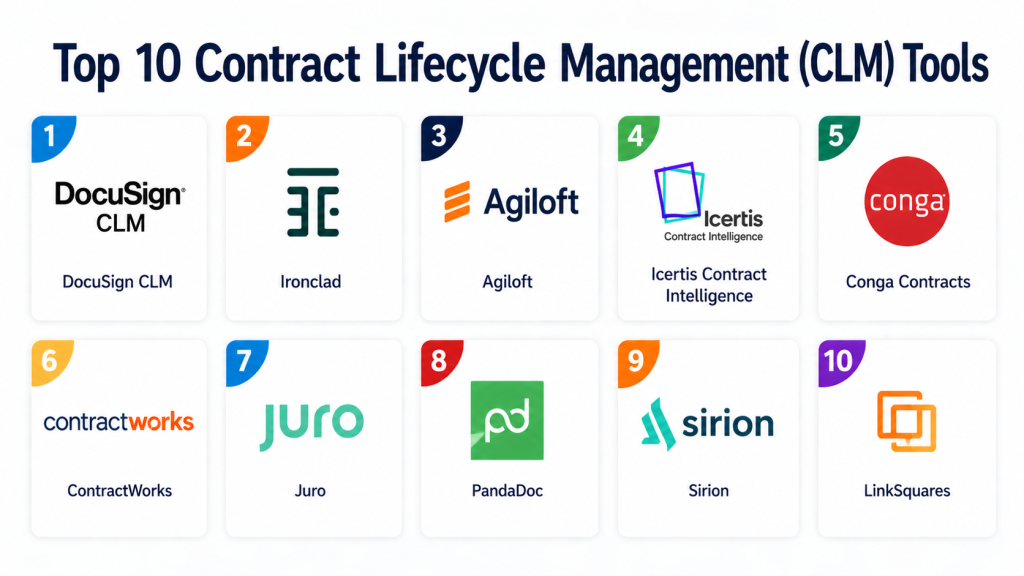
Top 10 Contract Lifecycle Management (CLM) Tools
#1 — DocuSign CLM
Short description:
DocuSign CLM is a widely used platform that extends beyond e-signatures to full contract lifecycle management. It enables organizations to automate contract workflows, manage templates, and track agreements. The platform integrates seamlessly with business systems. It is suitable for enterprises and mid-market organizations. It provides strong scalability and ease of use. It is often chosen for its reliability and ecosystem.
Key Features
- Contract authoring and templates
- Workflow automation
- Integration with e-signatures
- Reporting and analytics
- Document tracking
- Compliance tools
Pros
- Strong integration with e-signature workflows
- Scalable and widely adopted
Cons
- Advanced features can be costly
- Requires configuration for complex workflows
Platforms / Deployment
Web / Mobile
Cloud
Security & Compliance
SSO, encryption, audit logs, RBAC; compliance features supported
Integrations & Ecosystem
Strong integrations with business tools.
- CRM platforms
- ERP systems
- APIs
Support & Community
Extensive documentation and enterprise support
#2 — Ironclad
Short description:
Ironclad is a modern CLM platform focused on collaboration and automation. It helps legal and business teams manage contracts efficiently. The platform offers intuitive workflows and AI-powered insights. It is suitable for fast-growing companies and enterprises. It emphasizes usability and automation. It integrates well with popular business tools.
Key Features
- Workflow automation
- Contract analytics
- Collaboration tools
- AI insights
- Template management
Pros
- User-friendly interface
- Strong automation capabilities
Cons
- Limited advanced customization
- Pricing may be high
Platforms / Deployment
Web
Cloud
Security & Compliance
Encryption, access control; compliance varies
Integrations & Ecosystem
Integrates with CRM and productivity tools.
- Salesforce
- Collaboration tools
- APIs
Support & Community
Good support and onboarding
#3 — Agiloft
Short description:
Agiloft is a flexible CLM platform known for its customization capabilities. It supports complex workflows and contract management needs. The platform is suitable for enterprises and regulated industries. It offers strong automation and reporting features. It can be deployed in various environments. It is ideal for organizations needing flexibility.
Key Features
- Workflow automation
- Contract repository
- Reporting tools
- Custom workflows
- Compliance tracking
Pros
- Highly customizable
- Strong reporting capabilities
Cons
- Requires setup effort
- Interface may feel complex
Platforms / Deployment
Web
Cloud / Self-hosted
Security & Compliance
Encryption, access control; compliance varies
Integrations & Ecosystem
Supports integrations with enterprise tools.
- CRM systems
- ERP platforms
- APIs
Support & Community
Enterprise support available
#4 — Icertis Contract Intelligence (ICI)
Short description:
Icertis is an enterprise-grade CLM platform focused on contract intelligence. It provides AI-driven insights and analytics. The platform supports global contract management needs. It is widely used by large enterprises. It integrates with major business systems. It is designed for scalability and compliance.
Key Features
- AI contract analysis
- Workflow automation
- Compliance tracking
- Analytics dashboards
- Global contract management
Pros
- Strong AI capabilities
- Enterprise scalability
Cons
- Complex implementation
- Higher cost
Platforms / Deployment
Web
Cloud
Security & Compliance
Enterprise-grade security; compliance varies
Integrations & Ecosystem
Integrates with major enterprise systems.
- ERP systems
- CRM tools
- APIs
Support & Community
Enterprise-level support
#5 — Conga Contracts
Short description:
Conga Contracts provides contract lifecycle management integrated with document automation. It is widely used by organizations leveraging CRM systems. The platform simplifies contract creation and management. It supports automation and reporting. It is suitable for mid-market and enterprise teams.
Key Features
- Document automation
- Contract workflows
- Reporting tools
- Template management
- Integration capabilities
Pros
- Strong CRM integration
- Simplifies contract creation
Cons
- Setup complexity
- UI improvements needed
Platforms / Deployment
Web
Cloud
Security & Compliance
Encryption, access control; compliance varies
Integrations & Ecosystem
Integrates with CRM platforms and tools.
- Salesforce
- Document tools
- APIs
Support & Community
Moderate support and documentation
#6 — ContractWorks
Short description:
ContractWorks is a simple and secure CLM solution designed for SMBs. It focuses on contract storage, tracking, and reporting. The platform is easy to use and deploy. It offers essential features without complexity. It is ideal for organizations starting with CLM. It provides strong value for smaller teams.
Key Features
- Contract repository
- Search and tracking
- Reporting tools
- Alerts and notifications
- Security controls
Pros
- Easy to use
- Affordable
Cons
- Limited advanced features
- Not ideal for large enterprises
Platforms / Deployment
Web
Cloud
Security & Compliance
Encryption, access control; compliance varies
Integrations & Ecosystem
Limited integrations compared to enterprise tools.
- APIs
- Basic integrations
Support & Community
Basic support available
#7 — Juro
Short description:
Juro is a modern CLM platform designed for collaboration and automation. It allows teams to create, manage, and sign contracts within a single platform. The platform emphasizes ease of use and integration with business tools. It is suitable for startups and SMBs. It provides automation and analytics features.
Key Features
- Contract creation and editing
- Workflow automation
- E-signature integration
- Analytics
- Collaboration tools
Pros
- Easy to use
- All-in-one platform
Cons
- Limited enterprise features
- Customization constraints
Platforms / Deployment
Web
Cloud
Security & Compliance
Encryption, access control; compliance varies
Integrations & Ecosystem
Integrates with business tools.
- CRM tools
- Collaboration platforms
- APIs
Support & Community
Good onboarding and support
#8 — PandaDoc
Short description:
PandaDoc is a document automation and CLM platform focused on ease of use. It allows teams to create, send, and track contracts. The platform includes e-signature capabilities. It is widely used by SMBs. It provides automation and analytics features. It is ideal for sales-driven organizations.
Key Features
- Document automation
- E-signatures
- Analytics
- Workflow automation
- Content library
Pros
- Easy to use
- Strong document automation
Cons
- Limited advanced CLM features
- Not ideal for complex workflows
Platforms / Deployment
Web / Mobile
Cloud
Security & Compliance
Encryption, access control; compliance varies
Integrations & Ecosystem
Supports integrations with business tools.
- CRM systems
- Payment tools
- APIs
Support & Community
Good support and resources
#9 — Sirion
Short description:
Sirion is an enterprise CLM platform focused on contract performance and compliance. It provides analytics and insights into contract obligations. The platform is suitable for large organizations. It supports complex contract management needs. It integrates with enterprise systems.
Key Features
- Contract performance tracking
- Analytics
- Compliance management
- Workflow automation
- Reporting tools
Pros
- Strong analytics
- Enterprise capabilities
Cons
- Complex setup
- Higher cost
Platforms / Deployment
Web
Cloud
Security & Compliance
Enterprise-grade security; compliance varies
Integrations & Ecosystem
Integrates with enterprise tools.
- ERP systems
- CRM platforms
- APIs
Support & Community
Enterprise support available
#10 — LinkSquares
Short description:
LinkSquares is a CLM platform focused on contract analytics and management. It helps teams extract insights from contracts. The platform provides automation and reporting features. It is suitable for mid-market organizations. It integrates with business tools. It is known for its analytics capabilities.
Key Features
- Contract analytics
- Reporting tools
- Workflow automation
- Search capabilities
- Integration support
Pros
- Strong analytics
- Easy to use
Cons
- Limited customization
- Smaller ecosystem
Platforms / Deployment
Web
Cloud
Security & Compliance
Encryption, access control; compliance varies
Integrations & Ecosystem
Supports integrations with business tools.
- CRM systems
- Document platforms
- APIs
Support & Community
Moderate support and documentation
Comparison Table
| Tool Name | Best For | Platform(s) Supported | Deployment | Standout Feature | Public Rating |
|---|---|---|---|---|---|
| DocuSign CLM | Enterprise | Web, Mobile | Cloud | E-signature integration | N/A |
| Ironclad | Mid/Enterprise | Web | Cloud | Workflow automation | N/A |
| Agiloft | Enterprise | Web | Cloud/Self-hosted | Customization | N/A |
| Icertis | Enterprise | Web | Cloud | AI contract intelligence | N/A |
| Conga Contracts | Mid/Enterprise | Web | Cloud | CRM integration | N/A |
| ContractWorks | SMB | Web | Cloud | Simplicity | N/A |
| Juro | SMB | Web | Cloud | Collaboration | N/A |
| PandaDoc | SMB | Web, Mobile | Cloud | Document automation | N/A |
| Sirion | Enterprise | Web | Cloud | Contract performance | N/A |
| LinkSquares | Mid | Web | Cloud | Analytics | N/A |
Evaluation & Scoring of CLM Tools
| Tool Name | Core | Ease | Integrations | Security | Performance | Support | Value | Weighted Total |
|---|---|---|---|---|---|---|---|---|
| DocuSign CLM | 9 | 8 | 9 | 9 | 9 | 9 | 7 | 8.6 |
| Ironclad | 8 | 9 | 8 | 8 | 8 | 8 | 7 | 8.1 |
| Agiloft | 9 | 7 | 8 | 8 | 8 | 8 | 7 | 8.0 |
| Icertis | 9 | 6 | 9 | 9 | 9 | 8 | 6 | 8.2 |
| Conga | 8 | 7 | 9 | 8 | 8 | 7 | 7 | 7.9 |
| ContractWorks | 7 | 9 | 6 | 7 | 7 | 7 | 9 | 7.7 |
| Juro | 7 | 9 | 7 | 7 | 7 | 7 | 8 | 7.6 |
| PandaDoc | 7 | 9 | 7 | 7 | 7 | 7 | 8 | 7.6 |
| Sirion | 9 | 6 | 8 | 9 | 9 | 8 | 6 | 8.1 |
| LinkSquares | 8 | 8 | 7 | 7 | 8 | 7 | 7 | 7.8 |
Interpretation:
These scores are comparative and based on weighted criteria such as features, usability, integrations, and security. Higher scores indicate stronger overall capabilities, but the best choice depends on your specific business needs and scale.
Which CLM Tool Is Right for You?
Solo / Freelancer
Use PandaDoc or Juro for simplicity and ease of use.
SMB
ContractWorks, Juro, or PandaDoc offer affordability and quick setup.
Mid-Market
Ironclad, Conga, or LinkSquares provide balanced features and scalability.
Enterprise
DocuSign CLM, Icertis, Agiloft, or Sirion are best for complex workflows.
Budget vs Premium
Budget: ContractWorks, PandaDoc
Premium: DocuSign, Icertis
Feature Depth vs Ease of Use
Depth: Icertis, Agiloft
Ease: Juro, PandaDoc
Integrations & Scalability
Best: DocuSign, Conga
Moderate: Juro, ContractWorks
Security & Compliance Needs
Enterprise-grade: DocuSign, Icertis, Sirion
Basic: SMB-focused tools
Frequently Asked Questions (FAQs)
1. What is Contract Lifecycle Management (CLM)?
CLM refers to managing contracts from creation to renewal or termination. It includes drafting, approvals, execution, and compliance tracking. CLM tools automate these processes. They improve efficiency and reduce risks. Modern tools also provide analytics and insights.
2. Why do businesses need CLM tools?
CLM tools help reduce manual work and errors. They improve visibility into contract status. Businesses can ensure compliance and track obligations. These tools also speed up contract cycles. Overall, they enhance operational efficiency.
3. Are CLM tools suitable for small businesses?
Yes, many CLM tools offer SMB-friendly features. They provide essential contract management capabilities. Small teams benefit from automation and organization. However, very small businesses may not need full CLM platforms. Simpler tools may suffice.
4. What is the typical pricing model?
Pricing varies based on features and scale. Most tools use subscription-based pricing. Enterprise solutions may require custom pricing. Some tools offer tiered plans. Costs depend on customization and usage.
5. How long does implementation take?
Implementation can take days to months. Simple tools deploy quickly. Enterprise tools require integration and customization. Training and onboarding affect timelines. Proper planning ensures success.
6. Do CLM tools integrate with other systems?
Yes, most tools integrate with CRM, ERP, and procurement systems. APIs allow custom integrations. Integration depth varies by vendor. Strong integrations improve workflows. This is a key evaluation factor.
7. What are common mistakes when choosing CLM tools?
Choosing overly complex tools is common. Ignoring integration needs can cause issues. Not considering scalability is risky. Poor onboarding leads to low adoption. Proper evaluation helps avoid these mistakes.
8. Are CLM tools secure?
Most CLM tools offer encryption and access controls. Enterprise tools provide advanced security features. Compliance varies by vendor. Security is increasingly aligned with Zero Trust models. Verification is essential.
9. Can businesses switch CLM tools later?
Switching is possible but requires effort. Data migration and retraining are needed. Integration changes may also be required. Planning ahead reduces risks. Choosing scalable tools helps minimize switching.
10. What are alternatives to CLM tools?
Alternatives include manual processes or document management systems. However, they lack automation and analytics. Some businesses use custom solutions. CLM tools provide a comprehensive approach. They are ideal for structured contract management.
Conclusion
Contract Lifecycle Management (CLM) tools have become essential for organizations aiming to improve efficiency, compliance, and visibility across their contract processes. From AI-powered analytics to automated workflows and secure data handling, modern CLM platforms offer far more than basic document management. They enable teams to reduce risk, accelerate deal cycles, and maintain control over complex contractual obligations.
The right CLM tool depends on your organization’s size, complexity, and operational priorities. While enterprise platforms provide deep customization and scalability, SMB-focused tools offer simplicity and faster deployment. Start by identifying your core requirements, shortlist a few solutions, and run pilot implementations to evaluate usability, integrations, and security. This approach ensures you select a platform that delivers long-term value and aligns with your business goals.
