Introduction
AI Usage Control Tools are specialized software platforms that monitor, manage, and enforce policies on the use of AI systems across organizations. These tools help ensure compliance, prevent misuse, enforce ethical standards, and provide visibility into how AI models are applied. By tracking user actions, API calls, and model outputs, usage control tools allow organizations to mitigate risks associated with AI deployment.
Organizations rely on these tools to enforce access restrictions, usage quotas, content filtering, and governance policies for AI models used in customer service, content generation, decision-making, and automation. Usage control also supports auditability and reporting, helping organizations demonstrate responsible AI practices.
Real World Use Cases
- Monitoring employee access to generative AI tools
- Enforcing AI output usage policies in regulated industries
- Preventing unauthorized AI model queries or data exfiltration
- Managing API usage and quotas for AI services
- Tracking model outputs for compliance and quality assurance
- Implementing content filtering in NLP and generative AI
- Supporting enterprise AI governance frameworks
- Reporting and auditing AI model interactions
Evaluation Criteria for Buyers
- Support for policy-based access control
- Integration with AI platforms and APIs
- Real-time monitoring and alerts
- Usage quota enforcement
- Audit logging and reporting
- Role-based access control
- Content moderation and filtering capabilities
- Scalability for multiple users and models
- Multi-cloud or hybrid deployment support
- Integration with governance frameworks
Best for: Enterprises, IT administrators, compliance officers, AI governance teams, and organizations deploying AI at scale.
Not ideal for: Small teams with limited AI adoption or individual users without complex governance needs.
Key Trends in AI Usage Control Tools
- Integration with enterprise MLOps pipelines for continuous monitoring
- Real-time policy enforcement for AI outputs
- API-level access control and usage quotas
- Multi-cloud and hybrid AI model governance
- Content moderation for generative AI outputs
- Detailed audit logging and reporting
- AI usage analytics dashboards
- Human-in-the-loop oversight for sensitive AI tasks
- Role-based access and dynamic policy management
- Open-source and commercial tool adoption growing
How We Selected These Tools (Methodology)
- Adoption in enterprise AI and governance programs
- Support for access control, quotas, and content policies
- Integration with AI platforms and APIs
- Real-time monitoring and alerting capabilities
- Scalability for multiple users and models
- Logging, reporting, and auditing capabilities
- Human-in-the-loop oversight support
- Ease of configuration and deployment
- Open-source vs commercial availability
- Vendor support and community resources
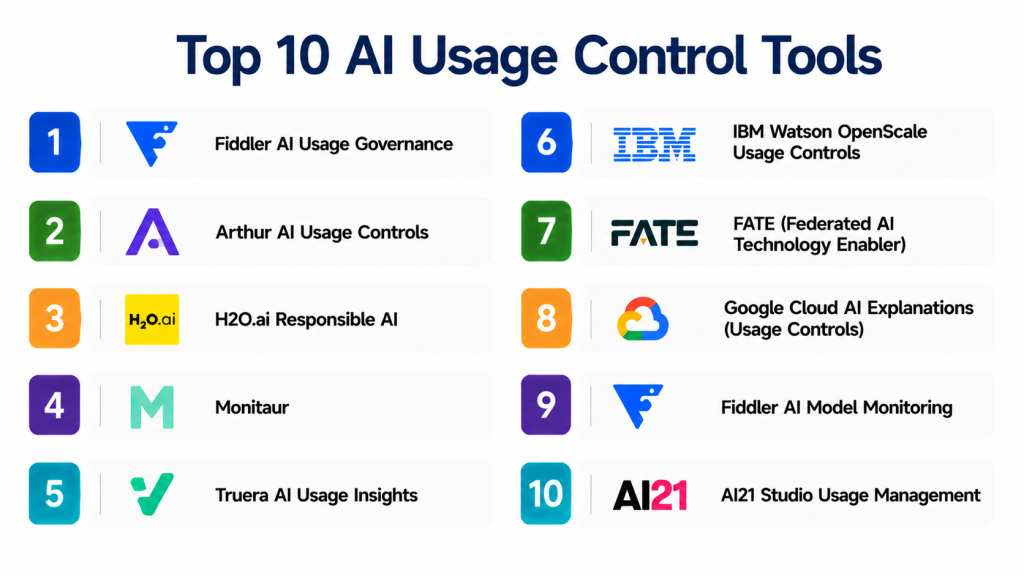
Top 10 AI Usage Control Tools
1- Fiddler AI Usage Governance
Short Description:
Fiddler provides enterprise-grade AI usage monitoring and governance, enabling visibility into model outputs and user actions.
Key Features
- Real-time usage monitoring
- Access control and policy enforcement
- Model output tracking
- Audit logging and reporting
- Multi-cloud support
- Alerts for anomalous AI usage
- Integration with MLOps pipelines
Pros
- Comprehensive governance capabilities
- Real-time monitoring
- Enterprise-ready
Cons
- Premium pricing
- Requires configuration for large deployments
Platforms / Deployment
Cloud, Hybrid
Security & Compliance
SSO, RBAC, encryption, audit logs
Integrations & Ecosystem
- TensorFlow, PyTorch
- ML pipelines
- Cloud AI APIs
Support & Community
Enterprise support and documentation
2- Arthur AI Usage Controls
Short Description:
Arthur AI provides monitoring and control over AI model usage, focusing on risk mitigation and compliance.
Key Features
- API and model usage tracking
- Access policy enforcement
- Alerts and notifications
- Usage dashboards
- Integration with ML platforms
- Multi-user support
- Audit logging
Pros
- Easy deployment
- Risk-focused governance
- Flexible integration
Cons
- Commercial tool
- Limited multi-cloud orchestration
Platforms / Deployment
Cloud
Security & Compliance
RBAC, encryption, audit logging
Integrations & Ecosystem
- Python ML workflows
- Cloud AI APIs
Support & Community
Enterprise support
3- H2O.ai Responsible AI
Short Description:
H2O.ai provides tools for AI usage control, fairness, and model monitoring in enterprise environments.
Key Features
- Model monitoring and usage tracking
- Policy enforcement for AI outputs
- Bias and fairness assessment
- Integration with H2O ML models
- Alerts and reporting
- Multi-cloud support
- Human-in-the-loop oversight
Pros
- Integrated with H2O platform
- Supports governance and fairness
- Scalable
Cons
- Limited support for non-H2O models
- Enterprise license required
Platforms / Deployment
Cloud, On-premise
Security & Compliance
Encryption, RBAC, audit logging
Integrations & Ecosystem
- H2O ML models
- ML pipelines
Support & Community
H2O enterprise support
4- Monitaur
Short Description:
Monitaur is an AI usage monitoring and control platform designed to enforce policies and detect anomalous model usage.
Key Features
- Real-time AI activity monitoring
- Policy-based enforcement
- Alerts for policy violations
- Usage dashboards
- Multi-model support
- Cloud and hybrid deployment
- Audit logging
Pros
- Real-time monitoring
- Supports multiple AI models
- Policy automation
Cons
- Paid platform
- Learning curve for complex rules
Platforms / Deployment
Cloud, Hybrid
Security & Compliance
Encryption, RBAC, audit logs
Integrations & Ecosystem
- ML pipelines
- Cloud AI APIs
Support & Community
Enterprise support
5- Truera AI Usage Insights
Short Description:
Truera provides visibility into AI model usage, governance, and bias, enabling responsible AI deployment.
Key Features
- Model usage analytics
- Policy enforcement dashboards
- Bias and fairness metrics
- Alerts for anomalous behavior
- Integration with ML frameworks
- Multi-cloud deployment
- Audit reporting
Pros
- Comprehensive monitoring
- Bias and fairness evaluation
- Enterprise-ready
Cons
- Paid solution
- Requires integration effort
Platforms / Deployment
Cloud, Hybrid
Security & Compliance
RBAC, encryption, audit logging
Integrations & Ecosystem
- TensorFlow, PyTorch
- ML pipelines
Support & Community
Enterprise support
6- IBM Watson OpenScale Usage Controls
Short Description:
IBM Watson OpenScale provides AI usage monitoring, bias detection, and policy enforcement for enterprise AI deployments.
Key Features
- Usage tracking
- Bias and fairness detection
- Policy enforcement and alerts
- Multi-cloud support
- Audit logging and reporting
- Dashboard analytics
- Integration with Watson ML models
Pros
- Enterprise-grade AI governance
- Integrates with Watson ecosystem
- Scalable
Cons
- Focused on IBM ML ecosystem
- Paid enterprise solution
Platforms / Deployment
Cloud, Hybrid
Security & Compliance
SSO, RBAC, encryption, audit logs
Integrations & Ecosystem
- IBM Watson models
- ML pipelines
Support & Community
Enterprise IBM support
7- FATE (Federated AI Technology Enabler)
Short Description:
FATE provides AI usage control and governance for federated learning systems, enabling secure and compliant multi-party AI.
Key Features
- Federated AI monitoring
- Policy enforcement in multi-party AI
- Real-time usage dashboards
- Alerts for anomalous activity
- Access control and RBAC
- Audit logging
- Integration with federated ML workflows
Pros
- Supports federated learning
- Enterprise governance
- Multi-party compliance
Cons
- Focused on federated AI
- Requires technical expertise
Platforms / Deployment
Cloud, On-premise
Security & Compliance
Encryption, RBAC, audit logging
Integrations & Ecosystem
- Federated ML frameworks
- ML pipelines
Support & Community
Community and enterprise support
8- Google Cloud AI Explanations (Usage Controls)
Short Description:
Google Cloud AI Explanations includes usage tracking, policy enforcement, and model interpretability for AI deployments.
Key Features
- AI usage monitoring
- Policy enforcement for model predictions
- Model interpretability and explainability
- Integration with Google Cloud AI
- Alerts and dashboards
- Audit logging
- Scalable cloud deployment
Pros
- Cloud-native
- Integrates with Google AI services
- Includes interpretability features
Cons
- Google Cloud-dependent
- Limited offline deployment
Platforms / Deployment
Cloud
Security & Compliance
IAM, encryption, audit logging
Integrations & Ecosystem
- Google Cloud AI
- TensorFlow
- Cloud ML pipelines
Support & Community
Google enterprise support
9- Fiddler AI Model Monitoring
Short Description:
Fiddler AI provides real-time monitoring of AI usage, model performance, and policy enforcement.
Key Features
- Usage analytics dashboards
- Alerts for unusual activity
- Policy enforcement
- Integration with ML models
- Multi-cloud support
- Human-in-the-loop oversight
- Audit logging
Pros
- Real-time monitoring
- Enterprise-ready
- Multi-model support
Cons
- Premium pricing
- Setup required for complex pipelines
Platforms / Deployment
Cloud, Hybrid
Security & Compliance
RBAC, encryption, audit logging
Integrations & Ecosystem
- ML pipelines
- Cloud AI APIs
Support & Community
Enterprise support
10- AI21 Studio Usage Management
Short Description:
AI21 Studio provides AI usage tracking, API monitoring, and governance features for language models.
Key Features
- API usage monitoring
- Model query tracking
- Usage quotas and limits
- Alerts for policy violations
- Audit logging
- Cloud-native deployment
- Integration with AI pipelines
Pros
- Designed for LLMs
- Cloud-native
- Policy enforcement
Cons
- Cloud-only
- Commercial license
Platforms / Deployment
Cloud
Security & Compliance
Encryption, RBAC, audit logging
Integrations & Ecosystem
- LLM pipelines
- Cloud ML workflows
Support & Community
Enterprise support
Comparison Table
| Tool Name | Best For | Platforms Supported | Deployment | Standout Feature | Public Rating |
|---|---|---|---|---|---|
| Fiddler AI Usage Governance | Enterprise AI | Cloud, Hybrid | Multi-model usage monitoring | Real-time monitoring | N/A |
| Arthur AI | Risk mitigation | Cloud | Policy enforcement | Alerts & dashboards | N/A |
| H2O.ai Responsible AI | H2O ML | Cloud, On-prem | Bias & usage tracking | Integration with H2O models | N/A |
| Monitaur | Multi-model AI | Cloud, Hybrid | Anomaly detection | Real-time AI activity | N/A |
| Truera | Model governance | Cloud, Hybrid | Bias & fairness | Model insights | N/A |
| IBM Watson OpenScale | IBM ML | Cloud, Hybrid | Enterprise governance | Bias & policy enforcement | N/A |
| FATE | Federated learning | Cloud, On-prem | Multi-party AI | Federated governance | N/A |
| Google Cloud AI Explanations | Google AI | Cloud | Interpretability & usage | Model explainability | N/A |
| Fiddler AI Model Monitoring | Enterprise AI | Cloud, Hybrid | Real-time monitoring | Multi-model support | N/A |
| AI21 Studio | LLM usage | Cloud | API monitoring | Usage quotas & limits | N/A |
Evaluation & Scoring Table
| Tool Name | Core | Ease | Integrations | Security | Performance | Support | Value | Weighted Total |
|---|---|---|---|---|---|---|---|---|
| Fiddler AI Usage Governance | 9.2 | 8.7 | 9.0 | 8.8 | 9.0 | 8.9 | 8.6 | 8.90 |
| Arthur AI | 9.0 | 8.5 | 8.9 | 8.7 | 8.8 | 8.7 | 8.5 | 8.77 |
| H2O.ai Responsible AI | 8.9 | 8.4 | 8.8 | 8.7 | 8.9 | 8.6 | 8.5 | 8.71 |
| Monitaur | 8.8 | 8.3 | 8.7 | 8.6 | 8.8 | 8.5 | 8.4 | 8.61 |
| Truera | 9.0 | 8.5 | 8.9 | 8.7 | 8.9 | 8.6 | 8.5 | 8.77 |
| IBM Watson OpenScale | 9.1 | 8.6 | 8.9 | 8.8 | 9.0 | 8.7 | 8.6 | 8.84 |
| FATE | 8.9 | 8.4 | 8.8 | 8.7 | 8.9 | 8.6 | 8.5 | 8.71 |
| Google Cloud AI Explanations | 8.8 | 8.5 | 8.7 | 8.6 | 8.8 | 8.5 | 8.4 | 8.61 |
| Fiddler AI Model Monitoring | 9.0 | 8.6 | 8.9 | 8.7 | 8.9 | 8.6 | 8.5 | 8.77 |
| AI21 Studio | 8.9 | 8.5 | 8.7 | 8.6 | 8.8 | 8.5 | 8.4 | 8.64 |
Which AI Usage Control Tool Is Right for You?
Solo / Freelancer
Google Cloud AI Explanations and Monitaur provide lightweight governance for small AI projects.
SMB
Arthur AI, Truera, and Fiddler AI Model Monitoring offer usability and pipeline integration for mid-sized teams.
Mid-Market
Fiddler AI Usage Governance, IBM Watson OpenScale, and H2O.ai Responsible AI provide enterprise-scale governance and monitoring.
Enterprise
IBM Watson OpenScale, FATE, Fiddler AI Usage Governance, and AI21 Studio support multi-model governance, usage control, and compliance.
Budget vs Premium
Open-source or developer-friendly tools like Monitaur and Google Cloud AI Explanations are cost-effective; enterprise platforms provide full dashboards and policy enforcement.
Feature Depth vs Ease of Use
IBM OpenScale, Fiddler AI Usage Governance, and Truera provide deep enterprise features; Google Cloud AI Explanations and Monitaur prioritize usability.
Integrations & Scalability
Enterprise platforms integrate with multi-cloud AI pipelines, model monitoring systems, and MLOps workflows.
Security & Compliance Needs
Enterprise deployments require RBAC, encryption, audit logs, and SSO/SAML for regulated AI systems.
Frequently Asked Questions
1- What is an AI usage control tool?
A platform that monitors, enforces policies, and governs the use of AI models in an organization.
2- Why is AI usage control important?
To prevent misuse, ensure compliance, and maintain ethical and secure AI operations.
3- Which industries use these tools?
Finance, healthcare, HR, e-commerce, and enterprise AI deployments.
4- Do these tools include mitigation for misuse?
Some provide alerts and automated enforcement policies.
5- Are there open-source options?
Yes, Monitaur and Google Cloud AI Explanations provide accessible governance tools.
6- Can they integrate with ML pipelines?
Yes, most provide APIs or SDKs for MLOps integration.
7- Do they support multi-model monitoring?
Enterprise tools like Fiddler AI and IBM OpenScale support multiple AI models.
8- Can they track real-time usage?
Yes, real-time monitoring and alerts are key features.
9- Are these tools secure?
Enterprise platforms offer RBAC, encryption, and audit logging.
10- How complex is setup?
Open-source tools require configuration; enterprise tools provide dashboards and automated policies.
Conclusion
AI Usage Control Tools are essential for responsible AI deployment, compliance, and risk mitigation. Fiddler AI Usage Governance, IBM Watson OpenScale, and Truera offer enterprise-grade monitoring, policy enforcement, and analytics. Monitaur and Google Cloud AI Explanations are developer-friendly options suitable for smaller teams. Organizations should assess scale, multi-model usage, integration requirements, and compliance needs before selecting a platform, and pilot multiple tools to ensure effective AI governance.
