Introduction
Medical Billing & Coding Software helps healthcare providers manage the financial side of patient care by automating billing, insurance claims processing, and medical coding. These systems ensure accurate coding of diagnoses and procedures using standardized codes, which is essential for reimbursements, compliance, and revenue cycle management.
As healthcare systems become more digitized and complex, manual billing processes are prone to errors and delays. Modern software solutions integrate billing, coding, claims management, and analytics to improve efficiency and reduce claim denials. They also support compliance with healthcare regulations and standards.
Real-world use cases:
- Processing insurance claims and reimbursements
- Managing patient billing and invoicing
- Automating medical coding workflows
- Reducing claim denials and errors
- Revenue cycle management
What buyers should evaluate:
- Billing and coding automation capabilities
- Compliance with coding standards
- Integration with EMR/EHR systems
- Claims management and tracking
- Reporting and analytics features
- Ease of use and training requirements
- Scalability for growing practices
- Security and data protection
- Support and customer service
Best for: Hospitals, clinics, billing companies, and healthcare providers managing patient billing and coding processes.
Not ideal for: Very small practices with minimal billing requirements or organizations using basic invoicing tools.
Key Trends in Medical Billing & Coding Software
- Cloud-based billing systems becoming standard
- AI-driven coding automation improving accuracy
- Integration with EMR/EHR platforms
- Real-time claims tracking and analytics
- Automation of revenue cycle management
- Increased focus on compliance and audit readiness
- Mobile access for billing operations
- Patient portals for billing transparency
- Advanced reporting for financial insights
How We Selected Medical Billing & Coding Software (Methodology)
- Evaluated adoption across healthcare providers
- Assessed billing and coding capabilities
- Reviewed claims management features
- Analyzed integration with healthcare systems
- Considered compliance and security features
- Evaluated usability and onboarding
- Reviewed scalability and performance
- Assessed vendor reputation and support
- Considered pricing and overall value
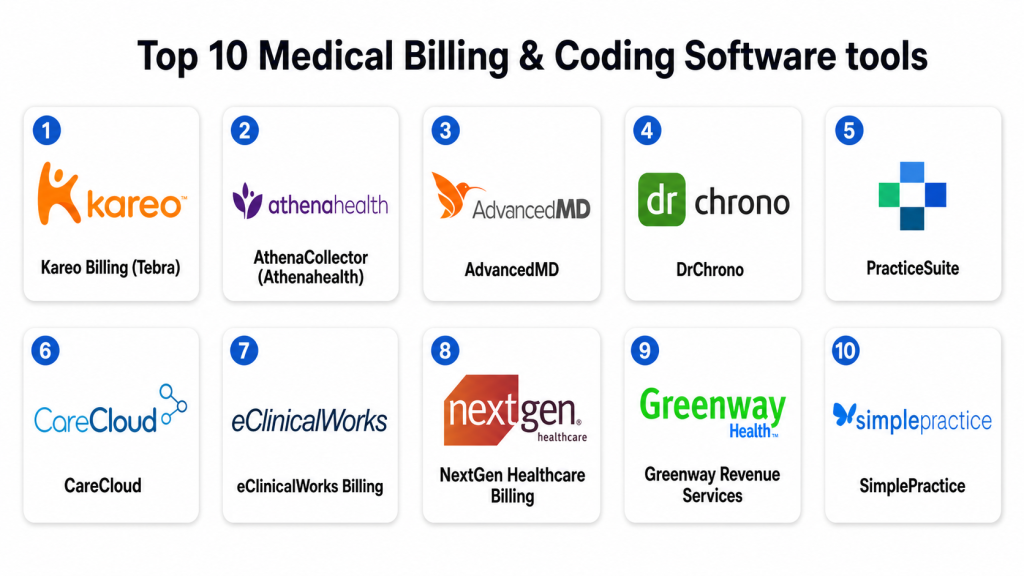
Top 10 Medical Billing & Coding Software
#1 — Kareo Billing (Tebra)
Short description: Kareo Billing is a cloud-based platform designed for small to mid-sized practices. It provides billing, coding, and claims management tools. It is easy to use and widely adopted. It supports revenue cycle management. It is ideal for clinics and billing companies.
Key Features
- Claims management
- Billing automation
- Coding support
- Reporting tools
- Revenue cycle management
Pros
- Easy to use
- Affordable
Cons
- Limited enterprise features
- Basic customization
Platforms / Deployment
Cloud
Security & Compliance
Access controls
Integrations & Ecosystem
Kareo integrates with healthcare systems and supports billing workflows.
- APIs
- Healthcare tools
Support & Community
Good support
#2 — AthenaCollector (Athenahealth)
Short description: AthenaCollector is a cloud-based billing solution that helps healthcare providers manage claims and reimbursements. It offers automation and analytics. It integrates with Athenahealth’s ecosystem. It is widely used in healthcare. It improves financial performance.
Key Features
- Claims management
- Billing automation
- Analytics tools
- Workflow automation
- Integration support
Pros
- Strong analytics
- Cloud-based
Cons
- Subscription cost
- Limited customization
Platforms / Deployment
Cloud
Security & Compliance
Encryption, access controls
Integrations & Ecosystem
AthenaCollector integrates with healthcare systems for efficient billing workflows.
- APIs
- EMR systems
Support & Community
Strong support
#3 — AdvancedMD
Short description: AdvancedMD is a comprehensive medical billing and coding platform designed for healthcare providers. It offers billing, coding, scheduling, and reporting tools. It supports automation and analytics. It is widely used in clinics. It improves workflow efficiency.
Key Features
- Billing and coding
- Scheduling tools
- Reporting features
- Workflow automation
- Claims tracking
Pros
- Feature-rich
- Scalable
Cons
- Complex interface
- Learning curve
Platforms / Deployment
Cloud
Security & Compliance
Access controls
Integrations & Ecosystem
AdvancedMD integrates with healthcare systems and supports data workflows.
- APIs
- Healthcare tools
Support & Community
Reliable support
#4 — DrChrono
Short description: DrChrono is a cloud-based healthcare platform that includes billing and coding features. It supports claims management and patient billing. It integrates with EMR systems. It is suitable for small to mid-sized practices. It offers mobile access.
Key Features
- Billing and coding
- Claims management
- Mobile access
- Reporting tools
- Workflow automation
Pros
- Mobile-friendly
- Easy to use
Cons
- Limited advanced features
- Subscription pricing
Platforms / Deployment
Cloud / Mobile
Security & Compliance
Access controls
Integrations & Ecosystem
DrChrono integrates with healthcare systems and supports mobile workflows.
- APIs
- Healthcare tools
Support & Community
Good support
#5 — PracticeSuite
Short description: PracticeSuite is a medical billing platform designed for healthcare providers. It offers billing, coding, and revenue cycle management tools. It supports workflow automation. It is suitable for small to mid-sized practices. It improves efficiency.
Key Features
- Billing automation
- Coding support
- Revenue cycle management
- Reporting tools
- Workflow automation
Pros
- Affordable
- Easy to use
Cons
- Limited advanced features
- Smaller ecosystem
Platforms / Deployment
Cloud
Security & Compliance
Access controls
Integrations & Ecosystem
PracticeSuite integrates with healthcare systems and supports billing workflows.
- APIs
- Healthcare tools
Support & Community
Reliable support
#6 — CareCloud
Short description: CareCloud provides billing and coding solutions for healthcare providers. It offers automation and analytics features. It supports claims management and reporting. It is widely used in healthcare. It is suitable for mid-sized organizations.
Key Features
- Billing automation
- Claims management
- Analytics tools
- Reporting features
- Workflow automation
Pros
- Strong analytics
- Scalable
Cons
- Complex setup
- Subscription cost
Platforms / Deployment
Cloud
Security & Compliance
Access controls
Integrations & Ecosystem
CareCloud integrates with healthcare systems for comprehensive workflows.
- APIs
- Healthcare tools
Support & Community
Professional support
#7 — eClinicalWorks Billing
Short description: eClinicalWorks offers billing and coding solutions integrated with its EMR platform. It supports claims processing and revenue cycle management. It is widely used in clinics. It provides automation features. It improves efficiency.
Key Features
- Billing and coding
- Claims processing
- Workflow automation
- Reporting tools
- Integration with EMR
Pros
- Integrated solution
- Feature-rich
Cons
- Interface issues
- Learning curve
Platforms / Deployment
Cloud
Security & Compliance
Access controls
Integrations & Ecosystem
eClinicalWorks integrates with healthcare systems and EMR platforms.
- APIs
- EMR systems
Support & Community
Reliable support
#8 — NextGen Healthcare Billing
Short description: NextGen Healthcare provides billing and coding solutions for healthcare providers. It supports revenue cycle management and claims processing. It is suitable for mid-sized organizations. It offers automation and analytics features.
Key Features
- Billing automation
- Claims processing
- Analytics tools
- Reporting features
- Workflow management
Pros
- Scalable
- Strong integration
Cons
- Complex interface
- Training required
Platforms / Deployment
Cloud
Security & Compliance
Access controls
Integrations & Ecosystem
NextGen integrates with healthcare systems for billing workflows.
- APIs
- Healthcare tools
Support & Community
Good support
#9 — Greenway Revenue Services
Short description: Greenway Revenue Services provides billing and coding solutions for healthcare providers. It supports claims management and reporting. It is suitable for small to mid-sized practices. It improves financial workflows.
Key Features
- Claims management
- Billing tools
- Reporting features
- Workflow automation
- Data management
Pros
- Easy to use
- Affordable
Cons
- Limited advanced features
- Smaller ecosystem
Platforms / Deployment
Cloud
Security & Compliance
Access controls
Integrations & Ecosystem
Greenway integrates with healthcare systems for billing workflows.
- APIs
- Healthcare tools
Support & Community
Reliable support
#10 — SimplePractice
Short description: SimplePractice is a billing and practice management platform designed for healthcare professionals. It offers billing, invoicing, and client management features. It is easy to use. It is suitable for small practices. It supports workflow automation.
Key Features
- Billing and invoicing
- Client management
- Workflow tools
- Reporting features
- Automation
Pros
- Simple interface
- Affordable
Cons
- Limited advanced features
- Not enterprise-ready
Platforms / Deployment
Cloud
Security & Compliance
Access controls
Integrations & Ecosystem
SimplePractice integrates with basic healthcare tools for small practice workflows.
- APIs
- Practice tools
Support & Community
Good support
Comparison Table (Top 10)
| Tool Name | Best For | Platform(s) Supported | Deployment | Standout Feature | Public Rating |
|---|---|---|---|---|---|
| Kareo Billing | SMB clinics | Web | Cloud | Ease of use | N/A |
| AthenaCollector | Healthcare orgs | Web | Cloud | Analytics | N/A |
| AdvancedMD | Clinics | Web | Cloud | Feature-rich | N/A |
| DrChrono | Mobile use | Web/Mobile | Cloud | Mobile access | N/A |
| PracticeSuite | SMB | Web | Cloud | Affordability | N/A |
| CareCloud | Mid-market | Web | Cloud | Analytics | N/A |
| eClinicalWorks | Clinics | Web | Cloud | EMR integration | N/A |
| NextGen Billing | Mid-market | Web | Cloud | Scalability | N/A |
| Greenway Revenue | SMB | Web | Cloud | Simplicity | N/A |
| SimplePractice | Small practices | Web | Cloud | Ease of use | N/A |
Evaluation & Scoring of Medical Billing & Coding Software
| Tool Name | Core (25%) | Ease (15%) | Integrations (15%) | Security (10%) | Performance (10%) | Support (10%) | Value (15%) | Weighted Total |
|---|---|---|---|---|---|---|---|---|
| Kareo | 8 | 9 | 7 | 7 | 8 | 8 | 8 | 8.0 |
| AthenaCollector | 9 | 8 | 8 | 8 | 9 | 9 | 7 | 8.4 |
| AdvancedMD | 9 | 7 | 8 | 8 | 8 | 8 | 8 | 8.2 |
| DrChrono | 8 | 9 | 7 | 7 | 8 | 8 | 8 | 8.0 |
| PracticeSuite | 7 | 9 | 6 | 7 | 7 | 7 | 8 | 7.5 |
| CareCloud | 9 | 7 | 8 | 8 | 8 | 8 | 7 | 8.1 |
| eClinicalWorks | 8 | 7 | 8 | 7 | 8 | 7 | 8 | 7.9 |
| NextGen | 8 | 7 | 8 | 7 | 8 | 7 | 8 | 7.9 |
| Greenway | 7 | 8 | 7 | 7 | 7 | 7 | 8 | 7.4 |
| SimplePractice | 7 | 9 | 6 | 7 | 7 | 7 | 8 | 7.5 |
Interpretation: These scores provide a comparative view of platform strengths across usability, performance, and value. Higher scores indicate better balance, but the ideal choice depends on practice size and billing complexity.
Which Medical Billing & Coding Software Is Right for You?
Solo / Freelancer
Small practices should consider SimplePractice or Kareo. These tools are easy to use and affordable. They provide essential billing features. They are suitable for basic workflows. Choose simple tools. Avoid complexity.
SMB
Small to mid-sized practices should look at DrChrono or PracticeSuite. These platforms provide a balance between usability and features. They support billing and claims management. SMBs benefit from cloud-based tools. Choose scalable options.
Mid-Market
Mid-sized organizations should consider AdvancedMD or CareCloud. These tools provide advanced features and scalability. They support complex workflows. Choose tools that support growth.
Enterprise
Large healthcare organizations should use AthenaCollector or NextGen. These platforms provide enterprise-grade features and scalability. They support large billing operations. Choose tools with strong integration.
Budget vs Premium
Affordable tools are suitable for small practices. Premium tools offer advanced features. Choose based on budget and needs.
Feature Depth vs Ease of Use
Simple tools are easier to adopt. Advanced tools provide deeper functionality. Balance usability and features.
Integrations & Scalability
Choose tools with strong integration capabilities. Scalability ensures long-term usability.
Security & Compliance Needs
Choose platforms with strong security features. Compliance is critical in healthcare.
Frequently Asked Questions FAQs
1. What is medical billing and coding software?
Medical billing and coding software helps healthcare providers manage patient billing, insurance claims, diagnosis codes, procedure codes, and payment tracking. It reduces manual paperwork by organizing billing workflows in one system. Clinics, hospitals, and private practices use it to improve claim accuracy and speed up reimbursements. It also helps teams reduce coding errors, rejected claims, and compliance risks. Overall, it supports smoother revenue cycle management for healthcare organizations.
2. Why is medical billing and coding software important?
Medical billing and coding software is important because healthcare billing involves complex codes, payer rules, and documentation requirements. Without a proper system, teams may face claim denials, delayed payments, and compliance issues. The software helps automate repetitive billing tasks and improves accuracy in claim submissions. It also gives billing teams better visibility into unpaid claims, patient balances, and revenue performance..
3. Who uses medical billing and coding software?
Medical billing and coding software is used by hospitals, clinics, private practices, billing companies, and healthcare administrators. Doctors, medical coders, billing specialists, front-desk staff, and revenue cycle teams often work with these systems. Small practices may use simple billing platforms, while large hospitals usually need advanced enterprise solutions. Third-party medical billing companies also rely on these tools to manage claims for multiple clients..
4. What features should I look for in medical billing and coding software?
Important features include claim creation, code management, insurance verification, denial tracking, patient billing, reporting, and payment posting. Good software should also support coding standards, payer rules, electronic claims, and integration with EHR or EMR systems. Automation features are useful for reducing manual data entry and improving claim submission speed. Security, compliance, user access controls, and audit logs are also important for healthcare data protection.
5. How does medical billing software reduce claim denials?
Medical billing software reduces claim denials by checking claims for missing information, coding errors, and payer-specific requirements before submission. Many platforms include claim scrubbing tools that identify problems early. This helps billing teams correct mistakes before claims reach insurance companies. The software can also track denial reasons and help teams understand recurring billing issues.
Over time, this improves clean claim rates and supports faster reimbursement.
6. Is medical billing and coding software useful for small clinics?
Yes, medical billing and coding software is very useful for small clinics because it reduces administrative workload and improves payment tracking. Small practices often have limited staff, so automation can save time and reduce billing mistakes. The software helps manage insurance claims, patient invoices, payment reminders, and reporting from one place..
7. Can medical billing software integrate with EHR or EMR systems?
Many medical billing software platforms integrate with EHR or EMR systems to connect clinical documentation with billing workflows. This helps reduce duplicate data entry and improves the accuracy of diagnosis and procedure codes. Integration also allows patient records, appointments, charges, and claims to flow more smoothly between systems.
8. What is the difference between medical billing software and medical coding software?
Medical billing software focuses on claim submission, insurance payments, patient invoices, collections, and revenue cycle tracking. Medical coding software focuses more on assigning correct diagnosis and procedure codes based on healthcare documentation.Some platforms combine both billing and coding features in one system.
9. Is cloud-based medical billing software better than desktop software?
Cloud-based medical billing software is often better for practices that need remote access, automatic updates, and easier scalability. It allows authorized users to access billing data from different locations through a secure internet connection. Desktop software may still work for smaller teams that prefer local installation and limited access.
10. How do I choose the right medical billing and coding software?
To choose the right software, start by reviewing your practice size, specialty, claim volume, billing team skills, and integration needs.Look for features such as claim scrubbing, denial management, reporting, payment posting, and patient billing.Also check deployment options, customer support, training resources, and compliance capabilities.
Conclusion
Medical Billing & Coding Software is essential for efficient revenue cycle management in modern healthcare. These tools automate billing processes, reduce errors, and improve reimbursement rates, making them critical for financial stability. From simple solutions like SimplePractice to advanced platforms like AthenaCollector and AdvancedMD, there are options for every type of healthcare organization.
Choosing the right software depends on your practice size, budget, and workflow complexity. Smaller practices should prioritize ease of use and affordability, while larger organizations need scalability, integration, and advanced analytics. The best approach is to evaluate a shortlist of tools, test them in real workflows, and ensure they align with your operational and financial goals before making a final decision.
