Introduction
Patient Portal Platforms are digital healthcare systems that allow patients to access medical information, book appointments, view test results, request prescription refills, communicate with providers, and manage healthcare activities online. These platforms improve communication between patients and healthcare organizations while reducing administrative workload for clinics, hospitals, and care teams.
A good patient portal creates a smoother healthcare experience by giving patients secure access to important health information anytime. It also helps providers improve engagement, reduce phone calls, speed up appointment management, and support better care coordination. Choosing the right patient portal depends on usability, EHR integration, mobile access, security, patient communication features, and scalability.
Key Trends in Patient Portal Platforms
- Growing demand for mobile-friendly patient access
- Integration with EHR and hospital information systems
- Secure messaging between patients and care teams
- Online appointment booking and reminders
- Digital access to lab reports and medical history
- Telehealth and virtual care integration
- Online billing and payment features
- Stronger privacy, consent, and access control
- Personalized patient engagement workflows
- Use of analytics to improve patient experience
How We Selected These Tools
- Patient engagement features
- Ease of use for patients and providers
- EHR and healthcare system integration
- Secure messaging and communication tools
- Appointment, billing, and document access features
- Mobile and web accessibility
- Security and privacy controls
- Scalability for clinics, hospitals, and networks
- Reporting and administrative usability
- Overall value and flexibility
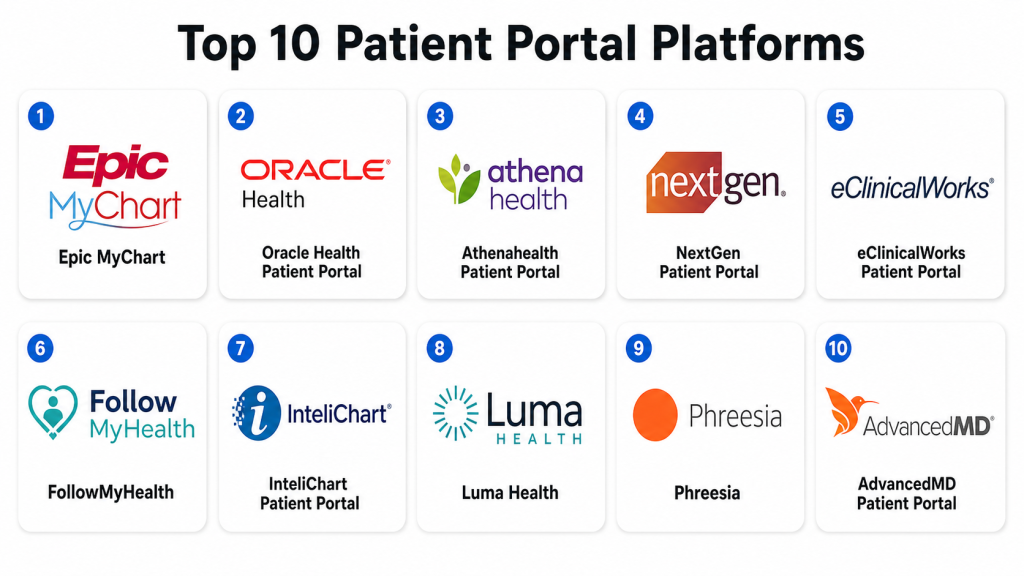
Top 10 Patient Portal Platforms
#1 — Epic MyChart
Short description: Epic MyChart is one of the most widely used patient portal platforms for hospitals and large healthcare networks. It allows patients to access medical records, test results, appointments, prescriptions, messages, and billing information. The platform is deeply connected with Epic’s healthcare ecosystem, making it suitable for large organizations already using Epic. It provides a familiar patient experience and strong digital care access. MyChart is best suited for enterprise hospitals and integrated health systems. It is powerful but usually works best within the Epic environment.
Key Features
- Patient medical record access
- Appointment scheduling
- Secure provider messaging
- Lab results and visit summaries
- Prescription refill requests
- Online billing and payments
- Mobile app access
Pros
- Strong patient adoption in large health systems
- Deep integration with Epic workflows
- Comprehensive patient self-service features
Cons
- Best suited for Epic users
- Implementation can be complex
- May be costly for smaller providers
Platforms / Deployment
Cloud and enterprise healthcare deployment models vary by implementation.
Security & Compliance
Strong healthcare-grade security controls are commonly supported, but exact compliance details vary by deployment.
Integrations & Ecosystem
Works deeply with Epic clinical, billing, scheduling, and patient engagement workflows.
Support & Community
Enterprise support is available based on organizational contract.
#2 — Oracle Health Patient Portal
Short description: Oracle Health Patient Portal supports digital access to healthcare information, appointments, messaging, and patient engagement workflows. It is designed for healthcare organizations using Oracle Health systems and enterprise healthcare infrastructure. The platform helps hospitals and clinics improve communication and reduce administrative workload. Patients can access key health information and interact with care teams through a secure digital channel. It is suitable for large hospitals and health networks. The platform is strongest when used within the broader Oracle Health ecosystem.
Key Features
- Patient record access
- Secure messaging
- Appointment management
- Billing and payment support
- Clinical data access
- Care team communication
- Enterprise system integration
Pros
- Good fit for large healthcare organizations
- Strong enterprise integration potential
- Supports patient engagement workflows
Cons
- Best for Oracle Health environments
- May require complex implementation
- Cost may be high for small practices
Platforms / Deployment
Cloud and enterprise deployment options may vary.
Security & Compliance
Security controls are available for healthcare environments, but exact details depend on deployment.
Integrations & Ecosystem
Integrates with Oracle Health clinical, administrative, and enterprise healthcare systems.
Support & Community
Support is available through enterprise service agreements.
#3 — Athenahealth Patient Portal
Short description: Athenahealth Patient Portal is a cloud-based platform designed to help medical practices improve patient engagement and administrative efficiency. It allows patients to view health information, book appointments, send messages, and handle billing tasks. The platform is known for being accessible and useful for small to mid-sized practices. It helps reduce front-desk workload by giving patients more self-service options. Athenahealth is a strong choice for ambulatory care and outpatient practices. It balances usability, engagement, and practice management features.
Key Features
- Online appointment scheduling
- Secure patient messaging
- Medical information access
- Billing and payment tools
- Patient reminders
- Mobile-friendly access
- Practice workflow integration
Pros
- User-friendly for practices
- Good for outpatient care
- Cloud-based and accessible
Cons
- Advanced customization may be limited
- Subscription cost may vary
- Best within Athenahealth workflows
Platforms / Deployment
Cloud-based.
Security & Compliance
Healthcare security features are supported, but exact compliance details vary by contract and configuration.
Integrations & Ecosystem
Works with Athenahealth practice management, billing, patient engagement, and clinical workflows.
Support & Community
Vendor support is available depending on plan.
#4 — NextGen Patient Portal
Short description: NextGen Patient Portal supports patient communication, health record access, appointment workflows, and practice engagement. It is designed for ambulatory practices, specialty clinics, and healthcare groups that use NextGen solutions. Patients can communicate with providers, review information, request appointments, and complete tasks digitally. The platform helps practices reduce manual communication and improve patient satisfaction. It is suitable for growing medical groups that need structured patient engagement. NextGen Patient Portal works best when connected to the broader NextGen healthcare ecosystem.
Key Features
- Secure patient messaging
- Appointment requests
- Health record access
- Forms and intake support
- Prescription refill requests
- Billing communication
- Practice workflow integration
Pros
- Strong for ambulatory practices
- Supports patient self-service
- Works well with NextGen systems
Cons
- Best for existing NextGen users
- Setup may require configuration
- Interface experience can vary
Platforms / Deployment
Cloud and hosted options may vary.
Security & Compliance
Healthcare-focused security features are available, but exact details depend on deployment.
Integrations & Ecosystem
Integrates with NextGen EHR, practice management, billing, and clinical workflows.
Support & Community
Support is available based on vendor package.
#5 — eClinicalWorks Patient Portal
Short description: eClinicalWorks Patient Portal is designed for clinics, practices, and healthcare groups that want to offer digital access to healthcare services. It helps patients view health records, schedule appointments, communicate with providers, and manage billing. The platform supports patient engagement and reduces administrative work for care teams. It is a practical option for small and mid-sized healthcare organizations. eClinicalWorks offers a connected portal experience within its broader healthcare platform. It is useful for providers seeking patient communication and practice efficiency.
Key Features
- Health record access
- Appointment scheduling
- Secure messaging
- Online payments
- Lab result access
- Patient reminders
- Mobile access
Pros
- Good fit for clinics and practices
- Covers common patient portal needs
- Supports digital communication
Cons
- Best inside eClinicalWorks ecosystem
- Customization may vary
- User experience depends on setup
Platforms / Deployment
Cloud-based.
Security & Compliance
Security features are available for healthcare use, but details vary by configuration.
Integrations & Ecosystem
Integrates with eClinicalWorks EHR, scheduling, billing, and patient engagement modules.
Support & Community
Vendor support is available depending on plan.
#6 — FollowMyHealth
Short description: FollowMyHealth is a patient engagement platform that gives patients access to health records, appointments, messages, and care information. It is designed to connect patients with healthcare providers through a secure digital portal. The platform supports communication, medical record access, and self-service healthcare tasks. It can be useful for hospitals, clinics, and healthcare organizations aiming to improve digital engagement. FollowMyHealth is suitable for organizations that need a patient-facing portal with broad access features. It helps improve convenience and transparency for patients.
Key Features
- Health record access
- Secure messaging
- Appointment support
- Test result viewing
- Medication information
- Mobile access
- Patient engagement tools
Pros
- Patient-friendly access
- Supports multiple healthcare workflows
- Useful for engagement and communication
Cons
- Integration quality may vary
- User experience depends on provider setup
- Advanced features may depend on configuration
Platforms / Deployment
Cloud-based options may vary by implementation.
Security & Compliance
Healthcare security controls are available, but exact details are not publicly stated for all deployments.
Integrations & Ecosystem
Can connect with healthcare systems, patient records, scheduling, and communication workflows depending on setup.
Support & Community
Support depends on vendor and provider configuration.
#7 — InteliChart Patient Portal
Short description: InteliChart Patient Portal is designed to improve patient engagement through communication, scheduling, reminders, forms, and record access. It supports healthcare organizations that want a focused patient engagement solution. The platform helps practices automate communication and reduce manual follow-up tasks. Patients can interact with providers, complete forms, and access health information through secure channels. InteliChart is suitable for practices that need strong communication and engagement workflows. It is a good fit for outpatient and ambulatory care settings.
Key Features
- Secure messaging
- Appointment reminders
- Online forms
- Patient record access
- Care communication
- Patient outreach tools
- Engagement automation
Pros
- Strong patient communication features
- Useful for outpatient practices
- Helps reduce front-desk workload
Cons
- May require integration planning
- Advanced clinical depth may vary
- Best for engagement-focused use cases
Platforms / Deployment
Cloud-based.
Security & Compliance
Not publicly stated in detail for all deployments.
Integrations & Ecosystem
Supports integrations with healthcare systems, patient engagement workflows, scheduling, and communication tools.
Support & Community
Vendor support availability varies by package.
#8 — Luma Health
Short description: Luma Health is a patient engagement platform focused on scheduling, communication, reminders, intake, and access improvement. It helps healthcare organizations reduce no-shows, improve appointment management, and create smoother patient journeys. While it is broader than a traditional portal, it provides many patient-facing digital access features. The platform is useful for clinics, hospitals, and specialty groups that want to optimize communication. Luma Health is strong for patient access and engagement workflows. It is best for organizations focused on improving patient experience and operational efficiency.
Key Features
- Appointment reminders
- Patient scheduling
- Digital intake
- Patient communication
- Waitlist management
- Outreach campaigns
- Access workflow automation
Pros
- Strong patient engagement focus
- Helps reduce missed appointments
- Good for access and communication workflows
Cons
- Not a full EHR replacement
- Portal depth may depend on integrations
- Best as an engagement layer
Platforms / Deployment
Cloud-based.
Security & Compliance
Healthcare security controls are supported, but exact details depend on implementation.
Integrations & Ecosystem
Integrates with EHR, scheduling, communication, intake, and patient access workflows depending on configuration.
Support & Community
Vendor support is available based on customer plan.
#9 — Phreesia
Short description: Phreesia is a patient intake and engagement platform that supports digital registration, forms, payments, communication, and patient access workflows. It helps healthcare organizations simplify front-desk operations and improve the pre-visit experience. Patients can complete forms, update information, make payments, and receive communication digitally. While it is not only a traditional patient portal, it plays a major role in patient engagement and access. Phreesia is suitable for clinics and healthcare groups that want to streamline intake and administrative workflows. It is especially strong for patient check-in and payment experiences.
Key Features
- Digital patient intake
- Registration forms
- Payment collection
- Patient communication
- Insurance and demographic updates
- Appointment workflow support
- Administrative automation
Pros
- Strong intake and registration workflows
- Helps reduce front-desk burden
- Good payment and form support
Cons
- Not a complete EHR portal
- Works best with integrated systems
- May focus more on intake than full records access
Platforms / Deployment
Cloud-based.
Security & Compliance
Healthcare data protection features are available, but details vary by implementation.
Integrations & Ecosystem
Integrates with EHR, practice management, intake, payment, and patient communication workflows.
Support & Community
Vendor support is available depending on plan.
#10 — AdvancedMD Patient Portal
Short description: AdvancedMD Patient Portal is designed for medical practices that need patient access, communication, appointment, and billing features. It allows patients to manage healthcare tasks online while helping practices reduce manual calls and paperwork. The portal works with AdvancedMD’s practice management and EHR ecosystem. It is suitable for small and mid-sized practices that need a practical and connected portal solution. The platform supports digital communication, payment, and access workflows. It is a good fit for practices seeking an all-in-one healthcare administration experience.
Key Features
- Patient record access
- Appointment requests
- Secure messaging
- Online payments
- Forms and intake support
- Practice management integration
- Mobile-friendly access
Pros
- Good for small and mid-sized practices
- Supports billing and appointment workflows
- Works with AdvancedMD ecosystem
Cons
- Best for AdvancedMD users
- Advanced customization may vary
- Enterprise scalability may be limited
Platforms / Deployment
Cloud-based.
Security & Compliance
Security features are available for healthcare usage, but exact details vary by configuration.
Integrations & Ecosystem
Integrates with AdvancedMD EHR, practice management, billing, forms, and scheduling workflows.
Support & Community
Vendor support is available based on plan.
Comparison Table
| Tool | Best For | Deployment | Core Strength | Patient Engagement | Standout Feature |
|---|---|---|---|---|---|
| Epic MyChart | Large hospitals | Cloud / Enterprise | Medical record access | High | Deep Epic ecosystem integration |
| Oracle Health Patient Portal | Enterprise healthcare networks | Cloud / Enterprise | Connected health data | High | Enterprise healthcare integration |
| Athenahealth Patient Portal | Small and mid-sized practices | Cloud | Practice engagement | High | Easy outpatient workflows |
| NextGen Patient Portal | Ambulatory care groups | Cloud / Hosted | Patient self-service | High | Strong practice workflow support |
| eClinicalWorks Patient Portal | Clinics and practices | Cloud | Portal and EHR connection | High | Practical patient communication |
| FollowMyHealth | Hospitals and clinics | Cloud | Record access and messaging | High | Broad patient portal access |
| InteliChart Patient Portal | Engagement-focused practices | Cloud | Communication automation | High | Forms, reminders, and outreach |
| Luma Health | Patient access teams | Cloud | Scheduling and communication | High | Appointment and access optimization |
| Phreesia | Intake-heavy practices | Cloud | Digital intake and payments | Medium to High | Front-desk automation |
| AdvancedMD Patient Portal | Small medical practices | Cloud | Practice portal workflows | Medium to High | Billing and appointment support |
Evaluation & Scoring Table
| Tool | Core | Ease | Integrations | Security | Performance | Support | Value | Weighted Total |
|---|---|---|---|---|---|---|---|---|
| Epic MyChart | 10 | 8 | 9 | 9 | 9 | 8 | 7 | 8.7 |
| Oracle Health Patient Portal | 9 | 7 | 9 | 9 | 9 | 8 | 7 | 8.4 |
| Athenahealth Patient Portal | 8 | 9 | 8 | 8 | 8 | 8 | 8 | 8.2 |
| NextGen Patient Portal | 8 | 8 | 8 | 8 | 8 | 8 | 8 | 8.0 |
| eClinicalWorks Patient Portal | 8 | 8 | 8 | 8 | 8 | 7 | 8 | 7.9 |
| FollowMyHealth | 8 | 8 | 8 | 8 | 8 | 7 | 8 | 7.9 |
| InteliChart Patient Portal | 8 | 8 | 8 | 8 | 7 | 7 | 8 | 7.8 |
| Luma Health | 8 | 9 | 8 | 8 | 8 | 8 | 8 | 8.2 |
| Phreesia | 8 | 9 | 8 | 8 | 8 | 8 | 8 | 8.2 |
| AdvancedMD Patient Portal | 8 | 8 | 8 | 8 | 7 | 7 | 8 | 7.8 |
Which Patient Portal Platform Is Right for You?
Choosing the right patient portal platform depends on your healthcare organization’s size, existing EHR system, patient communication needs, and digital engagement goals. A large hospital network will need a different portal than a small clinic or outpatient practice. The best option should make healthcare access easier for patients while reducing manual work for staff.
For large hospitals and health systems
Epic MyChart and Oracle Health Patient Portal are strong choices for enterprise healthcare organizations. They support broad patient access, medical record visibility, appointment workflows, messaging, and deep healthcare system integration. These platforms are best for hospitals with complex clinical and administrative workflows. They provide powerful capabilities but usually require structured implementation. They are ideal for organizations with larger budgets and mature IT teams.
For small and mid-sized medical practices
Athenahealth Patient Portal, eClinicalWorks Patient Portal, and AdvancedMD Patient Portal are practical options for smaller healthcare providers. They support appointment scheduling, patient communication, billing, and access to health information. These platforms are easier to adopt than large enterprise systems. They help reduce phone calls and front-desk workload. They are best for practices that need reliable patient engagement without excessive complexity.
For ambulatory and specialty care groups
NextGen Patient Portal is a good fit for ambulatory care providers, specialty clinics, and growing medical groups. It supports patient self-service, secure messaging, forms, prescription requests, and practice workflows. The platform is useful when patient engagement must connect closely with outpatient operations. It works best for organizations already using or considering NextGen systems. It provides a balanced mix of usability and healthcare workflow support.
For patient communication and engagement automation
InteliChart Patient Portal and Luma Health are suitable for healthcare organizations focused on communication, reminders, digital intake, and outreach. These platforms help improve patient response rates and reduce missed appointments. They are useful when the goal is better engagement rather than only medical record access. They can support scheduling, reminders, forms, and communication workflows. They are ideal for clinics trying to improve patient experience and operational efficiency.
For digital intake and front-desk automation
Phreesia is a strong choice for practices that want to improve registration, forms, payments, and check-in workflows. It helps reduce paperwork and administrative effort before and during visits. It is especially useful for organizations with high patient volume at the front desk. While it is not a full EHR portal by itself, it adds strong patient intake functionality. It is best for practices that want smoother patient arrival and payment experiences.
FAQs
1. What is a Patient Portal Platform?
A Patient Portal Platform is a secure digital system that allows patients to access healthcare information and services online. Patients can view records, book appointments, send messages, request prescription refills, and manage billing tasks. It improves communication between patients and healthcare providers. It also reduces manual work for clinic and hospital staff. These platforms are now important for modern digital healthcare.
2. What features should a patient portal include?
A good patient portal should include medical record access, appointment scheduling, secure messaging, test result viewing, prescription refill requests, and billing support. It should also be mobile-friendly and easy for patients to use. Strong security and privacy controls are essential. Integration with EHR and practice management systems is also important. The best features depend on the size and type of healthcare organization.
3. How does a patient portal improve patient experience?
A patient portal improves patient experience by giving patients convenient access to healthcare information without needing to call the clinic. Patients can check results, manage appointments, complete forms, and communicate securely with care teams. This saves time for both patients and staff. It also gives patients more control over their healthcare journey. Better access often leads to stronger engagement and satisfaction.
4. Are patient portals only for hospitals?
No, patient portals are useful for hospitals, clinics, specialty practices, diagnostic centers, and outpatient care providers. Large hospitals may use enterprise portals like Epic MyChart or Oracle Health Patient Portal. Smaller practices may prefer Athenahealth, eClinicalWorks, or AdvancedMD. Some platforms focus more on intake, reminders, and communication. The right choice depends on provider size and workflow needs.
5. Can patient portals integrate with EHR systems?
Yes, most patient portals are designed to integrate with EHR systems, practice management tools, billing platforms, and scheduling systems. Integration allows patients to view accurate health information and complete tasks online. It also helps providers avoid duplicate data entry. Strong integration improves workflow efficiency and reduces errors. Healthcare organizations should confirm integration capabilities before choosing a platform.
6. Are patient portals secure?
Patient portals usually include security features such as authentication, access control, encryption, and audit tracking. Security is important because patient health data is sensitive. Healthcare organizations should evaluate each platform’s privacy and compliance features carefully. Staff training and proper configuration also play an important role. A secure portal protects patient trust and organizational reputation.
7. Do patient portals support online payments?
Many patient portals support online billing and payment features. Patients can view balances, pay bills, and sometimes manage insurance-related information digitally. This improves convenience for patients and helps healthcare organizations collect payments faster. Payment features are especially useful for clinics and outpatient practices. Availability depends on the platform and integration setup.
8. Can patient portals reduce administrative workload?
Yes, patient portals can reduce calls, paperwork, manual appointment handling, and front-desk tasks. Patients can complete forms, request appointments, check results, and send messages without staff intervention. This allows administrative teams to focus on higher-value tasks. It also reduces errors caused by manual data entry. Over time, portals can improve operational efficiency significantly.
9. What is the difference between a patient portal and a patient engagement platform?
A patient portal mainly gives patients access to records, messages, appointments, and billing features. A patient engagement platform may include broader tools like reminders, outreach campaigns, digital intake, surveys, and access automation. Some modern platforms combine both functions. Patient portals are record-access focused, while engagement platforms focus more on communication and experience. Many healthcare organizations use both together.
10. Which Patient Portal Platform is best overall?
There is no single best platform for every healthcare organization. Epic MyChart and Oracle Health Patient Portal are strong for large hospitals and health systems. Athenahealth, eClinicalWorks, and AdvancedMD are practical for small and mid-sized practices. Luma Health, InteliChart, and Phreesia are useful for engagement, intake, and access workflows. The best choice depends on existing systems, patient needs, budget, and workflow complexity.
Conclusion
Patient Portal Platforms are essential for healthcare organizations that want to improve digital access, patient communication, and operational efficiency. They allow patients to manage appointments, view records, complete forms, make payments, and communicate with providers securely. By reducing manual administrative work, these platforms help healthcare teams focus more on care delivery and less on repetitive tasks.
The right patient portal depends on your healthcare environment and digital maturity. Large hospitals may prefer Epic MyChart or Oracle Health Patient Portal, while small practices may benefit from Athenahealth, eClinicalWorks, or AdvancedMD. Organizations focused on communication, intake, and patient access may choose Luma Health, InteliChart, or Phreesia. By evaluating usability, integrations, security, and patient experience, healthcare providers can choose a platform that supports long-term digital care improvement.
