Introduction
Hospital Information Systems are integrated software platforms used to manage hospital operations, patient records, clinical workflows, billing, departments, appointments, pharmacy, laboratory, radiology, and administrative processes. These systems help hospitals move from manual paperwork to centralized digital workflows, improving efficiency, accuracy, and coordination across departments.
A strong Hospital Information System supports doctors, nurses, administrators, billing teams, laboratory staff, and management teams through one connected platform. It improves patient care by making information easier to access, reduces duplicate work, and supports faster decision-making. Choosing the right system depends on hospital size, department needs, compliance requirements, integration capability, reporting depth, and ease of use.
Key Trends in Hospital Information Systems
- Growing adoption of cloud-based hospital platforms
- Stronger focus on interoperability between departments
- Integration with EHR, billing, pharmacy, lab, and radiology systems
- Increased use of patient portals and digital appointment booking
- AI-assisted reporting and clinical decision support
- Mobile access for doctors, nurses, and hospital staff
- Better analytics for hospital performance and resource planning
- Stronger data privacy, access control, and audit tracking
- Automation of billing, discharge, admission, and inventory workflows
- Demand for scalable systems for multi-location hospital networks
How We Selected These Tools
- Core hospital management capabilities
- Patient record and clinical workflow support
- Ease of use for hospital staff
- Billing, claims, and finance management features
- Laboratory, pharmacy, and radiology integration
- Scalability for small, mid-sized, and large hospitals
- Security, compliance, and access control features
- Reporting, analytics, and dashboard quality
- Deployment flexibility and support availability
- Overall value for healthcare organizations
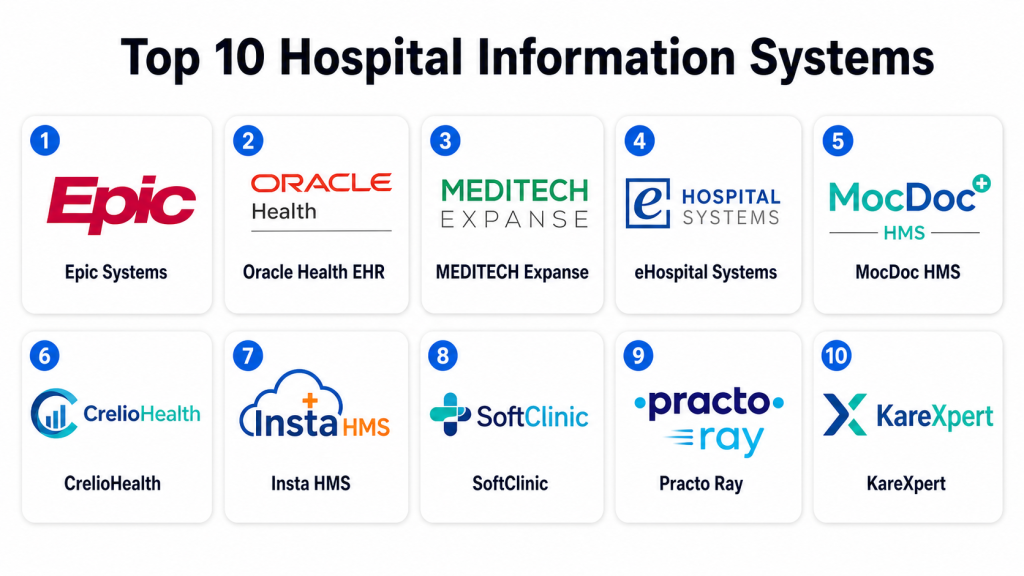
Top 10 Hospital Information Systems
#1 — Epic Systems
Epic Systems is a widely used hospital information and healthcare management platform designed for large hospitals and health networks. It supports patient records, clinical workflows, scheduling, billing, reporting, and care coordination. The system is known for strong enterprise capabilities and deep integration across healthcare departments. It is best suited for large hospitals that need a comprehensive and scalable digital infrastructure. Epic can support complex workflows across multiple facilities and specialties. It is powerful, but implementation usually requires significant planning, training, and budget.
Key Features
- Patient record management
- Clinical workflow support
- Appointment scheduling
- Billing and revenue cycle tools
- Reporting and analytics
- Patient portal support
- Multi-department integration
Pros
- Strong enterprise-grade functionality
- Highly scalable for large hospitals
- Comprehensive clinical and operational features
Cons
- Expensive for smaller hospitals
- Complex implementation process
- Requires staff training
Platforms / Deployment
Cloud and on-premise options may vary by implementation.
Security & Compliance
Strong healthcare security controls are commonly associated with enterprise deployments, but specific compliance details vary by implementation.
Integrations & Ecosystem
Epic supports wide hospital workflows and can integrate with clinical, billing, lab, pharmacy, imaging, and patient engagement systems depending on configuration.
Support & Community
Enterprise-level support is available, usually based on hospital contract and deployment model.
#2 — Oracle Health EHR
Oracle Health EHR is a hospital-focused healthcare platform used for clinical, administrative, and operational management. It supports patient data, care coordination, billing workflows, and department-level processes. The system is designed for hospitals, health systems, and large care organizations that require reliable data management. It helps connect clinical teams and administrative operations through shared patient information. Oracle Health EHR is suitable for hospitals needing strong interoperability and enterprise-scale infrastructure. It may require technical expertise and structured implementation planning.
Key Features
- Electronic health records
- Clinical workflow management
- Patient scheduling
- Revenue cycle support
- Reporting and analytics
- Interoperability features
- Department coordination tools
Pros
- Suitable for large healthcare networks
- Strong data management capabilities
- Supports integrated hospital workflows
Cons
- Can be complex to configure
- May require dedicated IT resources
- Higher cost for smaller providers
Platforms / Deployment
Cloud and enterprise deployment options vary.
Security & Compliance
Security and compliance features are generally available for healthcare environments, but exact details depend on deployment.
Integrations & Ecosystem
Integrates with healthcare operations, clinical systems, billing tools, and enterprise data environments.
Support & Community
Enterprise support is available depending on contract and implementation scope.
#3 — MEDITECH Expanse
MEDITECH Expanse is a hospital information system built for clinical, financial, and operational workflows. It supports patient care, hospital administration, EHR functionality, billing, pharmacy, and departmental coordination. The platform is used by hospitals that need a connected system without excessive complexity. It offers a modern interface and supports mobility for healthcare professionals. MEDITECH is suitable for mid-sized and large hospitals looking for a balanced solution. It provides strong hospital functionality while remaining more approachable than some larger enterprise systems.
Key Features
- Clinical documentation
- Patient record management
- Revenue cycle tools
- Pharmacy and lab support
- Mobile access
- Reporting dashboards
- Care coordination features
Pros
- Good fit for hospitals and health systems
- Balanced functionality and usability
- Supports mobile clinical workflows
Cons
- Customization may require effort
- Training is still needed
- Advanced workflows may need configuration
Platforms / Deployment
Cloud and hosted deployment options may be available.
Security & Compliance
Healthcare-focused security features are available, with specifics depending on implementation.
Integrations & Ecosystem
Supports integration with hospital departments, clinical workflows, financial systems, and patient engagement tools.
Support & Community
Support availability varies by plan and deployment model.
#4 — eHospital Systems
eHospital Systems is a hospital management solution designed for hospitals, clinics, and healthcare groups. It provides modules for patient registration, appointments, billing, pharmacy, laboratory, inventory, HR, and reporting. The system is useful for hospitals that want an all-in-one operational platform. It helps reduce manual paperwork and improves coordination between departments. eHospital Systems is suitable for small to mid-sized hospitals looking for modular functionality. It can be a practical choice for organizations that need broad hospital administration features.
Key Features
- Patient registration
- Appointment management
- Billing and invoicing
- Pharmacy management
- Laboratory management
- Inventory tracking
- HR and staff management
Pros
- Broad hospital management modules
- Useful for small and mid-sized hospitals
- Supports administrative automation
Cons
- Advanced clinical depth may vary
- Integration needs may require review
- User experience depends on configuration
Platforms / Deployment
Cloud and on-premise options may vary.
Security & Compliance
Not publicly stated in detail for all deployments.
Integrations & Ecosystem
Can support hospital departments such as billing, pharmacy, lab, inventory, and administration.
Support & Community
Support varies by vendor package and deployment.
#5 — MocDoc HMS
MocDoc HMS is a hospital management system designed to simplify hospital operations through digital workflows. It supports appointment scheduling, patient records, billing, pharmacy, inventory, laboratory, and reporting. The platform is often suitable for clinics, diagnostic centers, and hospitals that need a practical and easy-to-use solution. It helps improve operational visibility and reduce manual tasks. MocDoc can be useful for healthcare providers moving from spreadsheets or paper-based workflows. It is a good fit for small and mid-sized healthcare organizations.
Key Features
- Appointment scheduling
- Patient records
- Billing and finance tools
- Pharmacy management
- Lab management
- Inventory tracking
- Reports and dashboards
Pros
- Easy to use
- Good for small and mid-sized hospitals
- Covers multiple hospital departments
Cons
- May not fit very large hospital networks
- Advanced customization may be limited
- Enterprise integrations may vary
Platforms / Deployment
Cloud-based deployment is commonly used.
Security & Compliance
Not publicly stated in detail for all use cases.
Integrations & Ecosystem
Supports common hospital functions including pharmacy, lab, billing, appointments, and inventory.
Support & Community
Vendor support is available depending on plan.
#6 — CrelioHealth
CrelioHealth is a healthcare management platform commonly used by diagnostic centers, laboratories, clinics, and healthcare providers. It supports patient management, lab workflows, reports, billing, appointments, and operational dashboards. While it is especially strong for diagnostics and lab-centered workflows, it can support broader healthcare operations depending on configuration. It helps healthcare teams improve turnaround time, reporting accuracy, and patient communication. CrelioHealth is suitable for diagnostic-heavy hospitals and healthcare chains. It is especially useful where lab and reporting workflows are central.
Key Features
- Patient management
- Lab workflow support
- Report generation
- Billing tools
- Appointment management
- Operational dashboards
- Patient communication features
Pros
- Strong for diagnostic workflows
- Good reporting capabilities
- Useful for healthcare chains
Cons
- Full hospital depth may vary
- Best suited for lab-heavy environments
- May need integration for broader hospital needs
Platforms / Deployment
Cloud-based deployment.
Security & Compliance
Not publicly stated in detail for all regions.
Integrations & Ecosystem
Can integrate with diagnostic workflows, patient communication tools, billing workflows, and operational systems.
Support & Community
Support is available through vendor channels.
#7 — Insta HMS
Insta HMS is a hospital management system designed for hospitals, clinics, and healthcare networks. It supports clinical, financial, administrative, and operational workflows. The platform includes modules for patient registration, billing, appointment scheduling, pharmacy, inventory, and reporting. It helps hospitals improve process automation and reduce dependency on manual records. Insta HMS is suitable for healthcare organizations that need a configurable and scalable system. It can work well for hospitals looking for balanced operational and clinical management.
Key Features
- Patient registration
- Appointment scheduling
- Billing and insurance workflows
- Pharmacy management
- Inventory management
- Clinical documentation
- Reports and analytics
Pros
- Covers many hospital functions
- Suitable for growing hospitals
- Supports operational automation
Cons
- Configuration may take time
- Training may be required
- Advanced features may depend on plan
Platforms / Deployment
Cloud and hosted options may vary.
Security & Compliance
Not publicly stated in detail for all deployments.
Integrations & Ecosystem
Supports hospital operations, billing, pharmacy, inventory, patient workflows, and analytics.
Support & Community
Vendor support availability varies by package.
#8 — SoftClinic
SoftClinic is a hospital and clinic management system designed for patient records, appointments, billing, pharmacy, laboratory, and hospital administration. It supports digital workflows for small hospitals, clinics, and multi-specialty healthcare centers. The system helps manage patient visits, doctor schedules, prescriptions, and operational reporting. SoftClinic is suitable for organizations that need a practical and affordable hospital management solution. It can help reduce manual effort and improve department coordination. It is often a good fit for small and mid-sized healthcare providers.
Key Features
- Patient records
- Doctor scheduling
- Billing management
- Pharmacy module
- Laboratory module
- Prescription management
- Reporting tools
Pros
- Good for clinics and small hospitals
- Covers essential hospital workflows
- Practical and easy to adopt
Cons
- May not suit large enterprise hospitals
- Advanced integrations may vary
- Interface experience may depend on setup
Platforms / Deployment
Cloud and on-premise options may vary.
Security & Compliance
Not publicly stated in detail.
Integrations & Ecosystem
Supports clinic and hospital modules including billing, pharmacy, lab, appointments, and records.
Support & Community
Vendor support is available depending on package.
#9 — Practo Ray
Practo Ray is a healthcare practice and clinic management platform that supports patient appointments, digital records, billing, communication, and practice workflows. It is especially useful for clinics, small hospitals, and healthcare providers looking for simple digital operations. The platform helps manage doctor schedules, patient engagement, and everyday administrative tasks. It is more suitable for outpatient and practice management than highly complex hospital networks. Practo Ray is a good option for providers that want ease of use and patient-facing convenience. It works best for smaller healthcare setups.
Key Features
- Appointment scheduling
- Patient records
- Billing tools
- Patient communication
- Doctor schedule management
- Practice management
- Digital prescription support
Pros
- Easy to use
- Good for clinics and outpatient workflows
- Helpful patient engagement features
Cons
- Limited for large hospitals
- Advanced hospital modules may be limited
- Not ideal for complex inpatient workflows
Platforms / Deployment
Cloud-based deployment.
Security & Compliance
Not publicly stated in detail for all deployments.
Integrations & Ecosystem
Supports appointment, practice, patient communication, and billing workflows.
Support & Community
Vendor support availability depends on plan.
#10 — KareXpert
KareXpert is a digital healthcare platform offering hospital management, EHR, patient engagement, billing, pharmacy, laboratory, and connected care capabilities. It is designed for hospitals looking for a digital-first approach to operations and patient experience. The platform supports workflow automation across multiple departments. It can help improve hospital efficiency, digital access, and patient communication. KareXpert is suitable for hospitals and healthcare groups that want a modern platform with broad digital modules. It may be a strong fit for organizations aiming to improve digital transformation.
Key Features
- Hospital management
- EHR support
- Patient engagement
- Billing and finance tools
- Pharmacy module
- Laboratory module
- Digital workflow automation
Pros
- Modern digital healthcare approach
- Broad hospital modules
- Supports patient engagement
Cons
- Implementation needs planning
- Feature depth may vary by package
- Training may be needed
Platforms / Deployment
Cloud-based deployment options may be available.
Security & Compliance
Not publicly stated in detail for all deployments.
Integrations & Ecosystem
Supports hospital workflows, patient engagement, pharmacy, lab, EHR, billing, and operational modules.
Support & Community
Vendor support depends on implementation and plan.
Comparison Table
| Tool | Best For | Deployment | Core Strength | Scalability | Standout Feature |
|---|---|---|---|---|---|
| Epic Systems | Large hospitals and health networks | Cloud / On-premise | Enterprise hospital workflows | High | Comprehensive clinical ecosystem |
| Oracle Health EHR | Large healthcare organizations | Cloud / Enterprise | Data and interoperability | High | Integrated enterprise healthcare platform |
| MEDITECH Expanse | Mid-sized and large hospitals | Cloud / Hosted | Balanced clinical and admin workflows | High | Mobile-friendly hospital workflows |
| eHospital Systems | Small to mid-sized hospitals | Cloud / On-premise | Modular hospital administration | Medium | Broad operational modules |
| MocDoc HMS | Small hospitals and clinics | Cloud | Easy hospital automation | Medium | Simple multi-department management |
| CrelioHealth | Diagnostic-heavy healthcare providers | Cloud | Lab and diagnostic workflows | Medium | Strong reporting and lab operations |
| Insta HMS | Growing hospitals | Cloud / Hosted | Hospital operations automation | Medium to High | Configurable hospital modules |
| SoftClinic | Clinics and small hospitals | Cloud / On-premise | Clinic and hospital basics | Medium | Practical patient and billing workflows |
| Practo Ray | Clinics and outpatient practices | Cloud | Practice management | Low to Medium | Patient appointment and engagement tools |
| KareXpert | Digital-first hospitals | Cloud | Connected hospital workflows | Medium to High | Patient engagement and hospital automation |
Evaluation & Scoring Table
| Tool | Core | Ease | Integrations | Security | Performance | Support | Value | Weighted Total |
|---|---|---|---|---|---|---|---|---|
| Epic Systems | 10 | 7 | 9 | 9 | 9 | 8 | 7 | 8.6 |
| Oracle Health EHR | 9 | 7 | 9 | 9 | 9 | 8 | 7 | 8.4 |
| MEDITECH Expanse | 9 | 8 | 8 | 9 | 8 | 8 | 8 | 8.4 |
| eHospital Systems | 8 | 8 | 7 | 7 | 8 | 7 | 8 | 7.7 |
| MocDoc HMS | 7 | 9 | 7 | 7 | 7 | 7 | 9 | 7.7 |
| CrelioHealth | 8 | 8 | 8 | 8 | 8 | 7 | 8 | 7.9 |
| Insta HMS | 8 | 8 | 8 | 8 | 8 | 7 | 8 | 7.9 |
| SoftClinic | 7 | 8 | 7 | 7 | 7 | 7 | 9 | 7.6 |
| Practo Ray | 7 | 9 | 7 | 7 | 7 | 7 | 8 | 7.5 |
| KareXpert | 8 | 8 | 8 | 8 | 8 | 7 | 8 | 7.9 |
Which Hospital Information System Is Right for You?
Choosing the right Hospital Information System depends on hospital size, workflow complexity, department requirements, and budget. A small clinic does not need the same level of complexity as a large multi-specialty hospital. The right choice should improve patient care, simplify daily work, and support future growth.
For large hospitals and enterprise health networks
Large hospitals need strong scalability, clinical depth, and department-wide integration. Epic Systems, Oracle Health EHR, and MEDITECH Expanse are better suited for these environments. They support complex workflows, multiple specialties, large patient volumes, and advanced reporting. These systems are powerful but require structured implementation and staff training. They are best for organizations with larger budgets and dedicated IT teams.
For small and mid-sized hospitals
Small and mid-sized hospitals usually need practical systems that cover patient registration, appointments, billing, pharmacy, lab, and reporting. eHospital Systems, MocDoc HMS, Insta HMS, and SoftClinic are suitable options for these needs. They provide essential hospital automation without excessive complexity. These platforms can help reduce paperwork and improve coordination between departments. They are ideal for hospitals moving toward digital operations.
For diagnostic centers and lab-focused hospitals
Hospitals with strong diagnostic, pathology, or laboratory workflows should consider CrelioHealth. It is useful for report management, lab workflows, patient communication, and operational dashboards. It can help improve turnaround time and reporting accuracy. This type of system is best when laboratory operations are central to the healthcare service. It is especially useful for diagnostic chains and lab-heavy healthcare providers.
For clinics and outpatient practices
If your organization mainly handles outpatient visits, doctor appointments, prescriptions, and billing, Practo Ray can be a simple and practical option. It is suitable for small clinics and independent healthcare providers. The platform focuses on ease of use, appointment scheduling, and patient communication. It may not be ideal for complex inpatient hospital workflows. It is best for providers that need simplicity over deep hospital functionality.
For digital-first hospitals
Hospitals looking for a modern digital transformation platform can consider KareXpert. It supports hospital workflows, patient engagement, billing, pharmacy, lab, and digital care coordination. It can help healthcare providers improve operational efficiency and patient experience. This type of platform is useful for hospitals that want connected digital services. It is a good fit for organizations planning long-term digital growth.
FAQs
1. What is a Hospital Information System?
A Hospital Information System is software used to manage hospital operations, patient records, appointments, billing, departments, pharmacy, lab, and reporting. It helps hospitals replace manual paperwork with digital workflows. The system improves coordination between doctors, nurses, billing teams, and administrators. It also supports better patient care by making information easier to access. Overall, it improves hospital efficiency and accuracy.
2. What are the main features of a Hospital Information System?
Key features include patient registration, appointment scheduling, EHR, billing, pharmacy, laboratory, inventory, and reporting. Many systems also include doctor scheduling, discharge management, insurance workflows, and patient portals. Advanced systems may support analytics, telehealth, and clinical decision support. The best features depend on hospital size and department needs. A good system should connect clinical and administrative workflows smoothly.
3. How is a Hospital Information System different from an EHR system?
An EHR system mainly focuses on digital patient health records and clinical documentation. A Hospital Information System covers broader hospital operations, including billing, appointments, pharmacy, lab, inventory, HR, and administration. Many modern HIS platforms include EHR features as part of the system. In simple terms, EHR is patient-record focused, while HIS is hospital-wide. Large hospitals often need both functions working together.
4. Is a Hospital Information System suitable for small hospitals?
Yes, many Hospital Information Systems are designed for small and mid-sized hospitals. Smaller hospitals should choose systems that are easy to deploy, affordable, and simple to train staff on. Tools like MocDoc HMS, SoftClinic, and eHospital Systems can support essential workflows. These systems help reduce paperwork and improve daily operations. Small hospitals should avoid overly complex platforms unless they need advanced enterprise features.
5. What should hospitals check before choosing an HIS?
Hospitals should check features, ease of use, deployment model, integration capability, support quality, and security. It is also important to evaluate whether the system supports billing, pharmacy, lab, radiology, appointments, and reporting. The platform should match current workflows and future growth plans. Staff training and implementation support are also important. A trial or demo can help confirm fit before purchase.
6. Can Hospital Information Systems integrate with lab and pharmacy systems?
Yes, many Hospital Information Systems include or integrate with laboratory and pharmacy modules. This helps automate test orders, sample tracking, report generation, medicine inventory, prescriptions, and billing. Integration reduces manual entry and improves accuracy. It also helps doctors and staff access information faster. Hospitals should confirm integration capabilities before finalizing a system.
7. Are cloud-based Hospital Information Systems better?
Cloud-based systems are easier to access, faster to deploy, and usually require less internal IT maintenance. They are useful for hospitals that want remote access and regular updates. On-premise systems offer more control but require infrastructure and IT support. The best option depends on hospital size, budget, security policy, and internet reliability. Many hospitals prefer cloud or hybrid models for flexibility.
8. How secure are Hospital Information Systems?
Security depends on the vendor, deployment model, and hospital configuration. Good systems include access control, user permissions, audit logs, data backup, and encryption. Hospitals must also follow internal data privacy policies and train staff on secure usage. Security is especially important because patient data is sensitive. Before choosing a system, hospitals should review security and compliance details carefully.
9. Do Hospital Information Systems help with billing and finance?
Yes, most Hospital Information Systems include billing, invoicing, payment tracking, insurance workflows, and revenue reporting. These features help reduce billing errors and speed up payment processes. They also allow finance teams to monitor collections and outstanding balances. Integrated billing improves coordination between clinical services and accounts teams. This is important for both patient experience and hospital revenue management.
10. Which Hospital Information System is best overall?
There is no single best system for every hospital. Epic Systems, Oracle Health EHR, and MEDITECH Expanse are strong for large hospitals and enterprise networks. MocDoc HMS, eHospital Systems, SoftClinic, and Insta HMS are better for small and mid-sized hospitals. CrelioHealth is useful for diagnostic-heavy providers, while Practo Ray suits clinics. The best choice depends on hospital size, workflow needs, budget, and technical readiness.
Conclusion
Hospital Information Systems are essential for modern healthcare organizations that want to improve patient care, reduce paperwork, and manage operations more efficiently. These systems connect clinical, administrative, financial, laboratory, pharmacy, and reporting workflows into one digital environment. A well-selected HIS can improve coordination between departments, reduce manual errors, and help hospital teams make faster decisions.
The right system depends on the type and size of the healthcare organization. Large hospitals may need enterprise platforms like Epic Systems, Oracle Health EHR, or MEDITECH Expanse, while small and mid-sized hospitals may prefer simpler tools like MocDoc HMS, eHospital Systems, SoftClinic, or Insta HMS. Diagnostic centers may benefit from CrelioHealth, and outpatient clinics may find Practo Ray more practical. By evaluating usability, scalability, integrations, support, and security, hospitals can choose a system that supports long-term digital growth.
