Introduction
Knowledge Graph Databases are specialized graph databases designed to store, manage, and query complex relationships between entities. They model data as nodes, edges, and properties, enabling rich semantic connections that are difficult to capture with traditional relational databases. Organizations use knowledge graphs to gain deeper insights, enhance search and recommendation systems, and integrate diverse datasets.
With the exponential growth of data, enterprises increasingly require semantic querying, AI-driven analytics, and connected data intelligence. Knowledge graph databases enable real-time relationship discovery, reasoning, and advanced analytics across diverse domains such as finance, healthcare, e-commerce, research, and enterprise knowledge management.
Real World Use Cases
- Enhancing search engines with semantic understanding
- Recommendation engines for e-commerce or media platforms
- Enterprise data integration and master data management
- Fraud detection and risk analytics in finance
- Biomedical research and drug discovery
- Supply chain and logistics optimization
- Chatbots and conversational AI
- IoT device relationship mapping
Evaluation Criteria for Buyers
- Graph model support (property graph, RDF, hybrid)
- Query language support (SPARQL, Gremlin, Cypher)
- Scalability across large datasets
- Integration with analytics and AI pipelines
- Real-time querying and reasoning
- Data import and ETL capabilities
- Security and access control
- Multi-cloud and hybrid deployment support
- Observability and monitoring tools
- Developer ecosystem and support
Best for: Data engineers, AI and ML teams, enterprise architects, research institutions, and organizations needing semantic analytics or connected data intelligence.
Not ideal for: Teams with simple key-value or relational data needs that do not require semantic relationships or graph reasoning.
Key Trends in Knowledge Graph Databases
- Increased adoption of hybrid property and RDF graph models
- AI-driven knowledge graph reasoning and inference
- Real-time graph querying for operational intelligence
- Integration with machine learning and NLP pipelines
- Cloud-native deployments with elasticity
- Graph analytics for fraud detection and recommendation engines
- Low-latency graph search capabilities
- Support for multi-domain and multi-tenant graphs
- Semantic enrichment with linked open data
- Improved developer tooling and query optimization
How We Selected These Tools (Methodology)
- Enterprise and research adoption
- Graph model and query language support
- Scalability and performance on large datasets
- Integration with AI/ML and analytics pipelines
- Security and compliance capabilities
- Data import, transformation, and ETL tools
- Deployment flexibility (cloud, on-premise, hybrid)
- Observability and monitoring support
- Developer and community support
- Multi-tenant and enterprise feature set
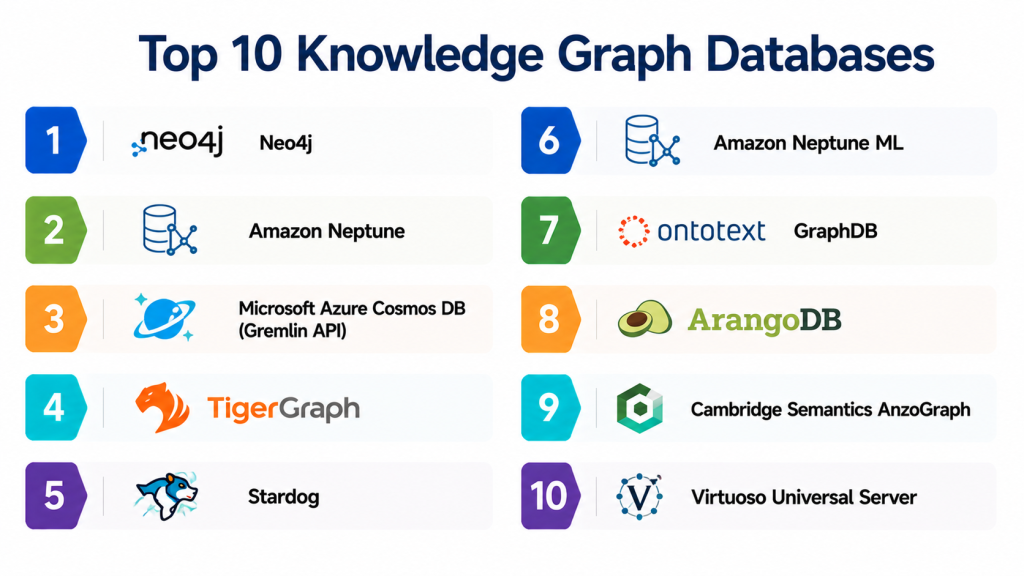
Top 10 Knowledge Graph Databases
1- Neo4j
Short Description:
Neo4j is a widely adopted property graph database designed for connected data, supporting complex queries and real-time analytics.
Key Features
- Native graph storage
- Cypher query language
- ACID transactions
- High-availability clustering
- Real-time graph analytics
- ETL and data import tools
- Cloud, on-premise, and hybrid deployment
Pros
- Mature and well-supported
- Strong developer community
- Real-time query performance
Cons
- Higher learning curve for new graph users
- Enterprise features require paid editions
Platforms / Deployment
Cloud, On-premise, Hybrid
Security & Compliance
SSO, RBAC, encryption, audit logging
Integrations & Ecosystem
- BI tools
- Apache Spark
- Graph algorithms libraries
- ML frameworks
Support & Community
Extensive documentation and active community
2- Amazon Neptune
Short Description:
Amazon Neptune is a fully managed graph database supporting both property graph and RDF models for real-time knowledge management.
Key Features
- Multi-model graph support (property, RDF)
- SPARQL, Gremlin, openCypher support
- Fully managed with high availability
- Integration with AWS ecosystem
- ACID-compliant transactions
- Backup and recovery support
- Scalable storage and compute
Pros
- Fully managed
- Multi-model support
- Strong cloud integration
Cons
- AWS dependency
- Limited customization
Platforms / Deployment
Cloud
Security & Compliance
IAM, encryption, VPC integration, audit logging
Integrations & Ecosystem
- AWS S3, Lambda, SageMaker
- BI and analytics tools
Support & Community
AWS enterprise support and documentation
3- Microsoft Azure Cosmos DB (Gremlin API)
Short Description:
Cosmos DB with Gremlin API supports graph data and enables scalable, globally distributed knowledge graph workloads.
Key Features
- Gremlin query support
- Multi-region replication
- Low-latency graph queries
- Global distribution
- Managed indexing and partitioning
- Integration with Azure AI and analytics services
- SLA-backed performance
Pros
- Fully managed
- High availability and low latency
- Global scalability
Cons
- Proprietary Azure service
- Costs can escalate at scale
Platforms / Deployment
Cloud
Security & Compliance
RBAC, encryption, audit logging
Integrations & Ecosystem
- Azure AI services
- Power BI
- Azure Data Lake
Support & Community
Enterprise-grade Azure support
4- TigerGraph
Short Description:
TigerGraph is an enterprise-grade graph database designed for real-time analytics, AI, and machine learning pipelines.
Key Features
- Native parallel graph engine
- GSQL query language
- High-performance analytics
- ACID compliance
- Multi-cloud deployment
- Real-time recommendations
- ETL and data import tools
Pros
- Extremely fast graph analytics
- Enterprise scalability
- Strong AI integration
Cons
- Paid enterprise licensing
- Learning GSQL required
Platforms / Deployment
Cloud, On-premise, Hybrid
Security & Compliance
SSO, RBAC, encryption, audit logging
Integrations & Ecosystem
- Spark, Python ML frameworks
- BI tools
- Cloud services
Support & Community
Enterprise support and active community
5- Stardog
Short Description:
Stardog is a knowledge graph platform optimized for semantic reasoning and AI-powered insights.
Key Features
- RDF and property graph support
- SPARQL query engine
- Reasoning and inference
- Ontology management
- Data virtualization and federation
- Cloud and on-prem deployment
- Integration with ML pipelines
Pros
- Semantic reasoning support
- Flexible deployment
- Strong data federation
Cons
- Complexity for beginners
- Enterprise licensing required
Platforms / Deployment
Cloud, On-premise, Hybrid
Security & Compliance
RBAC, encryption, auditing
Integrations & Ecosystem
- BI tools
- ML frameworks
- Data lakes
Support & Community
Enterprise support and documentation
6- Amazon Neptune ML
Short Description:
Neptune ML combines Amazon Neptune with machine learning capabilities for predictive analytics on graph data.
Key Features
- Property and RDF graph support
- Graph neural network model integration
- Predictive analytics
- SPARQL, Gremlin query support
- Managed cloud deployment
- Scalable for large datasets
- Integration with AWS AI services
Pros
- Managed ML on graph data
- Cloud-native
- Real-time predictions
Cons
- AWS-dependent
- Limited on-prem options
Platforms / Deployment
Cloud
Security & Compliance
IAM, encryption, logging
Integrations & Ecosystem
- SageMaker, Lambda
- AWS analytics tools
Support & Community
AWS enterprise support
7- Ontotext GraphDB
Short Description:
GraphDB is a semantic graph database with RDF support and reasoning capabilities for knowledge-intensive applications.
Key Features
- RDF triple store
- SPARQL query engine
- Inference and reasoning
- Ontology management
- Data federation
- High availability
- Cloud and on-prem deployment
Pros
- Semantic reasoning
- Ontology-driven modeling
- Enterprise-grade features
Cons
- RDF-focused
- Learning curve for complex queries
Platforms / Deployment
Cloud, On-premise
Security & Compliance
RBAC, encryption, auditing
Integrations & Ecosystem
- BI tools
- NLP and ML pipelines
- Data lakes
Support & Community
Enterprise support
8- ArangoDB
Short Description:
ArangoDB is a multi-model database supporting graph, document, and key-value data for knowledge graph applications.
Key Features
- Property and multi-model support
- AQL query language
- ACID transactions
- Multi-tenant deployment
- Real-time analytics
- Clustered and distributed architecture
- Cloud and on-premise support
Pros
- Flexible multi-model
- Open-source option
- Scalable and performant
Cons
- Smaller ecosystem for enterprise
- Learning AQL required
Platforms / Deployment
Cloud, On-premise, Hybrid
Security & Compliance
RBAC, encryption, audit logging
Integrations & Ecosystem
- BI and analytics tools
- ML frameworks
- Cloud services
Support & Community
Open-source and enterprise support
9- Cambridge Semantics AnzoGraph
Short Description:
AnzoGraph is a graph analytics database optimized for large-scale knowledge graphs and semantic analytics.
Key Features
- RDF triple store
- SPARQL query engine
- Graph analytics and reasoning
- Parallel processing for scale
- ETL and data import
- Cloud and on-prem deployment
- Multi-tenant support
Pros
- Scalable graph analytics
- Semantic reasoning
- Enterprise-grade performance
Cons
- Paid licensing
- Complexity for small teams
Platforms / Deployment
Cloud, On-premise, Hybrid
Security & Compliance
RBAC, encryption, audit logging
Integrations & Ecosystem
- BI tools
- ML frameworks
- Data lakes
Support & Community
Enterprise support
10- Virtuoso Universal Server
Short Description:
Virtuoso is a multi-model database with RDF support for knowledge graphs, analytics, and linked data applications.
Key Features
- RDF and relational hybrid support
- SPARQL and SQL query engines
- Data integration and federation
- High-performance querying
- Cloud and on-prem deployment
- Semantic reasoning
- Scalability for large datasets
Pros
- Mature platform
- Hybrid data model support
- Scalable for enterprise
Cons
- Enterprise licensing
- Steeper learning curve
Platforms / Deployment
Cloud, On-premise, Hybrid
Security & Compliance
RBAC, encryption, auditing
Integrations & Ecosystem
- BI and analytics tools
- ML pipelines
- Data federation systems
Support & Community
Enterprise support
Comparison Table
| Tool Name | Best For | Platforms Supported | Deployment | Standout Feature | Public Rating |
|---|---|---|---|---|---|
| Neo4j | Enterprise graphs | Cloud, On-prem, Hybrid | Multi-model | Property graph queries | N/A |
| Amazon Neptune | AWS cloud graphs | Cloud | Cloud | Multi-model support | N/A |
| Azure Cosmos DB Gremlin | Global distribution | Cloud | Cloud | Gremlin support | N/A |
| TigerGraph | Real-time analytics | Cloud, Hybrid | Enterprise | Parallel graph engine | N/A |
| Stardog | Semantic reasoning | Cloud, On-prem | Hybrid | Ontology support | N/A |
| Neptune ML | ML on graphs | Cloud | Cloud | Predictive graph analytics | N/A |
| Ontotext GraphDB | Semantic graphs | Cloud, On-prem | Hybrid | RDF reasoning | N/A |
| ArangoDB | Multi-model | Cloud, On-prem | Hybrid | Flexible multi-model | N/A |
| AnzoGraph | Large knowledge graphs | Cloud, On-prem | Hybrid | Parallel analytics | N/A |
| Virtuoso | Hybrid RDF & relational | Cloud, On-prem | Hybrid | Linked data support | N/A |
Evaluation & Scoring Table
| Tool Name | Core | Ease | Integrations | Security | Performance | Support | Value | Weighted Total |
|---|---|---|---|---|---|---|---|---|
| Neo4j | 9.5 | 8.7 | 9.4 | 9.2 | 9.3 | 9.1 | 8.7 | 9.11 |
| Amazon Neptune | 9.2 | 8.5 | 9.0 | 9.1 | 9.2 | 9.0 | 8.6 | 8.99 |
| Azure Cosmos DB | 9.0 | 8.4 | 8.8 | 9.0 | 8.9 | 8.8 | 8.5 | 8.79 |
| TigerGraph | 9.3 | 8.5 | 9.1 | 9.2 | 9.3 | 9.0 | 8.7 | 9.09 |
| Stardog | 9.0 | 8.2 | 8.9 | 9.0 | 9.0 | 8.8 | 8.5 | 8.80 |
| Neptune ML | 9.1 | 8.3 | 8.9 | 9.0 | 9.2 | 8.9 | 8.6 | 8.91 |
| Ontotext GraphDB | 8.9 | 8.2 | 8.7 | 8.9 | 8.8 | 8.7 | 8.4 | 8.68 |
| ArangoDB | 8.8 | 8.4 | 8.6 | 8.8 | 8.7 | 8.6 | 8.5 | 8.63 |
| AnzoGraph | 9.0 | 8.3 | 8.9 | 9.0 | 9.1 | 8.8 | 8.6 | 8.91 |
| Virtuoso | 9.0 | 8.2 | 8.8 | 9.0 | 9.0 | 8.7 | 8.5 | 8.84 |
Which Knowledge Graph Database Is Right for You?
Solo / Freelancer
ArangoDB and Neo4j Community are good for small-scale graphs and prototyping.
SMB
Stardog, Dremio, or TigerGraph Cloud provide a balance of features and usability.
Mid-Market
Neo4j Enterprise, TigerGraph, and Ontotext GraphDB support analytics and knowledge management at scale.
Enterprise
Neo4j Enterprise, Amazon Neptune, TigerGraph, and Stardog provide robust enterprise-grade features.
Budget vs Premium
Open-source options like ArangoDB and Neo4j Community are cost-effective, while enterprise editions offer enhanced security, support, and scalability.
Feature Depth vs Ease of Use
TigerGraph and Stardog provide deep analytics; Neo4j and ArangoDB are developer-friendly.
Integrations & Scalability
Neo4j, TigerGraph, and Amazon Neptune excel in integration with AI/ML and multi-source environments.
Security & Compliance Needs
Enterprise deployments should prioritize RBAC, encryption, auditing, and SSO/SAML integration.
Frequently Asked Questions
1- What is a knowledge graph database?
It is a graph database designed to model and query complex relationships and semantics between entities.
2- Why use a knowledge graph?
It enables semantic search, recommendations, AI insights, and data integration across heterogeneous sources.
3- Which industries benefit most?
Finance, healthcare, e-commerce, research, and enterprise knowledge management are prime users.
4- What is the difference between property graphs and RDF?
Property graphs store nodes, edges, and properties; RDF stores triples for semantic reasoning.
5- Are knowledge graphs suitable for AI?
Yes, they enhance machine learning, recommendation engines, and predictive analytics.
6- Can they scale to large datasets?
Enterprise-grade solutions like Neo4j, TigerGraph, and Amazon Neptune scale to billions of nodes.
7- Do they support cloud deployment?
Yes, most platforms support cloud, on-premise, or hybrid deployments.
8- Are they secure?
Enterprise platforms include encryption, RBAC, auditing, and SSO/SAML support.
9- Can they integrate with BI and ML tools?
Yes, integration with analytics, visualization, and ML pipelines is common.
10- How complex is setup?
Complexity depends on the graph model, data size, and enterprise requirements.
Conclusion
Knowledge Graph Databases enable enterprises to capture, query, and analyze complex relationships in their data. Neo4j, TigerGraph, and Amazon Neptune are strong enterprise solutions, while ArangoDB and Neo4j Community editions serve smaller deployments or prototyping needs. Stardog and Ontotext GraphDB offer semantic reasoning and federated data capabilities. Organizations should evaluate requirements for scale, semantic features, integration, and governance before choosing a platform. Testing multiple options in pilot projects is recommended to ensure performance, usability, and integration meet operational goals.
