Introduction
Search Indexing Pipelines are platforms and tools that automate the process of collecting, processing, transforming, and indexing data for search engines or enterprise search solutions. These pipelines ensure that content from multiple sources—databases, websites, documents, and applications—is discoverable, up-to-date, and efficiently searchable.
In 2026, as organizations handle increasingly large volumes of structured and unstructured data, search indexing pipelines are essential for providing fast, accurate, and scalable search experiences. Modern pipelines integrate AI-driven relevance, real-time updates, semantic understanding, and cross-platform indexing to enhance user search experience and data discoverability.
Real-world use cases include: enterprise search for internal knowledge, e-commerce product search, website search optimization, AI-assisted document retrieval, log and monitoring data indexing, and cross-platform search for SaaS applications.
Buyers evaluating Search Indexing Pipelines should consider:
- Scalability for large data volumes
- Real-time or near-real-time indexing capabilities
- Support for structured and unstructured data
- Integration with analytics and AI/ML pipelines
- Semantic search and relevance tuning
- Deployment flexibility (cloud, on-prem, hybrid)
- Monitoring and observability
- Security, access control, and governance
- Transformation and enrichment capabilities
- Ease of use and administration
Best for: Enterprises, e-commerce platforms, SaaS applications, knowledge management systems, AI/ML pipelines, and organizations requiring high-performance search.
Not ideal for: Small businesses with minimal search requirements or static datasets that rarely change.
Key Trends in Search Indexing Pipelines
- AI-powered relevance and ranking improvements
- Real-time and incremental indexing
- Cloud-native and multi-cloud support
- Semantic search and natural language processing integration
- Automated data transformation and enrichment
- Scalable and distributed indexing architecture
- Integration with analytics and monitoring tools
- Support for structured, unstructured, and multimedia content
- Low-latency search pipelines for high-volume applications
- Governance and access control embedded in pipelines
How We Selected These Tools (Methodology)
- Ability to handle high-volume and distributed data
- Integration with AI/ML and semantic search engines
- Real-time or incremental indexing capabilities
- Source diversity and data format support
- Scalability and performance in enterprise scenarios
- Security, access control, and compliance features
- Monitoring, observability, and alerting
- Ease of deployment and administration
- Customization and transformation capabilities
- Vendor support, documentation, and community engagement
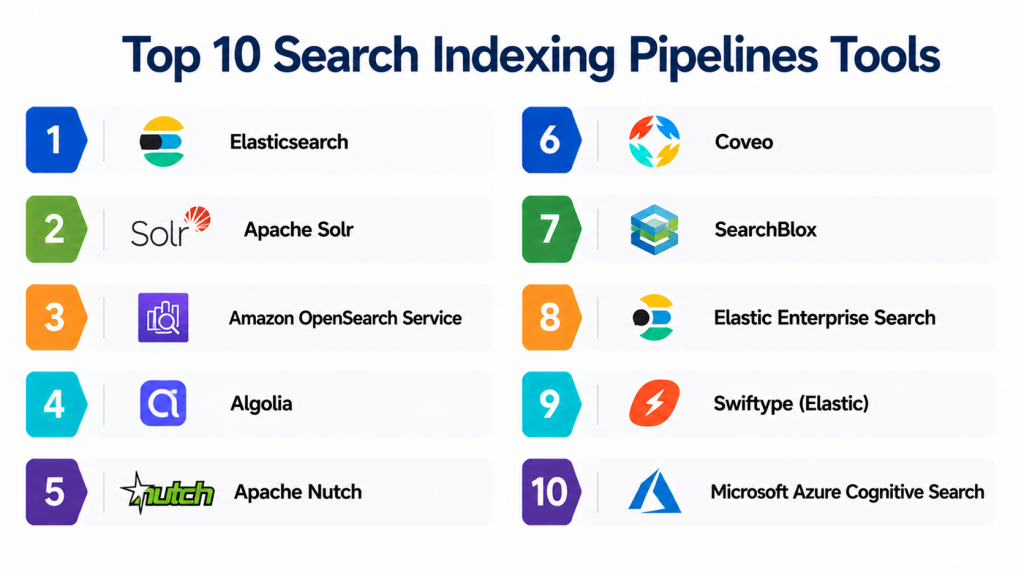
Top 10 Search Indexing Pipelines Tools
1- Elasticsearch
Short description:
Elasticsearch is an open-source distributed search and analytics engine that powers real-time search indexing pipelines across multiple industries and use cases.
Key Features
- Full-text search and analytics
- Distributed indexing architecture
- Real-time and incremental indexing
- RESTful API access
- Support for structured, unstructured, and JSON data
- Scalable across clusters
- Monitoring and observability tools
Pros
- High-performance search engine
- Open-source with strong community
- Scalable and flexible architecture
Cons
- Requires expertise for cluster tuning
- Memory and storage intensive at scale
- Complex query optimizations
Platforms / Deployment
Linux / Windows / Cloud / On-prem / Hybrid
Security & Compliance
RBAC, TLS encryption, audit logging, basic authentication
Integrations & Ecosystem
- Kibana for visualization
- Logstash and Beats for data ingestion
- AI/ML pipelines
- Cloud storage systems
Support & Community
Strong open-source community; enterprise support available
2- Apache Solr
Short description:
Apache Solr is an open-source enterprise search platform built on Lucene, widely used for search indexing and discovery pipelines.
Key Features
- Full-text search
- Faceted navigation and filtering
- Distributed indexing
- Real-time search indexing
- Schema management and transformation
- Analytics and aggregation
- Multi-language support
Pros
- Mature and widely adopted
- Flexible indexing and search options
- Extensible with plugins
Cons
- Setup and tuning can be complex
- Limited cloud-native features
- Requires expertise for advanced use
Platforms / Deployment
Linux / Cloud / On-prem / Hybrid
Security & Compliance
RBAC, authentication plugins, SSL/TLS support
Integrations & Ecosystem
- SolrJ and client libraries
- Hadoop and Spark pipelines
- Analytics and BI tools
- ETL systems
Support & Community
Active open-source community; commercial support available
3- Amazon OpenSearch Service
Short description:
Amazon OpenSearch Service is a managed service for Elasticsearch/OpenSearch, simplifying search indexing pipelines in the AWS cloud.
Key Features
- Fully managed cluster management
- Real-time indexing
- Scalability and high availability
- Kibana/OpenSearch Dashboards integration
- Automated backups and monitoring
- Security and access controls
- Cloud-native deployment
Pros
- Managed service reduces operational overhead
- Scales seamlessly in AWS environments
- Tight integration with AWS ecosystem
Cons
- AWS ecosystem lock-in
- Pricing can grow with cluster size
- Less flexibility than self-hosted deployments
Platforms / Deployment
Cloud / AWS
Security & Compliance
IAM integration, encryption at rest and in transit, audit logs
Integrations & Ecosystem
- AWS S3, Lambda, Kinesis
- OpenSearch Dashboards
- Cloud analytics and ML pipelines
- ETL tools
Support & Community
AWS enterprise support and documentation
4- Algolia
Short description:
Algolia is a hosted search-as-a-service platform designed for fast, scalable search indexing pipelines with advanced relevance and ranking.
Key Features
- Full-text search and filtering
- Real-time indexing
- AI-powered relevance ranking
- Multi-language support
- Faceted search
- API-driven indexing
- Analytics and monitoring dashboards
Pros
- Extremely fast search results
- Managed service with minimal maintenance
- Built-in relevance and ranking features
Cons
- Enterprise pricing
- Vendor lock-in
- Limited custom transformations on ingestion
Platforms / Deployment
Cloud / SaaS
Security & Compliance
SSO, API keys, encryption at rest and in transit
Integrations & Ecosystem
- CMS and e-commerce platforms
- Analytics pipelines
- AI/ML recommendation engines
- SaaS applications
Support & Community
Enterprise support and active documentation
5- Apache Nutch
Short description:
Apache Nutch is an open-source web crawler and search engine platform used for building custom search indexing pipelines.
Key Features
- Web crawling and indexing
- Plugin-based architecture
- Full-text search
- Distributed indexing
- Integration with Solr or Elasticsearch
- Flexible scheduling and fetching
- Extensible transformation pipelines
Pros
- Open-source and flexible
- Supports large-scale web indexing
- Extensible with custom plugins
Cons
- Requires setup and configuration
- Limited enterprise-level monitoring
- Not managed out-of-the-box
Platforms / Deployment
Linux / Cloud / On-prem
Security & Compliance
Varies / Not publicly stated
Integrations & Ecosystem
- Solr and Elasticsearch
- Hadoop and Spark pipelines
- Custom connectors
Support & Community
Open-source community
6- Coveo
Short description:
Coveo is an AI-powered search and relevance platform providing search indexing pipelines for enterprise and SaaS applications.
Key Features
- AI-driven relevance and ranking
- Multi-source indexing
- Real-time and incremental updates
- Semantic search support
- Analytics dashboards
- Security and access controls
- Cloud deployment
Pros
- Strong AI relevance capabilities
- Integrates with multiple content sources
- Cloud-managed with enterprise SLA
Cons
- Commercial pricing
- Complexity for custom workflows
- Cloud-only limits on on-prem integration
Platforms / Deployment
Cloud / SaaS
Security & Compliance
RBAC, SSO, encryption, audit logging
Integrations & Ecosystem
- CRM and CMS systems
- Analytics and reporting tools
- AI/ML pipelines
- SaaS platforms
Support & Community
Enterprise vendor support
7- SearchBlox
Short description:
SearchBlox provides an enterprise search and indexing solution for structured and unstructured data pipelines.
Key Features
- Full-text search and analytics
- Data connectors for multiple sources
- Real-time indexing
- REST API access
- Faceted search
- Security and access control
- Monitoring dashboards
Pros
- Easy deployment
- Wide source connectivity
- Real-time indexing
Cons
- Limited advanced AI features
- Scaling for very large datasets requires tuning
- Licensing costs for enterprise
Platforms / Deployment
Cloud / On-prem / Hybrid
Security & Compliance
RBAC, encryption, SSL/TLS, audit logs
Integrations & Ecosystem
- Databases and filesystems
- CMS and web sources
- BI and analytics tools
- Cloud storage
Support & Community
Enterprise support and documentation
8- Elastic Enterprise Search
Short description:
Elastic Enterprise Search provides a unified search indexing pipeline across websites, applications, and content repositories.
Key Features
- Real-time search indexing
- Unified API access
- Relevance tuning
- Multi-source connectors
- Analytics dashboards
- Security and access control
- Cloud and on-prem deployment
Pros
- Fast indexing and search
- Managed or self-hosted deployment options
- Integration with Elasticsearch ecosystem
Cons
- Learning curve for advanced features
- Commercial pricing for enterprise version
- Requires Elasticsearch knowledge
Platforms / Deployment
Cloud / On-prem / Hybrid
Security & Compliance
RBAC, SSO, encryption, audit logging
Integrations & Ecosystem
- Elasticsearch
- CMS and applications
- Analytics pipelines
- AI/ML models
Support & Community
Enterprise support and open-source community
9- Swiftype (Elastic)
Short description:
Swiftype is a SaaS-based search indexing platform optimized for website and application search pipelines.
Key Features
- Real-time indexing
- Search relevance tuning
- Multi-source integration
- Analytics and monitoring
- Cloud-native deployment
- API-based integration
- Faceted search
Pros
- Fast deployment
- Easy-to-use interface
- Cloud-managed indexing
Cons
- Cloud-only
- Less customization for complex workflows
- Pricing for high-volume datasets
Platforms / Deployment
Cloud / SaaS
Security & Compliance
RBAC, SSO, encryption at rest and in transit
Integrations & Ecosystem
- Websites and CMS
- Cloud applications
- Analytics and BI tools
- AI-driven search pipelines
Support & Community
Vendor enterprise support
10- Microsoft Azure Cognitive Search
Short description:
Azure Cognitive Search is a fully managed cloud search platform for building indexing pipelines with AI-powered enrichment.
Key Features
- Full-text search and indexing
- AI-powered cognitive skills
- Multi-source connectors
- Real-time and incremental indexing
- Cloud-native deployment
- Security and access controls
- Analytics dashboards
Pros
- Fully managed cloud service
- Tight integration with Azure ecosystem
- AI enrichment capabilities
Cons
- Azure ecosystem dependency
- Pricing scales with usage
- Limited on-premises options
Platforms / Deployment
Cloud / Azure
Security & Compliance
RBAC, SSO, encryption, audit logging, Azure compliance standards
Integrations & Ecosystem
- Azure SQL, Blob Storage
- Cognitive services
- AI/ML pipelines
- Applications and web services
Support & Community
Microsoft enterprise support
Comparison Table
| Tool Name | Best For | Platform(s) Supported | Deployment | Standout Feature | Public Rating |
|---|---|---|---|---|---|
| Elasticsearch | Enterprise real-time | Linux/Windows | Cloud/On-prem/Hybrid | Distributed search | N/A |
| Apache Solr | Enterprise search | Linux/Cloud | Cloud/On-prem | Mature open-source | N/A |
| Amazon OpenSearch | Cloud search | Cloud | AWS Cloud | Managed service | N/A |
| Algolia | Fast SaaS search | Cloud | SaaS | AI relevance ranking | N/A |
| Apache Nutch | Web crawling | Linux | Cloud/On-prem | Custom web indexing | N/A |
| Coveo | AI-powered enterprise | Cloud | Cloud | Semantic search | N/A |
| SearchBlox | Multi-source search | Cloud/On-prem | Hybrid | Easy connectors | N/A |
| Elastic Enterprise Search | Application search | Cloud/On-prem | Hybrid | Unified search API | N/A |
| Swiftype | Website/application search | Cloud | SaaS | Fast deployment | N/A |
| Azure Cognitive Search | AI-enriched search | Cloud | Azure | Cognitive skills integration | N/A |
Evaluation & Scoring
| Tool | Core (25%) | Ease (15%) | Integrations (15%) | Security (10%) | Performance (10%) | Support (10%) | Value (15%) | Weighted Total |
|---|---|---|---|---|---|---|---|---|
| Elasticsearch | 9.5 | 8.0 | 9.0 | 8.5 | 9.2 | 8.8 | 8.5 | 8.97 |
| Solr | 9.2 | 7.8 | 8.8 | 8.3 | 9.0 | 8.5 | 8.4 | 8.73 |
| OpenSearch | 9.3 | 8.2 | 9.0 | 8.5 | 9.1 | 8.7 | 8.5 | 8.91 |
| Algolia | 8.8 | 8.7 | 8.5 | 8.2 | 8.9 | 8.5 | 8.4 | 8.61 |
| Nutch | 8.5 | 7.5 | 8.0 | 8.0 | 8.4 | 8.0 | 8.2 | 8.10 |
| Coveo | 9.0 | 8.5 | 8.8 | 8.5 | 8.9 | 8.6 | 8.5 | 8.72 |
| SearchBlox | 8.7 | 8.2 | 8.5 | 8.2 | 8.6 | 8.4 | 8.3 | 8.42 |
| Elastic Enterprise Search | 8.9 | 8.3 | 8.7 | 8.5 | 8.8 | 8.5 | 8.4 | 8.60 |
| Swiftype | 8.5 | 8.6 | 8.4 | 8.2 | 8.5 | 8.3 | 8.3 | 8.44 |
| Azure Cognitive Search | 9.0 | 8.5 | 8.8 | 8.5 | 8.9 | 8.6 | 8.5 | 8.72 |
Which Search Indexing Pipeline Is Right for You?
Solo / Freelancer
Elasticsearch or Solr for flexible open-source deployments and small-scale indexing projects
SMB
Algolia or SearchBlox for managed search pipelines with multi-source support
Mid-Market
Amazon OpenSearch, Elastic Enterprise Search, or Coveo for enterprise-grade indexing pipelines
Enterprise
Azure Cognitive Search, Coveo, and OpenSearch for AI-enhanced search, multi-cloud, and enterprise-scale indexing
Budget vs Premium
Open-source Elasticsearch, Solr, and Nutch vs commercial platforms like Algolia, Coveo, and Azure Cognitive Search
Feature Depth vs Ease of Use
Coveo and Azure provide ease of use with AI features; Elasticsearch and Solr provide deeper control
Integrations & Scalability
OpenSearch, Elasticsearch, and Azure scale across multiple sources and cloud environments
Security & Compliance Needs
Enterprise platforms provide RBAC, encryption, SSO, audit logs, and compliance features
Frequently Asked Questions
1- What is a search indexing pipeline?
A system to automate data ingestion, transformation, and indexing for search applications across multiple sources.
2- How is it different from a database?
Search pipelines optimize data for fast retrieval and relevance ranking, unlike traditional storage-focused databases.
3- Can they handle real-time data?
Yes, modern pipelines like OpenSearch and Algolia support real-time and incremental indexing.
4- Are these tools cloud-friendly?
Many are cloud-native or provide managed SaaS options for easy deployment.
5- Which tool is best for AI-powered search?
Coveo, Azure Cognitive Search, and Algolia provide built-in AI ranking and semantic search features.
6- Are open-source options reliable?
Yes, Elasticsearch, Solr, and Nutch are mature and widely adopted in production environments.
7- Can they index unstructured data?
Yes, most pipelines handle structured, semi-structured, and unstructured content including documents and logs.
8- Do these tools support analytics?
Yes, many provide dashboards, metrics, and integrations with BI tools.
9- How complex is deployment?
Open-source requires setup expertise; managed services like Algolia or Azure are simpler to deploy.
10- What factors should guide selection?
Scale, data volume, AI/ML integration, cloud strategy, budget, and ease of maintenance.
Conclusion
Search Indexing Pipelines are essential for organizations seeking high-performance, scalable, and AI-enabled search across multiple data sources. Open-source platforms like Elasticsearch, Solr, and Nutch provide flexibility and control, while cloud-native and managed solutions such as Algolia, Coveo, and Azure Cognitive Search simplify deployment and provide advanced AI and semantic search features. Enterprises should evaluate data volume, real-time requirements, AI integration, and cloud strategy before selecting a tool. Piloting platforms ensures performance, scalability, and integration meet business needs.
