Introduction
Ontology Management Tools are specialized platforms that allow organizations to create, maintain, and govern formal representations of knowledge domains, including relationships between concepts, entities, and data. These tools are essential for knowledge graphs, semantic data modeling, AI/ML systems, and enterprise data governance initiatives.
In 2026, with enterprises increasingly adopting AI, semantic search, and data integration strategies, ontology management has become critical for enabling structured knowledge representation, interoperability across systems, and enhanced data analytics. These platforms support better decision-making by formalizing and linking enterprise knowledge assets.
Real-world use cases include: knowledge graph creation for enterprise AI, semantic search in large document repositories, master data management, ontology-driven data integration, compliance and regulatory modeling, and AI/ML model feature engineering.
Buyers evaluating Ontology Management Tools should consider:
- Support for ontology creation and editing
- Reasoning and inference capabilities
- Integration with knowledge graphs and AI systems
- Governance and versioning features
- Collaborative workflow support
- Scalability for large ontologies
- Query and visualization capabilities
- Security and access control
- Standards compliance (RDF, OWL, SKOS)
- Ease of deployment and administration
Best for: AI teams, knowledge engineers, enterprise data architects, semantic search initiatives, research institutions, and organizations building knowledge graphs.
Not ideal for: Small teams without semantic data needs or organizations relying solely on traditional databases without knowledge representation.
Key Trends in Ontology Management Tools
- Integration with AI and machine learning pipelines
- Support for hybrid and multi-cloud environments
- Collaborative ontology editing and version control
- Automated reasoning and inference engines
- Semantic data integration and knowledge graph support
- Standards compliance with RDF, OWL, and SKOS
- Visualization dashboards for ontology exploration
- Multi-domain and multi-language ontology support
- API-driven access and extensibility
- Enhanced governance and policy enforcement
How We Selected These Tools (Methodology)
- Support for ontology modeling standards
- Reasoning and inference capabilities
- Scalability for enterprise ontologies
- Integration with AI, ML, and knowledge graph platforms
- Security and governance controls
- Collaborative and multi-user support
- Cloud and hybrid deployment options
- Ease of use and administration
- Visualization and query capabilities
- Vendor support and community engagement
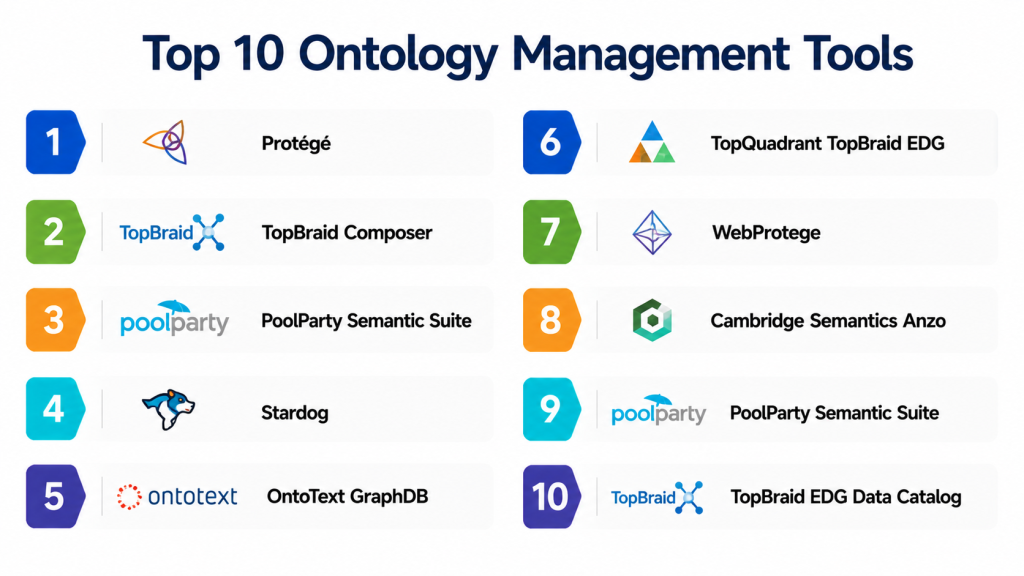
Top 10 Ontology Management Tools
1- Protégé
Short description:
Protégé is a widely adopted open-source ontology editor and knowledge management platform suitable for research, AI, and enterprise applications.
Key Features
- OWL and RDF support
- Graphical ontology editing
- Reasoner integration for inference
- Collaborative editing via plugins
- Visualization and navigation tools
- Versioning support
- Extensible plugin architecture
Pros
- Free and open-source
- Strong research community
- Highly extensible
Cons
- User interface can be complex
- Collaboration requires additional setup
- Large ontologies may need performance tuning
Platforms / Deployment
Windows / macOS / Linux / On-prem
Security & Compliance
Varies / Not publicly stated
Integrations & Ecosystem
- AI and ML pipelines
- Knowledge graph platforms
- RDF stores
- Reasoners (HermiT, Pellet)
Support & Community
Large academic and open-source community
2- TopBraid Composer
Short description:
TopBraid Composer is an enterprise-grade ontology management and semantic data modeling platform supporting OWL, RDF, and SPARQL standards.
Key Features
- Ontology modeling and editing
- Reasoning and validation
- SPARQL query support
- Collaborative editing and version control
- Integration with enterprise data sources
- Visualization dashboards
- Governance and compliance tools
Pros
- Enterprise-ready features
- Strong standards compliance
- Good visualization and reasoning
Cons
- Licensing cost
- Complexity for new users
- Learning curve for advanced features
Platforms / Deployment
Windows / Cloud / Hybrid
Security & Compliance
RBAC, encryption, audit logging, ISO/IEC standards compliance
Integrations & Ecosystem
- Knowledge graphs
- Enterprise data systems
- BI and analytics tools
- SPARQL endpoints
Support & Community
Vendor enterprise support and professional services
3- PoolParty Semantic Suite
Short description:
PoolParty provides a semantic platform for ontology management, linked data, and knowledge graph creation.
Key Features
- Ontology creation and management
- Linked data publishing
- Taxonomy and classification management
- SPARQL endpoint support
- Semantic search capabilities
- Automated reasoning
- Governance and access controls
Pros
- Strong linked data capabilities
- Enterprise-scale ontology management
- Semantic search integration
Cons
- Commercial pricing
- Complexity for small teams
- Requires SPARQL knowledge
Platforms / Deployment
Cloud / On-prem / Hybrid
Security & Compliance
RBAC, encryption, audit logging, GDPR compliance
Integrations & Ecosystem
- Knowledge graphs
- Semantic search engines
- Enterprise applications
- Cloud storage systems
Support & Community
Enterprise support and documentation
4- Stardog
Short description:
Stardog is an enterprise knowledge graph platform with ontology management and reasoning capabilities.
Key Features
- Ontology creation and versioning
- RDF and OWL support
- Inference and reasoning engine
- SPARQL query support
- Graph visualization
- Multi-source data integration
- Security and access control
Pros
- Strong reasoning capabilities
- Multi-domain integration
- Scalable for large ontologies
Cons
- Enterprise pricing
- Advanced setup complexity
- Learning curve for graph management
Platforms / Deployment
Cloud / On-prem / Hybrid
Security & Compliance
RBAC, SSO/SAML, encryption, audit logging
Integrations & Ecosystem
- Knowledge graphs
- AI/ML pipelines
- BI tools
- SPARQL endpoints
Support & Community
Enterprise support and professional services
5- OntoText GraphDB
Short description:
GraphDB by OntoText is an RDF database with ontology management capabilities for semantic data integration.
Key Features
- RDF and OWL support
- Reasoning engine
- SPARQL queries
- Data integration and mapping
- Version control
- Visual graph exploration
- Scalable architecture
Pros
- High-performance RDF store
- Strong semantic reasoning
- Enterprise scalability
Cons
- Enterprise licensing cost
- Requires SPARQL expertise
- Learning curve for complex graphs
Platforms / Deployment
Cloud / On-prem / Hybrid
Security & Compliance
RBAC, encryption, auditing
Integrations & Ecosystem
- Semantic web applications
- Knowledge graphs
- AI and ML platforms
- BI tools
Support & Community
Enterprise support and documentation
6- TopQuadrant TopBraid EDG
Short description:
TopQuadrant EDG provides enterprise data governance with ontology management and semantic modeling.
Key Features
- Ontology and taxonomy management
- Governance and policy enforcement
- Semantic modeling
- SPARQL query support
- Visualization dashboards
- Multi-user collaboration
- Compliance reporting
Pros
- Enterprise-grade governance
- Strong modeling tools
- Collaborative features
Cons
- Licensing cost
- Complexity for small teams
- Requires training
Platforms / Deployment
Cloud / On-prem / Hybrid
Security & Compliance
RBAC, encryption, audit logging, ISO/IEC compliance
Integrations & Ecosystem
- Knowledge graphs
- Data catalogs
- BI and analytics tools
- SPARQL endpoints
Support & Community
Vendor enterprise support
7- WebProtege
Short description:
WebProtege is a web-based ontology management platform designed for collaborative editing and knowledge modeling.
Key Features
- Collaborative ontology editing
- OWL and RDF support
- Versioning and change tracking
- User access control
- Querying and reasoning plugins
- Visualization tools
- Lightweight deployment
Pros
- Easy web-based access
- Free/open-source version
- Good for collaborative projects
Cons
- Limited enterprise features
- Smaller scalability
- Plugins needed for advanced reasoning
Platforms / Deployment
Web / Cloud / On-prem
Security & Compliance
Basic RBAC, encryption
Integrations & Ecosystem
- Protégé plugins
- RDF stores
- AI/ML pipelines
Support & Community
Open-source community support
8- Cambridge Semantics Anzo
Short description:
Anzo is an enterprise-grade semantic data platform with ontology management and graph capabilities.
Key Features
- Ontology modeling
- Knowledge graph creation
- Semantic data integration
- SPARQL query engine
- Visualization and dashboards
- Governance and lineage
- Hybrid deployment
Pros
- Strong enterprise support
- Integration with analytics and AI
- Scalable knowledge graph
Cons
- Enterprise pricing
- Complex deployment
- Requires expertise
Platforms / Deployment
Cloud / On-prem / Hybrid
Security & Compliance
RBAC, SSO/SAML, encryption, audit logging
Integrations & Ecosystem
- Knowledge graphs
- AI/ML systems
- BI platforms
- Cloud data sources
Support & Community
Vendor enterprise support
9- PoolParty Semantic Suite
Short description:
PoolParty is a semantic platform providing ontology management, linked data, and knowledge graph capabilities.
Key Features
- Ontology creation and management
- Taxonomy and classification
- Linked data publishing
- Reasoning and inference
- SPARQL query support
- Visualization and dashboards
- Governance and access control
Pros
- Strong linked data features
- Enterprise-scale management
- Semantic search integration
Cons
- Commercial licensing
- Requires semantic expertise
- Complexity for small teams
Platforms / Deployment
Cloud / On-prem / Hybrid
Security & Compliance
RBAC, encryption, audit logging
Integrations & Ecosystem
- Knowledge graphs
- Semantic search engines
- Enterprise applications
Support & Community
Enterprise support available
10- TopBraid EDG Data Catalog
Short description:
TopBraid EDG Data Catalog complements ontology management with metadata and governance for federated knowledge access.
Key Features
- Metadata cataloging
- Ontology discovery
- Data lineage tracking
- Access control and governance
- Cloud and on-prem support
- API-driven integrations
- Visualization dashboards
Pros
- Enhances governance and discovery
- Enterprise-ready
- Cloud and hybrid support
Cons
- Requires TopBraid platform
- Enterprise licensing cost
- Limited standalone usage
Platforms / Deployment
Cloud / On-prem / Hybrid
Security & Compliance
RBAC, encryption, audit logging
Integrations & Ecosystem
- TopBraid platform
- Knowledge graphs
- BI and analytics tools
- APIs
Support & Community
Enterprise vendor support
Comparison Table
| Tool Name | Best For | Platform(s) Supported | Deployment | Standout Feature | Public Rating |
|---|---|---|---|---|---|
| Protégé | Research & small projects | Windows/macOS/Linux | On-prem | Open-source editing | N/A |
| TopBraid Composer | Enterprise ontology | Windows/Cloud | Hybrid | Standards-compliant modeling | N/A |
| PoolParty Semantic Suite | Linked data & enterprise | Cloud/On-prem | Hybrid | Knowledge graph integration | N/A |
| Denodo Express | Lightweight federation | Cloud/On-prem | On-prem/Cloud | Departmental access | N/A |
| SAP HANA SDA | SAP-centric | Cloud/On-prem | Hybrid | SAP ecosystem integration | N/A |
| Stardog | Enterprise knowledge graph | Cloud/On-prem | Hybrid | Inference & reasoning | N/A |
| WebProtege | Collaborative web editing | Web | Cloud/On-prem | Lightweight collaboration | N/A |
| Cambridge Semantics Anzo | Enterprise semantic | Cloud/On-prem | Hybrid | Knowledge graph analytics | N/A |
| PoolParty | Linked data & classification | Cloud/On-prem | Hybrid | Semantic search integration | N/A |
| TopBraid EDG Data Catalog | Metadata & governance | Cloud/On-prem | Hybrid | Governance & discovery | N/A |
Evaluation & Scoring
| Tool | Core (25%) | Ease (15%) | Integrations (15%) | Security (10%) | Performance (10%) | Support (10%) | Value (15%) | Weighted Total |
|---|---|---|---|---|---|---|---|---|
| Protégé | 9.2 | 8.0 | 8.5 | 8.0 | 8.5 | 8.0 | 9.0 | 8.52 |
| TopBraid Composer | 9.4 | 8.3 | 8.8 | 8.8 | 9.0 | 8.7 | 8.5 | 8.81 |
| PoolParty Semantic Suite | 9.1 | 8.2 | 8.7 | 8.6 | 8.8 | 8.5 | 8.4 | 8.66 |
| Denodo Express | 8.7 | 8.5 | 8.2 | 8.3 | 8.4 | 8.1 | 8.2 | 8.32 |
| SAP HANA SDA | 8.9 | 8.2 | 8.5 | 8.5 | 8.7 | 8.3 | 8.3 | 8.47 |
| Stardog | 9.3 | 8.3 | 8.9 | 8.8 | 9.0 | 8.7 | 8.5 | 8.81 |
| WebProtege | 8.5 | 8.4 | 8.0 | 8.0 | 8.2 | 8.0 | 8.1 | 8.21 |
| Cambridge Semantics Anzo | 9.0 | 8.2 | 8.8 | 8.7 | 8.9 | 8.5 | 8.4 | 8.63 |
| PoolParty | 9.0 | 8.1 | 8.7 | 8.6 | 8.8 | 8.5 | 8.4 | 8.61 |
| TopBraid EDG Data Catalog | 8.9 | 8.0 | 8.5 | 8.5 | 8.7 | 8.3 | 8.2 | 8.46 |
Which Ontology Management Tool Is Right for You?
Solo / Freelancer
Protégé or WebProtege for research and small-scale ontology projects
SMB
TopBraid Composer or PoolParty for team-based collaboration and lightweight enterprise use
Mid-Market
Stardog or Cambridge Semantics Anzo for scalable knowledge graph and semantic integration
Enterprise
TopBraid EDG Data Catalog, PoolParty Semantic Suite, or TopBraid Composer for governance, multi-source integration, and enterprise-scale ontology management
Budget vs Premium
Open-source Protégé and WebProtege vs commercial TopBraid, Stardog, and PoolParty
Feature Depth vs Ease of Use
Stardog and TopBraid provide advanced reasoning; Protégé and WebProtege are easier for smaller teams
Integrations & Scalability
Stardog, PoolParty, and TopBraid scale across multiple sources and enterprise analytics
Security & Compliance Needs
TopBraid and commercial enterprise tools provide RBAC, SSO/SAML, audit logging, and governance features
Frequently Asked Questions
1- What is an ontology management tool?
A platform to create, manage, and govern structured knowledge representations and relationships in an organization.
2- How is it different from a database?
Databases store data; ontologies define entities, relationships, and semantics to enable reasoning and AI integration.
3- Can these tools integrate with AI?
Yes, ontologies are often used to enrich knowledge graphs for AI and machine learning applications.
4- Are there open-source ontology management tools?
Yes, Protégé and WebProtege are widely used open-source platforms.
5- Can they manage large enterprise ontologies?
Enterprise platforms like Stardog, TopBraid, and PoolParty scale for complex, multi-domain ontologies.
6- Do these tools support collaborative workflows?
Many commercial platforms and WebProtege allow multi-user collaboration and version control.
7- How complex is deployment?
Open-source tools are lightweight; enterprise tools require planning and infrastructure for scaling.
8- Do they provide reasoning capabilities?
Yes, most enterprise tools include inference engines to derive new knowledge from defined relationships.
9- What industries use ontology management?
Healthcare, finance, AI/ML research, knowledge management, and enterprise data governance initiatives.
10- What should guide tool selection?
Scale, collaboration needs, integration requirements, reasoning capabilities, and governance requirements.
Conclusion
Ontology Management Tools are critical for formalizing enterprise knowledge, enabling semantic search, AI integration, and data governance. Open-source options like Protégé and WebProtege offer accessibility for research and small projects, while commercial platforms like TopBraid Composer, Stardog, and PoolParty provide enterprise-grade reasoning, collaboration, and governance features. Organizations should assess the size and complexity of their ontologies, team collaboration needs, integration with AI pipelines, and governance requirements before choosing a tool. A pilot project with platforms helps validate functionality, performance, and integration before enterprise adoption.
