Introduction
IoT Security Platforms help organizations discover, monitor, manage, and protect connected devices across enterprise, industrial, healthcare, manufacturing, transportation, and smart infrastructure environments. As connected devices continue to expand across operational technology and information technology networks, organizations face increasing challenges related to visibility, threat detection, compliance, and device lifecycle security.
Modern IoT security platforms provide device discovery, behavioral analytics, risk assessment, vulnerability management, threat detection, network segmentation, and automated response capabilities. These platforms help security teams identify unmanaged devices, detect suspicious behavior, and reduce cyber risks associated with connected assets.
Real-world use cases include:
- Securing manufacturing and industrial IoT devices
- Monitoring connected healthcare equipment
- Protecting smart building infrastructure
- Managing security across retail IoT deployments
- Securing transportation and logistics devices
- Protecting utility and energy sector operational technology
Evaluation Criteria for Buyers
When evaluating IoT Security Platforms, buyers should consider:
- Device discovery and asset visibility
- Threat detection capabilities
- Vulnerability assessment features
- Network segmentation support
- AI-powered analytics and automation
- Integration with existing security tools
- Scalability across large deployments
- Compliance and governance features
- Deployment flexibility
- Total cost of ownership
Best for: Enterprises, manufacturers, healthcare organizations, utilities, transportation providers, smart city operators, and security teams managing large-scale connected environments.
Not ideal for: Organizations with minimal connected device footprints or businesses requiring only traditional endpoint protection without IoT-specific visibility.
Key Trends in IoT Security Platforms
- AI-driven threat detection and behavioral analytics are becoming standard capabilities.
- Zero Trust security architectures are increasingly applied to IoT environments.
- Convergence of IT, OT, and IoT security management platforms.
- Automated device classification and risk scoring are improving visibility.
- Cloud-native security platforms continue gaining adoption.
- Compliance reporting and governance automation are becoming critical requirements.
- Integration with SIEM, SOAR, and XDR platforms is expanding.
- Software-defined microsegmentation is replacing traditional network segmentation approaches.
- Real-time vulnerability intelligence is becoming more sophisticated.
- Digital twin and asset intelligence technologies are improving operational visibility.
Methodology
The tools in this list were evaluated using the following criteria:
- Market adoption and enterprise presence
- IoT-specific security capabilities
- Device discovery and visibility features
- Threat detection effectiveness
- Scalability across large deployments
- Security automation capabilities
- Ecosystem and integrations
- Reliability and performance
- Customer support and documentation
- Value relative to feature set
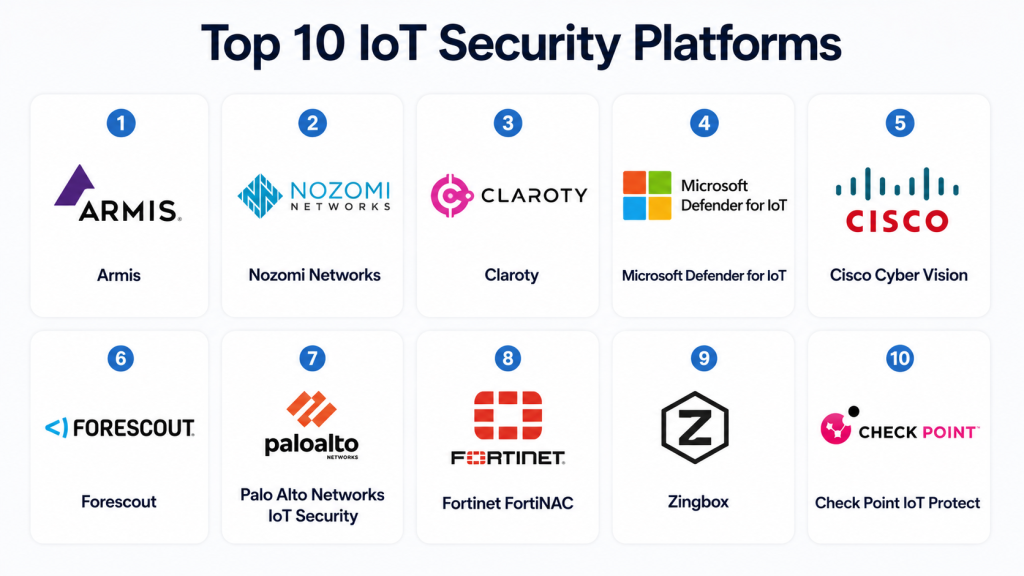
Top 10 IoT Security Platforms
1- Armis
Short Description
Armis is one of the most widely recognized IoT and cyber asset security platforms. It provides agentless visibility across IoT, OT, medical devices, and unmanaged assets while helping organizations identify risks and threats.
Key Features
- Agentless device discovery
- Asset inventory management
- Risk assessment and prioritization
- Threat detection analytics
- Vulnerability identification
- Medical device visibility
- Security policy enforcement
Pros
- Strong asset visibility capabilities
- Excellent healthcare and industrial support
- Mature threat intelligence
Cons
- Enterprise-focused pricing
- Complex deployments for smaller organizations
- Advanced features require expertise
Platforms / Deployment
Cloud, Hybrid
Security & Compliance
RBAC, encryption, audit logging, MFA support. Additional certifications vary by deployment.
Integrations & Ecosystem
Armis integrates with security operations platforms, SIEM solutions, vulnerability scanners, and network infrastructure.
- Security information systems
- Network access control solutions
- Vulnerability management tools
- Incident response platforms
Support & Community
Strong enterprise support with extensive documentation and professional services.
2- Nozomi Networks
Short Description
Nozomi Networks specializes in OT, IoT, and industrial control system security. It provides visibility, anomaly detection, and risk management for critical infrastructure environments.
Key Features
- Industrial asset discovery
- Network monitoring
- Threat detection
- Vulnerability management
- Asset inventory
- Compliance reporting
- Operational intelligence
Pros
- Strong industrial expertise
- Excellent OT visibility
- Advanced anomaly detection
Cons
- Primarily focused on industrial environments
- May be excessive for small deployments
- Learning curve for administrators
Platforms / Deployment
Cloud, Self-hosted, Hybrid
Security & Compliance
Role-based access controls, audit trails, encryption support.
Integrations & Ecosystem
- SIEM platforms
- Security orchestration tools
- Industrial systems
- Vulnerability scanners
Support & Community
Strong enterprise support and industrial cybersecurity expertise.
3- Claroty
Short Description
Claroty delivers cybersecurity solutions for industrial, healthcare, and critical infrastructure organizations seeking visibility and protection across connected assets.
Key Features
- Asset discovery
- Exposure management
- Threat monitoring
- Network protection
- Risk prioritization
- Vulnerability assessment
- Compliance support
Pros
- Strong healthcare support
- Deep OT security capabilities
- Comprehensive visibility
Cons
- Enterprise-oriented pricing
- Complex implementation
- Requires security expertise
Platforms / Deployment
Cloud, Hybrid
Security & Compliance
Encryption, RBAC, audit logging, identity integrations.
Integrations & Ecosystem
- SIEM systems
- CMDB platforms
- Security tools
- Incident response solutions
Support & Community
Comprehensive documentation and professional services.
4- Microsoft Defender for IoT
Short Description
Microsoft Defender for IoT extends Microsoft’s security ecosystem into IoT and OT environments, providing visibility, threat detection, and risk management.
Key Features
- Device discovery
- Threat analytics
- Vulnerability assessment
- Security monitoring
- Risk management
- Cloud integrations
- Security recommendations
Pros
- Strong Microsoft ecosystem integration
- Familiar management experience
- Enterprise scalability
Cons
- Best suited for Microsoft-centric environments
- Some advanced features require additional licensing
- Can be complex for smaller teams
Platforms / Deployment
Cloud, Hybrid
Security & Compliance
Supports enterprise identity controls, RBAC, encryption, audit capabilities.
Integrations & Ecosystem
- Microsoft Sentinel
- Microsoft Defender ecosystem
- Azure services
- Security management platforms
Support & Community
Large enterprise community and extensive documentation.
5- Cisco Cyber Vision
Short Description
Cisco Cyber Vision provides industrial network visibility and threat monitoring for operational technology and IoT environments.
Key Features
- Asset discovery
- Industrial protocol visibility
- Threat detection
- Network segmentation support
- Compliance monitoring
- Vulnerability analysis
- Security reporting
Pros
- Strong Cisco ecosystem integration
- Good OT visibility
- Enterprise scalability
Cons
- Best value in Cisco environments
- Configuration complexity
- Enterprise-focused licensing
Platforms / Deployment
Cloud, Self-hosted, Hybrid
Security & Compliance
Encryption, RBAC, logging capabilities.
Integrations & Ecosystem
- Cisco Secure products
- SIEM solutions
- Network infrastructure
- Security management tools
Support & Community
Strong enterprise support backed by Cisco’s global ecosystem.
6- Forescout
Short Description
Forescout provides agentless device visibility and control across managed, unmanaged, IoT, and OT assets.
Key Features
- Device discovery
- Network access control
- Asset management
- Threat detection
- Compliance monitoring
- Risk scoring
- Security automation
Pros
- Broad asset visibility
- Agentless architecture
- Strong automation capabilities
Cons
- Deployment complexity
- Enterprise pricing
- Requires tuning for large environments
Platforms / Deployment
Cloud, Hybrid
Security & Compliance
MFA support, RBAC, auditing, encryption.
Integrations & Ecosystem
- SIEM platforms
- Endpoint security tools
- Network infrastructure
- IT service management systems
Support & Community
Established enterprise support network.
7- Palo Alto Networks IoT Security
Short Description
Palo Alto Networks IoT Security provides ML-powered device identification, risk assessment, and threat prevention capabilities.
Key Features
- Machine learning analytics
- Device profiling
- Risk scoring
- Threat prevention
- Vulnerability management
- Security policy automation
- Cloud-based intelligence
Pros
- Strong AI capabilities
- Good integration with Palo Alto ecosystem
- Effective risk prioritization
Cons
- Best value with Palo Alto infrastructure
- Premium pricing
- Advanced features require expertise
Platforms / Deployment
Cloud
Security & Compliance
RBAC, encryption, auditing, policy controls.
Integrations & Ecosystem
- Next-generation firewalls
- Security operations tools
- Threat intelligence systems
- Cloud security solutions
Support & Community
Strong enterprise support and active customer ecosystem.
8- Fortinet FortiNAC
Short Description
FortiNAC provides device visibility, access control, and security automation across IoT and enterprise networks.
Key Features
- Device profiling
- Access control
- Automated response
- Threat containment
- Compliance management
- Asset visibility
- Security orchestration
Pros
- Strong network control capabilities
- Good automation
- Broad security integration
Cons
- Most effective in Fortinet environments
- Administration complexity
- Advanced features require training
Platforms / Deployment
Cloud, Self-hosted, Hybrid
Security & Compliance
Encryption, RBAC, MFA support, audit capabilities.
Integrations & Ecosystem
- Fortinet Security Fabric
- SIEM solutions
- Network infrastructure
- Security orchestration tools
Support & Community
Extensive enterprise support resources.
9- Zingbox
Short Description
Zingbox focuses on healthcare IoT security and connected medical device protection through AI-driven analytics.
Key Features
- Medical device discovery
- Behavioral analytics
- Risk management
- Threat detection
- Asset visibility
- Vulnerability monitoring
- Security reporting
Pros
- Healthcare specialization
- Strong device intelligence
- Good risk visibility
Cons
- Healthcare-focused use cases
- Less suitable for broader industrial deployments
- Limited compared to larger platforms
Platforms / Deployment
Cloud
Security & Compliance
Varies / Not publicly stated.
Integrations & Ecosystem
- Healthcare systems
- Security monitoring tools
- Compliance reporting platforms
Support & Community
Focused healthcare support capabilities.
10- Check Point IoT Protect
Short Description
Check Point IoT Protect helps organizations secure connected devices through automated policy management, threat prevention, and risk monitoring.
Key Features
- Device visibility
- Threat prevention
- Policy automation
- Risk analysis
- Vulnerability monitoring
- Security intelligence
- Network protection
Pros
- Strong security expertise
- Good policy automation
- Enterprise-grade capabilities
Cons
- Enterprise-oriented pricing
- Advanced deployment requirements
- Learning curve
Platforms / Deployment
Cloud, Hybrid
Security & Compliance
Encryption, auditing, access controls.
Integrations & Ecosystem
- Check Point security products
- Threat intelligence systems
- Network security platforms
- Security operations tools
Support & Community
Enterprise support with comprehensive documentation.
Comparison Table
| Tool Name | Best For | Platform(s) Supported | Deployment | Standout Feature | Public Rating |
|---|---|---|---|---|---|
| Armis | Enterprise Asset Visibility | Web | Cloud, Hybrid | Agentless Discovery | N/A |
| Nozomi Networks | Industrial Security | Web | Cloud, Hybrid | OT Monitoring | N/A |
| Claroty | Critical Infrastructure | Web | Cloud, Hybrid | Exposure Management | N/A |
| Microsoft Defender for IoT | Microsoft Environments | Web | Cloud, Hybrid | Microsoft Integration | N/A |
| Cisco Cyber Vision | Industrial Networks | Web | Hybrid | Industrial Visibility | N/A |
| Forescout | Device Control | Web | Hybrid | Agentless Control | N/A |
| Palo Alto IoT Security | AI-driven Security | Web | Cloud | ML Device Profiling | N/A |
| Fortinet FortiNAC | Network Access Control | Web | Hybrid | Security Fabric Integration | N/A |
| Zingbox | Healthcare IoT | Web | Cloud | Medical Device Security | N/A |
| Check Point IoT Protect | Enterprise Security | Web | Hybrid | Policy Automation | N/A |
Evaluation & Scoring Table
| Tool | Core | Ease | Integrations | Security | Performance | Support | Value | Weighted Total |
| Armis | 9.5 | 8.5 | 9.0 | 9.5 | 9.0 | 9.0 | 8.0 | 8.96 |
| Nozomi Networks | 9.2 | 8.0 | 8.7 | 9.2 | 9.0 | 8.8 | 8.0 | 8.77 |
| Claroty | 9.3 | 8.1 | 8.8 | 9.3 | 9.1 | 8.9 | 8.0 | 8.84 |
| Microsoft Defender for IoT | 8.9 | 8.8 | 9.4 | 9.1 | 8.9 | 9.0 | 8.8 | 8.97 |
| Cisco Cyber Vision | 8.8 | 8.0 | 9.0 | 9.0 | 9.0 | 8.8 | 8.1 | 8.67 |
| Forescout | 8.9 | 8.2 | 8.9 | 9.0 | 8.8 | 8.7 | 8.3 | 8.68 |
| Palo Alto IoT Security | 9.1 | 8.5 | 9.1 | 9.3 | 9.1 | 8.9 | 8.1 | 8.87 |
| Fortinet FortiNAC | 8.7 | 8.0 | 8.8 | 8.9 | 8.8 | 8.7 | 8.4 | 8.58 |
| Zingbox | 8.2 | 8.3 | 7.8 | 8.5 | 8.4 | 8.0 | 8.0 | 8.15 |
| Check Point IoT Protect | 8.8 | 8.1 | 8.8 | 9.1 | 8.9 | 8.8 | 8.2 | 8.66 |
These scores are comparative and intended to help buyers evaluate relative strengths across leading platforms. Actual results depend on deployment requirements, existing infrastructure, industry regulations, and organizational maturity.
Which IoT Security Platform Is Right for You?
Solo / Freelancer
Most solo professionals do not require dedicated IoT security platforms. Lightweight network security and endpoint protection solutions are often sufficient.
SMB
Microsoft Defender for IoT and Fortinet FortiNAC provide strong value for organizations seeking integrated security and manageable deployment complexity.
Mid-Market
Forescout, Cisco Cyber Vision, and Palo Alto Networks IoT Security offer balanced visibility, automation, and scalability.
Enterprise
Armis, Claroty, and Nozomi Networks are among the strongest choices for large-scale environments requiring comprehensive asset intelligence and risk management.
Budget vs Premium
Microsoft Defender for IoT may provide cost advantages for organizations already invested in Microsoft technologies. Armis and Claroty typically target premium enterprise requirements.
Feature Depth vs Ease of Use
Armis and Claroty offer extensive capabilities, while Microsoft Defender for IoT provides a more familiar experience for existing Microsoft customers.
Integrations & Scalability
Cisco, Microsoft, Palo Alto, and Fortinet offer extensive ecosystems for organizations prioritizing integrations and growth.
Security & Compliance Needs
Healthcare organizations should evaluate Armis, Claroty, and Zingbox. Critical infrastructure operators may benefit from Nozomi Networks and Cisco Cyber Vision.
Frequently Asked Questions
1- What is an IoT Security Platform?
An IoT Security Platform helps organizations discover, monitor, manage, and secure connected devices. These platforms provide visibility, threat detection, vulnerability assessment, and policy enforcement capabilities.
2- Why is IoT security different from endpoint security?
Many IoT devices cannot run traditional endpoint security software. IoT security platforms use network-based monitoring and behavioral analytics instead of device-installed agents.
3- How do IoT security platforms discover devices?
Most platforms use passive network monitoring, protocol analysis, traffic inspection, and behavioral analytics to identify connected assets automatically.
4- Are IoT security platforms suitable for industrial environments?
Yes. Many platforms such as Nozomi Networks, Claroty, and Cisco Cyber Vision are specifically designed for industrial and operational technology environments.
5- Can IoT security platforms integrate with SIEM solutions?
Most enterprise-grade platforms provide integrations with SIEM, SOAR, XDR, and incident response platforms to support security operations workflows.
6- How long does implementation typically take?
Implementation timelines vary significantly depending on network size, asset diversity, and organizational complexity. Large deployments often require phased rollouts.
7- Do these platforms support compliance requirements?
Many platforms include compliance monitoring, reporting, audit trails, and governance capabilities that help organizations address regulatory requirements.
8- What are the most common deployment mistakes?
Common mistakes include incomplete asset inventories, poor network segmentation, inadequate policy planning, and insufficient integration with security operations processes.
9- Are cloud deployments secure for IoT security platforms?
Many vendors provide secure cloud deployments with encryption, access controls, and auditing capabilities. Organizations should evaluate their specific compliance requirements.
10- How should buyers shortlist vendors?
Organizations should first identify device types, security objectives, integration requirements, and compliance needs before conducting pilot evaluations with shortlisted vendors.
Conclusion
IoT Security Platforms have become essential for organizations managing growing fleets of connected devices across enterprise, industrial, healthcare, and critical infrastructure environments. While Armis, Claroty, Nozomi Networks, Microsoft Defender for IoT, and Palo Alto Networks IoT Security lead many enterprise evaluations, the right choice ultimately depends on your existing technology stack, security maturity, industry requirements, and deployment scale. Organizations should focus on visibility, threat detection, integration capabilities, automation, and long-term scalability rather than selecting a platform solely based on popularity. Start by identifying your most critical connected assets, shortlist two or three suitable vendors, conduct a pilot deployment, and validate security, operational, and compliance requirements before making a long-term investment decision.
