Introduction
Smart City IoT Platforms help governments, municipalities, utility providers, transportation authorities, and urban planners connect, monitor, analyze, and manage city-wide infrastructure through Internet of Things technologies. These platforms collect data from sensors, cameras, connected devices, utility networks, transportation systems, environmental monitoring stations, and public services to improve operational efficiency, sustainability, safety, and citizen experiences.
As cities continue to digitize public services and infrastructure, Smart City IoT Platforms have become a foundational technology for managing traffic congestion, reducing energy consumption, optimizing waste collection, improving public safety, and supporting environmental initiatives. A modern smart city platform enables real-time decision-making while providing centralized visibility into diverse urban systems.
Real World Use Cases
- Smart traffic and transportation management
- Intelligent street lighting systems
- Water and utility monitoring
- Environmental and air quality monitoring
- Smart parking solutions
- Public safety and surveillance systems
- Waste management optimization
- Connected public infrastructure monitoring
Evaluation Criteria for Buyers
- Scalability across city-wide deployments
- Device and sensor compatibility
- Data analytics capabilities
- Real-time monitoring and alerting
- Security and privacy controls
- Integration with existing infrastructure
- AI and predictive analytics support
- Cloud and edge deployment options
- Citizen engagement capabilities
- Total cost of ownership
Best for: Municipal governments, transportation agencies, utilities, smart infrastructure operators, urban planners, and public sector organizations.
Not ideal for: Small organizations with limited IoT requirements or businesses that only need basic device monitoring solutions.
Key Trends
- AI-powered urban analytics is becoming a standard capability.
- Digital twins are improving city planning and infrastructure management.
- Edge computing is reducing latency for critical city operations.
- Smart mobility solutions continue to expand globally.
- Sustainability monitoring is becoming a major investment area.
- Multi-cloud smart city deployments are increasing.
- Predictive maintenance is reducing infrastructure downtime.
- Citizen-centric applications are gaining importance.
- Real-time environmental monitoring is becoming widespread.
- Cybersecurity and privacy regulations are driving platform investments.
Methodology
The platforms included in this list were evaluated based on:
- Industry adoption and market presence
- Smart city deployment experience
- IoT device management capabilities
- Analytics and reporting functionality
- Security and governance features
- Integration ecosystem
- Scalability for large deployments
- AI and automation capabilities
- Deployment flexibility
- Support and implementation resources
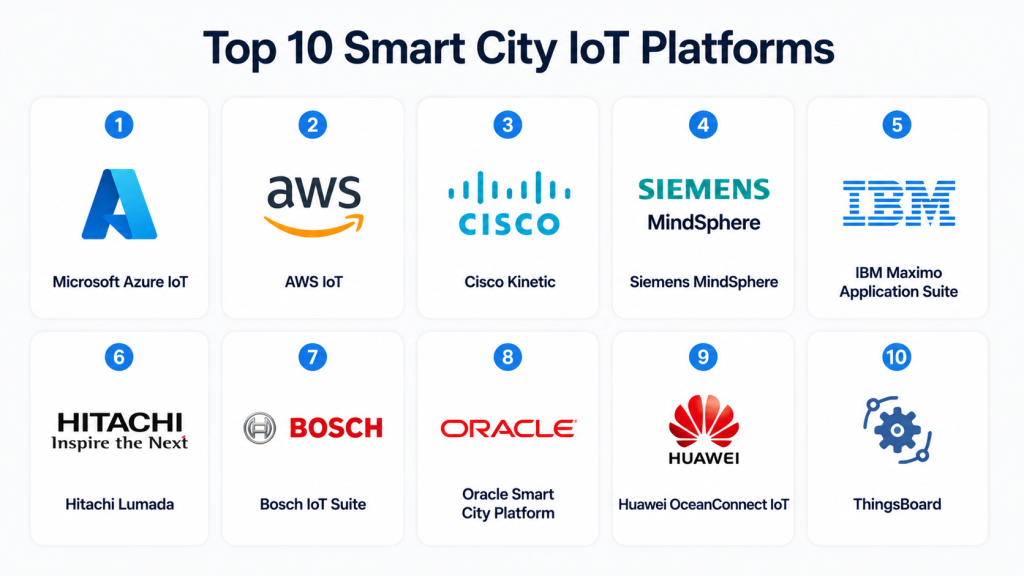
Top 10 Smart City IoT Platforms
1- Microsoft Azure IoT
Short Description
Microsoft Azure IoT provides a comprehensive cloud platform for managing connected city infrastructure, sensors, utilities, transportation systems, and public services.
Key Features
- IoT device management
- Digital twins
- Real-time analytics
- AI integration
- Edge computing support
- Security monitoring
- Scalable cloud infrastructure
Pros
- Comprehensive ecosystem
- Strong analytics capabilities
- Enterprise-grade scalability
Cons
- Can be complex for smaller deployments
- Azure expertise may be required
Platforms / Deployment
Cloud, Hybrid
Security & Compliance
RBAC, encryption, audit logging, identity management.
Integrations & Ecosystem
Strong integration with Microsoft cloud services and enterprise systems.
- Azure Digital Twins
- Power BI
- Azure AI Services
- Microsoft Security Solutions
Support & Community
Extensive documentation, training resources, and enterprise support.
2- AWS IoT
Short Description
AWS IoT offers a scalable infrastructure for smart city deployments involving transportation, utilities, public safety, and environmental monitoring.
Key Features
- Device management
- Real-time analytics
- AI and machine learning integration
- Edge computing support
- Data processing
- Event management
- Security controls
Pros
- Massive scalability
- Strong cloud ecosystem
- Extensive integration options
Cons
- Complexity for new users
- Cost management may require planning
Platforms / Deployment
Cloud
Security & Compliance
Encryption, IAM controls, audit capabilities.
Integrations & Ecosystem
- AWS IoT Core
- AWS Lambda
- Amazon SageMaker
- CloudWatch
Support & Community
Large developer and enterprise community.
3- Cisco Kinetic
Short Description
Cisco Kinetic enables organizations to extract value from connected city infrastructure through device management, analytics, and operational visibility.
Key Features
- Device connectivity
- Data orchestration
- Real-time monitoring
- Analytics
- Security controls
- Asset management
- Infrastructure integration
Pros
- Strong networking expertise
- Reliable connectivity management
- Enterprise-grade deployments
Cons
- Complex enterprise implementations
- May require Cisco ecosystem knowledge
Platforms / Deployment
Cloud, Hybrid
Security & Compliance
Encryption, access controls, monitoring capabilities.
Integrations & Ecosystem
- Cisco networking products
- Smart infrastructure systems
- Security solutions
- Enterprise applications
Support & Community
Strong enterprise support capabilities.
4- Siemens MindSphere
Short Description
Siemens MindSphere is an industrial IoT platform that supports smart city initiatives involving transportation, utilities, energy, and infrastructure.
Key Features
- Asset monitoring
- Data analytics
- Digital twin capabilities
- Predictive maintenance
- Device connectivity
- Industrial integration
- Cloud-based management
Pros
- Strong industrial expertise
- Advanced analytics
- Excellent infrastructure management
Cons
- Enterprise-focused
- Specialized implementation requirements
Platforms / Deployment
Cloud
Security & Compliance
Encryption, access management, audit capabilities.
Integrations & Ecosystem
- Siemens infrastructure systems
- Industrial automation
- Energy management solutions
- Analytics platforms
Support & Community
Strong industrial support network.
5- IBM Maximo Application Suite
Short Description
IBM Maximo combines asset management, IoT monitoring, analytics, and operational intelligence for smart infrastructure projects.
Key Features
- Asset lifecycle management
- IoT monitoring
- Predictive maintenance
- AI analytics
- Infrastructure visibility
- Work order management
- Operational intelligence
Pros
- Comprehensive asset management
- Strong analytics capabilities
- Enterprise scalability
Cons
- Complex implementation
- Requires dedicated administration
Platforms / Deployment
Cloud, Hybrid
Security & Compliance
RBAC, audit logging, encryption.
Integrations & Ecosystem
- IBM AI services
- Enterprise systems
- Infrastructure management tools
- IoT environments
Support & Community
Strong enterprise implementation support.
6- Hitachi Lumada
Short Description
Hitachi Lumada helps cities manage infrastructure, utilities, transportation networks, and operational data through IoT-driven intelligence.
Key Features
- IoT data management
- Analytics
- Asset monitoring
- Predictive insights
- Infrastructure optimization
- AI capabilities
- Operational dashboards
Pros
- Strong infrastructure focus
- Advanced analytics
- Enterprise-grade capabilities
Cons
- Specialized deployments
- Enterprise-oriented pricing
Platforms / Deployment
Cloud, Hybrid
Security & Compliance
Encryption, identity controls, auditing.
Integrations & Ecosystem
- Industrial systems
- Utility infrastructure
- Analytics platforms
- Enterprise software
Support & Community
Professional support and consulting services.
7- Bosch IoT Suite
Short Description
Bosch IoT Suite provides connectivity, management, and analytics capabilities for smart city and industrial IoT projects.
Key Features
- Device management
- Data analytics
- Connectivity management
- Rule engines
- Digital services
- Monitoring tools
- Cloud integration
Pros
- Mature IoT capabilities
- Strong device support
- Flexible deployment options
Cons
- Enterprise complexity
- Requires integration planning
Platforms / Deployment
Cloud, Hybrid
Security & Compliance
Encryption, authentication, access controls.
Integrations & Ecosystem
- IoT devices
- Enterprise applications
- Cloud services
- Smart infrastructure
Support & Community
Strong industrial and IoT expertise.
8- Oracle Smart City Platform
Short Description
Oracle provides smart city solutions that combine IoT, analytics, infrastructure management, and citizen services.
Key Features
- IoT management
- Data analytics
- Infrastructure monitoring
- Citizen engagement
- AI capabilities
- Security controls
- Cloud management
Pros
- Strong enterprise capabilities
- Integrated analytics
- Broad ecosystem
Cons
- Enterprise-focused
- Implementation complexity
Platforms / Deployment
Cloud
Security & Compliance
Encryption, access controls, audit management.
Integrations & Ecosystem
- Oracle Cloud
- Analytics platforms
- Infrastructure systems
- Enterprise applications
Support & Community
Enterprise-grade support services.
9- Huawei OceanConnect IoT
Short Description
Huawei OceanConnect supports large-scale IoT deployments for smart city infrastructure, utilities, transportation, and public services.
Key Features
- Device connectivity
- IoT management
- Analytics
- Security controls
- Data processing
- Platform integration
- Scalable architecture
Pros
- Large-scale IoT support
- Strong infrastructure capabilities
- Broad connectivity options
Cons
- Availability varies by region
- Regulatory considerations may apply
Platforms / Deployment
Cloud, Hybrid
Security & Compliance
Encryption, authentication, monitoring capabilities.
Integrations & Ecosystem
- IoT ecosystems
- Utility systems
- Transportation infrastructure
- Cloud services
Support & Community
Professional support resources.
10- ThingsBoard
Short Description
ThingsBoard is an open-source IoT platform widely used for smart city monitoring, device management, and analytics.
Key Features
- Device management
- Dashboards
- Data visualization
- Rule engine
- Alarm management
- Open APIs
- Multi-tenant support
Pros
- Open-source flexibility
- Cost-effective deployment
- Strong customization options
Cons
- Requires technical expertise
- Advanced deployments may need customization
Platforms / Deployment
Cloud, Self-hosted, Hybrid
Security & Compliance
Role-based access controls, authentication, encryption support.
Integrations & Ecosystem
- IoT devices
- Cloud services
- Databases
- Analytics tools
Support & Community
Active open-source community and commercial support options.
Comparison Table
| Tool Name | Best For | Platforms Supported | Deployment | Standout Feature | Public Rating |
|---|---|---|---|---|---|
| Microsoft Azure IoT | Large Smart Cities | Web | Cloud, Hybrid | Digital Twins | N/A |
| AWS IoT | Scalable IoT Deployments | Web | Cloud | Cloud Scalability | N/A |
| Cisco Kinetic | Infrastructure Management | Web | Cloud, Hybrid | Connectivity Management | N/A |
| Siemens MindSphere | Industrial Cities | Web | Cloud | Infrastructure Analytics | N/A |
| IBM Maximo | Asset Management | Web | Cloud, Hybrid | Predictive Maintenance | N/A |
| Hitachi Lumada | Utilities & Infrastructure | Web | Cloud, Hybrid | Operational Intelligence | N/A |
| Bosch IoT Suite | Connected Infrastructure | Web | Cloud, Hybrid | Device Connectivity | N/A |
| Oracle Smart City Platform | Government Projects | Web | Cloud | Citizen Services | N/A |
| Huawei OceanConnect | Large IoT Networks | Web | Cloud, Hybrid | Massive Connectivity | N/A |
| ThingsBoard | Open Source Smart Cities | Web | Cloud, Hybrid | Open Architecture | N/A |
Evaluation & Scoring Table
| Tool Name | Core | Ease | Integrations | Security | Performance | Support | Value | Weighted Total |
|---|---|---|---|---|---|---|---|---|
| Microsoft Azure IoT | 9.5 | 8.8 | 9.5 | 9.4 | 9.4 | 9.2 | 8.7 | 9.15 |
| AWS IoT | 9.4 | 8.7 | 9.5 | 9.3 | 9.5 | 9.1 | 8.8 | 9.13 |
| Cisco Kinetic | 9.0 | 8.2 | 8.9 | 9.1 | 9.0 | 8.9 | 8.2 | 8.79 |
| Siemens MindSphere | 9.1 | 8.1 | 8.8 | 9.1 | 9.1 | 8.8 | 8.3 | 8.82 |
| IBM Maximo | 9.3 | 8.0 | 8.9 | 9.2 | 9.2 | 9.0 | 8.1 | 8.88 |
| Hitachi Lumada | 9.0 | 8.1 | 8.7 | 9.0 | 9.0 | 8.7 | 8.3 | 8.74 |
| Bosch IoT Suite | 8.9 | 8.3 | 8.8 | 8.9 | 8.9 | 8.7 | 8.5 | 8.77 |
| Oracle Smart City Platform | 9.0 | 8.1 | 8.8 | 9.0 | 8.9 | 8.8 | 8.3 | 8.76 |
| Huawei OceanConnect | 8.9 | 8.2 | 8.7 | 8.9 | 9.0 | 8.6 | 8.4 | 8.73 |
| ThingsBoard | 8.6 | 8.7 | 8.5 | 8.5 | 8.7 | 8.4 | 9.3 | 8.68 |
The scores provide a comparative assessment across major evaluation categories. Buyers should prioritize the criteria most relevant to their city infrastructure, operational goals, security requirements, and budget constraints.
Which Smart City IoT Platform Is Right for You?
Solo / Freelancer
ThingsBoard is often the most accessible option due to its open-source nature and flexibility.
SMB
Bosch IoT Suite and ThingsBoard offer strong functionality without the complexity of some large enterprise platforms.
Mid-Market
Cisco Kinetic, Hitachi Lumada, and Siemens MindSphere provide a balance of scalability and operational capabilities.
Enterprise
Microsoft Azure IoT, AWS IoT, IBM Maximo, and Oracle Smart City Platform are well suited for large-scale city deployments.
Budget vs Premium
ThingsBoard provides excellent value for cost-conscious organizations, while Azure and AWS offer premium enterprise capabilities.
Feature Depth vs Ease of Use
ThingsBoard offers flexibility and customization, while Azure and AWS provide broader functionality with managed services.
Integrations & Scalability
Azure IoT and AWS IoT remain leaders for large-scale deployments requiring extensive integrations.
Security & Compliance Needs
Government agencies and critical infrastructure operators should prioritize platforms with strong identity management, auditing, encryption, and governance capabilities.
Frequently Asked Questions
1- What is a Smart City IoT Platform?
A Smart City IoT Platform connects devices, sensors, infrastructure systems, and applications to help cities manage operations more efficiently through real-time data.
2- Why are Smart City IoT Platforms important?
They help improve public services, optimize resource usage, reduce operational costs, and enhance citizen experiences.
3- Which city services can benefit from these platforms?
Transportation, utilities, waste management, public safety, environmental monitoring, and infrastructure maintenance can all benefit significantly.
4- Can Smart City IoT Platforms support millions of devices?
Yes. Enterprise-grade platforms are designed to manage large-scale deployments involving millions of connected devices and sensors.
5- Are Smart City IoT Platforms secure?
Leading platforms offer encryption, identity management, access controls, monitoring, and auditing capabilities to protect city infrastructure.
6- What role does AI play in smart cities?
AI helps analyze data, predict maintenance needs, optimize traffic flows, improve resource allocation, and support decision-making.
7- Can these platforms integrate with legacy systems?
Many platforms support APIs and connectors that enable integration with existing infrastructure and enterprise systems.
8- What is a digital twin?
A digital twin is a virtual representation of physical infrastructure that helps cities monitor, simulate, and optimize operations.
9- How long does implementation typically take?
Implementation timelines vary depending on project scope, infrastructure complexity, and integration requirements.
10- What is the biggest challenge in smart city projects?
Managing diverse technologies, ensuring cybersecurity, and integrating multiple systems across departments are common challenges.
Conclusion
Smart City IoT Platforms are transforming how cities manage infrastructure, deliver public services, and improve operational efficiency. From intelligent transportation systems and utility monitoring to environmental management and citizen engagement, these platforms provide the foundation for data-driven urban operations. Microsoft Azure IoT and AWS IoT continue to lead large-scale deployments, while IBM Maximo, Siemens MindSphere, and Hitachi Lumada offer strong infrastructure management capabilities. Organizations seeking flexibility may find ThingsBoard attractive, while government agencies often benefit from the comprehensive ecosystems offered by enterprise vendors. The ideal platform depends on city size, infrastructure complexity, integration requirements, security needs, and budget. Before making a final decision, evaluate several platforms, conduct pilot projects, validate integration capabilities, and ensure long-term scalability aligns with smart city objectives.
