Introduction
Edge AI Inference Platforms enable organizations to run artificial intelligence models directly on edge devices such as cameras, gateways, industrial machines, robots, smartphones, and embedded systems. Instead of sending data to the cloud for processing, these platforms execute inference closer to where data is generated, reducing latency, improving privacy, and enabling real-time decision-making.
With the rise of IoT, autonomous systems, smart manufacturing, and real-time analytics, Edge AI inference has become essential for modern digital infrastructure. These platforms help deploy optimized AI models, manage hardware acceleration, monitor performance, and ensure consistent inference across distributed environments.
Real World Use Cases
- Real-time video analytics in surveillance systems
- Predictive maintenance in industrial machines
- Autonomous vehicles and robotics decision-making
- Smart retail analytics and customer behavior tracking
- Healthcare imaging and bedside diagnostics
- Smart city traffic and safety systems
- Edge-based speech and vision recognition systems
Evaluation Criteria for Buyers
- Model deployment flexibility
- Hardware acceleration support (GPU, TPU, NPU)
- Latency and real-time performance
- Scalability across edge fleets
- Model optimization and compression tools
- Security and on-device privacy controls
- Multi-framework AI support
- Integration with IoT and cloud platforms
- Monitoring and observability features
- Ease of development and deployment
Best for: AI engineers, MLOps teams, IoT architects, robotics companies, automotive AI teams, and enterprises deploying real-time AI at the edge.
Not ideal for: Small projects with no real-time processing needs or workloads that rely heavily on large-scale cloud inference only.
Key Trends in Edge AI Inference Platforms
- Growth of real-time AI processing at the edge
- Increased use of lightweight transformer models
- Hardware acceleration with NPUs and AI chips
- Rise of containerized AI deployment pipelines
- Model quantization and compression becoming standard
- Expansion of hybrid edge-cloud AI architectures
- Strong focus on privacy-first AI processing
- Integration of MLOps into edge environments
- AI-powered observability and drift detection
- Cross-device AI model standardization
How We Selected These Tools (Methodology)
- Industry adoption and ecosystem maturity
- Support for real-time inference workloads
- Hardware compatibility and optimization support
- Model deployment and lifecycle management features
- Security, privacy, and compliance capabilities
- Integration with cloud and IoT platforms
- Performance efficiency at scale
- Developer experience and usability
- Edge device support breadth
- Monitoring and observability features
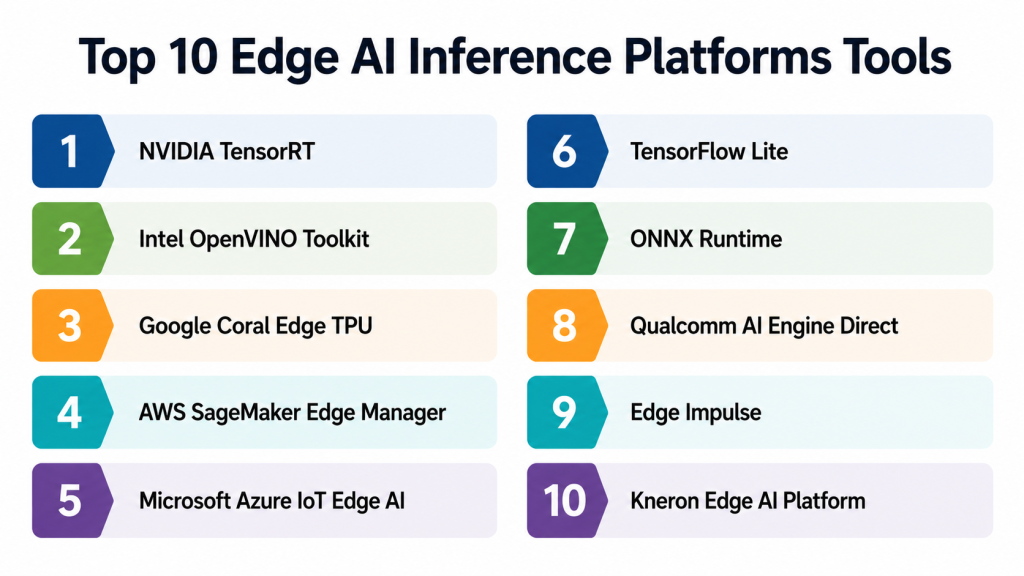
Top 10 Edge AI Inference Platforms Tools
1- NVIDIA TensorRT
Short Description:
NVIDIA TensorRT is a high-performance deep learning inference optimizer and runtime designed to deliver ultra-low latency AI execution on NVIDIA GPUs. It is widely used in robotics, autonomous systems, and real-time vision applications.
Key Features
- Deep learning inference optimization
- GPU acceleration support
- Model quantization and pruning
- Tensor fusion and kernel optimization
- Multi-framework support (ONNX, PyTorch, TensorFlow)
- High-throughput inference pipeline
- Edge GPU deployment support
Pros
- Extremely high performance
- Strong GPU optimization
- Widely adopted in industry
Cons
- NVIDIA ecosystem dependency
- Requires GPU expertise
Platforms / Deployment
- Linux, Windows
- On-premise, Edge GPU, Cloud
Security & Compliance
- Not publicly stated
Integrations & Ecosystem
Supports integration with AI frameworks and deployment pipelines
- PyTorch
- TensorFlow
- ONNX Runtime
- Kubernetes
Support & Community
Strong enterprise support and large developer community
2- Intel OpenVINO Toolkit
Short Description:
OpenVINO is Intel’s AI inference optimization toolkit designed for deploying high-performance models across Intel hardware at the edge.
Key Features
- Model optimization and conversion
- CPU, GPU, VPU support
- Real-time inference acceleration
- Edge device deployment tools
- Multi-framework support
- Computer vision optimization
- Model benchmarking tools
Pros
- Strong CPU-based inference
- Efficient edge optimization
- Wide hardware support
Cons
- Intel-focused ecosystem
- Learning curve for beginners
Platforms / Deployment
- Linux, Windows
- Edge devices, On-premise
Security & Compliance
- Not publicly stated
Integrations & Ecosystem
- TensorFlow
- PyTorch
- ONNX
- Kubernetes
Support & Community
Strong enterprise documentation and active community
3- Google Coral Edge TPU
Short Description:
Google Coral provides edge AI acceleration using Edge TPU hardware for ultra-low power inference at the edge.
Key Features
- Edge TPU hardware acceleration
- TensorFlow Lite support
- Low-power inference execution
- On-device model deployment
- USB and embedded modules
- Real-time vision processing
- Edge AI optimization tools
Pros
- Very low power consumption
- Fast inference on small models
- Easy edge integration
Cons
- Limited model size support
- Hardware dependency
Platforms / Deployment
- Linux-based edge devices
- Embedded systems
Security & Compliance
- Not publicly stated
Integrations & Ecosystem
- TensorFlow Lite
- Edge IoT devices
- Embedded systems
Support & Community
Strong developer ecosystem
4- AWS SageMaker Edge Manager
Short Description:
AWS SageMaker Edge Manager helps deploy, optimize, and monitor ML models on edge devices integrated with AWS cloud services.
Key Features
- Edge model deployment
- Device fleet monitoring
- Model synchronization
- Performance tracking
- Secure model updates
- Data sampling at edge
- Cloud integration
Pros
- Strong AWS integration
- Scalable architecture
- Enterprise-ready
Cons
- AWS ecosystem dependency
- Complexity in setup
Platforms / Deployment
- Cloud + Edge
Security & Compliance
- IAM-based security controls
Integrations & Ecosystem
- AWS IoT
- SageMaker
- CloudWatch
Support & Community
Enterprise-grade AWS support
5- Microsoft Azure IoT Edge AI
Short Description:
Azure IoT Edge enables deployment of AI models and analytics workloads directly on IoT devices with seamless Azure integration.
Key Features
- Edge AI model deployment
- IoT device management
- Offline inference support
- Containerized workloads
- Cloud synchronization
- Security modules
- Real-time analytics
Pros
- Strong enterprise ecosystem
- Hybrid cloud support
- Easy integration with Azure
Cons
- Azure dependency
- Complex architecture
Platforms / Deployment
- Cloud + Edge
Security & Compliance
- Azure security stack
Integrations & Ecosystem
- Azure AI services
- IoT Hub
- Kubernetes
Support & Community
Strong enterprise support
6- TensorFlow Lite
Short Description:
TensorFlow Lite is a lightweight framework for running machine learning models on mobile and edge devices.
Key Features
- Lightweight inference engine
- Mobile and embedded support
- Model quantization
- Hardware acceleration support
- Cross-platform deployment
- Optimized runtime
- On-device ML execution
Pros
- Easy to use
- Wide adoption
- Mobile-friendly
Cons
- Limited advanced optimization
- Requires model conversion
Platforms / Deployment
- Android, iOS, Linux
Security & Compliance
- Not publicly stated
Integrations & Ecosystem
- TensorFlow
- Mobile apps
- Edge devices
Support & Community
Very large open-source community
7- ONNX Runtime
Short Description:
ONNX Runtime is a cross-platform inference engine for deploying machine learning models efficiently across hardware types.
Key Features
- Cross-framework support
- High-performance inference
- Hardware acceleration
- Model optimization tools
- Cloud and edge deployment
- Multi-language support
- Scalable execution
Pros
- Framework agnostic
- High performance
- Flexible deployment
Cons
- Requires optimization expertise
- Setup complexity
Platforms / Deployment
- Linux, Windows, Cloud
Security & Compliance
- Not publicly stated
Integrations & Ecosystem
- PyTorch
- TensorFlow
- Azure AI
- OpenVINO
Support & Community
Strong open-source community
8- Qualcomm AI Engine Direct
Short Description:
Qualcomm AI Engine Direct enables AI inference optimization on Snapdragon-powered edge devices.
Key Features
- On-device AI inference
- NPU acceleration
- Mobile AI optimization
- Vision and speech processing
- Low-power execution
- Hardware abstraction layer
- Edge AI SDK
Pros
- Excellent mobile optimization
- Low power usage
- High performance on Snapdragon
Cons
- Hardware-specific
- Limited general-purpose use
Platforms / Deployment
- Mobile, Embedded
Security & Compliance
- Not publicly stated
Integrations & Ecosystem
- Snapdragon ecosystem
- Mobile frameworks
- AI SDKs
Support & Community
Enterprise developer support
9- Edge Impulse
Short Description:
Edge Impulse is a developer-friendly platform for building and deploying AI models on edge devices.
Key Features
- End-to-end AI pipeline
- Model training tools
- Edge deployment support
- Sensor data integration
- Real-time inference
- Embedded AI support
- No-code/low-code tools
Pros
- Easy to use
- Great for prototyping
- Strong embedded focus
Cons
- Limited enterprise customization
- Not ideal for large-scale deployments
Platforms / Deployment
- Cloud + Edge
Security & Compliance
- Not publicly stated
Integrations & Ecosystem
- Embedded devices
- IoT sensors
- ML frameworks
Support & Community
Strong developer community
10- Kneron Edge AI Platform
Short Description:
Kneron provides edge AI inference solutions optimized for smart cameras, robotics, and IoT devices.
Key Features
- Edge AI acceleration
- Vision processing
- Low-power inference
- Hardware AI chips
- Model deployment tools
- Edge analytics
- Security processing
Pros
- Efficient edge inference
- Strong hardware integration
- Good for vision AI
Cons
- Smaller ecosystem
- Limited general-purpose adoption
Platforms / Deployment
- Embedded, Edge Devices
Security & Compliance
- Not publicly stated
Integrations & Ecosystem
- AI chips
- IoT devices
- Vision systems
Support & Community
Enterprise-level support available
Comparison Table
| Tool Name | Best For | Platforms Supported | Deployment | Standout Feature | Public Rating |
|---|---|---|---|---|---|
| NVIDIA TensorRT | GPU AI inference | Linux, Windows | Edge/Cloud | GPU optimization | N/A |
| Intel OpenVINO | Intel hardware | Linux, Windows | Edge | CPU optimization | N/A |
| Google Coral | Low-power AI | Embedded | Edge | Edge TPU | N/A |
| AWS Edge Manager | Enterprise IoT | Cloud/Edge | Hybrid | AWS integration | N/A |
| Azure IoT Edge | Enterprise AI | Cloud/Edge | Hybrid | Azure ecosystem | N/A |
| TensorFlow Lite | Mobile AI | Mobile, Linux | Edge | Lightweight runtime | N/A |
| ONNX Runtime | Cross-platform AI | Multi OS | Edge/Cloud | Framework agnostic | N/A |
| Qualcomm AI Engine | Mobile AI | Embedded | Edge | Snapdragon AI | N/A |
| Edge Impulse | Developers | Cloud/Edge | Hybrid | No-code AI pipeline | N/A |
| Kneron Platform | Vision AI | Embedded | Edge | AI chip optimization | N/A |
Evaluation & Scoring Table
| Tool Name | Core | Ease | Integrations | Security | Performance | Support | Value | Weighted Total |
|---|---|---|---|---|---|---|---|---|
| NVIDIA TensorRT | 9.7 | 8.2 | 9.0 | 9.0 | 9.8 | 9.0 | 8.5 | 9.10 |
| Intel OpenVINO | 9.2 | 8.4 | 9.1 | 8.9 | 9.2 | 8.8 | 8.7 | 8.93 |
| Google Coral | 8.8 | 8.7 | 8.6 | 8.8 | 9.0 | 8.5 | 8.8 | 8.78 |
| AWS Edge Manager | 9.3 | 8.5 | 9.4 | 9.2 | 9.3 | 9.1 | 8.6 | 9.02 |
| Azure IoT Edge | 9.3 | 8.6 | 9.4 | 9.2 | 9.2 | 9.0 | 8.7 | 9.03 |
| TensorFlow Lite | 9.0 | 9.2 | 9.0 | 8.8 | 8.9 | 9.0 | 9.1 | 9.00 |
| ONNX Runtime | 9.2 | 8.6 | 9.3 | 9.0 | 9.2 | 8.9 | 8.8 | 9.01 |
| Qualcomm AI Engine | 8.9 | 8.7 | 8.7 | 8.8 | 9.1 | 8.6 | 8.7 | 8.80 |
| Edge Impulse | 8.7 | 9.3 | 8.6 | 8.5 | 8.7 | 8.8 | 9.2 | 8.79 |
| Kneron Platform | 8.6 | 8.4 | 8.5 | 8.7 | 8.9 | 8.5 | 8.6 | 8.66 |
Which Edge AI Inference Platform Is Right for You?
Solo / Freelancer
Edge Impulse and TensorFlow Lite offer simplicity, fast prototyping, and low entry barriers.
SMB
ONNX Runtime and OpenVINO provide flexibility and strong performance without heavy infrastructure costs.
Mid-Market
AWS SageMaker Edge Manager and Azure IoT Edge provide scalable enterprise-ready deployments.
Enterprise
NVIDIA TensorRT, AWS, Azure, and Intel OpenVINO offer high-performance, scalable, production-grade AI inference.
Budget vs Premium
TensorFlow Lite and Edge Impulse are cost-efficient, while NVIDIA and cloud platforms are premium but powerful.
Feature Depth vs Ease of Use
TensorRT and ONNX Runtime offer deep optimization; Edge Impulse focuses on usability.
Integrations & Scalability
AWS and Azure lead in integration ecosystems and global scalability.
Security & Compliance Needs
Enterprise platforms with cloud integration provide stronger governance and monitoring controls.
Frequently Asked Questions
1- What is Edge AI inference?
It is the process of running AI models directly on edge devices instead of sending data to the cloud.
2- Why is Edge AI important?
It reduces latency, improves privacy, and enables real-time decision-making.
3- Which industries use Edge AI?
Industries like automotive, healthcare, manufacturing, retail, and smart cities use Edge AI widely.
4- What hardware is needed for Edge AI?
GPUs, TPUs, NPUs, or optimized CPUs depending on workload.
5- Can Edge AI work offline?
Yes, many platforms support offline inference capabilities.
6- What is model optimization in Edge AI?
It involves compressing and optimizing models for faster execution on limited hardware.
7- Is Edge AI better than cloud AI?
It depends on use case; edge AI is better for real-time tasks, cloud AI for heavy computation.
8- What is ONNX in Edge AI?
ONNX is a format that allows models to run across multiple AI frameworks.
9- How secure is Edge AI?
Security depends on encryption, device security, and platform architecture.
10- What is the biggest challenge in Edge AI?
Managing hardware diversity and optimizing models across devices is the biggest challenge.
Conclusion
Edge AI Inference Platforms are transforming how intelligent systems operate by bringing computation closer to data sources. From industrial automation and smart cities to robotics and mobile AI, these platforms enable faster, more private, and more efficient AI execution. NVIDIA TensorRT and Intel OpenVINO lead in performance optimization, while AWS and Azure dominate enterprise-scale deployments. Developer-friendly tools like Edge Impulse and TensorFlow Lite make adoption easier for smaller teams. The right choice depends on your hardware ecosystem, scalability needs, and deployment strategy. A pilot implementation across 2–3 platforms is recommended before full-scale rollout.
