Introduction
Identity Verification (IDV) Tools help organizations confirm that a person is real, unique, and authorized by validating identity documents, biometrics, and digital signals. These platforms are essential for onboarding users securely in industries like fintech, banking, e-commerce, crypto, and online marketplaces.
With the rise of digital onboarding, remote services, and fraud risks, identity verification has become a critical security layer. Modern IDV tools use AI, machine learning, facial recognition, and document authentication to ensure fast and accurate verification while reducing fraud and manual review efforts.
Common use cases include:
- Customer onboarding (KYC processes)
- Fraud prevention and risk reduction
- Age verification and access control
- Account creation validation
- Regulatory compliance (AML/KYC support)
Key evaluation criteria:
- Verification accuracy and speed
- Document and biometric support
- Fraud detection capabilities
- Global identity coverage
- Integration with APIs and systems
- Compliance and security standards
- User experience and onboarding flow
- Scalability and performance
Best for: Fintech companies, banks, crypto platforms, gig economy apps, and any digital business requiring secure onboarding.
Not ideal for: Offline businesses with no digital user onboarding.
Key Trends in Identity Verification (IDV) Tools
- AI-powered facial recognition and liveness detection
- Real-time document verification and OCR automation
- Behavioral biometrics for fraud prevention
- API-first IDV platforms for easy integration
- Cloud-based identity verification solutions
- Reduced onboarding friction with instant verification
- Cross-border identity verification support
- Enhanced fraud detection using machine learning
- Mobile-first verification workflows
- Integration with KYC/AML compliance systems
How We Evaluated Identity Verification (IDV) Tools (Methodology)
- Assessed verification accuracy and reliability
- Evaluated AI and biometric capabilities
- Reviewed fraud detection effectiveness
- Considered integration ecosystem and API strength
- Assessed global identity coverage
- Evaluated ease of onboarding and user experience
- Considered performance and scalability
- Assessed fit across fintech, enterprise, and SMB use cases
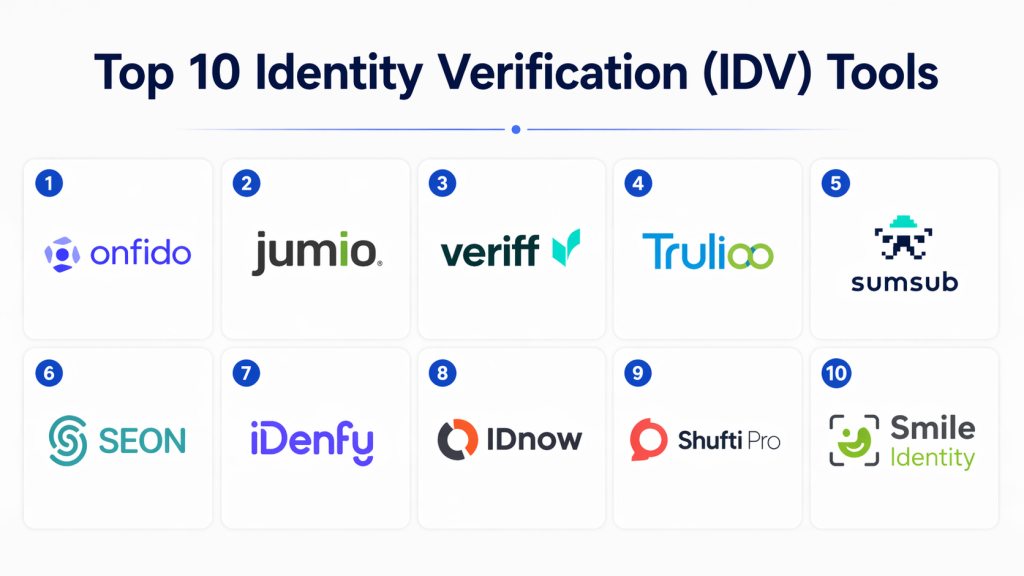
Top 10 Identity Verification (IDV) Tools
#1 — Onfido
Short description: A leading identity verification platform using AI-based document and biometric verification. Known for fast onboarding and strong fraud detection. Widely used in fintech and digital platforms. Provides seamless API integration. Ideal for global businesses.
Key Features
- Document verification
- Facial recognition
- Liveness detection
- Risk scoring
- API integration
Pros
- High accuracy
- Fast onboarding
Cons
- Premium pricing
- Limited customization in lower tiers
Platforms / Deployment
Cloud
Security & Compliance
Encryption, audit logs (others not publicly stated)
Integrations & Ecosystem
- Fintech platforms
- APIs
- Mobile apps
Support & Community
Strong enterprise support.
#2 — Jumio
Short description: A comprehensive IDV platform offering AI-powered identity verification and authentication. Known for strong compliance and fraud detection capabilities. Suitable for enterprise-scale onboarding.
Key Features
- ID document verification
- Biometric authentication
- AML/KYC support
- Risk scoring
- Reporting
Pros
- High security standards
- Strong fraud prevention
Cons
- Complex setup
- Expensive
Platforms / Deployment
Cloud
Security & Compliance
Encryption, audit logs (others not publicly stated)
Integrations & Ecosystem
- Banking systems
- APIs
Support & Community
Enterprise support.
#3 — Veriff
Short description: A global identity verification platform specializing in video and document verification. Known for high accuracy and global coverage. Ideal for fintech and digital onboarding.
Key Features
- Video verification
- Document authentication
- Liveness detection
- Fraud detection
- API integration
Pros
- Strong global reach
- High accuracy
Cons
- Limited advanced analytics
- Premium pricing
Platforms / Deployment
Cloud
Security & Compliance
Encryption (others not publicly stated)
Integrations & Ecosystem
- Digital platforms
- APIs
Support & Community
Good support.
#4 — Trulioo
Short description: A global identity verification platform offering extensive data coverage for KYC compliance. Suitable for enterprises operating internationally.
Key Features
- Global identity verification
- Data validation
- KYC compliance
- Risk assessment
- API integration
Pros
- Wide global coverage
- Strong compliance support
Cons
- Complex pricing
- Integration effort required
Platforms / Deployment
Cloud
Security & Compliance
Encryption (others not publicly stated)
Integrations & Ecosystem
- Fintech systems
- APIs
Support & Community
Good enterprise support.
#5 — Sumsub
Short description: A unified identity verification platform supporting KYC, AML, and fraud prevention. Popular among fintech and crypto platforms. Offers flexible onboarding flows.
Key Features
- Identity verification
- AML screening
- Risk scoring
- Fraud detection
- Workflow automation
Pros
- All-in-one platform
- Flexible workflows
Cons
- UI complexity
- Pricing varies
Platforms / Deployment
Cloud
Security & Compliance
Encryption (others not publicly stated)
Integrations & Ecosystem
- Fintech apps
- APIs
Support & Community
Good support.
#6 — SEON ID Verification
Short description: A fraud-focused identity verification platform using data enrichment and risk scoring. Suitable for SMB and fintech companies.
Key Features
- Identity verification
- Fraud detection
- Risk scoring
- Data enrichment
- API integration
Pros
- Affordable
- Easy to use
Cons
- Limited enterprise features
- Smaller ecosystem
Platforms / Deployment
Cloud
Security & Compliance
Encryption (others not publicly stated)
Integrations & Ecosystem
- Payment systems
- APIs
Support & Community
SMB-focused support.
#7 — iDenfy
Short description: A cost-effective identity verification platform offering document and biometric verification. Known for simplicity and fast setup.
Key Features
- Document verification
- Facial recognition
- Liveness detection
- Risk scoring
- API integration
Pros
- Affordable
- Easy setup
Cons
- Limited advanced features
- Smaller global reach
Platforms / Deployment
Cloud
Security & Compliance
Encryption (others not publicly stated)
Integrations & Ecosystem
- Fintech tools
- APIs
Support & Community
Good support.
#8 — IDnow
Short description: A European identity verification platform focused on compliance and secure onboarding. Strong in regulated industries.
Key Features
- Video identification
- Document verification
- Compliance tools
- Risk scoring
- Reporting
Pros
- Strong compliance focus
- Trusted in Europe
Cons
- Limited global expansion
- Complex integration
Platforms / Deployment
Cloud
Security & Compliance
GDPR support, encryption (others not publicly stated)
Integrations & Ecosystem
- Banking systems
- APIs
Support & Community
Enterprise support.
#9 — Shufti Pro
Short description: A global IDV platform offering AI-based identity verification and AML support. Known for fast verification and wide coverage.
Key Features
- Identity verification
- AML screening
- Biometric checks
- Risk scoring
- API integration
Pros
- Fast verification
- Global coverage
Cons
- UI limitations
- Support varies
Platforms / Deployment
Cloud
Security & Compliance
Encryption (others not publicly stated)
Integrations & Ecosystem
- Fintech platforms
- APIs
Support & Community
Moderate support.
#10 — Smile Identity
Short description: An identity verification platform focused on emerging markets. Provides strong support for African and global identity verification needs.
Key Features
- Identity verification
- Biometric checks
- Document validation
- Fraud detection
- API integration
Pros
- Strong emerging market focus
- Good accuracy
Cons
- Limited global coverage
- Smaller ecosystem
Platforms / Deployment
Cloud
Security & Compliance
Encryption (others not publicly stated)
Integrations & Ecosystem
- Fintech apps
- APIs
Support & Community
Growing support.
Comparison Table (Top 10)
| Tool Name | Best For | Platform(s) | Deployment | Standout Feature | Public Rating |
|---|---|---|---|---|---|
| Onfido | Fintech | Web | Cloud | Biometrics | N/A |
| Jumio | Enterprise | Web | Cloud | AI verification | N/A |
| Veriff | Global onboarding | Web | Cloud | Video ID | N/A |
| Trulioo | Global KYC | Web | Cloud | Data coverage | N/A |
| Sumsub | All-in-one | Web | Cloud | Unified platform | N/A |
| SEON | SMB | Web | Cloud | Data enrichment | N/A |
| iDenfy | SMB | Web | Cloud | Affordability | N/A |
| IDnow | Europe | Web | Cloud | Compliance | N/A |
| Shufti Pro | Global | Web | Cloud | Fast verification | N/A |
| Smile Identity | Emerging markets | Web | Cloud | Regional focus | N/A |
Evaluation & Scoring of Identity Verification (IDV) Tools
| Tool | Core | Ease | Integrations | Security | Performance | Support | Value | Total |
|---|---|---|---|---|---|---|---|---|
| Onfido | 9 | 9 | 8 | 9 | 9 | 8 | 7 | 8.4 |
| Jumio | 9 | 7 | 8 | 9 | 9 | 8 | 7 | 8.2 |
| Veriff | 8 | 8 | 8 | 8 | 8 | 8 | 8 | 8.0 |
| Trulioo | 8 | 7 | 9 | 9 | 8 | 8 | 7 | 8.1 |
| Sumsub | 8 | 8 | 8 | 8 | 8 | 8 | 8 | 8.0 |
| SEON | 7 | 9 | 7 | 7 | 7 | 7 | 9 | 7.8 |
| iDenfy | 7 | 9 | 7 | 7 | 7 | 7 | 9 | 7.8 |
| IDnow | 8 | 7 | 8 | 9 | 8 | 8 | 7 | 8.0 |
| Shufti Pro | 7 | 8 | 7 | 7 | 8 | 7 | 8 | 7.7 |
| Smile Identity | 7 | 8 | 7 | 7 | 7 | 7 | 8 | 7.6 |
Which Identity Verification (IDV) Tool Is Right for You?
Solo / Freelancer
iDenfy or SEON are simple and cost-effective.
SMB
SEON or Shufti Pro offer affordability and ease of use.
Mid-Market
Sumsub or Veriff provide balanced features.
Enterprise
Onfido, Jumio, and Trulioo are top choices.
Budget vs Premium
- Budget: iDenfy
- Premium: Jumio
Feature Depth vs Ease of Use
- Easy: Onfido
- Advanced: Jumio
Integrations & Scalability
- Best integrations: Trulioo, Sumsub
Security & Compliance
- High compliance: IDnow, Jumio
FAQs
1. What are Identity Verification (IDV) tools?
IDV tools verify a person’s identity using documents, biometrics, and digital checks. They help prevent fraud and ensure secure onboarding. These tools are widely used in fintech and banking. They improve trust and compliance.
2. Who uses IDV tools?
Fintech companies, banks, crypto platforms, and online marketplaces use them. Any business requiring secure user onboarding benefits from IDV tools. They help reduce identity fraud.
3. Are IDV tools expensive?
Pricing depends on usage volume and features. Enterprise solutions are more expensive. SMB tools are more affordable.
4. How fast is identity verification?
Most modern tools verify identity in seconds to minutes. Speed depends on document quality and system integration. AI improves processing speed.
5. Do IDV tools use AI?
Yes, most tools use AI for facial recognition and document verification. AI improves accuracy and fraud detection. It also reduces manual review.
6. Are IDV tools secure?
Yes, they use encryption and secure data handling practices. Security standards vary by provider. Compliance is a key feature.
7. Can IDV tools integrate with apps?
Yes, they offer APIs for seamless integration. They work with fintech, banking, and SaaS platforms. Integration is a core feature.
8. What are common challenges?
Challenges include false rejections and integration complexity. Proper setup reduces issues. Continuous monitoring improves performance.
9. What are alternatives to IDV tools?
Manual verification or basic document checks are alternatives. However, they are slow and less secure. IDV tools are more efficient.
10. Do IDV tools support global users?
Yes, most tools support global identity verification. Coverage varies by vendor. Global compliance is important.
Conclusion
Identity Verification (IDV) tools are essential for modern digital businesses that rely on secure and fast user onboarding. As fraud risks increase and digital interactions grow, these platforms provide the necessary technology to verify identities accurately using AI, biometrics, and document authentication. They help organizations reduce fraud, improve compliance, and deliver a seamless user experience across global markets.
Choosing the right IDV solution depends on your business size, risk profile, and geographic reach. Enterprises may prefer robust platforms like Onfido or Jumio, while SMBs can benefit from cost-effective tools like SEON or iDenfy. The best approach is to evaluate multiple providers, test their APIs, and ensure they align with your onboarding and compliance requirements before making a final decision.
