Introduction
KYC (Know Your Customer) and AML (Anti-Money Laundering) compliance tools help organizations verify customer identities, monitor transactions, and detect suspicious activities to prevent financial crimes. These platforms are essential for banks, fintech companies, and regulated industries to meet global compliance requirements and reduce fraud risks.
With the rise of digital banking, online onboarding, and cross-border transactions, compliance has become more complex and critical. Modern KYC/AML tools use AI, machine learning, and real-time analytics to streamline identity verification, reduce false positives, and improve compliance efficiency while maintaining a seamless customer experience.
Common use cases include:
- Customer identity verification and onboarding
- Transaction monitoring and fraud detection
- Sanctions and watchlist screening
- Risk scoring and profiling
- Regulatory compliance and reporting
Key evaluation criteria:
- Identity verification accuracy
- AML transaction monitoring capabilities
- Global compliance coverage
- Integration with banking and fintech systems
- Automation and AI capabilities
- Reporting and audit features
- Scalability and performance
- Ease of use and onboarding
Best for: Banks, fintech companies, payment processors, and enterprises operating in regulated industries.
Not ideal for: Small businesses with minimal regulatory requirements or low transaction volume.
Key Trends in KYC/AML Compliance Tools
- AI-driven identity verification and fraud detection
- Real-time transaction monitoring and alerts
- Integration with digital onboarding platforms
- Automation of compliance workflows
- Global sanctions and watchlist screening
- Behavioral analytics and risk scoring
- Cloud-based compliance platforms
- Reduction of false positives through ML models
- Expansion into cross-border compliance
- Enhanced reporting and audit capabilities
How We Evaluated KYC/AML Compliance Tools (Methodology)
- Assessed market adoption and industry usage
- Evaluated core KYC and AML capabilities
- Reviewed AI and automation features
- Considered integration ecosystem and scalability
- Assessed compliance coverage across regions
- Evaluated ease of use and onboarding experience
- Considered performance and reliability
- Assessed fit across fintech, banking, and enterprise use cases
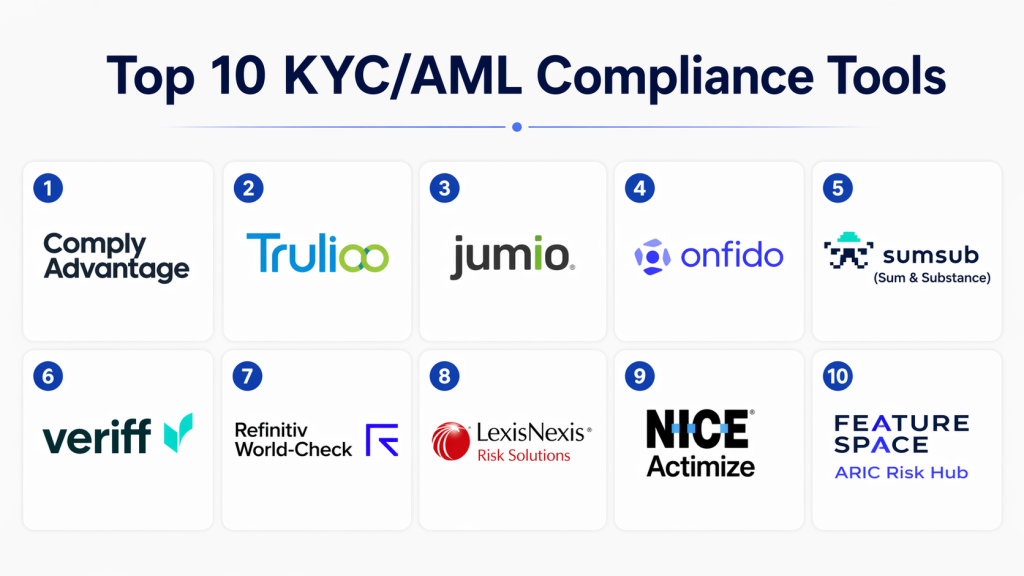
Top 10 KYC/AML Compliance Tools
#1 — ComplyAdvantage
Short description: A modern compliance platform offering real-time AML monitoring and risk screening. Known for strong AI-driven analytics and global data coverage. Suitable for fintech and enterprises.
Key Features
- AML monitoring
- Risk screening
- Watchlist filtering
- Reporting
- Analytics
Pros
- Strong AI capabilities
- Real-time insights
Cons
- Premium pricing
- Requires integration
Platforms / Deployment
Cloud
Security & Compliance
Encryption, audit logs (others not publicly stated)
Integrations & Ecosystem
- Financial systems
- APIs
- Enterprise tools
Support & Community
Enterprise support.
#2 — Trulioo
Short description: A global identity verification platform offering KYC and AML services. Known for wide data coverage and fast verification. Suitable for global businesses.
Key Features
- Identity verification
- Global data coverage
- Risk assessment
- Reporting
- Integration
Pros
- Wide global reach
- Fast onboarding
Cons
- Pricing complexity
- Limited customization
Platforms / Deployment
Cloud
Security & Compliance
Encryption (others not publicly stated)
Integrations & Ecosystem
- Fintech platforms
- APIs
Support & Community
Good support.
#3 — Onfido
Short description: A digital identity verification platform using AI for document and biometric verification. Ideal for remote onboarding and fintech applications.
Key Features
- Document verification
- Biometric authentication
- Risk scoring
- Reporting
- Integration
Pros
- Strong AI verification
- Easy integration
Cons
- Limited AML features
- Premium pricing
Platforms / Deployment
Cloud
Security & Compliance
Encryption (others not publicly stated)
Integrations & Ecosystem
- Digital platforms
- APIs
Support & Community
Good support.
#4 — Jumio
Short description: A comprehensive identity verification and AML platform offering AI-driven solutions. Known for high accuracy and fraud detection.
Key Features
- Identity verification
- AML screening
- Biometric authentication
- Risk analysis
- Reporting
Pros
- High accuracy
- Strong fraud detection
Cons
- Expensive
- Complex setup
Platforms / Deployment
Cloud
Security & Compliance
Encryption, audit logs (others not publicly stated)
Integrations & Ecosystem
- Financial systems
- APIs
Support & Community
Enterprise support.
#5 — Sumsub (Sum & Substance)
Short description: A unified KYC/AML platform offering identity verification and transaction monitoring. Suitable for fintech and crypto companies.
Key Features
- Identity verification
- AML monitoring
- Risk scoring
- Reporting
- Integration
Pros
- All-in-one platform
- Flexible
Cons
- UI complexity
- Pricing varies
Platforms / Deployment
Cloud
Security & Compliance
Encryption (others not publicly stated)
Integrations & Ecosystem
- Fintech tools
- APIs
Support & Community
Good support.
#6 — SEON
Short description: A fraud and AML platform focusing on data enrichment and risk scoring. Suitable for SMB and mid-market fintech.
Key Features
- Data enrichment
- Risk scoring
- Fraud detection
- Reporting
- Integration
Pros
- Easy to use
- Affordable
Cons
- Limited enterprise features
- Smaller ecosystem
Platforms / Deployment
Cloud
Security & Compliance
Encryption (others not publicly stated)
Integrations & Ecosystem
- Payment platforms
- APIs
Support & Community
SMB-focused support.
#7 — Veriff
Short description: An identity verification platform specializing in video and document verification. Suitable for global onboarding and compliance.
Key Features
- Identity verification
- Video verification
- Risk scoring
- Reporting
- Integration
Pros
- High accuracy
- Global coverage
Cons
- Limited AML features
- Premium pricing
Platforms / Deployment
Cloud
Security & Compliance
Encryption (others not publicly stated)
Integrations & Ecosystem
- Digital platforms
- APIs
Support & Community
Good support.
#8 — iDenfy
Short description: A KYC platform offering identity verification and fraud prevention. Known for ease of use and affordability.
Key Features
- Identity verification
- Fraud detection
- Risk scoring
- Reporting
- Integration
Pros
- Affordable
- Easy setup
Cons
- Limited advanced features
- Smaller ecosystem
Platforms / Deployment
Cloud
Security & Compliance
Encryption (others not publicly stated)
Integrations & Ecosystem
- Fintech tools
- APIs
Support & Community
Good support.
#9 — Refinitiv World-Check
Short description: A widely used AML screening solution offering global watchlist data and risk intelligence. Ideal for large enterprises and banks.
Key Features
- Watchlist screening
- Risk intelligence
- AML monitoring
- Reporting
- Analytics
Pros
- Extensive data coverage
- Trusted by banks
Cons
- Expensive
- Complex integration
Platforms / Deployment
Cloud
Security & Compliance
Encryption, audit logs (others not publicly stated)
Integrations & Ecosystem
- Banking systems
- APIs
Support & Community
Enterprise support.
#10 — LexisNexis Risk Solutions
Short description: A comprehensive compliance platform offering identity verification and risk analytics. Suitable for enterprises and financial institutions.
Key Features
- Identity verification
- Risk analytics
- AML monitoring
- Reporting
- Integration
Pros
- Strong data insights
- Scalable
Cons
- Complex setup
- Premium pricing
Platforms / Deployment
Cloud
Security & Compliance
Encryption, audit logs (others not publicly stated)
Integrations & Ecosystem
- Financial systems
- APIs
Support & Community
Enterprise support.
Comparison Table (Top 10)
| Tool Name | Best For | Platform(s) | Deployment | Standout Feature | Public Rating |
|---|---|---|---|---|---|
| ComplyAdvantage | Fintech | Web | Cloud | AML analytics | N/A |
| Trulioo | Global KYC | Web | Cloud | Data coverage | N/A |
| Onfido | Identity | Web | Cloud | Biometrics | N/A |
| Jumio | Fraud detection | Web | Cloud | AI verification | N/A |
| Sumsub | All-in-one | Web | Cloud | Unified platform | N/A |
| SEON | SMB | Web | Cloud | Data enrichment | N/A |
| Veriff | Global onboarding | Web | Cloud | Video verification | N/A |
| iDenfy | SMB | Web | Cloud | Affordability | N/A |
| Refinitiv | Enterprise | Web | Cloud | Watchlist data | N/A |
| LexisNexis | Enterprise | Web | Cloud | Risk analytics | N/A |
Evaluation & Scoring of KYC/AML Compliance Tools
| Tool | Core | Ease | Integrations | Security | Performance | Support | Value | Total |
|---|---|---|---|---|---|---|---|---|
| ComplyAdvantage | 9 | 8 | 8 | 9 | 9 | 8 | 8 | 8.5 |
| Trulioo | 8 | 9 | 8 | 8 | 8 | 8 | 8 | 8.2 |
| Onfido | 8 | 9 | 8 | 8 | 8 | 8 | 7 | 8.1 |
| Jumio | 9 | 7 | 8 | 9 | 9 | 8 | 7 | 8.3 |
| Sumsub | 8 | 8 | 8 | 8 | 8 | 8 | 8 | 8.0 |
| SEON | 7 | 9 | 7 | 7 | 7 | 7 | 9 | 7.8 |
| Veriff | 8 | 8 | 7 | 8 | 8 | 7 | 8 | 7.9 |
| iDenfy | 7 | 9 | 7 | 7 | 7 | 7 | 9 | 7.7 |
| Refinitiv | 9 | 6 | 8 | 9 | 9 | 8 | 7 | 8.2 |
| LexisNexis | 9 | 7 | 8 | 9 | 9 | 8 | 7 | 8.3 |
Interpretation:
Higher scores indicate stronger capabilities across identity verification, AML monitoring, and compliance. Enterprise tools excel in data coverage and scalability, while modern tools focus on usability and cost-effectiveness.
Which KYC/AML Compliance Tool Is Right for You?
Solo / Freelancer
iDenfy or SEON are simple and affordable.
SMB
SEON or Sumsub provide balanced features.
Mid-Market
Trulioo or Onfido offer strong onboarding capabilities.
Enterprise
ComplyAdvantage, LexisNexis, and Refinitiv are top choices.
Budget vs Premium
- Budget: iDenfy
- Premium: LexisNexis
Feature Depth vs Ease of Use
- Easy: Onfido
- Advanced: Refinitiv
Integrations & Scalability
- Best integrations: ComplyAdvantage, Trulioo
Security & Compliance
- High compliance: Refinitiv, LexisNexis
FAQs
1. What are KYC/AML compliance tools?
KYC/AML tools help verify customer identities and monitor transactions to prevent financial crimes. They ensure organizations comply with regulatory requirements. These tools use AI and analytics to detect suspicious activities. They are essential for financial institutions and fintech companies.
2. Who should use KYC/AML tools?
Banks, fintech companies, and payment providers benefit the most from these tools. Any business handling financial transactions or sensitive customer data should use them. They help reduce fraud and ensure compliance. Large enterprises rely heavily on them.
3. Are KYC/AML tools expensive?
Pricing varies depending on features, usage, and scale. Enterprise tools are typically expensive due to advanced capabilities. Some platforms offer flexible pricing models. Organizations should evaluate cost based on compliance needs.
4. How long does implementation take?
Implementation time depends on integration complexity and organization size. Cloud-based tools can be deployed quickly within days. Larger deployments may take weeks. Proper planning ensures better performance.
5. Do these tools use AI?
Yes, most modern KYC/AML tools use AI and machine learning. These technologies improve identity verification and fraud detection accuracy. They help reduce false positives. AI enables real-time decision-making.
6. Can KYC/AML tools integrate with existing systems?
Yes, most platforms integrate with banking systems, payment gateways, and APIs. Integration ensures seamless onboarding and monitoring. It improves efficiency and automation. Strong integration is a key requirement.
7. Are KYC/AML tools secure?
Most tools include strong security features such as encryption and access controls. They are designed to handle sensitive financial data. Security capabilities vary by vendor. Compliance standards are important.
8. What are common challenges?
Common challenges include integration complexity and false positives. Proper configuration helps reduce these issues. Continuous monitoring and updates are required. Choosing the right tool improves results.
9. What are alternatives to KYC/AML tools?
Alternatives include manual verification and basic compliance processes. However, they are less efficient and scalable. KYC/AML tools provide automation and accuracy. They are essential for modern compliance.
10. Do these tools support global compliance?
Yes, many platforms support global regulations and compliance frameworks. They help organizations operate across regions. Capabilities vary by vendor. They are critical for international businesses.
Conclusion
KYC/AML compliance tools have become essential for organizations operating in regulated environments, particularly in banking, fintech, and digital services. As financial crimes become more sophisticated and regulations continue to evolve globally, these platforms provide the necessary capabilities to verify identities, monitor transactions, and ensure compliance efficiently. By leveraging AI, automation, and real-time analytics, modern tools help organizations reduce fraud risks while maintaining a smooth customer experience.
Choosing the right KYC/AML platform depends on your organization’s size, regulatory exposure, and transaction volume. Enterprises may require comprehensive solutions like LexisNexis or Refinitiv, while smaller businesses can benefit from flexible and cost-effective tools like SEON or iDenfy. The best approach is to evaluate multiple options, run pilot integrations, and ensure they align with your compliance workflows and operational requirements before making a final decision.
