Introduction
Home Health Care Management Software helps home health agencies, private duty care providers, hospice teams, and community-based care organizations manage daily operations from one connected system. Instead of relying on spreadsheets, paper notes, disconnected billing tools, and manual caregiver coordination, these platforms bring scheduling, visit documentation, patient records, caregiver management, billing, compliance, reporting, and communication into a single workflow.
It matters now because home-based care is becoming more complex, more regulated, and more technology-driven. Agencies need faster documentation, better caregiver visibility, stronger security, reliable electronic visit verification, and smoother integration with billing, payroll, and healthcare systems. Modern platforms also help leaders improve care quality, reduce administrative work, and support caregivers in the field.
Real-world use cases:
- Scheduling caregivers and clinicians for home visits
- Capturing visit notes, care plans, assessments, and signatures
- Managing billing, payroll, authorizations, and payer workflows
- Tracking EVV, compliance exceptions, and audit-ready records
- Improving communication between office staff, caregivers, patients, and families
Evaluation Criteria for Buyers
- Scheduling and caregiver coordination
- Mobile app experience for field staff
- Clinical documentation and care plan flexibility
- EVV and compliance workflow support
- Billing, claims, payroll, and payer support
- Integration with EHR, accounting, payroll, and referral systems
- Reporting, dashboards, and operational analytics
- Security controls such as MFA, RBAC, encryption, and audit logs
- Ease of onboarding and user adoption
- Scalability for multi-location agencies
Best for: Home health agencies, hospice providers, private duty care businesses, personal care agencies, multi-location care networks, and healthcare administrators that need structured workflows for care delivery, documentation, billing, compliance, and workforce coordination.
Not ideal for: Solo caregivers or very small informal care teams that only need basic appointment scheduling, simple invoicing, or manual client tracking. In those cases, lightweight scheduling tools, spreadsheets, or basic practice management systems may be enough until compliance and operational needs increase.
Key Trends in Home Health Care Management Software
- Mobile-first field documentation: Caregivers and clinicians increasingly need mobile apps to view schedules, complete care notes, capture signatures, and submit visit data from the patient’s home.
- Electronic Visit Verification support: EVV is now a major operational requirement for many agencies, especially those working with Medicaid-funded personal care or home health services.
- AI-assisted workflow automation: Modern platforms are adding AI for schedule optimization, caregiver matching, documentation support, risk alerts, and operational recommendations.
- Stronger security expectations: Buyers are placing more focus on MFA, role-based access, audit logs, encryption, user permissions, and identity management controls.
- Interoperability with healthcare systems: Agencies want smoother data exchange with EHRs, referral partners, clearinghouses, billing platforms, payroll tools, and payer systems.
- Caregiver retention features: Staffing challenges are increasing demand for better caregiver communication, availability tracking, training support, and shift-matching tools.
- Family and patient engagement: Portals, messaging, visit updates, and care visibility features are becoming more important for trust and transparency.
- Compliance-centered reporting: Agencies need dashboards for missed visits, authorization tracking, documentation gaps, billing exceptions, and audit preparation.
- Cloud-based deployment: Most modern home health care platforms are cloud-first, making them easier for distributed teams and mobile caregivers to access.
- Value-based care readiness: More providers are looking for reporting tools that help track outcomes, care quality, hospitalization risk, and service performance.
How We Selected Home Health Care Management Software
- Market adoption: We prioritized tools that are widely recognized in home health, home care, hospice, private duty, or post-acute care markets.
- Feature completeness: The selected platforms offer important workflows such as scheduling, documentation, EVV, billing, reporting, and caregiver coordination.
- Care model fit: The list includes software for clinical home health, hospice, private duty care, personal care, and multi-service agencies.
- Operational depth: Platforms were evaluated for how well they support office staff, caregivers, clinicians, billing teams, and administrators.
- Security posture signals: We considered whether the platform appears suitable for healthcare environments where access control, auditability, and data protection matter.
- Integration ecosystem: Tools with stronger support for billing, payroll, EVV, EHR, referral, clearinghouse, and reporting connections were weighted higher.
- Scalability: We included options for small agencies, growing teams, mid-market providers, and enterprise-level care organizations.
- Ease of adoption: Software with practical user workflows, mobile access, onboarding resources, and clear agency fit was prioritized.
- Reporting and compliance: We considered the ability to help agencies track documentation, visits, exceptions, performance, and compliance workflows.
- Buyer practicality: The final list focuses on tools that real agencies are likely to compare when choosing home health or home care software.
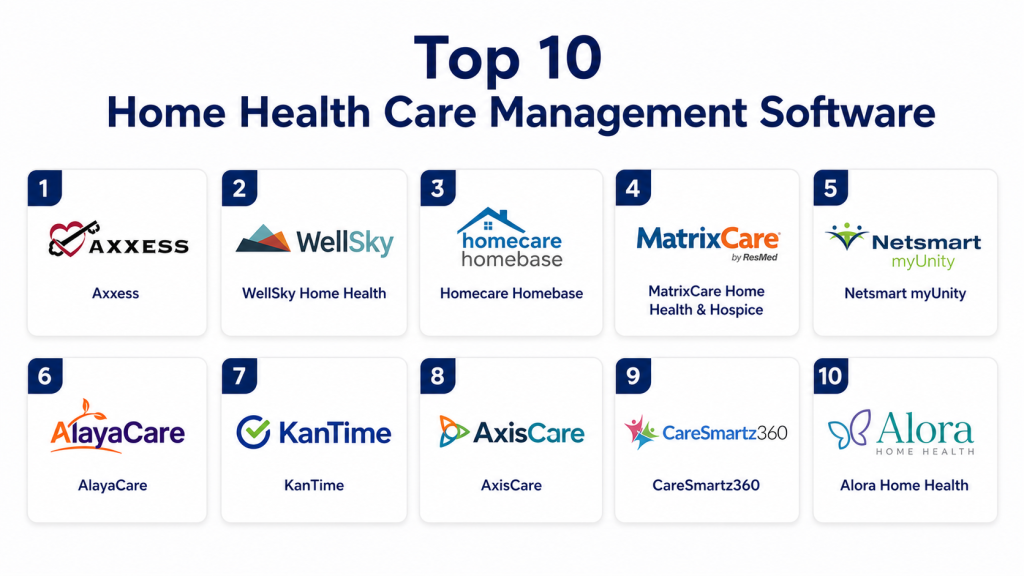
Top 10 Home Health Care Management Software
#1 — Axxess
Short description: Axxess is a widely recognized care-at-home software platform for home health, hospice, palliative care, staffing, and private duty organizations. It helps agencies manage intake, scheduling, clinical documentation, EVV, billing, reporting, and mobile field operations. The platform is designed for agencies that need a cloud-based system with broad workflow coverage.
Key Features
- Intake and referral management workflows
- Scheduling and visit coordination
- Mobile documentation for field staff
- EVV and visit verification support
- Billing and claims-related workflows
- Reporting and operational dashboards
- Multi-care-setting platform coverage
Pros
- Strong fit for home health and broader care-at-home operations
- Cloud-based access supports distributed teams and mobile staff
- Broad workflow coverage across clinical, billing, and operational needs
Cons
- May require structured onboarding for teams moving from manual processes
- Feature depth can feel complex for very small agencies
- Pricing and implementation details may vary by agency requirements
Platforms / Deployment
Web / iOS / Android
Cloud
Security & Compliance
HIPAA-oriented healthcare platform expectations are applicable. Specific controls such as SSO/SAML, MFA, SOC 2, ISO 27001, or advanced identity management should be verified directly with the vendor.
Integrations & Ecosystem
Axxess supports a broad care-at-home ecosystem that connects clinical documentation, billing, mobile workflows, staffing, and agency reporting. Buyers should validate payer, payroll, accounting, EVV, and EHR integration requirements before rollout.
- EHR and clinical workflow connections
- Billing and claims-related workflows
- EVV and visit verification support
- Mobile caregiver ecosystem
- Reporting and analytics tools
- Partner and API availability should be confirmed
Support & Community
Axxess is an established vendor in the healthcare-at-home market. Agencies can expect vendor-led onboarding, training, documentation, and support resources, but exact support tiers and service levels should be confirmed before purchase.
#2 — WellSky Home Health
Short description: WellSky Home Health is designed for agencies that need clinical, financial, and operational control across home health workflows. It helps providers manage documentation, scheduling, billing, care coordination, quality tracking, and business performance. The platform is often considered by established agencies that need structured workflows and reliable operational visibility.
Key Features
- Clinical documentation and care management
- Scheduling and staff coordination
- Billing and revenue workflow support
- Quality and compliance-related workflows
- Reporting and performance visibility
- Patient and staff communication support
- Administrative process automation
Pros
- Strong fit for established home health agencies
- Good operational and financial workflow depth
- Useful for agencies prioritizing structured documentation and billing
Cons
- May require implementation planning for complex workflows
- Smaller agencies may find the system more advanced than needed
- Exact pricing and security certifications should be verified
Platforms / Deployment
Web
Cloud
Security & Compliance
Healthcare security and compliance expectations apply. Specific details such as SSO, MFA, RBAC, audit logs, encryption, SOC 2, ISO 27001, or HIPAA documentation should be validated directly with the vendor.
Integrations & Ecosystem
WellSky Home Health supports connected agency operations across clinical documentation, care coordination, billing, and reporting. Agencies should assess integration fit with existing EHR, payroll, accounting, referral, and payer systems.
- Clinical workflow integrations
- Billing and claims ecosystem
- Reporting and analytics tools
- Referral and intake workflows
- Payer and financial operations support
- Interface availability should be confirmed
Support & Community
WellSky provides enterprise-style software support and implementation resources. Support experience may depend on package, agency size, implementation scope, and service agreement.
#3 — Homecare Homebase
Short description: Homecare Homebase is a home-based care software platform often used by larger home health and hospice organizations. It supports end-to-end workflows such as clinical documentation, scheduling, field operations, compliance, and revenue cycle tasks. The platform is especially relevant for agencies with high visit volumes, complex teams, and multi-location operations.
Key Features
- Home health and hospice workflow support
- Clinical documentation tools
- Scheduling and visit management
- Revenue cycle and billing workflows
- Compliance and quality management support
- Mobile field documentation
- Enterprise reporting and operational visibility
Pros
- Strong fit for larger and complex care organizations
- Supports both clinical and back-office workflows
- Designed for high-volume home-based care operations
Cons
- Implementation may be more involved than lightweight platforms
- May not be ideal for small agencies with simple workflows
- Pricing and support details are typically quote-based
Platforms / Deployment
Web / Mobile support varies
Cloud
Security & Compliance
Healthcare compliance support is central to this category. Specific security controls such as MFA, SSO, audit logs, encryption, SOC 2, ISO 27001, and HIPAA documentation should be verified with the vendor.
Integrations & Ecosystem
Homecare Homebase is built for connected agency operations and may support integrations across billing, clinical, analytics, and healthcare partner workflows. Buyers should confirm interoperability needs before selection.
- Clinical documentation ecosystem
- Billing and revenue cycle workflows
- Reporting and quality analytics
- Mobile field operations
- Referral and partner workflow support
- Integration availability varies by environment
Support & Community
Homecare Homebase is positioned for serious agency deployments, so implementation support and training are important parts of adoption. Exact support tiers, service levels, and onboarding timelines should be reviewed during vendor evaluation.
#4 — MatrixCare Home Health & Hospice
Short description: MatrixCare Home Health & Hospice supports providers that need technology for documentation, scheduling, billing, care coordination, and compliance. It is part of a broader post-acute and long-term care technology ecosystem, making it useful for organizations with multiple care settings.
The platform is often considered by home health and hospice agencies seeking mature workflows and connected care records. It can help agencies improve visibility into patient care, operational performance, and documentation status..
Key Features
- Home health and hospice documentation
- Scheduling and visit management
- Billing and revenue workflow support
- Compliance and quality tracking
- Reporting and analytics
- Post-acute care ecosystem alignment
- Mobile-friendly field workflows
Pros
- Strong fit for post-acute and home-based care providers
- Useful for agencies needing clinical and billing alignment
- Good option for organizations that value ecosystem breadth
Cons
- May require configuration for agency-specific workflows
- Smaller agencies may need more time for full adoption
- Detailed pricing and security certifications should be confirmed
Platforms / Deployment
Web / Mobile support varies
Cloud
Security & Compliance
Healthcare compliance capabilities are expected. Specific details such as HIPAA, RBAC, audit logs, MFA, SSO/SAML, SOC 2, or ISO 27001 should be confirmed during vendor due diligence.
Integrations & Ecosystem
MatrixCare’s ecosystem orientation is useful for organizations connected to post-acute, long-term care, and home-based care workflows. Buyers should verify integrations with billing, pharmacy, EHR, payroll, and referral partners.
- Post-acute care ecosystem support
- Billing and financial workflows
- Clinical documentation connections
- Reporting and analytics
- Referral and partner workflows
- Integration scope varies by deployment
Support & Community
MatrixCare provides vendor-led support and implementation resources. Agencies should review onboarding timelines, training options, support response expectations, and migration services before purchase.
#5 — Netsmart myUnity
Short description: Netsmart my Unity is a healthcare platform used across post-acute, home health, hospice, senior living, and community care settings. It is designed for organizations that want a connected platform for clinical, operational, and financial workflows. The software is especially relevant for providers working across multiple care environments and needing interoperability.
Key Features
- Home health and hospice workflow support
- Clinical documentation and care coordination
- Billing and revenue cycle capabilities
- Reporting and analytics
- Interoperability-focused healthcare ecosystem
- Multi-care-setting support
- Compliance and operational visibility
Pros
- Strong fit for post-acute and community care organizations
- Useful for providers operating across multiple service lines
- Broad healthcare ecosystem and interoperability focus
Cons
- May be complex for smaller agencies
- Implementation effort can be significant
- Some capabilities may depend on configuration and modules
Platforms / Deployment
Web / Mobile support varies
Cloud / Hybrid options may vary
Security & Compliance
Healthcare-grade security and compliance expectations apply. Specific details such as HIPAA support, SSO, MFA, RBAC, audit logs, SOC 2, or ISO 27001 should be verified with Netsmart.
Integrations & Ecosystem
Netsmart myUnity is part of a broad healthcare technology ecosystem, especially for post-acute and community-based care. Agencies should validate integrations with EHR networks, referral partners, payers, analytics systems, and financial platforms.
- Post-acute care interoperability
- Referral and partner network workflows
- Billing and revenue cycle systems
- Analytics and reporting ecosystem
- Clinical documentation integrations
- API and interface details should be confirmed
Support & Community
Netsmart offers enterprise-oriented implementation and support services. Buyers should assess training, rollout planning, service levels, configuration support, and long-term customer success options before selection.
#6 — AlayaCare
Short description: AlayaCare is a modern home-based care platform focused on scheduling, care delivery, clinical documentation, billing, and operational intelligence. It is often considered by agencies looking for flexible workflows, mobile caregiver tools, and data-driven decision support. The platform supports home care and home health operations across different agency sizes and care models.
Key Features
- Scheduling and caregiver coordination
- Mobile care documentation
- Clinical and non-clinical workflow support
- Billing and financial operations
- Analytics and operational dashboards
- Client and family engagement capabilities
- Automation and optimization features
Pros
- Modern cloud-first experience
- Strong fit for growing agencies and distributed care teams
- Good balance of operational, clinical, and analytics capabilities
Cons
- Implementation needs depend on agency complexity
- Some advanced features may require configuration
- Regional compliance and payer support should be validated
Platforms / Deployment
Web / iOS / Android
Cloud
Security & Compliance
Healthcare compliance expectations apply. Specific controls such as MFA, RBAC, audit logs, encryption, SSO/SAML, SOC 2, ISO 27001, or HIPAA-related documentation should be verified directly.
Integrations & Ecosystem
AlayaCare supports connected care operations through scheduling, documentation, billing, analytics, and partner ecosystem capabilities. Agencies should review integration availability for payroll, accounting, EVV, payer, and EHR systems.
- Payroll and workforce integrations
- Billing and accounting workflows
- EVV and visit tracking ecosystem
- Mobile caregiver tools
- Analytics and reporting
- API availability should be confirmed
Support & Community
AlayaCare offers vendor support and implementation resources. Support quality may depend on region, package, and agency size, so buyers should confirm onboarding, migration, and training expectations.
#7 — KanTime
Short description: KanTime is a home health, hospice, pediatric, private duty, and post-acute care software platform. It supports agencies that need end-to-end workflows across intake, scheduling, documentation, billing, compliance, and reporting. KanTime is often considered by organizations with complex payer rules, clinical documentation needs, and multi-service operations.
Key Features
- Intake and referral management
- Scheduling and visit coordination
- Clinical documentation workflows
- Billing and revenue cycle support
- EVV and compliance-related tools
- Reporting and analytics
- Multi-service-line support
Pros
- Broad coverage across home health and related care models
- Useful for agencies with complex billing or documentation needs
- Strong operational depth for growing providers
Cons
- May require training for full adoption
- Interface experience may vary by role and workflow
- Exact pricing and security certifications should be verified
Platforms / Deployment
Web / Mobile support varies
Cloud
Security & Compliance
Healthcare compliance support is expected. Specific details such as HIPAA, MFA, RBAC, audit logs, SSO/SAML, encryption, SOC 2, or ISO 27001 should be confirmed with the vendor.
Integrations & Ecosystem
KanTime supports agency workflows that connect clinical, financial, and administrative processes. Buyers should evaluate integration options for billing, payroll, clearinghouses, EVV, accounting, and partner systems.
- Billing and claims workflows
- EVV-related integrations
- Payroll and accounting connections
- Clinical documentation ecosystem
- Reporting and analytics
- Interface details vary by deployment
Support & Community
KanTime provides implementation and support resources for agencies. Training quality, service tiers, onboarding timelines, and migration help should be evaluated during vendor selection.
#8 — AxisCare
Short description: AxisCare is a home care management platform often used by non-medical home care agencies, personal care providers, and private duty businesses. It focuses on scheduling, caregiver management, client records, billing, payroll, EVV, and communication workflows. AxisCare is especially practical for agencies that need an operational system without excessive enterprise complexity.
Key Features
- Scheduling and caregiver management
- EVV and visit tracking
- Client and caregiver profiles
- Billing and payroll workflows
- Mobile caregiver app capabilities
- Family portal and communication tools
- Reporting and operational dashboards
Pros
- Strong fit for private duty and personal care agencies
- Practical interface for day-to-day scheduling and operations
- Good option for SMB and growing home care businesses
Cons
- May not be ideal for highly clinical home health workflows
- Enterprise customization needs should be reviewed
- Security certifications should be verified if required
Platforms / Deployment
Web / iOS / Android
Cloud
Security & Compliance
Healthcare and home care security expectations apply. Specific controls such as MFA, RBAC, audit logs, SSO, encryption, SOC 2, ISO 27001, or HIPAA documentation should be confirmed directly.
Integrations & Ecosystem
AxisCare commonly fits into agency operations involving billing, payroll, EVV, caregiver communication, and client management. Buyers should validate integration fit for their payroll provider, accounting system, and EVV requirements.
- Payroll workflow support
- Billing and invoicing workflows
- EVV and visit tracking
- Caregiver mobile app ecosystem
- Family communication tools
- Reporting and dashboard capabilities
Support & Community
AxisCare provides onboarding and support resources for home care agencies. Buyers should ask about training, migration support, customer success options, and support response times.
#9 — CareSmartz360
Short description: CareSmartz360 is a home care management platform built for agencies that need scheduling, caregiver management, EVV, billing, payroll, reporting, and client communication. It is often considered by growing agencies, franchise networks, and multi-location care providers. The platform emphasizes operational automation, caregiver engagement, and scalable agency management.
Key Features
- Scheduling and caregiver coordination
- EVV and GPS-based visit tracking
- Billing and payroll workflows
- Client and caregiver portals
- Reporting and operational analytics
- Training and caregiver engagement capabilities
- AI-assisted operational features in supported offerings
Pros
- Strong fit for growing and multi-location home care agencies
- Broad operational feature set for non-medical home care
- Useful caregiver and client engagement capabilities
Cons
- Feature breadth may require structured onboarding
- Exact AI capabilities may vary by package
- Clinical home health depth should be validated if needed
Platforms / Deployment
Web / iOS / Android
Cloud
Security & Compliance
Healthcare data security expectations apply. Specific details such as HIPAA support, MFA, RBAC, audit logs, encryption, SSO/SAML, SOC 2, or ISO 27001 should be verified with the vendor.
Integrations & Ecosystem
CareSmartz360 supports common home care agency operations across scheduling, payroll, billing, EVV, caregiver engagement, and reporting. Integration requirements should be validated against existing payroll, accounting, and payer workflows.
- Payroll and billing workflows
- EVV and GPS visit tracking
- Caregiver and client portals
- Reporting and analytics
- Training-related ecosystem
- API and third-party integrations should be confirmed
Support & Community
CareSmartz360 provides onboarding, training, and support resources. Agencies should compare support tiers, migration services, training options, and customer success availability before final selection.
#10 — Alora Home Health
Short description: Alora Home Health is a home health software platform designed for agencies that need documentation, scheduling, billing, compliance, and mobile care workflows. It is often considered by small and mid-sized agencies looking for a practical system to reduce paper-based processes. Alora supports field documentation, office workflows, payer-related processes, and operational visibility.
Key Features
- Home health documentation workflows
- Scheduling and visit management
- Billing and payer support
- Mobile access for field staff
- Compliance-related tracking
- Reporting and dashboards
- Patient and agency workflow management
Pros
- Practical option for small and mid-sized home health agencies
- Supports core agency workflows in one platform
- Can help reduce paper-based documentation
Cons
- May not match enterprise-scale platforms for large networks
- Advanced integrations should be verified
- Security certifications and pricing should be confirmed
Platforms / Deployment
Web / Mobile support varies
Cloud
Security & Compliance
Healthcare compliance support is relevant for the category. Specific details such as HIPAA, MFA, RBAC, audit logs, encryption, SSO, SOC 2, or ISO 27001 should be validated directly.
Integrations & Ecosystem
Alora supports common home health agency workflows across scheduling, documentation, billing, and reporting. Agencies should review integration availability for clearinghouses, payroll, accounting, EVV, and referral sources.
- Billing and claims workflows
- Mobile field documentation
- Scheduling and visit tracking
- Reporting and compliance dashboards
- Payer-related workflows
- Third-party integration details vary
Support & Community
Alora provides vendor support and implementation resources. Buyers should evaluate onboarding help, training materials, migration support, and response times before purchase.
Comparison Table
| Tool Name | Best For | Platform(s) Supported | Deployment | Standout Feature | Public Rating |
|---|---|---|---|---|---|
| Axxess | Home health, hospice, and care-at-home agencies | Web, iOS, Android | Cloud | Broad healthcare-at-home ecosystem | N/A |
| WellSky Home Health | Established home health agencies | Web | Cloud | Operational and financial control | N/A |
| Homecare Homebase | Large home health and hospice providers | Web, mobile support varies | Cloud | Enterprise home-based care workflows | N/A |
| MatrixCare Home Health & Hospice | Post-acute and home-based care providers | Web, mobile support varies | Cloud | Post-acute ecosystem alignment | N/A |
| Netsmart myUnity | Multi-service post-acute care organizations | Web, mobile support varies | Cloud / Hybrid varies | Interoperability-focused care platform | N/A |
| AlayaCare | Modern growing home care and home health agencies | Web, iOS, Android | Cloud | Data-driven scheduling and care coordination | N/A |
| KanTime | Agencies with complex home health and hospice workflows | Web, mobile support varies | Cloud | Multi-service-line workflow depth | N/A |
| AxisCare | Private duty and personal care agencies | Web, iOS, Android | Cloud | Caregiver scheduling and EVV operations | N/A |
| CareSmartz360 | Growing and multi-location home care agencies | Web, iOS, Android | Cloud | Scalable agency operations and caregiver engagement | N/A |
| Alora Home Health | Small and mid-sized home health agencies | Web, mobile support varies | Cloud | Practical home health workflow management | N/A |
Evaluation & Scoring of Home Health Care Management Software
| Tool Name | Core 25% | Ease 15% | Integrations 15% | Security 10% | Performance 10% | Support 10% | Value 15% | Weighted Total 0–10 |
|---|---|---|---|---|---|---|---|---|
| Axxess | 9.2 | 8.2 | 8.7 | 8.4 | 8.6 | 8.5 | 8.2 | 8.64 |
| WellSky Home Health | 9.0 | 7.8 | 8.5 | 8.5 | 8.7 | 8.3 | 7.8 | 8.37 |
| Homecare Homebase | 9.1 | 7.5 | 8.6 | 8.5 | 8.8 | 8.2 | 7.5 | 8.33 |
| MatrixCare Home Health & Hospice | 8.8 | 7.9 | 8.4 | 8.4 | 8.5 | 8.1 | 7.8 | 8.27 |
| Netsmart myUnity | 8.9 | 7.6 | 8.7 | 8.5 | 8.5 | 8.0 | 7.4 | 8.25 |
| AlayaCare | 8.7 | 8.4 | 8.4 | 8.2 | 8.4 | 8.0 | 8.0 | 8.36 |
| KanTime | 8.6 | 7.9 | 8.2 | 8.2 | 8.3 | 8.0 | 8.1 | 8.22 |
| AxisCare | 8.1 | 8.6 | 8.0 | 8.0 | 8.2 | 8.3 | 8.4 | 8.22 |
| CareSmartz360 | 8.3 | 8.4 | 8.1 | 8.0 | 8.2 | 8.4 | 8.5 | 8.29 |
| Alora Home Health | 8.0 | 8.3 | 7.7 | 7.8 | 8.0 | 8.0 | 8.3 | 8.03 |
These scores are comparative and should be used as a shortlist guide, not as a universal ranking.
A higher score usually reflects stronger breadth, scalability, or ecosystem maturity.
A lower score does not mean a tool is weak; it may simply be better suited to smaller or more focused agencies.
Enterprise platforms may score higher in depth but require more implementation effort.
SMB-friendly platforms may score well on ease and value but may not match enterprise interoperability needs.
Buyers should validate workflows, integrations, security, and support through demos and pilots before choosing.
Which Home Health Care Management Software Is Right for You?
Solo / Freelancer
Solo caregivers and very small care businesses should avoid overbuying complex enterprise platforms. A simple platform with scheduling, client records, visit notes, mobile access, and basic billing may be enough. If the business is still early, tools like AxisCare, CareSmartz360, or Alora may be more practical than heavy enterprise systems.
The main priority should be ease of use. A solo operator needs software that saves time, not a system that requires long configuration cycles. Choose a tool that supports daily work without adding unnecessary administrative burden.
SMB
Small and mid-sized agencies need a balanced platform that can manage scheduling, EVV, documentation, billing, caregiver communication, and reporting. AxisCare, CareSmartz360, Alora, KanTime, and AlayaCare are strong options depending on whether the agency is clinical, non-medical, or mixed-service.
SMBs should focus on caregiver adoption, onboarding support, billing accuracy, mobile usability, and payroll integration. A good SMB platform should help office staff reduce manual coordination while giving caregivers a simple way to complete visits and documentation.
Mid-Market
Mid-market agencies usually need stronger reporting, multi-location visibility, more structured workflows, and deeper integration capabilities. Axxess, AlayaCare, KanTime, MatrixCare, and WellSky Home Health are worth evaluating for this segment.
At this level, the decision should be based on service lines, payer complexity, workflow configuration, reporting requirements, and integration depth. Mid-market agencies should run workflow-based demos for scheduling, documentation, billing, compliance, and management reporting.
Enterprise
Enterprise home health and post-acute care organizations need scalability, advanced reporting, interoperability, strong security controls, and structured implementation support. Homecare Homebase, Netsmart myUnity, WellSky Home Health, MatrixCare, and Axxess are strong enterprise-focused options.
Enterprise buyers should include IT, compliance, operations, billing, clinical leadership, and field staff in the evaluation process. Security review, integration testing, data migration planning, and multi-location workflow validation should happen before final selection.
Budget vs Premium
Budget-focused agencies should prioritize the core workflows that directly reduce manual work: scheduling, EVV, care notes, billing, payroll, and basic reporting. A lower-cost platform can be a smart choice if it solves daily operational pain without unnecessary complexity.
Premium platforms make more sense when the agency needs advanced clinical documentation, complex payer workflows, multi-location reporting, enterprise integrations, or stronger compliance controls. The best choice depends on operational complexity, not just software price.
Feature Depth vs Ease of Use
Feature-rich platforms are useful for complex agencies, but they can create adoption challenges if office staff or caregivers find them difficult to use. Ease of use matters especially for field teams because delayed documentation, missed visits, and incomplete notes can directly affect billing and compliance.
Buyers should test the caregiver mobile app, scheduler interface, billing workflow, reporting dashboard, and admin controls before choosing. The best platform should match real daily workflows, not just look impressive in a demo.
Integrations & Scalability
Agencies should validate integrations with payroll, accounting, EVV systems, EHRs, clearinghouses, referral sources, and analytics tools. Integration gaps can lead to duplicate data entry, billing delays, and reporting problems.
For scalability, buyers should check whether the platform supports multiple branches, user roles, permission levels, centralized reporting, configurable workflows, and high caregiver volume. A system that works for one office may not automatically support a growing multi-location network.
Security & Compliance Needs
Healthcare and home care agencies should evaluate MFA, role-based access control, audit logs, encryption, secure mobile access, access reviews, and data handling practices. For organizations handling protected health information, HIPAA readiness and security documentation should be reviewed carefully.
Agencies with enterprise identity management needs should also ask about SSO/SAML, SCIM provisioning, admin controls, audit exports, and user lifecycle management. Security should be treated as a core buying requirement, not a final-stage checklist item.
Frequently Asked Questions FAQs
1. What is Home Health Care Management Software?
Home Health Care Management Software is a platform that helps agencies manage care delivered in a patient’s home. It usually includes scheduling, documentation, caregiver coordination, EVV, billing, reporting, and compliance workflows. The software helps replace manual spreadsheets, paper notes, and disconnected systems.
2. How much does Home Health Care Management Software cost?
Pricing varies based on agency size, number of users, modules, visit volume, implementation scope, and support requirements. Some vendors use subscription pricing, while others provide quote-based plans or module-based packages. Additional costs may include onboarding, training, data migration, premium support, and custom integrations.
3. What features should a home health agency prioritize first?
Most agencies should prioritize scheduling, mobile documentation, EVV, billing, caregiver communication, and reporting. Clinical home health agencies should also evaluate assessments, care plans, clinical notes, and payer documentation. Private duty agencies may care more about caregiver matching, shift management, payroll, and family communication.
4. How long does implementation usually take?
Implementation time depends on agency size, data migration, integrations, staff training, and workflow complexity. A small agency with simple scheduling and billing needs may launch faster than a multi-location provider. Larger organizations often need phased rollout, configuration, testing, and security review.
5. Is cloud-based home health software better than self-hosted software?
Cloud-based software is usually easier for home health and home care teams because staff work across many locations. It supports mobile access, remote office work, automatic updates, and easier collaboration between caregivers and administrators. Self-hosted or hybrid options may be considered by organizations with strict internal IT or data control requirements.
6. What security features should buyers look for?
Buyers should look for MFA, role-based access control, encryption, audit logs, secure mobile access, and permission management. Larger agencies may also need SSO/SAML, SCIM provisioning, admin reporting, and advanced identity controls. Healthcare organizations should confirm HIPAA-related data handling and compliance documentation.
7. Can these platforms integrate with payroll and accounting systems?
Many home health and home care platforms support payroll, billing, accounting, clearinghouse, and EVV-related workflows. However, exact integrations vary by vendor, package, region, payer requirements, and agency configuration. Before demos, agencies should list all systems they need to connect.
8. What are common mistakes when choosing home health care software?
A common mistake is choosing software based only on feature lists instead of real workflow fit. Agencies may also overlook caregiver adoption, mobile usability, billing complexity, and implementation support.
Another mistake is failing to validate integrations before signing the contract..
9. How do agencies switch from one platform to another?
Switching platforms requires data migration, workflow mapping, user training, integration planning, and a clear cutover timeline. Agencies should identify which records need to move, including clients, caregivers, schedules, care plans, billing data, and documents. It is important to test migrated data before go-live to avoid operational errors..
10. Are AI features important in home health care management software?
AI features can be useful, but they should not be the only reason to choose a platform. Practical AI may help with schedule optimization, caregiver matching, documentation assistance, alerts, and operational insights. Buyers should ask how AI suggestions are reviewed, controlled, and audited.
Conclusion
Home Health Care Management Software has become an essential operating system for agencies that need to coordinate caregivers, manage patient or client records, document visits, support billing, meet compliance expectations, and improve visibility across distributed care teams. There is no single best platform for every organization. Axxess, WellSky Home Health, Homecare Homebase, MatrixCare, and Netsmart myUnity are strong options for complex or larger care environments, while AlayaCare, KanTime, AxisCare, CareSmartz360, and Alora can be excellent choices depending on agency size, care model, usability needs, budget, and integration requirements.
The best next step is to shortlist 2–3 platforms that match your agency’s care model and operational maturity. Run workflow-based demos with office staff, caregivers, billing teams, and compliance stakeholders, then pilot the strongest option using real scheduling, documentation, EVV, billing, and reporting scenarios. Before scaling, validate integrations, data migration, identity management, security controls, support commitments, and total cost so the selected platform improves daily operations instead of adding another layer of complexity.
