Introduction
Nutrition Practice Management Tools are software platforms that help dietitians, nutritionists, wellness coaches, functional health practitioners, and nutrition clinics manage client care and daily business operations. These tools usually combine appointment scheduling, client records, intake forms, meal planning, billing, payments, telehealth, messaging, progress tracking, and reporting in one organized system.
Instead of managing clients through spreadsheets, email, manual forms, payment apps, and separate meal-planning documents, nutrition professionals can use one platform to create a smoother experience for both practitioner and client. The right tool can reduce admin work, improve client follow-up, support better documentation, and help nutrition businesses scale more professionally.
Real-world use cases:
- Managing client bookings, reminders, and consultations
- Creating personalized meal plans and nutrition programs
- Tracking client progress, habits, measurements, and goals
- Collecting intake forms, health history, and lifestyle data
- Handling invoices, payments, packages, and subscriptions
- Delivering telehealth sessions and secure client messaging
Evaluation Criteria for Buyers
- Client records and documentation features
- Meal planning and nutrition analysis depth
- Appointment scheduling and calendar sync
- Billing, invoicing, payments, and packages
- Telehealth and secure communication
- Client mobile app or portal experience
- Integrations with payments, calendars, labs, and wearables
- Reporting, progress tracking, and analytics
- Ease of use for both practitioner and client
- Security, privacy, and access controls
Best for: Independent dietitians, nutritionists, wellness coaches, functional medicine practices, health consultants, and multi-practitioner nutrition teams that need a structured system for managing client care and business operations.
Not ideal for: Users who only need a basic calorie counter, a simple recipe app, or a personal meal planner without client management, billing, scheduling, or professional workflow needs.
Key Trends in Nutrition Practice Management Tools
- All-in-one platforms are becoming more popular because practitioners want scheduling, client records, forms, payments, telehealth, and programs in one place.
- Client mobile apps are now a key buying factor because nutrition clients expect easy access to meal plans, appointments, reminders, food logs, and messages.
- Meal planning is becoming more personalized with support for dietary preferences, allergies, medical goals, recipe libraries, and reusable templates.
- Automation is reducing admin work through automated reminders, recurring forms, package workflows, follow-up messages, and client tasks.
- Telehealth is now a standard workflow for nutrition professionals who serve clients remotely or through hybrid consultation models.
- Secure messaging is becoming more important because practitioners handle sensitive health, lifestyle, food, and wellness information.
- Progress tracking is moving beyond weight and now includes habits, symptoms, measurements, energy levels, food patterns, and behavior-based outcomes.
- Group programs and memberships are growing as nutrition professionals scale beyond one-to-one sessions into structured coaching packages.
- Integrations are becoming a major differentiator because practices want payments, calendars, wearable data, email tools, and client apps to connect smoothly.
- AI-assisted workflows are emerging carefully in meal suggestions, food logging, task automation, and client insights, but human review remains essential.
How We Selected Nutrition Practice Management Tools
- We considered market adoption and recognition among dietitians, nutritionists, health coaches, wellness professionals, and private practices.
- We evaluated core practice management features, including scheduling, client records, forms, telehealth, billing, payments, and messaging.
- We reviewed nutrition-specific depth, especially meal planning, food tracking, recipes, nutrient analysis, and client progress monitoring.
- We assessed ease of use, because both practitioners and clients need a simple, smooth experience.
- We considered client engagement features, including portals, mobile apps, reminders, tasks, messaging, and program delivery.
- We reviewed integration potential, including calendars, payments, telehealth, wearables, labs, and communication tools.
- We included tools for solo practitioners, small practices, growing teams, and larger wellness organizations.
- We looked at workflow flexibility, such as packages, memberships, group programs, recurring appointments, and templates.
- We avoided guessing private security claims, public ratings, certifications, or pricing details where information is not confidently known.
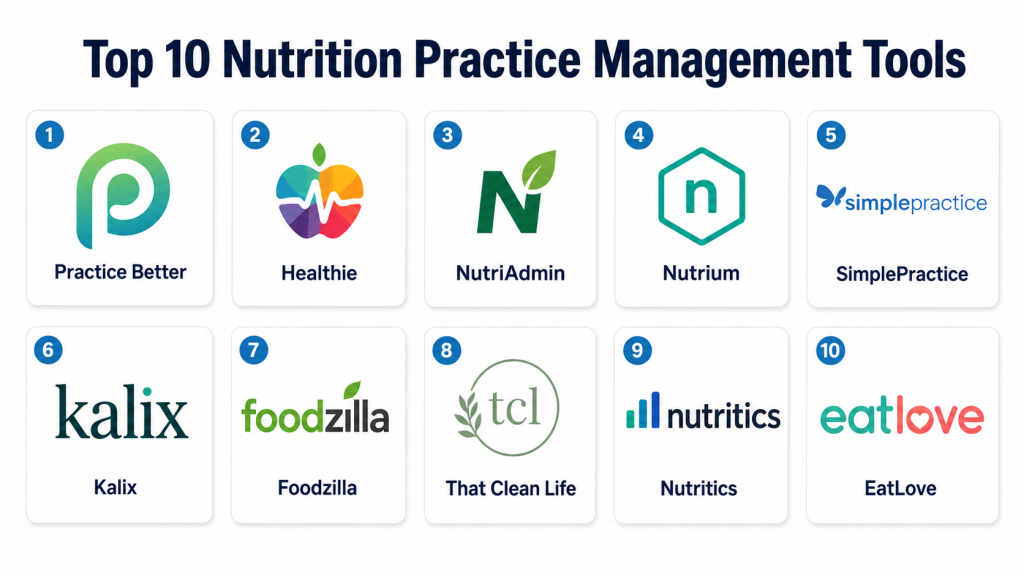
Top 10 Nutrition Practice Management Tools
#1 — Practice Better
Short description:
Practice Better is an all-in-one practice management platform designed for wellness professionals, including dietitians, nutritionists, health coaches, and functional health practitioners. It helps manage client records, scheduling, forms, packages, payments, telehealth, messaging, and program delivery. The platform is especially useful for practitioners who sell structured programs, memberships, or coaching packages.
Key Features
- Client records and wellness-focused practice management
- Appointment scheduling and automated reminders
- Intake forms, waivers, questionnaires, and charting workflows
- Package, program, and membership management
- Telehealth and client communication tools
- Payments, invoices, and billing workflow support
- Client portal and mobile-friendly experience
Pros
- Strong all-in-one workflow for wellness and nutrition businesses
- Useful for scaling programs, packages, and memberships
- Good balance of client experience and practitioner automation
Cons
- May feel feature-heavy for very small practices
- Advanced setup can take time
- Some deep clinical nutrition analysis may require companion tools
Platforms / Deployment
Web / iOS / Android
Cloud
Security & Compliance
Not publicly stated
Integrations & Ecosystem
Practice Better works well for practitioners who need connected scheduling, payments, communication, forms, and program delivery. Its ecosystem is built around client management and wellness business operations rather than only meal planning.
- Calendar workflows
- Payment workflow support
- Telehealth workflow support
- Client forms and document workflows
- Program and package delivery tools
- Communication and reminder workflows
Support & Community
Practice Better offers support resources, onboarding guidance, and documentation for solo practitioners and growing wellness teams. It has strong recognition among health coaches, nutrition professionals, and wellness businesses.
#2 — Healthie
Short description:
Healthie is a practice management and client engagement platform used by nutrition, wellness, and virtual care teams. It supports scheduling, client records, charting, billing, forms, telehealth, secure messaging, and care coordination. Healthie is especially useful for providers that need a more healthcare-style workflow with team support. It can serve solo professionals, group practices, and digital health organizations.
Key Features
- Client records and charting workflows
- Scheduling, calendar management, and reminders
- Telehealth and secure communication tools
- Billing, payments, packages, and invoicing
- Intake forms and client onboarding
- Team and provider workflow support
- Client portal and mobile app experience
Pros
- Strong fit for nutrition teams and virtual care models
- Good balance of administration and client engagement
- Suitable for scaling beyond a solo practice
Cons
- Setup may take time for complex practices
- May be more than needed for basic coaching businesses
- Advanced workflows may require careful configuration
Platforms / Deployment
Web / iOS / Android
Cloud
Security & Compliance
Not publicly stated
Integrations & Ecosystem
Healthie supports connected practice workflows where appointments, records, communication, billing, and telehealth work together. It is useful for teams that want to standardize nutrition care delivery.
- Calendar workflows
- Payment and billing workflows
- Telehealth tools
- Forms and document management
- Team-based client management
- Client app and engagement tools
Support & Community
Healthie provides support, help resources, and onboarding guidance for individual providers and teams. It is commonly used by health and wellness practices that need structured client care workflows.
#3 — NutriAdmin
Short description:
NutriAdmin is a nutrition-focused practice management tool designed for dietitians, nutritionists, and wellness professionals. It helps manage client records, meal planning, questionnaires, reports, and administrative workflows. The platform is useful for practitioners who want practical nutrition planning features along with client management. NutriAdmin supports recipe and meal plan creation, which makes it helpful for professionals who regularly provide food-based guidance.
Key Features
- Client profile and record management
- Meal planning and recipe tools
- Nutrition questionnaires and intake forms
- Client report generation
- Appointment and admin workflow support
- Templates for repeated nutrition workflows
- Food and nutrition planning support
Pros
- Strong nutrition-specific workflow
- Helpful for meal planning and client reporting
- Practical choice for solo dietitians and nutritionists
Cons
- May not be as broad as larger all-in-one platforms
- Team management may be limited compared with enterprise tools
- Interface preferences may vary by user
Platforms / Deployment
Web
Cloud
Security & Compliance
Not publicly stated
Integrations & Ecosystem
NutriAdmin focuses on nutrition practice workflows, meal planning, and client documentation. It is useful when the main priority is creating structured plans, reports, and nutrition-focused client materials.
- Client records
- Meal planning workflows
- Nutrition questionnaires
- Report templates
- Practice administration tools
- Exportable client materials
Support & Community
NutriAdmin offers support resources and guidance for practitioners using the platform for nutrition planning and client management. Community strength may vary by region and practice type.
#4 — Nutrium
Short description:
Nutrium is a nutrition software platform designed for dietitians and nutrition professionals who need meal planning, client tracking, and practice management capabilities. It supports nutrition analysis, client communication, meal plans, appointments, and client engagement tools. Nutrium is especially useful for practitioners who prioritize clinical nutrition planning and ongoing client progress tracking. It helps professionals deliver personalized plans and monitor adherence over time.
Key Features
- Meal planning and nutrition analysis
- Client progress tracking
- Food diary and nutrition monitoring
- Appointment and practice management support
- Client communication tools
- Personalized plan creation
- Client app experience
Pros
- Strong nutrition-specific functionality
- Good for personalized meal plans and progress tracking
- Useful client engagement features
Cons
- May not be ideal for non-nutrition wellness businesses
- Administrative workflows may be less broad than all-in-one platforms
- Advanced business automation may vary by plan
Platforms / Deployment
Web / iOS / Android
Cloud
Security & Compliance
Not publicly stated
Integrations & Ecosystem
Nutrium is built around nutrition planning and client engagement. It supports workflows where practitioners create plans, monitor progress, and communicate with clients regularly.
- Meal planning tools
- Client mobile app
- Food and progress tracking
- Appointment workflows
- Client communication
- Nutrition analysis features
Support & Community
Nutrium provides user support and learning resources for nutrition professionals. It has a recognizable presence among dietitians and nutritionists who need digital meal planning and client tracking.
#5 — SimplePractice
Short description:
SimplePractice is a broad practice management platform used by many health and wellness professionals, including dietitians and nutritionists. It offers scheduling, client records, billing, telehealth, intake forms, reminders, and client portal features. While it is not only nutrition-specific, it is useful for professionals who want a clean administrative system.
Key Features
- Appointment scheduling and calendar management
- Client records and documentation
- Telehealth support
- Billing, invoices, and payment workflows
- Intake forms and client portal
- Automated reminders
- Practice reporting tools
Pros
- Clean and easy-to-use interface
- Strong administrative workflow for private practices
- Good fit for solo and small group providers
Cons
- Not deeply nutrition-specific
- Meal planning may require separate tools
- Advanced nutrition analysis is limited compared with specialist platforms
Platforms / Deployment
Web / iOS / Android
Cloud
Security & Compliance
Not publicly stated
Integrations & Ecosystem
SimplePractice works well as an administrative hub for appointments, records, forms, billing, and client communication. Nutrition professionals may pair it with specialized meal planning software when needed.
- Calendar management
- Telehealth workflows
- Billing and payment support
- Client portal
- Intake forms
- Practice reporting
Support & Community
SimplePractice has a large user base and strong support resources for health and wellness professionals. It is widely recognized in private practice management.
#6 — Kalix
Short description:
Kalix is a practice management tool designed for dietitians, nutritionists, and health professionals who need client records, charting, forms, scheduling, billing, and telehealth workflows. It is often considered by practitioners who want an EHR-style system with nutrition-friendly features. Kalix supports client management, care notes, templates, and practice administration. It is useful for professionals who want practical tools without a large enterprise system.
Key Features
- Client charting and records
- Scheduling and appointment management
- Forms, templates, and documentation workflows
- Billing and invoicing support
- Telehealth and client communication
- Nutrition-focused client tracking
- Practice management tools
Pros
- Practical fit for dietitians and nutrition professionals
- Useful charting and documentation features
- Can be cost-effective for smaller practices
Cons
- Interface may not feel as modern as some newer tools
- Advanced automation may be limited compared with larger platforms
- Ecosystem may be smaller than leading all-in-one tools
Platforms / Deployment
Web
Cloud
Security & Compliance
Not publicly stated
Integrations & Ecosystem
Kalix focuses on client records, documentation, and nutrition practice workflows. It is suitable for users who need organized client management and professional charting.
- Scheduling tools
- Client files and records
- Forms and templates
- Billing workflows
- Telehealth support
- Nutrition tracking workflows
Support & Community
Kalix provides support resources for practitioners using the system for clinical and wellness practice management. Community strength may vary depending on market and region.
#7 — Foodzilla
Short description:
Foodzilla is a nutrition coaching and diet planning platform designed to help professionals manage clients, food tracking, and personalized nutrition guidance. It is useful for dietitians, coaches, and wellness professionals who want modern client engagement features. The platform focuses on food logging, nutrition insights, and client communication. It can help practitioners monitor client habits and provide feedback more efficiently.
Key Features
- Food logging and client tracking
- Nutrition coaching workflows
- Client communication tools
- Meal and diet planning support
- Progress tracking
- Client engagement tools
- Digital nutrition insights
Pros
- Strong client engagement experience
- Useful for ongoing nutrition coaching
- Modern approach to food tracking and feedback
Cons
- May not replace a full practice management system for every user
- Administrative depth may be limited compared with all-in-one platforms
- Best fit depends on coaching style
Platforms / Deployment
Web / iOS / Android
Cloud
Security & Compliance
Not publicly stated
Integrations & Ecosystem
Foodzilla is built around food tracking, client engagement, and nutrition coaching. It can be useful alongside broader practice management tools if advanced admin workflows are needed.
- Food logging tools
- Client tracking
- Nutrition planning support
- Coaching workflows
- Mobile engagement
- Progress monitoring
Support & Community
Foodzilla provides support resources for nutrition professionals using the platform for digital coaching. Community presence is growing among modern nutrition and wellness practitioners.
#8 — That Clean Life
Short description:
That Clean Life is a meal planning and nutrition content platform designed for nutrition professionals, health coaches, and wellness practitioners. It is especially strong for creating meal plans, recipes, grocery lists, and nutrition resources for clients. The platform is not a full traditional practice management system, but it works well for professionals who need polished food-first planning tools. It helps practitioners save time by using reusable templates and recipe collections.
Key Features
- Meal plan creation
- Recipe library and customization
- Grocery list generation
- Client-ready nutrition resources
- Templates for repeat workflows
- Food-first client planning
- Brand-friendly plan delivery
Pros
- Excellent for meal planning and recipe-based services
- Saves time with templates and reusable content
- Professional client-facing outputs
Cons
- Not a complete practice management platform
- Limited clinical charting and billing features
- May require another tool for scheduling and client records
Platforms / Deployment
Web
Cloud
Security & Compliance
Not publicly stated
Integrations & Ecosystem
That Clean Life is best used as a meal planning and nutrition content engine. It can complement broader practice tools by handling recipes, grocery lists, and client-ready plans.
- Meal planning workflows
- Recipe customization
- Grocery list generation
- Client handouts
- Template-based plan creation
- Nutrition content delivery
Support & Community
That Clean Life has helpful resources for practitioners focused on meal planning and nutrition content. It is popular among coaches and dietitians who want professional-looking client materials.
#9 — Nutritics
Short description:
Nutritics is a nutrition analysis and food data platform used by dietitians, sports nutrition professionals, food service teams, and health organizations. It is known for detailed nutrition analysis, recipe analysis, menu planning, and food data management. Nutritics is especially useful where accuracy, food data, and advanced nutrition reporting matter. It can support professionals working in clinical, sports, wellness, and institutional settings. The platform is more data-heavy than basic practice management tools.
Key Features
- Detailed nutrition analysis
- Recipe and menu analysis
- Food database tools
- Diet and meal planning support
- Reporting and professional outputs
- Sports and clinical nutrition workflows
- Food service and institutional use cases
Pros
- Strong nutrition data and analysis capabilities
- Useful for advanced dietitians and sports nutrition teams
- Suitable for professional and institutional environments
Cons
- May feel complex for simple coaching practices
- Not primarily focused on basic admin workflows
- Pricing and setup may be less suitable for beginners
Platforms / Deployment
Web / iOS / Android
Cloud
Security & Compliance
Not publicly stated
Integrations & Ecosystem
Nutritics is built around nutrition data, analysis, and reporting. It fits well in workflows where precise nutrient information and professional outputs are important.
- Food database tools
- Recipe analysis
- Menu planning
- Nutrition reporting
- Diet analysis
- Professional nutrition workflows
Support & Community
Nutritics provides support and resources for professional nutrition users. It is well suited for users who need detailed nutrition data and advanced analysis workflows.
#10 — EatLove
Short description:
EatLove is a nutrition planning and meal guidance platform designed to help professionals provide personalized meal recommendations and client nutrition support. It focuses on connecting nutrition guidance with practical food choices, recipes, and planning. EatLove can be useful for dietitians, wellness programs, and healthcare-aligned nutrition services. It helps clients follow recommendations through meal plans and structured food guidance.
Key Features
- Personalized meal planning
- Recipe and food recommendation workflows
- Client nutrition guidance
- Dietary preference support
- Goal-based plan creation
- Practical food and grocery support
- Client engagement tools
Pros
- Strong focus on practical meal adherence
- Useful for personalized nutrition programs
- Helps connect recommendations with daily food choices
Cons
- May not cover every practice management need
- Advanced billing or charting may require another tool
- Best fit depends on client service model
Platforms / Deployment
Web / iOS / Android
Cloud
Security & Compliance
Not publicly stated
Integrations & Ecosystem
EatLove focuses on meal guidance, nutrition recommendations, and client adherence. It can be useful for practices that want food plans to feel practical and actionable.
- Meal planning workflows
- Recipe guidance
- Client engagement
- Dietary preference support
- Nutrition recommendation tools
- Grocery-oriented planning support
Support & Community
EatLove offers support resources for professionals using the platform for personalized meal planning and nutrition guidance. Community visibility may vary by practice type and region.
Comparison Table
| Tool Name | Best For | Platform Supported | Deployment | Standout Feature | Public Rating |
|---|---|---|---|---|---|
| Practice Better | Wellness practices and programs | Web, iOS, Android | Cloud | All-in-one practice and program management | N/A |
| Healthie | Nutrition teams and virtual care | Web, iOS, Android | Cloud | Client engagement and care workflows | N/A |
| NutriAdmin | Solo dietitians and nutritionists | Web | Cloud | Meal planning and client reports | N/A |
| Nutrium | Nutrition planning and client tracking | Web, iOS, Android | Cloud | Nutrition analysis and client app | N/A |
| SimplePractice | Private practice administration | Web, iOS, Android | Cloud | Scheduling, billing, and telehealth | N/A |
| Kalix | Dietitian charting and documentation | Web | Cloud | EHR-style nutrition workflows | N/A |
| Foodzilla | Digital nutrition coaching | Web, iOS, Android | Cloud | Food tracking and client engagement | N/A |
| That Clean Life | Meal planning and recipes | Web | Cloud | Recipe library and grocery lists | N/A |
| Nutritics | Advanced nutrition analysis | Web, iOS, Android | Cloud | Detailed food and nutrient data | N/A |
| EatLove | Personalized meal guidance | Web, iOS, Android | Cloud | Practical meal recommendations | N/A |
Evaluation & Scoring of Nutrition Practice Management Tools
| Tool Name | Core | Ease | Integrations | Security | Performance | Support | Value | Weighted Total |
|---|---|---|---|---|---|---|---|---|
| Practice Better | 9 | 8 | 8 | 7 | 8 | 8 | 8 | 8.2 |
| Healthie | 9 | 7 | 8 | 7 | 8 | 8 | 7 | 7.9 |
| NutriAdmin | 8 | 8 | 6 | 6 | 7 | 7 | 8 | 7.4 |
| Nutrium | 8 | 8 | 7 | 6 | 8 | 7 | 8 | 7.6 |
| SimplePractice | 7 | 9 | 7 | 7 | 8 | 8 | 8 | 7.8 |
| Kalix | 7 | 7 | 6 | 6 | 7 | 7 | 8 | 7.0 |
| Foodzilla | 7 | 8 | 6 | 6 | 7 | 7 | 8 | 7.2 |
| That Clean Life | 7 | 9 | 6 | 6 | 8 | 8 | 8 | 7.5 |
| Nutritics | 9 | 6 | 7 | 6 | 8 | 7 | 6 | 7.2 |
| EatLove | 7 | 8 | 7 | 6 | 7 | 7 | 7 | 7.1 |
How to interpret the scores:
These scores are comparative and based on practical buyer criteria, not official public ratings. A higher score means the tool performs strongly across the full mix of practice management, usability, integrations, support, and value. Some tools score higher because they are broader all-in-one platforms, while others are stronger in specialized areas like meal planning or nutrition analysis. A lower total does not mean the tool is weak; it may simply be more focused. Buyers should prioritize the criteria that match their business model and client workflow.
Which Nutrition Practice Management Tool Is Right for You?
Solo / Freelancer
Solo dietitians, nutritionists, and health coaches should look for tools that are easy to set up, affordable, and simple for clients to use. Practice Better, NutriAdmin, SimplePractice, and Kalix are practical choices depending on whether you need coaching programs, meal planning, admin workflows, or charting. If your work is mostly meal plans and recipes, That Clean Life may be enough as a focused planning tool. If your main need is client booking, forms, and payments, SimplePractice or Practice Better may be better.
SMB
Small and medium nutrition practices need better workflow structure, repeatable client processes, and professional communication tools. Practice Better and Healthie are strong options for practices managing multiple clients, packages, and ongoing programs. Nutrium is a good fit if nutrition analysis and client tracking are central. SimplePractice can work well for teams that prioritize scheduling, documentation, and telehealth. SMB buyers should focus on onboarding, team permissions, billing workflows, and client app experience.
Mid-Market
Mid-market wellness businesses, multi-practitioner clinics, and hybrid care teams need stronger scalability, reporting, and standardized workflows. Healthie and Practice Better are good options when the practice needs team-based client management and consistent service delivery. Nutritics may be suitable for organizations that require advanced nutrition analysis, food data, or institutional planning. Mid-market buyers should evaluate admin controls, client segmentation, provider workflows, and integration flexibility before committing.
Enterprise
Enterprise nutrition programs, healthcare organizations, sports teams, and corporate wellness providers often need configurable workflows, reporting, privacy controls, and support for multiple stakeholders. Healthie, Nutritics, and selected advanced nutrition platforms may be better suited for complex environments. Enterprise buyers should avoid choosing based only on the practitioner interface. They should validate onboarding, data access, integrations, reporting, compliance expectations, and long-term support.
Budget vs Premium
Budget-conscious practitioners should start with tools that cover essential scheduling, client records, forms, and meal planning without adding unnecessary complexity. Kalix, NutriAdmin, and That Clean Life can be useful depending on the workflow. Premium tools like Practice Better and Healthie offer broader automation, client experience, and scaling features. The best value depends on whether the platform saves enough admin time, improves client retention, or enables higher-value packages.
Feature Depth vs Ease of Use
Feature-rich platforms are powerful but may require more setup and training. Practice Better and Healthie offer broad workflows, but users should configure them carefully to avoid clutter. Simpler tools like That Clean Life, NutriAdmin, or SimplePractice may be easier for smaller practices. If clients struggle with technology, ease of use should be a top priority. If the practice has complex programs, deeper features may be worth the learning curve.
Integrations & Scalability
Nutrition practices should consider how the tool connects with calendars, payment systems, telehealth, wearable data, email tools, and client communication workflows. A platform that works for a small client base should also support growth if the business expands. For larger teams, integrations and scalability matter more than small differences in interface design. Choose a system that can grow with your services, team size, and client volume.
Security & Compliance Needs
Nutrition professionals often collect sensitive health and lifestyle information, so security should be taken seriously. Look for role-based access, secure communication, data protection, and clear privacy controls. If you work in regulated healthcare or provide medical nutrition therapy, compliance requirements should be validated directly with the vendor. Do not assume a platform meets your legal obligations unless the vendor clearly confirms it. Security should be reviewed before migrating client data.
Frequently Asked Questions
1. What are Nutrition Practice Management Tools?
Nutrition Practice Management Tools help dietitians, nutritionists, and wellness professionals manage clients, appointments, notes, meal plans, billing, and communication. They reduce the need for separate spreadsheets, email threads, payment tools, and manual forms. Most platforms include scheduling, client records, reminders, and progress tracking.
2. How much do Nutrition Practice Management Tools cost?
Pricing usually depends on the number of users, clients, features, and practice size.
Solo practitioners may need a lower-cost plan, while larger teams often require advanced plans. Some platforms charge monthly subscriptions, while others may offer tiered packages. Additional costs can include payment processing, telehealth, onboarding, or premium features.
3. Are these tools useful for solo dietitians?
Yes, solo dietitians can benefit greatly from practice management tools. They help reduce repetitive admin tasks such as scheduling, reminders, forms, and invoices. They also create a more professional client experience through portals and structured workflows. For solo users, ease of setup and affordability are usually more important than enterprise features.
4. Which tool is best for meal planning?
Nutrium, NutriAdmin, That Clean Life, Nutritics, and EatLove are strong options for meal planning workflows. That Clean Life is especially useful for recipe-based plans and grocery lists. Nutrium and NutriAdmin provide nutrition-focused planning and client support. Nutritics is better for advanced nutrient analysis and detailed food data.
5. Which tool is best for coaching programs?
Practice Better is a strong choice for coaching programs, packages, memberships, and structured client journeys. Healthie can also work well for teams offering remote nutrition care and client engagement.
Foodzilla may suit practitioners who focus heavily on food logging and ongoing coaching feedback.
For group programs, look for automation, client tasks, reminders, messaging, and content delivery features.
6. Can these tools support telehealth?
Many nutrition practice management tools include telehealth or support remote consultation workflows.
Telehealth is useful for dietitians and nutrition coaches serving clients across different locations. When evaluating telehealth, check video quality, appointment reminders, client access, and documentation flow.
7. Are Nutrition Practice Management Tools secure?
Most professional platforms include some level of security, but features vary by vendor and plan. Buyers should look for secure login, access controls, data protection, backups, and clear privacy policies. If handling sensitive health data, security should be reviewed before storing client information.
8. Can I switch from spreadsheets to a nutrition platform easily?
Yes, but switching requires planning to avoid data loss and workflow confusion. Start by organizing your client records, forms, meal templates, payment workflows, and appointment history. Import only clean and necessary data rather than moving every old file into the new system. Run a small pilot with a few clients before fully migrating your practice.
9. What common mistakes should buyers avoid?
A common mistake is choosing a tool only because it looks popular or has a low price. Another mistake is ignoring the client experience, especially if clients must use an app or portal. Some practitioners buy a feature-heavy platform but never configure it properly.
10. Do these tools replace EHR systems?
Some nutrition practice management tools include EHR-style features like charting, records, forms, and documentation. However, not every tool is suitable as a full clinical EHR replacement. If you provide medical nutrition therapy or work in regulated healthcare, confirm requirements carefully. Tools like Healthie, Kalix, and SimplePractice may support healthcare-style workflows, while others focus more on meal planning.
Conclusion
Nutrition Practice Management Tools help practitioners move from scattered admin work to organized, professional, and scalable client care. The right platform can support scheduling, intake, client records, telehealth, billing, meal planning, food tracking, and progress monitoring in one connected workflow. Practice Better and Healthie are strong all-in-one options, Nutrium and NutriAdmin are useful for nutrition-specific planning, SimplePractice is strong for private practice administration, and tools like That Clean Life, Nutritics, Foodzilla, and EatLove are valuable for more specialized nutrition workflows. The best choice depends on your service model, client volume, budget, and whether you need deep nutrition analysis or broader practice management.
Before choosing a platform, shortlist two or three tools that match your workflow and test them with real client scenarios. Run a small pilot using your actual intake forms, appointment process, meal planning needs, billing flow, and client communication style. Then verify security expectations, client experience, integrations, and long-term scalability before moving your full practice into the system. A well-chosen nutrition practice management tool should save time, improve client consistency, and give your business a stronger foundation for growth.
