Introduction
Function-as-a-Service (FaaS) is a cloud computing model that allows developers to deploy individual functions or code snippets without managing servers. This serverless approach abstracts infrastructure, enabling companies to focus on application logic and scalability. FaaS is valuable for dynamic workloads, event-driven applications, and microservices architectures.
FaaS adoption continues to grow as enterprises seek agile, cost-effective, and automated solutions. Its integration with AI, edge computing, and hybrid cloud environments has made it a core component of modern IT strategies. Real-world use cases include running microservices triggered by events, automating back-end processes for e-commerce, managing dynamic content generation for websites and mobile apps, real-time data processing in IoT and sensor networks, and orchestrating AI or ML workloads.
When evaluating FaaS tools, buyers should consider scalability and performance, ease of deployment and monitoring, integration with other cloud services, security and compliance, pricing models, event triggers and workflow support, support and community resources, language and framework support, customization and extensibility, and reliability and SLAs.
Best for: Developers, IT teams, SaaS companies, startups, and enterprises requiring scalable, event-driven workloads.
Not ideal for: Organizations with static, monolithic applications or those requiring full control over server infrastructure. Traditional PaaS or IaaS may be better in such cases.
Key Trends in Function-as-a-Service (FaaS)
- Integration with AI and ML pipelines for automated decision-making
- Edge FaaS deployment for low-latency workloads and IoT processing
- Enhanced security with zero-trust models and automated compliance checks
- Multi-cloud interoperability to prevent vendor lock-in
- Pay-per-execution pricing and granular cost optimization
- Event-driven orchestration tools for complex workflows
- Native support for containerized workloads and hybrid serverless
- Improved monitoring, observability, and real-time logging
- Low-code and no-code function orchestration for business users
- Support for multiple programming languages and polyglot environments
How We Selected These Tools
- Analyzed market adoption and popularity across enterprise and developer communities
- Evaluated feature completeness, including triggers, scaling, and observability
- Measured performance and reliability via reported SLAs
- Assessed security posture, certifications, and compliance capabilities
- Reviewed integrations and ecosystem including APIs and third-party connectors
- Considered customer fit across solo developers, SMBs, mid-market, and enterprise
- Compared pricing transparency and cost flexibility
- Examined support and community strength for onboarding and troubleshooting
- Verified platform coverage, deployment options, and ease of use
- Balanced open-source and proprietary solutions for flexibility
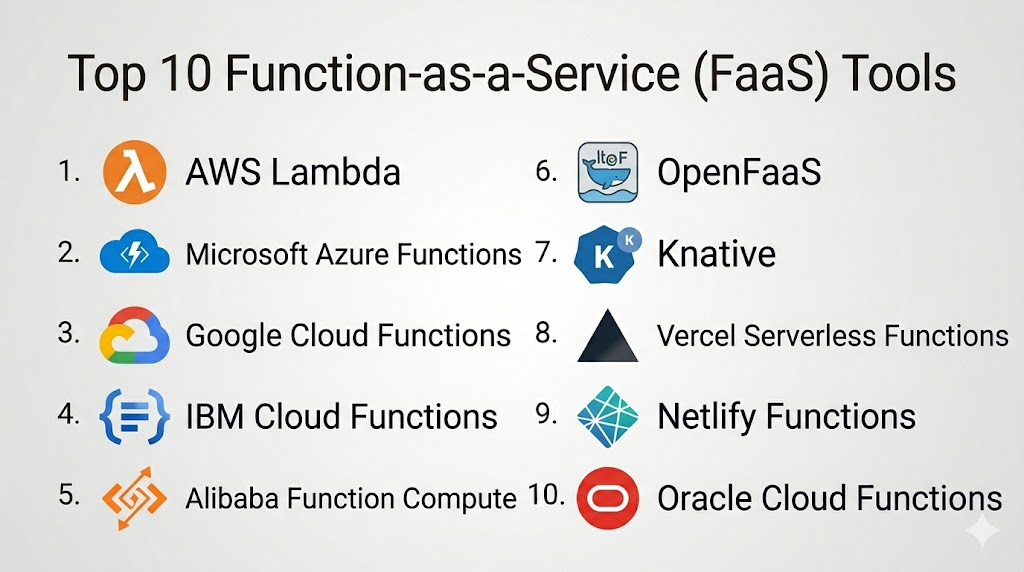
Top 10 Function-as-a-Service (FaaS) Tools
#1 — AWS Lambda
Short description: AWS Lambda allows developers to run code in response to events without managing servers. Ideal for enterprises and startups leveraging the AWS ecosystem.
Key Features
- Event-driven execution from AWS services
- Automatic scaling based on request volume
- Integrated monitoring with Amazon CloudWatch
- Supports multiple languages: Python, Node.js, Java, C#
- Layer support for packaging dependencies
- VPC integration for secure network access
- Flexible timeout and memory allocation
Pros
- Deep AWS ecosystem integration
- Reliable and scalable
- Supports complex workflows with Step Functions
Cons
- Cost can increase with high-frequency workloads
- Limited control over runtime environment
Platforms / Deployment
- Web / Windows / macOS / Linux
- Cloud
Security & Compliance
- SSO/SAML, MFA, encryption
- SOC 2, ISO 27001, GDPR, HIPAA
Integrations & Ecosystem
AWS Lambda integrates with the broader AWS ecosystem.
- Amazon S3
- DynamoDB
- API Gateway
- EventBridge
- CloudFormation
Support & Community
Extensive AWS documentation, multiple support tiers, and a large community
#2 — Microsoft Azure Functions
Short description: Azure Functions enables serverless compute in the Microsoft ecosystem. Ideal for .NET developers and hybrid cloud scenarios.
Key Features
- Event-driven architecture
- Supports multiple languages: C#, JavaScript, Python
- Durable Functions for stateful workflows
- Integrated monitoring and logging
- Deployment via Visual Studio and CI/CD
- Supports Kubernetes and containerized deployments
Pros
- Strong enterprise and hybrid support
- Good developer tooling
- Integration with Azure DevOps and services
Cons
- Learning curve for non-Microsoft users
- Cold start latency for infrequent executions
Platforms / Deployment
- Web / Windows / macOS / Linux
- Cloud / Hybrid
Security & Compliance
- SSO/SAML, MFA, encryption
- SOC 2, ISO 27001, GDPR, HIPAA
Integrations & Ecosystem
- Azure Event Grid, Service Bus
- Azure Storage, CosmosDB
- Logic Apps, Power Platform
Support & Community
Strong documentation, active enterprise community, professional support tiers
#3 — Google Cloud Functions
Short description: Google Cloud Functions is a lightweight serverless compute platform for event-driven workloads, best for organizations leveraging GCP.
Key Features
- Event-driven from GCP services
- Supports Node.js, Python, Go
- Auto-scaling based on demand
- Stackdriver monitoring
- Cloud Pub/Sub and Storage triggers
- Easy deployment via CLI and console
Pros
- Seamless integration with GCP ecosystem
- Quick deployment and scaling
- Ideal for microservices and real-time data
Cons
- Limited runtime control
- Not ideal for non-GCP users
Platforms / Deployment
- Web / Windows / macOS / Linux
- Cloud
Security & Compliance
- SSO/SAML, MFA, encryption
- Not publicly stated
Integrations & Ecosystem
- Cloud Pub/Sub
- Firebase
- BigQuery
- Cloud Storage
Support & Community
Varies / Not publicly stated
#4 — IBM Cloud Functions
Short description: Based on Apache OpenWhisk, IBM Cloud Functions provides flexible serverless options, suited for enterprise-grade, multi-cloud applications.
Key Features
- OpenWhisk foundation for flexibility
- Event-driven and API-triggered execution
- Supports multiple languages
- Integrated monitoring and logging
- Hybrid deployment capability
- Auto-scaling and concurrency controls
Pros
- Open-source foundation
- Good enterprise support
- Supports hybrid and multi-cloud
Cons
- Smaller community than AWS/Azure
- UI and CLI learning curve
Platforms / Deployment
- Web / Windows / macOS / Linux
- Cloud / Hybrid
Security & Compliance
Not publicly stated
Integrations & Ecosystem
- IBM Cloud services
- Cloudant, Watson AI
- API Gateway, Event Streams
Support & Community
Enterprise-level support, limited community forums
#5 — Alibaba Function Compute
Short description: Function Compute offers serverless execution in Alibaba Cloud, ideal for APAC-focused businesses and global workloads.
Key Features
- Event-driven scaling
- Supports multiple languages
- Integrated logging and monitoring
- API Gateway integration
- Pay-per-use pricing
- Auto-scaling based on demand
Pros
- Strong regional support in APAC
- Competitive pricing
- Enterprise integrations
Cons
- Smaller global community
- Limited learning resources
Platforms / Deployment
- Web / Windows / macOS / Linux
- Cloud
Security & Compliance
Not publicly stated
Integrations & Ecosystem
- Alibaba Cloud OSS
- MQ, API Gateway
- Function orchestration
Support & Community
Varies / Not publicly stated
#6 — OpenFaaS
Short description: Open-source FaaS framework enabling serverless workloads on any cloud or on-premises Kubernetes cluster.
Key Features
- Kubernetes-native
- Supports multiple languages
- Auto-scaling and load balancing
- Web UI and CLI
- Community-contributed templates
- Prometheus monitoring integration
Pros
- Vendor-neutral and flexible
- Strong open-source community
- Easy deployment on Kubernetes
Cons
- Requires Kubernetes expertise
- Enterprise support not included by default
Platforms / Deployment
- Web / Windows / macOS / Linux
- Self-hosted / Cloud / Hybrid
Security & Compliance
Not publicly stated
Integrations & Ecosystem
- Kubernetes
- Prometheus
- Grafana
- CI/CD pipelines
Support & Community
Strong open-source community, varies / Not publicly stated
#7 — Knative
Short description: Kubernetes-based FaaS platform allowing developers to run serverless workloads on cloud or on-premises environments.
Key Features
- Kubernetes-native
- Event-driven architecture
- Supports multiple languages
- Auto-scaling and scaling-to-zero
- Integrated logging and monitoring
- CI/CD and GitOps support
Pros
- Flexibility for hybrid cloud
- Strong Kubernetes integration
- Open-source extensibility
Cons
- Requires Kubernetes expertise
- Setup complexity
Platforms / Deployment
- Web / Windows / macOS / Linux
- Self-hosted / Cloud / Hybrid
Security & Compliance
Not publicly stated
Integrations & Ecosystem
- Knative Eventing
- Tekton pipelines
- Prometheus and Grafana
Support & Community
Active open-source community, varies / Not publicly stated
#8 — Vercel Serverless Functions
Short description: Vercel offers FaaS for front-end developers and Jamstack applications, enabling rapid deployment of API endpoints and serverless backends.
Key Features
- Deploy functions with frontend code
- Supports Node.js, Go, Python
- Auto-scaling and zero configuration
- Integration with Git workflows
- Built-in analytics and logging
Pros
- Ideal for front-end developers
- Rapid deployment
- Minimal configuration required
Cons
- Limited backend capabilities
- Not suitable for high-compute workloads
Platforms / Deployment
- Web / Windows / macOS / Linux
- Cloud
Security & Compliance
Not publicly stated
Integrations & Ecosystem
- GitHub, GitLab
- Frontend frameworks
- CDN integration
Support & Community
Documentation and forums, varies / Not publicly stated
#9 — Netlify Functions
Short description: Serverless function hosting for developers building static sites or Jamstack applications.
Key Features
- Node.js and Go support
- Event-driven endpoints
- Auto-scaling
- Integrated with build/deploy pipeline
- Logging and monitoring
Pros
- Easy deployment for frontend apps
- Integrates with static site generators
- Simplifies backend API development
Cons
- Limited to certain languages
- Less suitable for complex backends
Platforms / Deployment
- Web / Windows / macOS / Linux
- Cloud
Security & Compliance
Not publicly stated
Integrations & Ecosystem
- GitHub, GitLab
- CMS integrations
- Edge functions
Support & Community
Developer documentation, active community
#10 — Oracle Cloud Functions
Short description: Serverless platform integrated with Oracle Cloud Infrastructure, ideal for enterprise workloads.
Key Features
- Event-driven execution
- Supports multiple languages
- Integration with OCI services
- Auto-scaling
- CI/CD pipeline support
- Observability and logging
Pros
- Enterprise-focused
- OCI ecosystem integration
- High performance and scalability
Cons
- Limited outside Oracle ecosystem
- Learning curve for new users
Platforms / Deployment
- Web / Windows / macOS / Linux
- Cloud
Security & Compliance
- SSO/SAML, encryption
- Not publicly stated
Integrations & Ecosystem
- Oracle Database, Object Storage
- API Gateway
- Event Service
Support & Community
Oracle documentation, enterprise support tiers
Comparison Table (Top 10)
| Tool Name | Best For | Platform(s) Supported | Deployment | Standout Feature | Public Rating |
|---|---|---|---|---|---|
| AWS Lambda | Enterprises, startups | Web / Windows / macOS / Linux | Cloud | Event-driven scaling | N/A |
| Azure Functions | .NET developers, hybrid | Web / Windows / macOS / Linux | Cloud / Hybrid | Durable Functions | N/A |
| Google Cloud Functions | GCP users | Web / Windows / macOS / Linux | Cloud | GCP-native integrations | N/A |
| IBM Cloud Functions | Enterprise multi-cloud | Web / Windows / macOS / Linux | Cloud / Hybrid | OpenWhisk foundation | N/A |
| Alibaba Function Compute | APAC-focused businesses | Web / Windows / macOS / Linux | Cloud | Regional enterprise support | N/A |
| OpenFaaS | Kubernetes developers | Web / Windows / macOS / Linux | Self-hosted / Hybrid / Cloud | Vendor-neutral flexibility | N/A |
| Knative | Hybrid cloud users | Web / Windows / macOS / Linux | Self-hosted / Hybrid / Cloud | Kubernetes-native serverless | N/A |
| Vercel Serverless Functions | Frontend developers | Web / Windows / macOS / Linux | Cloud | Rapid frontend deployment | N/A |
| Netlify Functions | Jamstack developers | Web / Windows / macOS / Linux | Cloud | Static site backend | N/A |
| Oracle Cloud Functions | Enterprise users | Web / Windows / macOS / Linux | Cloud | OCI ecosystem integration | N/A |
Evaluation & Scoring of Function-as-a-Service (FaaS)
| Tool Name | Core (25%) | Ease (15%) | Integrations (15%) | Security (10%) | Performance (10%) | Support (10%) | Value (15%) | Weighted Total (0–10) |
|---|---|---|---|---|---|---|---|---|
| AWS Lambda | 9 | 8 | 9 | 9 | 9 | 8 | 8 | 8.85 |
| Azure Functions | 8 | 7 | 8 | 8 | 8 | 7 | 8 | 7.85 |
| Google Cloud Functions | 8 | 8 | 7 | 8 | 8 | 7 | 7 | 7.70 |
| IBM Cloud Functions | 7 | 7 | 7 | 7 | 7 | 7 | 7 | 7.00 |
| Alibaba Function Compute | 7 | 6 | 6 | 6 | 7 | 6 | 7 | 6.65 |
| OpenFaaS | 8 | 7 | 8 | 6 | 7 | 6 | 8 | 7.45 |
| Knative | 8 | 6 | 8 | 6 | 7 | 6 | 8 | 7.35 |
| Vercel Serverless Functions | 7 | 9 | 7 | 6 | 7 | 6 | 7 | 7.35 |
| Netlify Functions | 7 | 9 | 6 | 6 | 7 | 6 | 7 | 7.10 |
| Oracle Cloud Functions | 7 | 6 | 7 | 7 | 8 | 7 | 7 | 7.25 |
Scores indicate relative performance. Higher totals suggest stronger overall capability, but the ideal tool depends on workflow, integration needs, and company size.
Which Function-as-a-Service (FaaS) Tool Is Right for You?
Solo / Freelancer
Use lightweight and easy-to-deploy platforms like Vercel or Netlify Functions for small APIs or front-end projects.
SMB
Prioritize cost-efficiency, scalability, and integrations. AWS Lambda or Azure Functions provide enterprise-grade features with flexible pricing.
Mid-Market
Select hybrid options and multi-cloud support. OpenFaaS or Knative allow vendor neutrality and complex orchestration.
Enterprise
Focus on enterprise-grade security, compliance, and integration. AWS Lambda, Azure Functions, and IBM Cloud Functions are ideal.
Budget vs Premium
Open-source tools like OpenFaaS and Knative suit smaller budgets. Premium platforms justify their cost with support, reliability, and integrations.
Feature Depth vs Ease of Use
High feature depth: AWS Lambda, Azure Functions
Ease of use: Vercel, Netlify Functions
Integrations & Scalability
Multi-cloud and hybrid options provide the most flexibility. Verify compatibility with existing services before selecting a platform.
Security & Compliance Needs
For enterprises with strict regulatory requirements, choose tools with SOC 2, ISO 27001, GDPR, or HIPAA certifications.
Frequently Asked Questions (FAQs)
1 What is the cost model for FaaS tools?
Most platforms charge per execution, memory usage, and execution time. Pay-as-you-go pricing reduces upfront costs.
2 How do I monitor FaaS performance?
Platforms include logging, metrics, and dashboards. Integrations with Prometheus, CloudWatch, or other monitoring tools enhance visibility.
3 Can FaaS handle high-frequency workloads?
Yes, but costs increase with volume. Platforms like AWS Lambda and Azure Functions handle millions of events with auto-scaling.
4 Are FaaS tools secure for sensitive data?
Security depends on configuration and platform. Look for encryption, MFA, audit logs, and compliance certifications.
5 Which programming languages do FaaS tools support?
Python, Node.js, Java, C#, Go, and Ruby are common. Open-source frameworks may support additional languages.
6 How do I deploy functions?
Deploy via CLI, console, CI/CD pipelines, or Git integration. Many platforms support automated pipelines and versioning.
7 Can FaaS replace backend APIs?
Yes, serverless functions can serve as backend APIs, handling request processing and integrating with databases.
8 How do FaaS tools scale?
Scaling is automatic, triggered by events or requests. Some platforms support scaling-to-zero for cost efficiency.
9 Are there open-source FaaS options?
Yes, OpenFaaS and Knative are widely used open-source solutions that offer flexibility and multi-cloud deployment.
10 Can FaaS work with hybrid cloud environments?
Yes, several FaaS platforms integrate with on-premises and multi-cloud environments, providing flexibility for enterprises.
Conclusion
Function-as-a-Service (FaaS) platforms provide agility, scalability, and cost efficiency for modern applications. Choosing the right tool depends on your organization’s size, tech stack, and workflow requirements. Solo developers and SMBs may favor Vercel, Netlify,
