Introduction
Serverless platforms allow developers to run code without managing servers or infrastructure. Functions automatically scale based on demand, reducing operational overhead and cost. This approach helps teams focus on building features and delivering value faster while simplifying deployment and maintenance.
Serverless platforms are widely adopted for:
- Building scalable web applications without manual server management
- Running event-driven workflows such as IoT or streaming data processing
- Automating backend tasks like image processing, database triggers, and notifications
- Hosting APIs with automatic scaling and authentication
- Orchestrating complex multi-cloud or hybrid cloud workflows efficiently
When choosing a serverless platform, buyers should evaluate:
- Performance and scalability
- Supported languages and frameworks
- Integration capabilities with cloud services and APIs
- Security and compliance certifications
- Pricing models and cost predictability
- Monitoring, logging, and debugging features
- Ease of deployment and operations
- Ecosystem support and community engagement
- Vendor lock-in and portability options
Best for: Developers, DevOps teams, IT managers, startups, SMBs, and enterprise teams seeking scalable compute for microservices, backend workflows, or event-driven applications.
Not ideal for: Organizations needing strict on-premises infrastructure control, low-latency workloads, or legacy system integrations without cloud adoption.
Key Trends in Serverless Platforms
- AI-powered serverless workflows for automation and predictive analytics
- Multi-cloud and hybrid deployments for portability and risk mitigation
- Event-driven architectures for streaming, IoT, and real-time analytics
- Enhanced security features including identity management, encryption, and audit logs
- Granular cost optimization with pay-per-execution models
- Expanded programming language and container support
- Built-in monitoring and observability for operational insight
- Vendor ecosystem partnerships for rapid integration with SaaS and PaaS
- Edge computing and low-latency function execution
- AI-assisted deployment and scaling recommendations
How We Selected These Tools
- Evaluated market adoption and enterprise mindshare
- Reviewed feature completeness for triggers, orchestration, and API management
- Analyzed reliability and performance under real-world loads
- Verified security posture and compliance standards
- Considered integrations with cloud services, SaaS tools, and APIs
- Assessed customer satisfaction and ease of use
- Balanced enterprise, SMB, and open-source solutions
- Focused on production scalability
- Ensured clear pricing and cost management tools
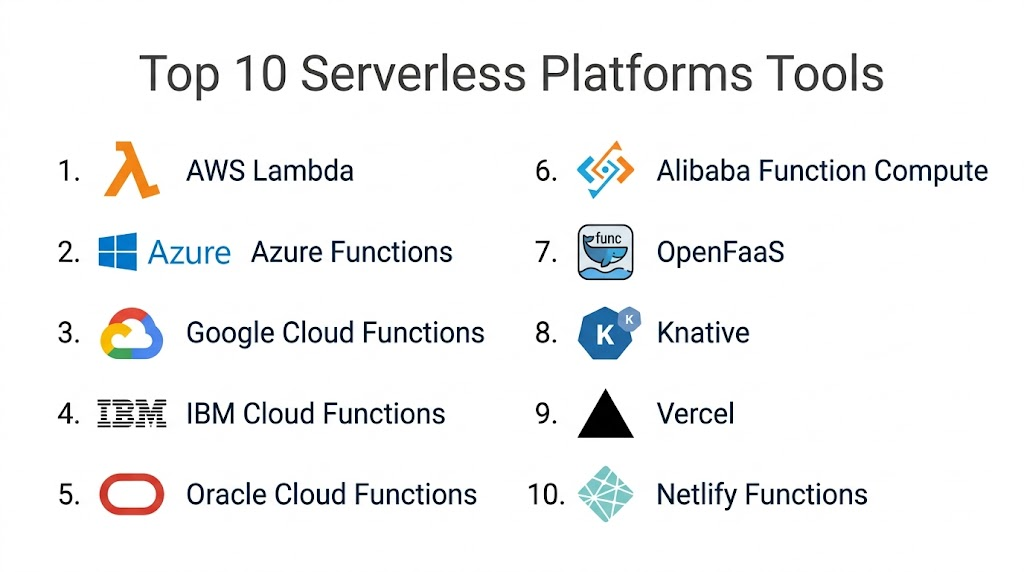
Top 10 Serverless Platforms Tools
#1 — AWS Lambda
Short description: Event-driven function execution at scale, ideal for cloud-native applications.
Key Features
- Automatic scaling and event triggers
- Multiple language support: Python, Node.js, Java, Go, C#
- Deep AWS ecosystem integration
- Pay-per-use billing
- Monitoring with CloudWatch
- Function versioning and aliases
- Dead-letter queues and retry mechanisms
Pros
- Seamless AWS integration
- Auto-scaling for unpredictable workloads
Cons
- Vendor lock-in
- Cold-start latency
Platforms / Deployment
- Web / Windows / macOS / Linux
- Cloud
Security & Compliance
- SSO/SAML, MFA, encryption, audit logs, RBAC
- SOC 2, ISO 27001, GDPR, HIPAA
Integrations & Ecosystem
AWS Lambda integrates with core AWS services and APIs.
- Amazon S3, DynamoDB, RDS
- API Gateway
- EventBridge
- SNS/SQS
- Step Functions
Support & Community
- Comprehensive documentation and onboarding
- Active community forums and AWS support tiers
#2 — Azure Functions
Short description: Event-driven code deployment with strong Microsoft ecosystem integration.
Key Features
- Multiple trigger types: HTTP, timers, queues
- Supports C#, Python, Java, JavaScript, PowerShell
- Integration with Azure DevOps and Logic Apps
- Consumption-based or premium plans
- Diagnostics and monitoring via Application Insights
- Durable Functions for workflow orchestration
Pros
- Enterprise Microsoft integration
- Complex workflows with Durable Functions
Cons
- Learning curve for orchestration
- Higher cost for sustained workloads
Platforms / Deployment
- Web / Windows / macOS / Linux
- Cloud
Security & Compliance
- SSO/SAML, MFA, encryption, audit logs, RBAC
- SOC 2, ISO 27001, GDPR
Integrations & Ecosystem
- Azure DevOps
- Microsoft Graph
- Logic Apps
- Event Grid
- Power Automate
Support & Community
- Extensive documentation, enterprise support plans, active community
#3 — Google Cloud Functions
Short description: Serverless execution in Google Cloud with developer-friendly APIs.
Key Features
- HTTP, Pub/Sub, and storage triggers
- Supports Node.js, Python, Go, Java
- Pay-per-use billing with auto-scaling
- Monitoring via Cloud Logging
- Integration with Firestore, Firebase, and Pub/Sub
Pros
- Strong GCP integration
- Simplified development for web/mobile backends
Cons
- Limited execution duration
- Vendor lock-in
Platforms / Deployment
- Web / Windows / macOS / Linux
- Cloud
Security & Compliance
- SSO/SAML, MFA, encryption, audit logs
- SOC 2, ISO 27001, GDPR
Integrations & Ecosystem
- Cloud Pub/Sub
- Firebase
- BigQuery
- Cloud Storage
- API Gateway
Support & Community
- Strong documentation and developer community
#4 — IBM Cloud Functions
Short description: OpenWhisk-based serverless compute with enterprise reliability.
Key Features
- Event-driven execution
- Multiple language support: Node.js, Python, Java, Swift
- Workflow orchestration via action sequences
- Logging and monitoring tools
Pros
- Open-source flexibility
- Enterprise-grade infrastructure
Cons
- Smaller community
- Limited global presence
Platforms / Deployment
- Web / Windows / macOS / Linux
- Cloud / Hybrid
Security & Compliance
- SSO/SAML, MFA, encryption, audit logs
- ISO 27001, SOC 2, GDPR
Integrations & Ecosystem
- IBM Cloud Databases
- API Connect
- Event Streams
- Watson AI services
Support & Community
- Varies / Not publicly stated, enterprise support available
#5 — Oracle Cloud Functions
Short description: Serverless compute on Oracle Cloud for event-driven workloads.
Key Features
- Supports Java, Node.js, Python
- OCI service integration
- Auto-scaling and consumption-based pricing
- Secure execution via identity management
- Logging and monitoring via OCI Monitoring
Pros
- Strong OCI integration
- Secure and compliant
Cons
- Limited community
- Learning curve for non-Oracle users
Platforms / Deployment
- Web / Windows / macOS / Linux
- Cloud
Security & Compliance
- SSO/SAML, MFA, encryption, audit logs
- SOC 2, ISO 27001, GDPR
Integrations & Ecosystem
- OCI API Gateway
- Object Storage
- Autonomous DB
- Event Service
Support & Community
- Enterprise support available, moderate community
#6 — Alibaba Function Compute
Short description: Scalable serverless compute in Alibaba Cloud for global applications.
Key Features
- HTTP, OSS, and MQ triggers
- Supports Python, Node.js, Java, PHP
- Auto-scaling and granular billing
- Logging and monitoring
- Container image support
Pros
- Multi-region deployment
- Cost-efficient scaling
Cons
- Limited English documentation
- Smaller ecosystem
Platforms / Deployment
- Web / Windows / macOS / Linux
- Cloud
Security & Compliance
- SSO/SAML, MFA, encryption, audit logs
- ISO 27001, SOC 2, GDPR
Integrations & Ecosystem
- OSS, MQ, API Gateway, CloudMonitor, third-party APIs
Support & Community
- Enterprise support, moderate community
#7 — OpenFaaS
Short description: Open-source framework to run serverless functions on Kubernetes or Docker.
Key Features
- Kubernetes or Docker deployment
- Multi-language support via containers
- HTTP and message queue triggers
- Dashboard for monitoring and scaling
Pros
- Cloud-agnostic and portable
- Active open-source community
Cons
- Requires Kubernetes knowledge
- Manual setup compared to managed clouds
Platforms / Deployment
- Web / Windows / macOS / Linux
- Self-hosted / Cloud / Hybrid
Security & Compliance
- Varies / Not publicly stated
Integrations & Ecosystem
- Prometheus metrics, Grafana dashboards, Kafka/NATS/RabbitMQ, Docker images
Support & Community
- Strong open-source documentation and community
#8 — Knative
Short description: Kubernetes extension providing serverless auto-scaling and eventing.
Key Features
- Auto-scaling to zero
- Traffic routing and splitting
- Eventing framework
- Containerized language support
Pros
- Kubernetes-native serverless
- Flexible and extensible
Cons
- Requires Kubernetes expertise
- Complex initial setup
Platforms / Deployment
- Web / Windows / macOS / Linux
- Self-hosted / Cloud / Hybrid
Security & Compliance
- Varies / Not publicly stated
Integrations & Ecosystem
- CloudEvents, Istio/Envoy, Prometheus, Docker/OCI images
Support & Community
- Active open-source community and documentation
#9 — Vercel
Short description: Cloud platform for frontend deployment with edge serverless functions.
Key Features
- Edge functions for low latency
- Automatic scaling
- Git-based deployment
- Logging and analytics
Pros
- Excellent web developer experience
- Quick deployment with previews
Cons
- Limited backend compute
- Some integrations need workarounds
Platforms / Deployment
- Web / Windows / macOS / Linux
- Cloud
Security & Compliance
- SSO/SAML, MFA, GDPR
Integrations & Ecosystem
- GitHub, GitLab, Bitbucket, headless CMS, CDN
Support & Community
- Strong documentation, growing community
#10 — Netlify Functions
Short description: Serverless backend for frontend-driven projects, optimized for JAMstack.
Key Features
- Node.js functions with Git integration
- Automatic scaling
- Local testing and debugging
- Edge routing for fast responses
Pros
- Developer-friendly
- Seamless JAMstack integration
Cons
- Limited long-running tasks
- Cost efficiency varies for small deployments
Platforms / Deployment
- Web / Windows / macOS / Linux
- Cloud
Security & Compliance
- SSO/MFA, encryption
- Not publicly stated
Integrations & Ecosystem
- GitHub, GitLab, Bitbucket, CMS integrations, edge caching
Support & Community
- Active community and documentation
Comparison Table
| Tool Name | Best For | Platform(s) Supported | Deployment | Standout Feature | Public Rating |
|---|---|---|---|---|---|
| AWS Lambda | Enterprise, SMB | Web/Windows/macOS/Linux | Cloud | Deep AWS integration & auto-scaling | N/A |
| Azure Functions | Enterprise, DevOps | Web/Windows/macOS/Linux | Cloud | Durable Functions workflow | N/A |
| Google Cloud Functions | SMB, Startups | Web/Windows/macOS/Linux | Cloud | Strong GCP integration | N/A |
| IBM Cloud Functions | Enterprise | Web/Windows/macOS/Linux | Cloud/Hybrid | OpenWhisk flexibility | N/A |
| Oracle Cloud Functions | Enterprise | Web/Windows/macOS/Linux | Cloud | OCI integration & security | N/A |
| Alibaba Function Compute | SMB, Global | Web/Windows/macOS/Linux | Cloud | Multi-region scaling & cost-efficiency | N/A |
| OpenFaaS | Developers | Web/Windows/macOS/Linux | Self-hosted/Cloud/Hybrid | Cloud-agnostic open-source | N/A |
| Knative | Kubernetes teams | Web/Windows/macOS/Linux | Self-hosted/Cloud/Hybrid | Kubernetes-native serverless | N/A |
| Vercel | Web developers | Web/Windows/macOS/Linux | Cloud | Edge functions low latency | N/A |
| Netlify Functions | Frontend teams | Web/Windows/macOS/Linux | Cloud | JAMstack backend integration | N/A |
Evaluation & Scoring
| Tool Name | Core (25%) | Ease (15%) | Integrations (15%) | Security (10%) | Performance (10%) | Support (10%) | Value (15%) | Weighted Total |
|---|---|---|---|---|---|---|---|---|
| AWS Lambda | 10 | 9 | 10 | 10 | 9 | 9 | 9 | 9.7 |
| Azure Functions | 9 | 8 | 9 | 9 | 9 | 9 | 8 | 8.9 |
| Google Cloud Functions | 9 | 9 | 8 | 9 | 9 | 8 | 8 | 8.6 |
| IBM Cloud Functions | 8 | 7 | 7 | 8 | 8 | 7 | 7 | 7.6 |
| Oracle Cloud Functions | 8 | 7 | 7 | 9 | 8 | 7 | 7 | 7.7 |
| Alibaba Function Compute | 8 | 8 | 7 | 8 | 8 | 7 | 8 | 7.9 |
| OpenFaaS | 7 | 7 | 7 | 7 | 8 | 7 | 8 | 7.5 |
| Knative | 7 | 6 | 7 | 7 | 8 | 6 | 7 | 7.0 |
| Vercel | 8 | 9 | 7 | 7 | 8 | 7 | 8 | 8.0 |
| Netlify Functions | 8 | 9 | 7 | 7 | 8 | 7 | 8 | 8.0 |
Scores compare features, ease, integrations, security, performance, support, and value. Use them as a guide to select the platform that fits your workload and organization type.
Which Serverless Platforms Tool Is Right for You?
Solo / Freelancer
- Vercel or Netlify Functions for fast deployment and minimal setup
- OpenFaaS if self-hosted flexibility is needed
SMB
- AWS Lambda or Google Cloud Functions for reliability and ecosystem integration
- Azure Functions if using Microsoft software stack
Mid-Market
- AWS Lambda or Azure Functions for scalable, secure workflows
- Alibaba Function Compute if cost-effective multi-region deployment is needed
Enterprise
- AWS Lambda or Azure Functions for high reliability and global infrastructure
- IBM Cloud Functions or Oracle Cloud Functions for specialized compliance needs
Budget vs Premium
- Budget: OpenFaaS or Netlify Functions for minimal cost and flexible deployment
- Premium: AWS Lambda, Azure Functions, or Oracle Cloud Functions for enterprise-grade features and support
Feature Depth vs Ease of Use
- Feature Depth: AWS Lambda, Azure Functions, Knative
- Ease of Use: Vercel, Netlify Functions
Integrations & Scalability
- Large ecosystem: AWS Lambda, Azure Functions, Google Cloud Functions
- Portable/open-source: OpenFaaS, Knative
Security & Compliance Needs
- Highest compliance: AWS Lambda, Azure Functions, IBM Cloud Functions
- Basic security: Vercel, Netlify Functions
Frequently Asked Questions (FAQs)
1. What is serverless computing?
Serverless computing runs code without managing servers. It scales automatically and you pay only for actual usage.
2. How is pricing determined for serverless platforms?
Pricing is usually pay-per-execution or pay-per-request. Some platforms offer premium plans for predictable workloads.
3. Can I run long-running tasks on serverless platforms?
Most platforms have execution time limits. For long-running tasks, consider containerized solutions or managed orchestration.
4. Which languages are supported?
Common languages include Node.js, Python, Java, Go, C#, and others depending on the platform.
5. How do serverless functions integrate with other services?
Functions typically integrate via event triggers, APIs, or message queues to connect with cloud and SaaS services.
6. Are serverless platforms secure?
Yes, they offer built-in security features like encryption, SSO, MFA, RBAC, and audit logs. Compliance varies by platform.
7. What are common mistakes when using serverless?
- Overlooking cold-start latency
- Ignoring cost for high-frequency execution
- Poor monitoring and logging setup
8. Can I migrate between platforms easily?
Open-source frameworks like OpenFaaS or Knative provide portability, while proprietary clouds may involve some vendor lock-in.
9. Are serverless platforms suitable for enterprise use?
Yes, most top platforms provide enterprise-grade security, compliance, and global scalability.
10. How do I monitor and debug functions?
Built-in tools like CloudWatch, Application Insights, or platform dashboards provide logging, metrics, and tracing for debugging.
Conclusion
Serverless platforms are transforming how developers and organizations deploy applications. Choosing the right platform depends on workload type, ecosystem preference, compliance requirements, and cost considerations. Solo developers may prefer Vercel or Netlify, SMBs benefit from AWS or Google Cloud, and enterprises need robust options like AWS Lambda or Azure Functions. The best approach is to shortlist 2–3 platforms, run a pilot, and evaluate performance, integrations, and security for your specific needs.
