Introduction
Database Monitoring Tools help organizations track, analyze, and optimize database performance, availability, and security in real time. These tools continuously monitor database queries, system health, resource usage, and user activity to ensure smooth and reliable operations.
As modern applications rely heavily on high-performance databases, cloud-native architectures, and distributed systems, database downtime or slow performance can directly impact business outcomes. Monitoring tools provide real-time alerts, performance analytics, query optimization insights, and anomaly detection to maintain system stability and efficiency.
Common use cases include:
- Database performance monitoring
- Query optimization and tuning
- Resource utilization tracking
- Uptime and availability monitoring
- Security and anomaly detection
Key evaluation criteria:
- Real-time monitoring capabilities
- Query performance analysis
- Alerting and notification system
- Multi-database support
- Cloud and on-prem compatibility
- Dashboard and reporting features
- Scalability and performance impact
- Ease of integration
Best for: Enterprises, DevOps teams, database administrators (DBAs), SaaS companies, and cloud-native organizations.
Not ideal for: Very small projects with simple or non-critical databases.
Key Trends in Database Monitoring Tools
- AI-powered anomaly detection and predictive analytics
- Unified observability platforms (logs, metrics, traces)
- Cloud-native and multi-cloud monitoring support
- Real-time query performance optimization
- Integration with DevOps and AIOps pipelines
- Automated root cause analysis (RCA)
- Focus on cost optimization in cloud databases
- Improved visualization and dashboarding
- Security and performance monitoring convergence
- Serverless and distributed database monitoring support
How We Evaluated Database Monitoring Tools (Methodology)
- Assessed real-time monitoring capabilities
- Evaluated query performance and optimization insights
- Reviewed alerting and anomaly detection features
- Considered database and cloud platform support
- Assessed scalability and performance impact
- Evaluated dashboarding and reporting quality
- Considered integration with DevOps tools
- Assessed enterprise adoption and reliability
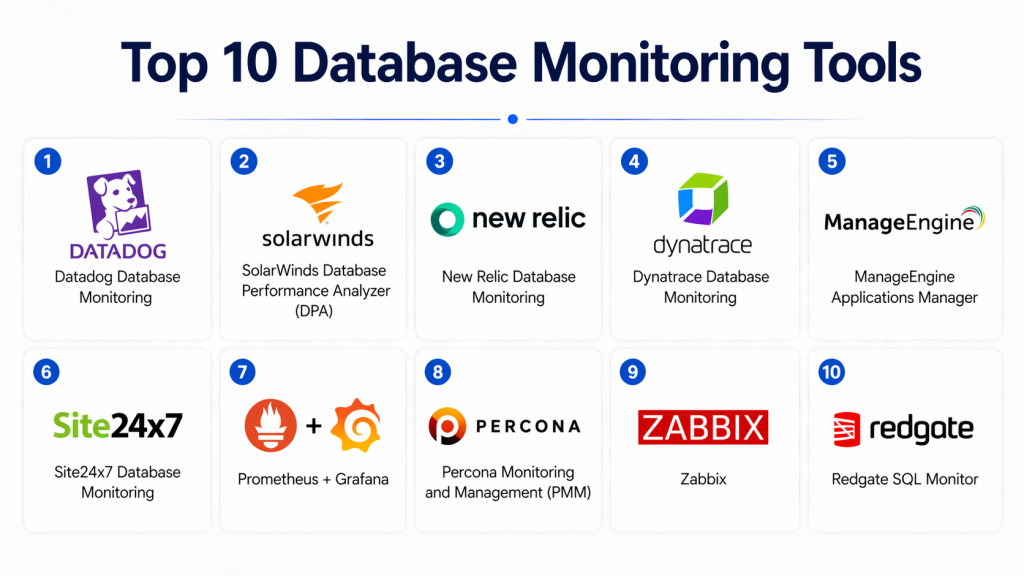
Top 10 Database Monitoring Tools
#1 — Datadog Database Monitoring
Short description: A leading observability platform offering real-time database performance monitoring. Provides deep insights into queries, latency, and system health. Widely used in cloud-native environments. Supports multiple database types. Ideal for DevOps and SRE teams.
Key Features
- Real-time database monitoring
- Query performance analysis
- Alerting and dashboards
- Infrastructure monitoring
- Anomaly detection
Pros
- Strong observability platform
- Easy cloud integration
Cons
- Expensive at scale
- Complex setup for beginners
Platforms / Deployment
Cloud
Security & Compliance
Encryption, audit logging (others not publicly stated)
Integrations & Ecosystem
- Cloud providers
- DevOps tools
- APIs
Support & Community
Strong enterprise support.
#2 — SolarWinds Database Performance Analyzer
Short description: A powerful database monitoring tool focused on performance tuning and query optimization. Known for deep database insights and troubleshooting capabilities.
Key Features
- Query performance tracking
- Resource utilization monitoring
- Wait-time analysis
- Alerts and reporting
- Performance tuning
Pros
- Excellent performance diagnostics
- Easy-to-use interface
Cons
- Limited cloud-native features
- Licensing cost can be high
Platforms / Deployment
On-prem / Cloud
Security & Compliance
Enterprise security standards
Integrations & Ecosystem
- Databases (SQL, Oracle, etc.)
- IT monitoring tools
Support & Community
Strong vendor support.
#3 — New Relic Database Monitoring
Short description: A modern observability platform offering real-time database monitoring and performance insights. Ideal for cloud and SaaS applications.
Key Features
- Query monitoring
- Performance dashboards
- Alerting system
- Distributed tracing
- Analytics
Pros
- Strong observability stack
- Easy integration
Cons
- Pricing complexity
- Learning curve
Platforms / Deployment
Cloud
Security & Compliance
Encryption and compliance support
Integrations & Ecosystem
- Cloud platforms
- DevOps tools
Support & Community
Good enterprise support.
#4 — Dynatrace Database Monitoring
Short description: An AI-powered monitoring platform offering automated performance analysis and root cause detection for databases and applications.
Key Features
- AI-based monitoring
- Automatic root cause analysis
- Query performance tracking
- Infrastructure monitoring
- Alerting
Pros
- Strong AI capabilities
- Automated insights
Cons
- Expensive
- Complex deployment
Platforms / Deployment
Cloud / Hybrid
Security & Compliance
Enterprise-grade encryption
Integrations & Ecosystem
- Cloud providers
- DevOps tools
Support & Community
Enterprise support.
#5 — ManageEngine Applications Manager
Short description: A comprehensive IT monitoring tool offering database performance monitoring and availability tracking. Suitable for SMBs and enterprises.
Key Features
- Database monitoring
- Performance tracking
- Alerts and notifications
- Reporting dashboards
- Resource monitoring
Pros
- Affordable
- Easy to deploy
Cons
- Limited advanced analytics
- UI can be complex
Platforms / Deployment
On-prem / Cloud
Security & Compliance
Standard enterprise security
Integrations & Ecosystem
- IT infrastructure tools
- APIs
Support & Community
Good vendor support.
#6 — Site24x7 Database Monitoring
Short description: A cloud-based monitoring platform offering database performance tracking and uptime monitoring. Suitable for DevOps and SMBs.
Key Features
- Database performance monitoring
- Uptime tracking
- Alerting system
- Dashboards
- Analytics
Pros
- Easy setup
- Affordable
Cons
- Limited deep analytics
- SMB-focused
Platforms / Deployment
Cloud
Security & Compliance
Encryption support
Integrations & Ecosystem
- Cloud platforms
- DevOps tools
Support & Community
Good support.
#7 — Prometheus + Grafana
Short description: A widely used open-source monitoring stack for metrics collection and visualization. Commonly used for database and infrastructure monitoring.
Key Features
- Metrics collection
- Custom dashboards
- Alerting system
- Time-series monitoring
- Open-source flexibility
Pros
- Free and open-source
- Highly customizable
Cons
- Requires setup effort
- No built-in enterprise support
Platforms / Deployment
On-prem / Cloud
Security & Compliance
Depends on configuration
Integrations & Ecosystem
- Kubernetes
- Databases
- DevOps tools
Support & Community
Strong open-source community.
#8 — Percona Monitoring and Management (PMM)
Short description: An open-source database monitoring tool designed for MySQL, PostgreSQL, and MongoDB performance tracking.
Key Features
- Query performance monitoring
- Database dashboards
- Alerting system
- Metrics collection
- Performance analysis
Pros
- Free and open-source
- Strong database focus
Cons
- Limited enterprise features
- Requires setup expertise
Platforms / Deployment
On-prem / Cloud
Security & Compliance
Depends on deployment
Integrations & Ecosystem
- Open-source databases
- DevOps tools
Support & Community
Community + enterprise support.
#9 — Edge Delta
Short description: A modern observability platform offering real-time database and system monitoring with streaming analytics.
Key Features
- Real-time streaming analytics
- Database monitoring
- Log processing
- Alerting
- Observability dashboards
Pros
- Real-time insights
- Lightweight architecture
Cons
- Newer platform
- Smaller ecosystem
Platforms / Deployment
Cloud
Security & Compliance
Encryption support
Integrations & Ecosystem
- Cloud tools
- APIs
Support & Community
Growing support.
#10 — Zabbix
Short description: An open-source monitoring solution widely used for infrastructure and database monitoring. Known for flexibility and scalability.
Key Features
- Database monitoring
- Infrastructure tracking
- Alerting system
- Dashboards
- Custom metrics
Pros
- Free and open-source
- Highly flexible
Cons
- Complex setup
- Requires maintenance
Platforms / Deployment
On-prem / Cloud
Security & Compliance
Depends on configuration
Integrations & Ecosystem
- IT infrastructure tools
- APIs
Support & Community
Strong open-source community.
Comparison Table (Top 10)
| Tool Name | Best For | Platform(s) | Deployment | Standout Feature | Public Rating |
|---|---|---|---|---|---|
| Datadog | Cloud monitoring | Web | Cloud | Full observability | N/A |
| SolarWinds | DB tuning | Web | On-prem/Cloud | Query analysis | N/A |
| New Relic | SaaS apps | Web | Cloud | Observability | N/A |
| Dynatrace | Enterprise AI | Web | Cloud/Hybrid | AI RCA | N/A |
| ManageEngine | SMB/Enterprise | Web | On-prem/Cloud | Affordability | N/A |
| Site24x7 | SMB | Web | Cloud | Ease of use | N/A |
| Prometheus | DevOps | Web | Hybrid | Open-source metrics | N/A |
| Percona PMM | DB-focused | Web | Hybrid | MySQL/PostgreSQL focus | N/A |
| Edge Delta | Modern cloud | Web | Cloud | Real-time streaming | N/A |
| Zabbix | Infrastructure | Web | Hybrid | Flexibility | N/A |
Evaluation & Scoring of Database Monitoring Tools
| Tool | Core | Ease | Integrations | Security | Performance | Support | Value | Total |
|---|---|---|---|---|---|---|---|---|
| Datadog | 9 | 8 | 9 | 8 | 9 | 9 | 7 | 8.4 |
| SolarWinds | 9 | 8 | 8 | 8 | 9 | 8 | 7 | 8.1 |
| New Relic | 9 | 8 | 9 | 8 | 9 | 8 | 7 | 8.3 |
| Dynatrace | 10 | 7 | 9 | 9 | 10 | 9 | 6 | 8.4 |
| ManageEngine | 8 | 8 | 7 | 8 | 8 | 8 | 8 | 7.9 |
| Site24x7 | 7 | 9 | 7 | 7 | 7 | 7 | 9 | 7.6 |
| Prometheus | 8 | 7 | 9 | 7 | 8 | 8 | 10 | 8.1 |
| Percona PMM | 8 | 7 | 8 | 8 | 8 | 8 | 9 | 8.0 |
| Edge Delta | 8 | 8 | 8 | 8 | 8 | 8 | 7 | 7.9 |
| Zabbix | 8 | 7 | 8 | 7 | 8 | 8 | 10 | 8.0 |
Which Database Monitoring Tool Is Right for You?
Solo / Freelancer
Prometheus or Zabbix for free monitoring.
SMB
Site24x7 or ManageEngine for simplicity.
Mid-Market
New Relic or SolarWinds for balanced features.
Enterprise
Datadog or Dynatrace for advanced observability.
Budget vs Premium
- Budget: Zabbix
- Premium: Dynatrace
Feature Depth vs Ease of Use
- Easy: Site24x7
- Advanced: Dynatrace
Integrations & Scalability
- Best integrations: Datadog, New Relic
Security & Compliance
- High compliance: Dynatrace, Datadog
FAQs
1. What are database monitoring tools?
Database monitoring tools track database performance, health, and usage in real time. They help detect issues early and optimize performance. They are essential for modern applications.
2. Why is database monitoring important?
It ensures databases run efficiently without downtime. It helps prevent performance bottlenecks. It improves system reliability.
3. Who uses database monitoring tools?
DevOps teams, DBAs, and IT teams use them. SaaS companies rely on them heavily. Any data-driven organization benefits.
4. Are these tools expensive?
Pricing varies widely. Enterprise tools are expensive. Open-source tools are free.
5. Do they support cloud databases?
Yes, most modern tools support AWS, Azure, and GCP databases. Cloud support is standard.
6. What is query monitoring?
It tracks how database queries perform. It identifies slow or inefficient queries. It helps optimize performance.
7. Are monitoring tools secure?
Yes, they include encryption and access controls. Security depends on configuration. Enterprise tools follow strict standards.
8. Can they integrate with DevOps tools?
Yes, integration with CI/CD and DevOps platforms is common. APIs enable customization.
9. What are common challenges?
Setup complexity and tuning are common challenges. Proper configuration is required. Training helps.
10. What are alternatives?
Manual monitoring is possible but inefficient. Dedicated tools are more scalable. They provide automation and insights.
Conclusion
Database monitoring tools are essential for ensuring the performance, reliability, and availability of modern data systems. As applications become more complex and data-driven, real-time visibility into database behavior is critical for preventing downtime, optimizing performance, and improving user experience. These tools provide deep insights into queries, system resources, and anomalies, enabling teams to proactively manage database health.
Choosing the right database monitoring solution depends on your infrastructure, scale, and technical expertise. Enterprises often rely on platforms like Datadog or Dynatrace for full observability, while SMBs and DevOps teams may prefer tools like Site24x7, Prometheus, or Zabbix. The key is to evaluate your monitoring needs, integration requirements, and scalability expectations before selecting a tool that fits your
