Introduction
Database Security Tools help organizations protect databases from unauthorized access, data breaches, insider threats, and external cyberattacks. These tools ensure that sensitive data stored in relational and non-relational databases remains secure, compliant, and properly monitored.
As organizations increasingly rely on cloud databases, hybrid architectures, and real-time applications, securing data at the database layer has become critical. Modern database security tools provide encryption, activity monitoring, access control, vulnerability scanning, and threat detection to reduce risk and ensure compliance with regulations.
Common use cases include:
- Database activity monitoring (DAM)
- Data encryption and masking
- User access control and auditing
- Vulnerability detection and patching
- Compliance reporting (GDPR, HIPAA, PCI-DSS)
Key evaluation criteria:
- Real-time monitoring capabilities
- Data encryption and masking features
- Access control and authentication
- Threat detection and alerts
- Integration with databases and cloud platforms
- Compliance support
- Scalability and performance
- Ease of deployment and management
Best for: Enterprises, financial institutions, healthcare organizations, and any business managing sensitive or regulated data.
Not ideal for: Small teams with minimal database usage or low-security requirements.
Key Trends in Database Security Tools
- AI-driven anomaly detection for database activity
- Cloud-native database security adoption
- Zero-trust database access models
- Automated threat detection and response
- Database encryption everywhere (at rest, in transit, in use)
- Integration with DevSecOps pipelines
- Real-time compliance monitoring and reporting
- Behavioral analytics for insider threat detection
- Unified data security platforms emerging
- Increased focus on ransomware protection for databases
How We Evaluated Database Security Tools (Methodology)
- Assessed database activity monitoring capabilities
- Evaluated data encryption and masking features
- Reviewed threat detection and alert systems
- Considered integration with database systems and cloud platforms
- Assessed compliance support and reporting features
- Evaluated performance and scalability
- Considered ease of deployment and usability
- Assessed enterprise adoption and reliability
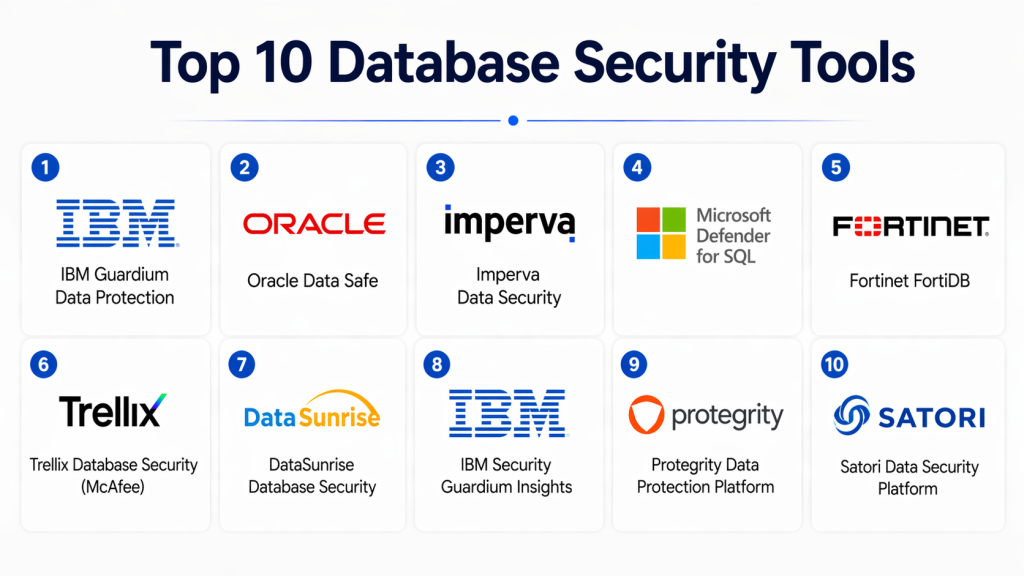
Top 10 Database Security Tools
#1 — IBM Guardium Data Protection
Short description: A leading enterprise database security platform offering real-time monitoring, data protection, and compliance management. Widely used in regulated industries. Provides deep visibility into database activity. Ideal for large-scale enterprise environments.
Key Features
- Database activity monitoring
- Data encryption and masking
- Compliance reporting
- Risk detection
- User activity tracking
Pros
- Strong enterprise security
- Comprehensive monitoring
Cons
- Complex deployment
- High cost
Platforms / Deployment
Cloud / On-prem / Hybrid
Security & Compliance
AES encryption, audit logging (others not publicly stated)
Integrations & Ecosystem
- Databases (SQL, NoSQL)
- Enterprise security tools
- APIs
Support & Community
Enterprise-level support.
#2 — Oracle Data Safe
Short description: A cloud-based database security solution designed for Oracle databases. Offers monitoring, data masking, and compliance tools. Suitable for Oracle-heavy environments.
Key Features
- Activity monitoring
- Data masking
- User assessment
- Security configuration analysis
- Compliance reporting
Pros
- Strong Oracle integration
- Easy cloud deployment
Cons
- Limited to Oracle ecosystem
- Basic external integrations
Platforms / Deployment
Cloud
Security & Compliance
Encryption, Oracle security standards
Integrations & Ecosystem
- Oracle databases
- Cloud services
Support & Community
Oracle enterprise support.
#3 — Imperva Data Security
Short description: A widely used database security platform offering activity monitoring and data protection across multiple database types. Known for strong threat detection capabilities.
Key Features
- Database activity monitoring
- Threat detection
- Data masking
- Risk analytics
- Compliance reporting
Pros
- Strong multi-database support
- Advanced threat detection
Cons
- Complex setup
- Premium pricing
Platforms / Deployment
Cloud / On-prem
Security & Compliance
Encryption and compliance support
Integrations & Ecosystem
- Multiple databases
- Security tools
- APIs
Support & Community
Enterprise support.
#4 — Microsoft Defender for SQL
Short description: A security solution integrated with Microsoft Azure SQL databases. Provides threat detection, vulnerability assessment, and advanced security monitoring.
Key Features
- Threat detection
- Vulnerability scanning
- Activity monitoring
- Alerts and reporting
- Compliance tracking
Pros
- Strong Azure integration
- Easy to use
Cons
- Limited to Microsoft ecosystem
- Basic customization
Platforms / Deployment
Cloud
Security & Compliance
Microsoft security standards
Integrations & Ecosystem
- Azure services
- SQL databases
Support & Community
Microsoft support.
#5 — Fortinet FortiDB
Short description: A database security solution focused on monitoring and protecting database environments. Suitable for enterprises requiring strong security controls.
Key Features
- Database monitoring
- Activity tracking
- Vulnerability assessment
- Compliance reporting
- Alerting
Pros
- Strong security features
- Good performance
Cons
- Limited UI flexibility
- Complex configuration
Platforms / Deployment
On-prem / Cloud
Security & Compliance
Encryption and audit support
Integrations & Ecosystem
- Enterprise databases
- Security platforms
Support & Community
Enterprise support.
#6 — McAfee Database Security (Trellix)
Short description: A database security platform offering monitoring, encryption, and access control features. Designed for enterprise-scale environments.
Key Features
- Database monitoring
- Data encryption
- Access control
- Threat detection
- Compliance reporting
Pros
- Strong enterprise focus
- Reliable performance
Cons
- Complex setup
- High cost
Platforms / Deployment
Cloud / On-prem
Security & Compliance
Enterprise-grade encryption
Integrations & Ecosystem
- Enterprise systems
- APIs
Support & Community
Enterprise support.
#7 — DataSunrise Database Security
Short description: A flexible database security platform offering real-time monitoring, auditing, and encryption features. Suitable for multi-cloud environments.
Key Features
- Activity monitoring
- Data encryption
- Audit logging
- Compliance tools
- Risk detection
Pros
- Multi-cloud support
- Flexible deployment
Cons
- Smaller ecosystem
- Learning curve
Platforms / Deployment
Cloud / Hybrid
Security & Compliance
Encryption and compliance support
Integrations & Ecosystem
- Multiple databases
- Cloud platforms
Support & Community
Good support.
#8 — IBM Security Guardium Insights
Short description: A modern analytics-driven database security platform offering visibility and risk insights across data environments.
Key Features
- Security analytics
- Activity monitoring
- Risk detection
- Compliance reporting
- Data protection
Pros
- Strong analytics
- Enterprise scalability
Cons
- Complex interface
- High cost
Platforms / Deployment
Cloud / Hybrid
Security & Compliance
Enterprise encryption standards
Integrations & Ecosystem
- Databases
- Security tools
Support & Community
Enterprise support.
#9 — Protegrity Data Protection Platform
Short description: A data-centric security platform offering encryption, tokenization, and masking for databases. Focuses on protecting sensitive data.
Key Features
- Data encryption
- Tokenization
- Data masking
- Access control
- Compliance support
Pros
- Strong data protection
- Scalable
Cons
- Complex setup
- Premium pricing
Platforms / Deployment
Cloud / On-prem / Hybrid
Security & Compliance
Advanced encryption standards
Integrations & Ecosystem
- Databases
- Enterprise systems
Support & Community
Enterprise support.
#10 — Satori Data Security Platform
Short description: A modern data security platform focused on database access control, monitoring, and compliance automation. Designed for cloud-first organizations.
Key Features
- Access control
- Activity monitoring
- Data masking
- Compliance automation
- Risk analytics
Pros
- Easy cloud integration
- Strong visibility
Cons
- Newer platform
- Limited enterprise adoption
Platforms / Deployment
Cloud
Security & Compliance
Encryption and audit logging
Integrations & Ecosystem
- Cloud databases
- APIs
Support & Community
Growing support.
Comparison Table (Top 10)
| Tool Name | Best For | Platform(s) | Deployment | Standout Feature | Public Rating |
|---|---|---|---|---|---|
| IBM Guardium | Enterprise | Web | Hybrid | Monitoring | N/A |
| Oracle Data Safe | Oracle users | Web | Cloud | DB integration | N/A |
| Imperva | Multi-DB | Web | Hybrid | Threat detection | N/A |
| Microsoft Defender | Azure users | Web | Cloud | SQL security | N/A |
| Fortinet FortiDB | Enterprise | Web | Hybrid | Monitoring | N/A |
| McAfee/Trellix | Enterprise | Web | Hybrid | Security control | N/A |
| DataSunrise | Multi-cloud | Web | Cloud | Flexibility | N/A |
| IBM Guardium Insights | Enterprise | Web | Cloud | Analytics | N/A |
| Protegrity | Data protection | Web | Hybrid | Tokenization | N/A |
| Satori | Cloud-first | Web | Cloud | Access control | N/A |
Evaluation & Scoring of Database Security Tools
| Tool | Core | Ease | Integrations | Security | Performance | Support | Value | Total |
|---|---|---|---|---|---|---|---|---|
| IBM Guardium | 9 | 7 | 9 | 10 | 9 | 9 | 7 | 8.6 |
| Oracle Data Safe | 8 | 9 | 8 | 9 | 8 | 8 | 8 | 8.2 |
| Imperva | 9 | 7 | 8 | 9 | 9 | 8 | 7 | 8.3 |
| Microsoft Defender | 8 | 9 | 8 | 9 | 8 | 9 | 9 | 8.5 |
| Fortinet | 8 | 7 | 8 | 9 | 8 | 8 | 7 | 8.0 |
| McAfee/Trellix | 8 | 7 | 8 | 9 | 8 | 8 | 7 | 8.0 |
| DataSunrise | 8 | 8 | 8 | 8 | 8 | 7 | 8 | 8.0 |
| Guardium Insights | 9 | 7 | 9 | 9 | 9 | 8 | 7 | 8.4 |
| Protegrity | 9 | 7 | 8 | 10 | 8 | 8 | 7 | 8.3 |
| Satori | 8 | 9 | 8 | 8 | 8 | 8 | 8 | 8.1 |
Which Database Security Tool Is Right for You?
Solo / Freelancer
Satori or DataSunrise for simplicity.
SMB
Microsoft Defender for SQL or DataSunrise.
Mid-Market
Imperva or Fortinet FortiDB.
Enterprise
IBM Guardium, Oracle Data Safe, Protegrity.
Budget vs Premium
- Budget: Satori
- Premium: IBM Guardium
Feature Depth vs Ease of Use
- Easy: Microsoft Defender
- Advanced: IBM Guardium
Integrations & Scalability
- Best integrations: IBM Guardium, Imperva
Security & Compliance
- Highest security: IBM Guardium, Protegrity
FAQs
1. What are database security tools?
Database security tools protect databases from unauthorized access, breaches, and attacks. They monitor activity and enforce security policies. They ensure data protection and compliance. These tools are essential for modern organizations.
2. Why is database security important?
Databases store sensitive business and customer data. Without protection, they are vulnerable to attacks. Security tools reduce these risks. They help maintain trust and compliance.
3. Who uses database security tools?
Enterprises, financial institutions, and IT teams use them. Any organization storing sensitive data needs them. They are widely used in regulated industries.
4. Are database security tools expensive?
Pricing varies based on features and scale. Enterprise tools are costly. Some solutions are more affordable for SMBs.
5. Do they support cloud databases?
Yes, most modern tools support cloud databases. They work with AWS, Azure, and GCP. Cloud support is standard.
6. What is database monitoring?
It tracks database activity in real time. It detects suspicious behavior. It helps prevent attacks.
7. Are these tools secure?
Yes, they use encryption and monitoring systems. Security depends on proper configuration. Enterprise tools follow strict standards.
8. Can they integrate with other systems?
Yes, they integrate with databases and security platforms. APIs are commonly used. Integration improves efficiency.
9. What are common challenges?
Complex setup and configuration are common issues. Proper planning helps reduce challenges. Training is important.
10. What are alternatives?
Manual monitoring or basic security tools exist. However, they are not scalable. Dedicated tools are more effective.
Conclusion
Database security tools are essential for protecting sensitive organizational data in today’s threat-heavy digital environment. As cyberattacks, ransomware, and insider threats continue to rise, securing databases has become a top priority for businesses across industries. These tools provide critical capabilities such as real-time monitoring, encryption, access control, and compliance reporting to safeguard valuable data assets.
Choosing the right database security solution depends on your infrastructure, compliance requirements, and scalability needs. Enterprises often rely on robust platforms like IBM Guardium or Imperva, while cloud-focused organizations prefer Microsoft Defender or Satori. The key is to evaluate your security posture, integration needs, and operational complexity before selecting a solution that aligns with your long-term data protection strategy.
