Introduction
Lakehouse platforms combine the flexibility and low-cost storage model of a data lake with the performance, governance, and analytical structure of a data warehouse. In simple terms, they help teams store raw and structured data in one environment while supporting SQL analytics, data engineering, machine learning, and AI workflows without constant copying between systems. These platforms are increasingly positioned as unified foundations for analytics, BI, data science, and AI workloads, usually with open table formats such as Delta Lake or Apache Iceberg playing a major role.
This matters because modern data teams want one governed environment for analytics, AI, BI, data science, and increasingly agentic workflows. Real-world use cases include building governed analytics on open formats, reducing warehouse-to-lake duplication, supporting streaming plus batch pipelines, powering enterprise AI and RAG on unified data, and enabling cross-engine interoperability across cloud or hybrid environments. Buyers should evaluate open format support, governance, SQL performance, multi-engine interoperability, AI-readiness, cost control, security, ecosystem breadth, deployment flexibility, and operational simplicity.
Best for: enterprises, data platform teams, analytics engineering teams, AI and ML teams, regulated organizations, and businesses trying to unify lakes, warehouses, and AI workloads on fewer platforms.
Not ideal for: very small teams with simple BI needs, companies that only need a classic data warehouse, or organizations with lightweight data volumes that do not justify lakehouse complexity.
Key Trends in Lakehouse Platforms
- Open table formats are becoming central to platform strategy, especially Apache Iceberg and Delta Lake, because buyers want interoperability and less lock-in.
- AI and agentic analytics are now part of the positioning, not just data engineering.
- Open lakehouse messaging is growing fast as vendors emphasize interoperability across engines and clouds rather than single-engine lock-in.
- Governance is a top buying factor, with platforms highlighting unified catalogs, row- and column-level controls, and shared policy layers.
- Lakehouse plus BI plus AI in one SaaS layer is becoming more common, especially in integrated cloud suites.
- Cloud-managed and serverless options continue expanding, but hybrid and multi-cloud remain important for enterprises.
- Single-copy analytics is a major value theme, with platforms promising analytics and AI directly on open data instead of repeated data movement.
- Lakehouse buyers increasingly compare platforms by ecosystem fit, not only storage or query speed, because catalog, notebooks, ML, governance, and sharing now influence decisions heavily.
How We Evaluate Lakehouse Platforms (Methodology)
We selected the top platforms using a practical market and architecture-based methodology:
- Market adoption and mindshare across enterprise data teams, analytics engineers, and AI platform teams
- Lakehouse completeness across storage, metadata, governance, SQL, pipelines, and AI support
- Open format and interoperability strength including Iceberg, Delta Lake, or open catalog support
- Security posture signals such as centralized governance, role-based controls, and policy management
- Deployment flexibility across SaaS, self-hosted, hybrid, and multi-cloud
- Analytics and performance fit for BI, ETL, AI, and mixed workloads
- Ecosystem depth across data integration, notebooks, ML, dashboards, APIs, and governance tooling
- Customer fit across segments from cloud-native teams to large regulated enterprises
- Operational simplicity including managed services, catalog design, and data sharing experience
- Value relative to platform complexity and lock-in risk
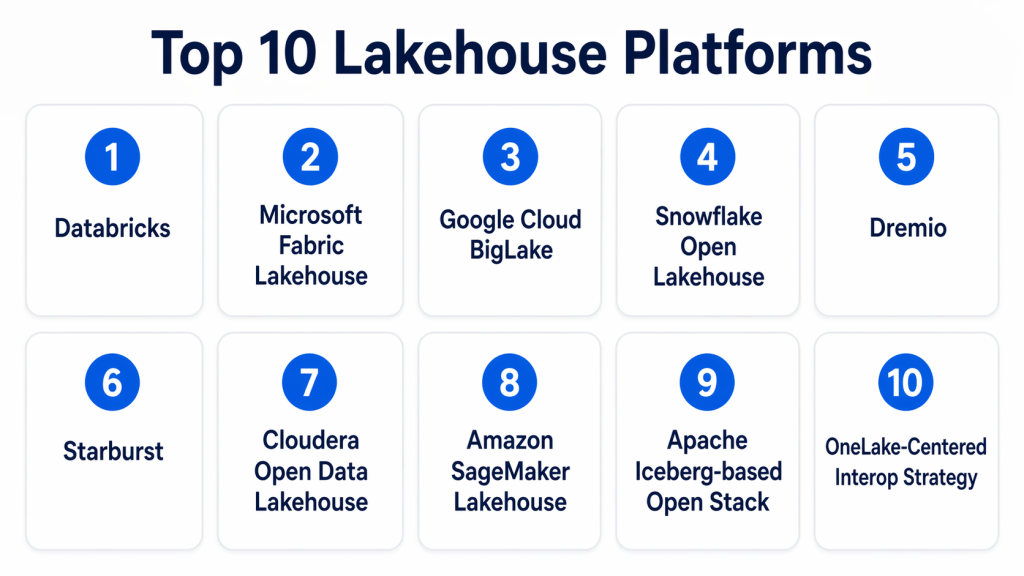
Top 10 Lakehouse Platforms
#1 — Databricks
Short description : Databricks remains the most recognizable lakehouse platform brand and is still closely identified with the lakehouse category itself. The platform is positioned as an open, unified foundation for ETL, ML, AI, and BI workloads, with centralized governance as a major strength. It is especially strong for organizations that want one strategic platform across data engineering, analytics, and AI. It fits startups through large enterprises, but is particularly compelling in data-mature organizations. It is often the benchmark against which other lakehouse platforms are judged.
Key Features
- Unified lakehouse architecture
- Strong support for ETL, BI, ML, and AI
- Central governance through catalog-based controls
- Open platform positioning
- Strong notebook and engineering workflows
- Broad cloud deployment support
- Mature Delta-based ecosystem
Pros
- Strongest category identity and platform breadth
- Excellent fit for analytics plus AI unification
- Mature governance and engineering story
Cons
- Can be complex and expensive for smaller teams
- Best value appears when multiple workloads are consolidated
- Requires disciplined platform ownership
Platforms / Deployment
- Web / Cloud
- Cloud / Hybrid
Security & Compliance
Supports centralized governance and enterprise platform controls. Specific certification scope varies by cloud and contract.
Integrations & Ecosystem
Databricks has one of the deepest ecosystems in the lakehouse market, with strong alignment to notebooks, ML pipelines, SQL analytics, streaming, governance, and open storage patterns.
- Strong data engineering ecosystem
- Good AI and ML platform fit
- Broad BI and analytics compatibility
- Mature partner and integration landscape
Support & Community
Documentation, training, and community reach are very strong. Enterprise support is mature and the hiring market is large.
#2 — Microsoft Fabric Lakehouse
Short description : Microsoft Fabric Lakehouse combines lake and warehouse-style analytics inside the broader Fabric SaaS platform. It stores structured and unstructured data in one location, supports Spark and SQL on one data layer, and integrates tightly with the broader Microsoft analytics ecosystem. It is especially attractive to Microsoft-centric organizations wanting tightly integrated analytics, BI, and data engineering. It works well for enterprises standardizing on SaaS data workflows. It is one of the strongest integrated lakehouse options for business-facing teams.
Key Features
- Native lakehouse experience inside Fabric
- Delta Lake storage model
- Spark and SQL on one data layer
- Unified storage shortcuts and sharing
- Tight BI ecosystem alignment
- Strong end-to-end SaaS analytics workflows
- Integrated data engineering and real-time experiences
Pros
- Excellent fit for Microsoft-centered analytics programs
- Very strong SaaS integration across data and BI
- Good for organizations wanting fewer moving parts
Cons
- Best value depends on broader Microsoft adoption
- Less attractive for teams wanting maximum engine neutrality
- Platform breadth can feel large for simple use cases
Platforms / Deployment
- Web / Cloud
- Cloud
Security & Compliance
Supports governed data access patterns and centralized platform administration. Compliance specifics vary by service configuration.
Integrations & Ecosystem
Fabric’s strength is deep internal integration across data engineering, BI, warehousing, real-time analytics, and business consumption.
- Strong BI alignment
- Good Microsoft ecosystem fit
- Useful for cross-team analytics workflows
- Strong SaaS operational simplicity
Support & Community
Documentation is active and improving quickly. Enterprise support is strong, especially in Microsoft-heavy organizations.
#3 — Google Cloud BigLake
Short description : BigLake is a lakehouse storage engine for building open lakehouses around Apache Iceberg and open formats such as Parquet and ORC. It is positioned around unified governance, a single copy of data, and fine-grained security across cloud analytics and open-source processing engines. It is especially compelling for teams that want open-format analytics without constant duplication between lake and warehouse layers. It is a strong fit for Google Cloud-centric data architectures. It works best when openness plus managed cloud governance are both priorities.
Key Features
- Open lakehouse storage engine
- Apache Iceberg support
- Fine-grained row and column security
- Single-copy governed data model
- Cloud analytics and open-engine access
- Managed cloud integration
- Strong open-format positioning
Pros
- Strong balance of openness and managed governance
- Excellent for Google Cloud analytics estates
- Good fit for Iceberg-oriented architectures
Cons
- Best fit is closely tied to Google Cloud
- Broader platform story may feel less unified than all-in-one suites
- Requires clarity on where storage, governance, and query responsibilities begin and end
Platforms / Deployment
- Web / Cloud
- Cloud
Security & Compliance
Supports centralized row- and column-level access control and governance through cloud-native security and catalog services.
Integrations & Ecosystem
BigLake fits best when organizations want open formats with managed analytics performance and governance rather than a closed warehouse-only model.
- Strong cloud analytics ecosystem fit
- Strong Apache Iceberg alignment
- Good for open-engine interoperability
- Useful for governed single-copy analytics
Support & Community
Documentation is strong, and enterprise support is mature within cloud contracts.
#4 — Snowflake Open Lakehouse
Short description : Snowflake’s lakehouse approach focuses on open table formats, governed data lakes, and interoperability across engines, including open catalog and Iceberg-based workflows. The platform increasingly frames its value around lakehouse analytics and AI over open data while maintaining a managed user experience. It is especially attractive to enterprises that already trust Snowflake for warehousing and want lakehouse capabilities without giving up managed simplicity. It is strongest when governed collaboration and cross-engine openness matter. It is one of the most credible commercial contenders in this category.
Key Features
- Native support for open table formats
- Open catalog capabilities
- Governed lakehouse analytics
- Secure sharing and collaboration
- Managed platform experience
- AI and ML service alignment
- Strong enterprise analytics usability
Pros
- Strong managed experience with growing open-lakehouse capabilities
- Good fit for Snowflake-centered enterprises
- Useful for governed cross-team analytics
Cons
- Best value often depends on existing Snowflake adoption
- Open-lakehouse story is still compared against more open-native rivals
- Cost can be significant for broad platform use
Platforms / Deployment
- Web / Cloud
- Cloud
Security & Compliance
Supports governance, secure collaboration, and role-based access patterns around open formats. Exact compliance scope varies by account and cloud region.
Integrations & Ecosystem
Snowflake has a broad ecosystem for BI, sharing, data engineering, and AI, now extended further into open catalog and Iceberg workflows.
- Strong enterprise analytics ecosystem
- Good secure-sharing story
- Useful for open-format collaboration
- Broad partner integration landscape
Support & Community
Commercial support is strong and the enterprise footprint is broad. Documentation is mature.
#5 — Dremio
Short description : Dremio positions itself directly as a data lakehouse platform and more recently as an agentic lakehouse for AI and analytics. It emphasizes open architecture, SQL performance, governance, and gradual adoption across existing storage and table formats. Dremio is especially attractive to teams that want an open lakehouse control plane without fully replacing their broader storage strategy. It is a strong fit for data engineering and analytics teams that value flexibility and lower lock-in. It is one of the strongest open-lakehouse-first commercial platforms.
Key Features
- Open lakehouse architecture
- SQL lakehouse engine
- Strong support for gradual adoption
- End-to-end governance framing
- Good fit for analytics and AI
- Open storage and table format compatibility
- Strong semantic and data-access layer positioning
Pros
- Strong open-lakehouse platform identity
- Good for flexibility and incremental modernization
- Attractive for analytics plus AI unification
Cons
- Less mainstream than the largest hyperscaler platforms
- Best value depends on strong engineering adoption
- Some teams may prefer more vertically integrated suites
Platforms / Deployment
- Web / Cloud / Linux
- Cloud / Self-hosted / Hybrid
Security & Compliance
Dremio emphasizes end-to-end governance and access control. Detailed compliance scope varies by edition and deployment.
Integrations & Ecosystem
Dremio is strongest when used as an open access and performance layer across data lakehouse storage, BI, and AI workflows.
- Strong SQL analytics fit
- Good open storage compatibility
- Useful for AI-ready governed access
- Broad interoperability orientation
Support & Community
Documentation is good, commercial support is available, and community awareness is strong in open-lakehouse conversations.
#6 — Starburst
Short description : Starburst positions itself as an end-to-end platform for the open data lakehouse and emphasizes federated access, governance, and analytics across distributed enterprise data. It is especially strong for organizations that want a lakehouse access layer spanning multiple clouds or data estates rather than moving everything into one engine. That makes it attractive in hybrid and multi-cloud architectures. It is a good fit for enterprises with distributed data sprawl and a strong SQL culture. It is less a monolithic warehouse replacement and more a strategic access platform.
Key Features
- Open data lakehouse positioning
- Federated access across distributed data
- Strong governance and sharing story
- Hybrid and multi-cloud support
- Good SQL access layer fit
- Useful for AI and enterprise intelligence use cases
- Strong optionality around storage and engines
Pros
- Excellent for hybrid and multi-cloud access patterns
- Good fit for large distributed enterprises
- Strong open optionality story
Cons
- May be less appealing to teams wanting one tightly integrated platform
- Best value depends on data federation needs
- Complexity rises with architectural sprawl
Platforms / Deployment
- Web / Cloud / Linux
- Cloud / Self-hosted / Hybrid
Security & Compliance
Starburst emphasizes governance, lineage, and secure deployment for analytics and AI workflows. Specific compliance scope varies by offering.
Integrations & Ecosystem
Starburst is strongest as a unifying query and governance layer over distributed enterprise data rather than a single closed storage platform.
- Strong federation fit
- Good multi-cloud alignment
- Useful for governed SQL access
- Strong enterprise data architecture relevance
Support & Community
Commercial support is solid and enterprise relevance is high, especially among teams already familiar with federated SQL access patterns.
#7 — Cloudera Open Data Lakehouse
Short description : Cloudera’s Open Data Lakehouse is aimed at enterprises that want unified data engineering, BI, and ML across cloud or private environments. It highlights trusted, reliable, and unified data for AI apps and analytics, with strong emphasis on interoperability and open architecture. It is especially relevant for large enterprises with hybrid, private cloud, or regulated data needs. It is not the simplest option for smaller teams, but it remains highly credible for governed enterprise deployments. It is strongest where data platform control and hybrid flexibility matter deeply.
Key Features
- Open data lakehouse architecture
- Unified support for BI, ML, and engineering
- Strong enterprise governance positioning
- Hybrid and private cloud relevance
- Interoperability emphasis
- AI application support messaging
- Good fit for large data estates
Pros
- Strong fit for large governed enterprises
- Good private and hybrid cloud relevance
- Credible open-lakehouse enterprise story
Cons
- Can be heavyweight for SMB or cloud-native-only teams
- Broader platform complexity may be high
- Best value appears in large multi-team environments
Platforms / Deployment
- Cloud / Private cloud / Linux
- Cloud / Self-hosted / Hybrid
Security & Compliance
Emphasizes trusted and reliable data plus enterprise governance, but specific certification details depend on deployment and contract structure.
Integrations & Ecosystem
Cloudera is best suited to enterprises that need lakehouse capabilities inside a broader governed data platform with hybrid reach.
- Strong hybrid deployment fit
- Useful for regulated industries
- Good engineering plus BI alignment
- Enterprise interoperability orientation
Support & Community
Commercial support is strong. Community mindshare is narrower than some cloud-native rivals but still meaningful in enterprise data teams.
#8 — Amazon SageMaker Lakehouse
Short description : AWS positions Amazon SageMaker Lakehouse around an open lakehouse architecture compatible with Apache Iceberg and designed to unify S3 lakes and Redshift warehouses on a single copy of data. This makes it an important lakehouse option for AWS-first organizations that want analytics and AI or ML on top of a unified architecture. It is especially strong when S3, Redshift, and SageMaker are already strategic services. It is a newer named lakehouse offering than some rivals, but highly relevant. It is best for cloud-native AWS data and AI estates.
Key Features
- Open lakehouse architecture
- Apache Iceberg compatibility
- Unifies S3 lakes and Redshift warehouses
- Shared metadata and data access model
- Strong analytics and AI/ML positioning
- AWS-native platform fit
- Single-copy data strategy
Pros
- Excellent for AWS-first organizations
- Strong fit for analytics plus ML workloads
- Good open-format alignment
Cons
- Best value depends on broader AWS adoption
- Newer lakehouse packaging than long-standing category leaders
- Teams should validate cross-service complexity
Platforms / Deployment
- Web / Cloud
- Cloud
Security & Compliance
Security posture benefits from cloud controls and service-level governance, with specifics varying by service configuration.
Integrations & Ecosystem
SageMaker Lakehouse is strongest when organizations already use AWS storage, analytics, and ML services and want one architecture to connect them.
- Strong object storage and warehouse fit
- Good AWS AI and analytics alignment
- Useful for Iceberg-centric open workflows
- Strong cloud-native platform compatibility
Support & Community
Enterprise support is broad, and adoption should rise among AWS-centric data teams.
#9 — Apache Iceberg-based Open Stack
Short description : For some organizations, the most practical lakehouse platform is not a single vendor suite but an open stack centered on Apache Iceberg plus a query engine, catalog, and object storage. This approach is increasingly validated by multiple commercial and cloud vendors that now anchor their lakehouse story around Iceberg. It is especially useful for organizations prioritizing portability and long-term architecture control. It works best for technically mature teams. It is not the easiest route, but it is strategically important enough to include.
Key Features
- Open table format foundation
- Strong interoperability potential
- Portable architecture design
- Flexible engine and catalog choices
- Good for avoiding deep lock-in
- Multi-cloud compatibility potential
- Growing ecosystem momentum
Pros
- Highest architectural flexibility
- Strong future-proofing around open formats
- Useful for platform teams wanting control
Cons
- More design and integration work required
- No single-vendor simplicity
- Requires stronger internal engineering maturity
Platforms / Deployment
- Varies / N/A
- Cloud / Self-hosted / Hybrid
Security & Compliance
Security depends on the chosen catalog, engine, storage, and cloud controls rather than one bundled platform.
Integrations & Ecosystem
The biggest strength here is optionality: teams can choose storage, compute, and governance components that match their long-term architecture goals.
- Strong open-format ecosystem fit
- Good multi-engine compatibility
- Useful for hybrid or multi-cloud strategies
- Lower structural lock-in risk
Support & Community
Support depends on the specific vendors and open-source projects you assemble around the stack.
#10 — OneLake-Centered Interop Strategy
Short description : A growing enterprise pattern is building a lakehouse around a unified SaaS storage layer plus open interoperability with other engines and catalogs. This approach is increasingly relevant as organizations want centralized storage, governed sharing, and broader openness at the same time. It is most valuable where data sharing, centralized SaaS storage, and interoperability matter together. It is more architectural than product-pure, but highly practical for enterprise buyers. It is especially compelling for organizations already committed to an integrated SaaS analytics ecosystem.
Key Features
- Unified SaaS storage foundation
- Strong integrated analytics alignment
- Open interoperability momentum
- Useful for shared governed data access
- Cross-tenant and shortcut-based patterns
- Good fit for business-facing analytics teams
- Strong ecosystem leverage
Pros
- Very strong fit for integrated enterprise estates
- Good blend of SaaS simplicity and growing openness
- Useful for shared governed analytics
Cons
- Best value depends on ecosystem commitment
- Less neutral than fully open component-led strategies
- Architecture can blur product boundaries for buyers
Platforms / Deployment
- Web / Cloud
- Cloud
Security & Compliance
Benefits from platform governance and controlled sharing patterns; specifics vary by tenant and service configuration.
Integrations & Ecosystem
This strategy is strongest when a shared storage plane supports analytics while interoperating with adjacent platforms and open standards.
- Strong BI and analytics fit
- Good enterprise sharing model
- Useful for cross-team governed data access
- Growing interoperability relevance
Support & Community
Enterprise support is strong and practical adoption is growing in integrated SaaS-centered organizations.
Comparison Table (Top 10)
| Tool Name | Best For | Platform(s) Supported | Deployment (Cloud/Self-hosted/Hybrid) | Standout Feature | Public Rating |
|---|---|---|---|---|---|
| Databricks | Unified analytics, engineering, and AI | Web / Cloud | Cloud / Hybrid | Deep lakehouse platform breadth | N/A |
| Microsoft Fabric Lakehouse | Integrated end-to-end analytics | Web / Cloud | Cloud | Spark plus SQL on unified storage | N/A |
| Google Cloud BigLake | Open Iceberg lakehouse on managed cloud | Web / Cloud | Cloud | Single-copy governed open lakehouse | N/A |
| Snowflake Open Lakehouse | Managed lakehouse analytics on open formats | Web / Cloud | Cloud | Open catalog plus governed sharing | N/A |
| Dremio | Open lakehouse for analytics and AI | Web / Cloud / Linux | Cloud / Self-hosted / Hybrid | Open architecture with SQL lakehouse engine | N/A |
| Starburst | Federated open lakehouse access | Web / Cloud / Linux | Cloud / Self-hosted / Hybrid | Distributed access across hybrid data | N/A |
| Cloudera Open Data Lakehouse | Hybrid enterprise lakehouse | Cloud / Private cloud / Linux | Cloud / Self-hosted / Hybrid | Governed open lakehouse for enterprise | N/A |
| Amazon SageMaker Lakehouse | Unified lakehouse and ML in AWS | Web / Cloud | Cloud | Object storage plus warehouse unification on open formats | N/A |
| Apache Iceberg-based Open Stack | Maximum openness and portability | Varies / N/A | Cloud / Self-hosted / Hybrid | Open-format-first architecture control | N/A |
| OneLake-Centered Interop Strategy | Unified SaaS storage plus open interop | Web / Cloud | Cloud | Shared governed storage with interop momentum | N/A |
Evaluation & Scoring of Lakehouse Platforms
| Tool Name | Core (25%) | Ease (15%) | Integrations (15%) | Security (10%) | Performance (10%) | Support (10%) | Value (15%) | Weighted Total (0–10) |
|---|---|---|---|---|---|---|---|---|
| Databricks | 9.6 | 8.0 | 9.4 | 9.0 | 9.2 | 9.0 | 7.6 | 8.83 |
| Microsoft Fabric Lakehouse | 9.0 | 8.7 | 9.1 | 8.8 | 8.6 | 8.8 | 7.9 | 8.67 |
| Google Cloud BigLake | 8.8 | 8.1 | 8.7 | 8.9 | 8.6 | 8.5 | 8.0 | 8.49 |
| Snowflake Open Lakehouse | 8.9 | 8.6 | 8.9 | 8.9 | 8.8 | 8.8 | 7.2 | 8.52 |
| Dremio | 8.8 | 7.8 | 8.7 | 8.2 | 8.5 | 8.3 | 8.6 | 8.42 |
| Starburst | 8.5 | 7.5 | 9.1 | 8.5 | 8.3 | 8.2 | 8.0 | 8.27 |
| Cloudera Open Data Lakehouse | 8.6 | 7.0 | 8.4 | 8.8 | 8.4 | 8.5 | 7.6 | 8.12 |
| Amazon SageMaker Lakehouse | 8.6 | 8.2 | 8.7 | 8.9 | 8.4 | 8.5 | 7.8 | 8.39 |
| Apache Iceberg-based Open Stack | 8.4 | 6.6 | 8.8 | 7.8 | 8.2 | 7.4 | 9.0 | 8.03 |
| OneLake-Centered Interop Strategy | 8.2 | 8.3 | 8.8 | 8.8 | 8.1 | 8.4 | 8.0 | 8.27 |
These scores are comparative, not absolute. Higher totals reflect how well a platform balances completeness, usability, interoperability, governance, and value under this model. Vendor suites usually score higher on ease and support, while open architectures often score higher on value and control. The right answer depends on your existing cloud commitments, your tolerance for platform complexity, and how much openness you need.
Which Lakehouse Platform Is Right for You?
Solo / Freelancer
For solo builders or very small teams, a full lakehouse platform is often more than necessary. If you still want one, Microsoft Fabric Lakehouse or Dremio can be more approachable than heavyweight enterprise stacks, depending on your environment. Many solo teams are better served by a simpler warehouse until data complexity grows.
SMB
SMBs should usually prioritize simplicity, governed growth, and manageable cost. Microsoft Fabric Lakehouse, Google Cloud BigLake, and Dremio are strong candidates depending on ecosystem alignment. If you are deeply committed to an integrated SaaS analytics stack, a unified suite is especially practical. If you want more open architecture, Dremio can be attractive.
Mid-Market
Mid-market organizations often need stronger governance, AI readiness, and fewer duplicated data paths. Databricks, Snowflake Open Lakehouse, Google Cloud BigLake, and Amazon SageMaker Lakehouse are strong here. The best fit depends mostly on cloud strategy and whether you want one broad platform or a more open architecture.
Enterprise
Enterprises should choose based on governance, interoperability, AI strategy, and existing cloud or platform commitments. Databricks is often the strongest all-around strategic platform. Microsoft Fabric Lakehouse is compelling for integrated analytics estates. Snowflake, Starburst, and Cloudera are especially relevant where governed sharing, federation, or hybrid infrastructure are major requirements.
Budget vs Premium
If cost control and architectural flexibility matter most, Dremio, Apache Iceberg-based open stacks, and some Starburst or Cloudera patterns can be attractive. If operational simplicity and support matter more, premium suites like Databricks, Snowflake, Microsoft Fabric, and Amazon SageMaker Lakehouse can justify their price.
Feature Depth vs Ease of Use
For maximum breadth, Databricks leads. For business-facing SaaS simplicity, Microsoft Fabric Lakehouse is very strong. For open-format governance on managed cloud, BigLake is compelling. For open flexible engineering control, Dremio is one of the strongest options.
Integrations & Scalability
If your environment already spans many tools and clouds, Starburst, Dremio, and Apache Iceberg-based open stacks often make more sense than tightly closed suites. If you want vertical integration and scale under one vendor, Databricks, Snowflake, Fabric, and Amazon SageMaker Lakehouse are stronger.
Security & Compliance Needs
For stricter governance and compliance-heavy environments, prioritize platforms with centralized catalog and policy controls. Databricks, Microsoft Fabric, Google BigLake, Snowflake, and Cloudera stand out here. Open stacks can still be secure, but much more of the burden shifts to your architecture and operations team.
Frequently Asked Questions (FAQs)
1. What is a lakehouse platform?
A lakehouse platform combines the low-cost, flexible storage style of a data lake with the structure and analytics performance associated with a data warehouse. It lets teams work on one core data layer for engineering, BI, ML, and AI instead of moving data between multiple systems constantly. This is useful when organizations want fewer silos and better governance. In practice, a lakehouse is often as much about architecture and metadata as raw storage. That is why catalog and interoperability features matter so much.
2. How is a lakehouse different from a data warehouse?
A data warehouse is usually more tightly structured and optimized for curated analytical data. A lakehouse tries to keep the openness and scale of a lake while adding governance, SQL performance, and reliability. The lakehouse model is often better for mixed workloads involving raw data, ML, and AI. Warehouses are still excellent for classic BI and reporting. The right choice depends on whether your organization needs one broader platform or a more specialized analytics layer.
3. Is Databricks still the leader in lakehouse platforms?
Databricks remains one of the strongest and most category-defining lakehouse platforms. It has strong breadth across ETL, ML, BI, governance, and AI, which makes it a common enterprise default. That said, it is not automatically the best fit for every team. Microsoft Fabric, Snowflake, Google BigLake, Dremio, and AWS each have strong cases depending on ecosystem fit. Leadership depends on what you need most.
4. Is Microsoft Fabric really a lakehouse platform?
Yes. Fabric lakehouse combines lake-style scalability with warehouse-style querying and supports Spark plus SQL over one shared data layer. In practice, it is a lakehouse platform embedded inside a larger SaaS analytics suite. Its appeal is especially strong for teams that want integrated BI, data engineering, and sharing. It is one of the most integrated business-facing lakehouse options available. It is best judged as both a platform and a broader ecosystem.
5. What is the importance of Apache Iceberg in lakehouse architecture?
Apache Iceberg has become a major open table format for lakehouse design because it helps separate data storage from the compute engines that read it. That enables more interoperability, less lock-in, and stronger multi-engine workflows. Multiple cloud and commercial vendors now position Iceberg or open-format support as strategically important. For buyers, this matters because open formats influence long-term portability. It is one of the clearest architectural signals in the market.
6. Can a lakehouse platform replace both my data lake and data warehouse?
Sometimes yes, but not always completely. Many lakehouse platforms are designed to reduce duplication and unify analytics, engineering, and AI over one data layer. However, some organizations still keep specialized warehouses or operational stores for specific needs. The decision depends on workload diversity, governance maturity, and performance requirements. A lakehouse can often become the center of the architecture even if other systems remain at the edges.
7. What is the biggest mistake buyers make when choosing a lakehouse platform?
A common mistake is buying based on category hype instead of architecture fit. Teams often underestimate how much governance, metadata management, and cloud commitment shape the real outcome. Another mistake is assuming every lakehouse product solves the same problem in the same way. Some are tightly integrated suites, while others are open access or federation layers. You need to match the platform to your operating model.
8. Is an open lakehouse always better than a managed one?
Not always. Open lakehouse approaches are often better for portability, interoperability, and avoiding deep vendor lock-in. Managed platforms are often better for speed, support, and operational simplicity. The best choice depends on whether your organization values control more than convenience. Many enterprises want a blend: open formats with a managed platform on top. That is why open managed lakehouse offerings are becoming more common.
9. Which lakehouse platform is best for AI and RAG workloads?
For broad AI and RAG use cases, Databricks, Dremio, Snowflake, Microsoft Fabric, and Amazon SageMaker Lakehouse are all credible options. The right one depends on where your data already lives and how important unified governance is. If you need one strategic AI plus analytics platform, Databricks is a strong candidate. If you want open architecture, Dremio can be compelling. If you are deeply aligned to one hyperscaler, that cloud’s lakehouse option may be the smartest path.
10. How should I shortlist lakehouse platforms?
Start by identifying your cloud alignment, governance requirements, AI roadmap, and how open you need the architecture to be. Then narrow the list to two or three platforms that genuinely match those priorities. Run a pilot that includes ingestion, cataloging, SQL analytics, sharing, and at least one AI or ML use case. That gives you a much better signal than comparing marketing claims alone. The best lakehouse choice is highly context dependent.
Conclusion
Lakehouse platforms are increasingly becoming the strategic center of enterprise data architecture because they promise one governed layer for analytics, engineering, AI, and collaboration. The strongest choices today each reflect a different philosophy: Databricks for broad platform depth, Microsoft Fabric for integrated SaaS analytics, Google BigLake for open governed Iceberg on managed cloud, Snowflake for managed open lakehouse analytics, Dremio and Starburst for open access and interoperability, Cloudera for enterprise hybrid control, and Amazon SageMaker Lakehouse for cloud-native unified analytics and ML.
The best lakehouse platform depends on your architecture, cloud commitment, governance model, and AI goals. Start by shortlisting two or three realistic options, run a pilot with real ingestion, analytics, sharing, and AI workflows, and validate not just performance but openness, governance, and operational fit before deciding.
