Introduction
Data centers are the backbone of modern IT operations, supporting critical applications, cloud services, and enterprise workloads. Data Center Infrastructure Management (DCIM) software provides a unified platform to monitor, manage, and optimize all aspects of a data center—from power and cooling to rack utilization and network connectivity. By offering real-time visibility and analytics, DCIM solutions help organizations reduce operational costs, improve efficiency, enhance uptime, and ensure compliance.
Real-world use cases include:
- Optimizing power and cooling efficiency to lower operational costs.
- Monitoring server and network health to prevent outages.
- Tracking asset inventory for better capacity planning and lifecycle management.
- Ensuring compliance with industry standards and environmental regulations.
- Planning expansions and migrations with accurate capacity and floor space data.
Evaluation Criteria for Buyers:
- Visibility & Monitoring: Real-time dashboards, alerts, and reporting.
- Capacity Planning: Accurate modeling for power, space, and network.
- Integration: Compatibility with existing IT and building systems.
- Scalability: Support for multi-site and hybrid cloud environments.
- Analytics & Automation: Predictive analytics, AI insights, and workflow automation.
Best for: Organizations running medium to large data centers seeking centralized visibility, optimized resource utilization, and enhanced uptime.
Not ideal for: Small server rooms or environments with minimal infrastructure where DCIM deployment cost may outweigh benefits.
Key Trends in DCIM Software
- Increased adoption of AI and machine learning for predictive maintenance.
- Integration with IoT sensors for granular environmental monitoring.
- Unified platforms combining IT and facilities management.
- Cloud-enabled DCIM for multi-site and hybrid infrastructure management.
- Enhanced energy efficiency and sustainability analytics.
- Automated workflow and change management features.
Methodology
Our ranking of DCIM software considered:
- Depth of monitoring and visibility features.
- Real-time alerting and predictive analytics capabilities.
- Ease of integration with IT, network, and building management systems.
- User experience and platform usability.
- Scalability for multi-site or global operations.
- Customer support, training, and community resources.
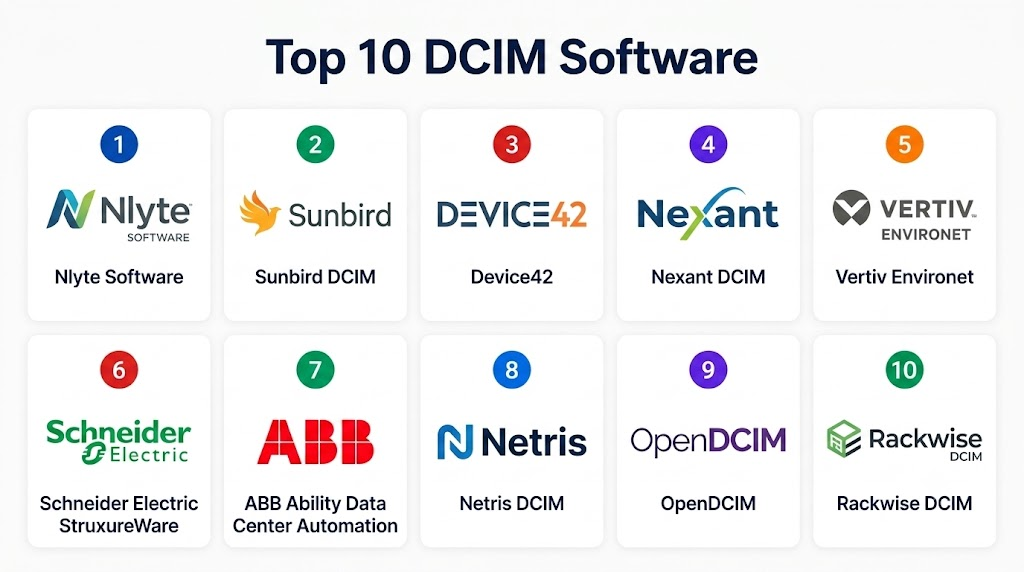
Top 10 DCIM Software
1- Nlyte Software
Short description: Nlyte is a comprehensive DCIM platform that streamlines asset management, power monitoring, and capacity planning across complex data centers.
Key Features:
- Real-time asset tracking
- Power and environmental monitoring
- Capacity planning tools
- Workflow automation
- Integration with ITSM platforms
Pros: - Robust visualization dashboards
- Strong automation capabilities
Cons: - High initial deployment cost
- Steeper learning curve for new users
Platforms / Deployment: On-premises, SaaS
Security & Compliance: SOC 2, ISO 27001
Integrations & Ecosystem: Connects with ITSM, ERP, BMS systems; API support
Support & Community: Dedicated support, online knowledge base, user forums
2- Sunbird DCIM
Short description: Sunbird provides an intuitive DCIM solution focused on simplifying monitoring, capacity planning, and predictive analytics for data center operations.
Key Features:
- AI-driven predictive insights
- Environmental and energy monitoring
- Cabinet and rack visualization
- Mobile access and reporting
- Workflow automation
Pros: - Modern, user-friendly interface
- Cloud-enabled multi-site management
Cons: - Some advanced features require add-ons
- Limited legacy system integrations
Platforms / Deployment: SaaS, cloud
Security & Compliance: SOC 2, GDPR
Integrations & Ecosystem: APIs, BMS, ITSM integration
Support & Community: 24/7 support, community portal, webinars
3- Device42
Short description: Device42 combines DCIM and IT asset management to deliver full visibility into infrastructure dependencies, helping prevent outages.
Key Features:
- Auto-discovery of devices and dependencies
- Power, cooling, and rack monitoring
- Asset lifecycle management
- API-driven integration
- Analytics dashboards
Pros: - Comprehensive asset dependency mapping
- Strong integration capabilities
Cons: - Can be complex to configure
- UI less intuitive for new users
Platforms / Deployment: On-premises, SaaS
Security & Compliance: SOC 2, HIPAA
Integrations & Ecosystem: ITSM, CMDB, cloud platforms
Support & Community: 24/7 support, documentation, online community
4- Nexant DCIM
Short description: Nexant delivers a DCIM platform focused on energy management and operational efficiency for enterprise-scale data centers.
Key Features:
- Energy consumption monitoring
- Predictive analytics
- Asset and capacity planning
- Reporting and dashboards
- Workflow management
Pros: - Strong energy analytics
- Scalable for large environments
Cons: - Interface may feel dated
- Limited mobile functionality
Platforms / Deployment: On-premises
Security & Compliance: ISO 27001, NERC compliance
Integrations & Ecosystem: Integration with building systems, API access
Support & Community: Dedicated account managers, knowledge base
5- Vertiv Environet
Short description: Vertiv Environet focuses on real-time monitoring and environmental control, enhancing uptime and efficiency.
Key Features:
- Environmental sensors monitoring
- Alerting and notifications
- Capacity and floor space management
- Reporting and dashboards
- Remote monitoring capabilities
Pros: - Real-time monitoring and alerts
- Reliable vendor support
Cons: - Limited advanced analytics
- Higher cost for smaller deployments
Platforms / Deployment: On-premises, hybrid
Security & Compliance: SOC 2, ISO 27001
Integrations & Ecosystem: BMS and IT integrations
Support & Community: Professional services, online resources
6- Schneider Electric StruxureWare
Short description: StruxureWare provides an integrated DCIM solution for facilities and IT teams to optimize energy, cooling, and capacity planning.
Key Features:
- Energy and power monitoring
- Rack and floor visualization
- Capacity and utilization analytics
- Alarming and workflow automation
- Mobile and web access
Pros: - Strong enterprise-grade features
- Reliable hardware and software ecosystem
Cons: - Complex implementation
- Expensive for smaller sites
Platforms / Deployment: On-premises, hybrid
Security & Compliance: ISO 27001, SOC 2, NERC
Integrations & Ecosystem: BMS, ITSM, cloud platforms
Support & Community: Vendor support, training, community forums
7- ABB Ability Data Center Automation
Short description: ABB Ability offers DCIM with a focus on energy efficiency, predictive maintenance, and operational intelligence.
Key Features:
- Energy usage monitoring
- Predictive analytics for maintenance
- Real-time dashboards
- Remote management
- Reporting and compliance tools
Pros: - Strong energy optimization
- Industrial-grade reliability
Cons: - May require ABB hardware for full features
- Limited UI flexibility
Platforms / Deployment: On-premises, cloud
Security & Compliance: ISO 27001
Integrations & Ecosystem: BMS, ITSM, APIs
Support & Community: Technical support, professional services
8- Netris DCIM
Short description: Netris combines network visualization and DCIM to provide full infrastructure insights across data centers.
Key Features:
- Network and device mapping
- Capacity planning
- Power and cooling monitoring
- Alerts and notifications
- API integrations
Pros: - Easy network visibility
- Simplifies multi-site management
Cons: - Limited predictive analytics
- Smaller vendor ecosystem
Platforms / Deployment: SaaS, cloud
Security & Compliance: SOC 2
Integrations & Ecosystem: Network monitoring tools, ITSM
Support & Community: Online support, documentation
9- OpenDCIM
Short description: OpenDCIM is an open-source DCIM tool ideal for organizations seeking cost-effective infrastructure management.
Key Features:
- Asset and rack management
- Power and space monitoring
- Customizable reporting
- API access
- Community-driven updates
Pros: - Free and open-source
- Highly customizable
Cons: - Requires technical expertise
- Limited official support
Platforms / Deployment: On-premises
Security & Compliance: Varies / N/A
Integrations & Ecosystem: APIs and custom scripts
Support & Community: Community forums and GitHub
10- Rackwise DCIM
Short description: Rackwise focuses on infrastructure visualization, energy management, and asset lifecycle tracking for medium to large data centers.
Key Features:
- 3D rack visualization
- Energy and PUE monitoring
- Asset lifecycle management
- Capacity planning and alerts
- Reporting and dashboards
Pros: - Strong visualization tools
- Comprehensive asset tracking
Cons: - Implementation can be time-consuming
- Limited cloud-native features
Platforms / Deployment: On-premises, SaaS
Security & Compliance: SOC 2, ISO 27001
Integrations & Ecosystem: ITSM, BMS, ERP systems
Support & Community: Vendor support, training, online community
Comparison Table
| Tool Name | Best For | Platforms Supported | Deployment | Standout Feature | Public Rating |
|---|---|---|---|---|---|
| Nlyte | Large enterprise DC | On-prem, SaaS | On-prem, SaaS | Workflow automation | N/A |
| Sunbird | Multi-site cloud DC | SaaS | Cloud | AI predictive insights | N/A |
| Device42 | Asset dependency mapping | On-prem, SaaS | On-prem, SaaS | Auto-discovery | N/A |
| Nexant | Energy optimization | On-prem | On-prem | Energy analytics | N/A |
| Vertiv Environet | Environmental monitoring | On-prem, hybrid | Hybrid | Real-time environmental alerts | N/A |
| StruxureWare | Facilities & IT integration | On-prem, hybrid | Hybrid | Energy & capacity planning | N/A |
| ABB Ability | Energy efficiency | On-prem, cloud | Hybrid | Predictive maintenance | N/A |
| Netris | Network & DC visibility | SaaS, cloud | Cloud | Network mapping | N/A |
| OpenDCIM | Cost-conscious DC | On-prem | On-prem | Open-source customization | N/A |
| Rackwise | Visualization & lifecycle | On-prem, SaaS | On-prem, SaaS | 3D rack visualization | N/A |
Evaluation & Scoring Table
| Tool | Core 25% | Ease 15% | Integrations 15% | Security 10% | Performance 10% | Support 10% | Value 15% | Weighted Total |
|---|---|---|---|---|---|---|---|---|
| Nlyte | 9 | 7 | 8 | 8 | 9 | 8 | 7 | 8.2 |
| Sunbird | 8 | 9 | 7 | 8 | 8 | 8 | 8 | 8.1 |
| Device42 | 8 | 7 | 9 | 8 | 8 | 7 | 7 | 7.9 |
| Nexant | 7 | 6 | 7 | 8 | 7 | 7 | 8 | 7.2 |
| Vertiv Environet | 7 | 8 | 6 | 7 | 7 | 7 | 7 | 7.1 |
| StruxureWare | 8 | 6 | 8 | 9 | 8 | 8 | 7 | 7.8 |
| ABB Ability | 7 | 7 | 7 | 8 | 7 | 7 | 7 | 7.1 |
| Netris | 6 | 8 | 7 | 7 | 7 | 7 | 7 | 7.0 |
| OpenDCIM | 6 | 6 | 6 | 6 | 6 | 6 | 9 | 6.5 |
| Rackwise | 7 | 7 | 7 | 7 | 7 | 7 | 7 | 7.0 |
Which DCIM Tool Is Right for You?
- Solo / Small Data Centers: OpenDCIM for cost-effective, customizable infrastructure management.
- SMB / Growing Data Centers: Netris or Vertiv Environet for easy monitoring and multi-site management.
- Mid-Market Enterprises: Sunbird or Device42 for predictive analytics and asset dependency mapping.
- Large Enterprises: Nlyte, StruxureWare, ABB Ability for full-scale operational intelligence, energy optimization, and workflow automation.
- Budget vs Premium: OpenDCIM for low-cost deployment; Nlyte and StruxureWare for full-featured premium DCIM solutions.
- Integrations & Scalability: Sunbird, Device42, and StruxureWare for multi-site, cloud-integrated deployments.
- Security & Compliance Needs: Nlyte, StruxureWare, and ABB Ability offer robust certifications and compliance support.
10 Frequently Asked Questions
1- What is DCIM software?
DCIM software is a platform that centralizes monitoring, management, and optimization of all aspects of a data center including power, cooling, space, and IT assets.
2- Why is DCIM important for modern data centers?
It helps reduce operational costs, prevent outages, improve energy efficiency, ensure compliance, and streamline capacity planning and expansion.
3- Can DCIM integrate with existing IT systems?
Yes, most DCIM tools support integration with ITSM, ERP, building management systems, and cloud platforms for unified operations.
4- Is DCIM suitable for small server rooms?
For small setups, DCIM may be overkill. Tools like OpenDCIM are more cost-effective and customizable for limited infrastructure.
5- Do DCIM solutions support predictive analytics?
Many modern DCIM platforms use AI/ML for predictive maintenance, failure prevention, and operational efficiency forecasting.
6- Can DCIM improve energy efficiency?
Yes, DCIM software monitors power and cooling, provides PUE calculations, and recommends optimizations to reduce energy costs.
7- Is DCIM software cloud-based?
Some tools like Sunbird and Netris offer SaaS/cloud deployment, while others like Nlyte and Rackwise are on-premises or hybrid.
8- How does DCIM handle asset lifecycle management?
It tracks equipment from installation to decommission, including maintenance history, location, and utilization, improving inventory accuracy.
9- What are the key metrics tracked by DCIM?
DCIM tracks power usage, cooling efficiency, rack/cabinet space, temperature, humidity, PUE, asset utilization, and network connectivity.
10- How do I choose the right DCIM tool?
Consider your data center size, integration needs, budget, predictive analytics requirements, and security/compliance requirements when evaluating tools.
DCIM software is an essential enabler for modern data centers seeking operational efficiency, cost reduction, and high uptime. By selecting the right solution based on your infrastructure size, integration requirements, and strategic priorities, you can ensure optimal resource utilization and long-term scalability. Organizations can start with smaller or open-source solutions to gain visibility, then scale to advanced AI-enabled platforms as operational complexity grows. shortlist tools, run a pilot, and validate/scale deployment to match business needs.
