Introduction
Asset Lifecycle Management (ALM) tools are software platforms designed to manage an organization’s assets throughout their entire lifecycle—from procurement and deployment to maintenance and retirement. These tools help companies maximize asset performance, reduce costs, and ensure compliance with regulations. Effective ALM improves operational efficiency, minimizes downtime, and provides data-driven insights for strategic decision-making.
Real-World Use Cases Include:
- Tracking IT hardware and software assets across multiple locations.
- Monitoring industrial machinery and equipment performance to schedule maintenance.
- Managing fleet vehicles and optimizing replacement cycles.
- Ensuring compliance with safety regulations for medical and laboratory assets.
- Budgeting and forecasting for asset procurement and decommissioning.
What Buyers Should Evaluate:
- Scalability: Can the tool handle your asset volume and locations?
- Integration: Does it connect with ERP, CMMS, or financial systems?
- Reporting & Analytics: Are dashboards customizable and actionable?
- Mobile Access: Can field teams update asset data in real-time?
- Compliance & Security: Does it adhere to standards like ISO, SOC 2, or internal policies?
Best For:
Organizations looking to streamline asset tracking, reduce maintenance costs, and extend asset life while ensuring compliance.
Not Ideal For:
Companies with minimal assets or very small operations where manual tracking is sufficient.
Key Trends in Asset Lifecycle Management
- Increased adoption of IoT-enabled assets for real-time monitoring.
- AI-driven predictive maintenance reducing unplanned downtime.
- Cloud-based ALM solutions for remote workforce access.
- Integration with ERP and financial systems for holistic asset visibility.
- Emphasis on sustainability and energy efficiency in asset management.
Methodology
- Evaluated tools based on core asset lifecycle functionalities, ease of use, integration, security, performance, support, and value.
- Included only widely adopted and credible platforms.
- Compared deployment options: cloud, on-premises, and hybrid.
- Assessed pros and cons from industry reviews and user feedback.
- Weighted scores applied to generate a final recommendation.
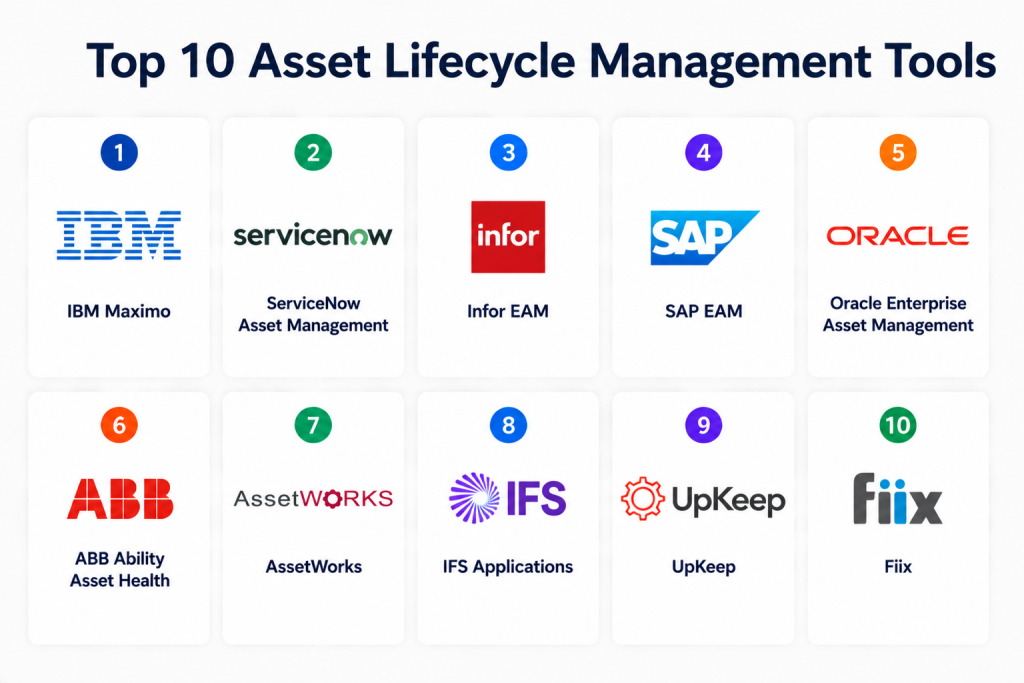
Top 10 Asset Lifecycle Management Tools
1- IBM Maximo
Short Description: IBM Maximo provides enterprise-grade asset management with extensive modules for maintenance, inventory, and work order management.
Key Features:
- Predictive maintenance with AI insights
- Work order and service request management
- Asset hierarchy and location tracking
- Mobile access for field teams
- IoT integration for real-time monitoring
Pros: - Comprehensive enterprise solution
- Strong predictive analytics capabilities
Cons: - High implementation cost
- Steep learning curve
Platforms / Deployment: Cloud, On-premises
Security & Compliance: SOC 2, ISO 27001
Integrations & Ecosystem: ERP systems, IoT platforms, SAP, Oracle
Support & Community: 24/7 support, IBM user forums, knowledge base
2- ServiceNow Asset Management
Short Description: ServiceNow streamlines IT and enterprise asset management with automation and workflow-driven processes.
Key Features:
- Automated asset discovery and tracking
- Lifecycle workflows for IT and non-IT assets
- Financial management of assets
- Cloud-based dashboards and reporting
- Integration with CMDB and ITSM
Pros: - Strong IT asset management focus
- Automation reduces manual work
Cons: - Can be complex for non-IT assets
- Customization may require expertise
Platforms / Deployment: Cloud
Security & Compliance: SOC 2, ISO 27001
Integrations & Ecosystem: ITSM tools, ERP systems, CMDB
Support & Community: Knowledge base, ServiceNow community, professional services
3- Infor EAM
Short Description: Infor EAM offers robust asset management features for industries such as manufacturing, healthcare, and utilities.
Key Features:
- Asset tracking and lifecycle management
- Predictive and preventive maintenance
- Mobile-enabled inspections
- Environmental and regulatory compliance
- Reporting dashboards and KPIs
Pros: - Flexible deployment options
- Industry-specific templates
Cons: - Initial setup can be complex
- Requires ongoing configuration
Platforms / Deployment: Cloud, On-premises, Hybrid
Security & Compliance: Varies / N/A
Integrations & Ecosystem: ERP systems, IoT devices, SCADA
Support & Community: Customer support, online community, training programs
4- SAP EAM
Short Description: SAP EAM integrates asset lifecycle management with enterprise resource planning, providing operational insights.
Key Features:
- Centralized asset repository
- Preventive maintenance scheduling
- Work order and service request management
- Mobile access and reporting
- Energy and sustainability tracking
Pros: - Deep integration with SAP ERP
- Scalable for large enterprises
Cons: - High cost for small businesses
- Complex configuration and customization
Platforms / Deployment: Cloud, On-premises
Security & Compliance: SOC 2, ISO 27001
Integrations & Ecosystem: SAP ERP, IoT sensors, analytics tools
Support & Community: SAP support portal, community forums, training
5- Oracle Enterprise Asset Management
Short Description: Oracle EAM provides an integrated suite to optimize asset performance, reduce costs, and manage compliance.
Key Features:
- Asset lifecycle tracking
- Predictive maintenance with AI insights
- Mobile and cloud accessibility
- Comprehensive reporting dashboards
- Compliance and risk management
Pros: - Enterprise-level functionality
- Strong analytics and reporting
Cons: - Costly for mid-size businesses
- Complexity may require specialized staff
Platforms / Deployment: Cloud, On-premises
Security & Compliance: SOC 2, ISO 27001
Integrations & Ecosystem: ERP, IoT platforms, analytics tools
Support & Community: Oracle support, online forums, professional services
6- ABB Ability Asset Health
Short Description: ABB Ability focuses on industrial asset monitoring and predictive maintenance to improve operational uptime.
Key Features:
- Real-time asset monitoring
- Predictive maintenance using AI
- Cloud-based dashboards
- Condition-based alerts and reporting
- Mobile access for field technicians
Pros: - Strong in industrial environments
- Reliable predictive maintenance
Cons: - Best suited for industrial assets
- Limited IT asset management features
Platforms / Deployment: Cloud
Security & Compliance: Varies / N/A
Integrations & Ecosystem: IoT sensors, industrial control systems
Support & Community: ABB support, customer training, technical documentation
7- AssetWorks
Short Description: AssetWorks provides flexible ALM solutions for government, education, and enterprise organizations.
Key Features:
- Fleet and equipment tracking
- Preventive maintenance scheduling
- Mobile-enabled inspections
- Financial and compliance reporting
- Dashboard analytics and KPIs
Pros: - User-friendly interface
- Customizable workflows
Cons: - Smaller community compared to enterprise platforms
- Limited global deployment options
Platforms / Deployment: Cloud, On-premises
Security & Compliance: Varies / N/A
Integrations & Ecosystem: ERP systems, GIS platforms
Support & Community: Customer support, training, user forums
8- IFS Applications
Short Description: IFS Applications combines enterprise asset management with service and project management modules.
Key Features:
- Full asset lifecycle management
- Service and maintenance planning
- Predictive analytics and AI-based insights
- Mobile field operations
- Energy and sustainability monitoring
Pros: - Strong integration with project and service modules
- Scalable for global enterprises
Cons: - Complexity may require training
- Initial setup time can be high
Platforms / Deployment: Cloud, On-premises, Hybrid
Security & Compliance: SOC 2, ISO 27001
Integrations & Ecosystem: ERP, IoT, analytics platforms
Support & Community: Support portal, online community, consulting services
9- UpKeep
Short Description: UpKeep is a mobile-first ALM tool focused on simplifying maintenance management for teams of all sizes.
Key Features:
- Mobile maintenance requests and work orders
- Preventive maintenance scheduling
- Asset tracking and inventory management
- Reporting dashboards and KPIs
- Offline mobile access
Pros: - Easy to use and implement
- Affordable for small to mid-size teams
Cons: - Limited advanced analytics
- May not scale for large enterprises
Platforms / Deployment: Cloud
Security & Compliance: Varies / N/A
Integrations & Ecosystem: ERP, IoT sensors, analytics tools
Support & Community: Online help center, customer support, user community
10- Fiix
Short Description: Fiix is a cloud-based ALM solution focused on predictive maintenance, workflow automation, and asset optimization.
Key Features:
- Predictive and preventive maintenance
- Work order management and automation
- Asset performance tracking
- Mobile-enabled inspections
- Reporting dashboards and KPI tracking
Pros: - Cloud-based and easy to deploy
- Strong predictive maintenance tools
Cons: - May require integrations for full enterprise functionality
- Limited customization for very large organizations
Platforms / Deployment: Cloud
Security & Compliance: SOC 2, ISO 27001
Integrations & Ecosystem: ERP, IoT platforms, analytics tools
Support & Community: Customer support, online knowledge base, training
Comparison Table
| Tool Name | Best For | Platforms Supported | Deployment | Standout Feature | Public Rating |
|---|---|---|---|---|---|
| IBM Maximo | Large enterprises | Windows, Linux | Cloud, On-prem | Predictive maintenance | N/A |
| ServiceNow Asset Management | IT-heavy organizations | Web | Cloud | Automated workflows | N/A |
| Infor EAM | Manufacturing & utilities | Web, Mobile | Cloud, On-prem, Hybrid | Industry-specific templates | N/A |
| SAP EAM | Large-scale ERP integration | Web, Mobile | Cloud, On-prem | ERP integration | N/A |
| Oracle EAM | Enterprises seeking analytics | Web, Mobile | Cloud, On-prem | AI insights | N/A |
| ABB Ability Asset Health | Industrial operations | Web, Mobile | Cloud | Real-time monitoring | N/A |
| AssetWorks | Government & education | Web, Mobile | Cloud, On-prem | Fleet & equipment tracking | N/A |
| IFS Applications | Global enterprises | Web, Mobile | Cloud, On-prem, Hybrid | Service & project integration | N/A |
| UpKeep | Small to mid-size teams | Web, Mobile | Cloud | Mobile-first maintenance | N/A |
| Fiix | Predictive maintenance focus | Web, Mobile | Cloud | Maintenance workflow automation | N/A |
Evaluation & Scoring Table
| Tool | Core 25% | Ease 15% | Integrations 15% | Security 10% | Performance 10% | Support 10% | Value 15% | Weighted Total |
|---|---|---|---|---|---|---|---|---|
| IBM Maximo | 9 | 7 | 9 | 9 | 9 | 8 | 7 | 8.5 |
| ServiceNow | 8 | 8 | 8 | 9 | 8 | 8 | 8 | 8.1 |
| Infor EAM | 8 | 7 | 8 | 7 | 8 | 8 | 8 | 7.7 |
| SAP EAM | 9 | 6 | 9 | 9 | 8 | 8 | 7 | 8.1 |
| Oracle EAM | 9 | 7 | 8 | 9 | 8 | 7 | 7 | 7.9 |
| ABB Ability | 7 | 8 | 7 | 7 | 8 | 7 | 7 | 7.3 |
| AssetWorks | 7 | 8 | 7 | 7 | 7 | 7 | 8 | 7.3 |
| IFS Applications | 8 | 7 | 8 | 8 | 8 | 7 | 7 | 7.7 |
| UpKeep | 7 | 9 | 6 | 6 | 7 | 7 | 8 | 7.1 |
| Fiix | 7 | 8 | 7 | 7 | 7 | 7 | 8 | 7.3 |
Which Asset Lifecycle Management Tool Is Right for You?
- Solo / Small Teams: UpKeep and Fiix provide easy-to-use mobile solutions at affordable cost.
- SMBs: AssetWorks or ABB Ability offer industry-tailored functionality with moderate scaling.
- Mid-Market: ServiceNow and Infor EAM provide workflow automation and integration with ERP.
- Enterprise: IBM Maximo, SAP EAM, and Oracle EAM offer full enterprise scalability with predictive analytics, compliance, and deep reporting.
FAQs
1- What is the main purpose of ALM tools?
ALM tools manage assets throughout their lifecycle to reduce downtime, optimize performance, and ensure compliance. They provide insights for cost reduction and strategic decision-making.
2- Can ALM software integrate with ERP systems?
Yes, most enterprise ALM tools like SAP EAM, Oracle EAM, and IBM Maximo support ERP integration for financial tracking, procurement, and reporting.
3- Are cloud-based ALM tools secure?
Most cloud ALM platforms follow industry security standards such as SOC 2 and ISO 27001, though always check compliance features before deployment.
4- What is predictive maintenance in ALM?
Predictive maintenance uses IoT data and AI to anticipate equipment failures before they occur, reducing downtime and maintenance costs.
5- Do small businesses need ALM tools?
Small businesses may not need full-scale ALM. Mobile-first tools like UpKeep and Fiix offer affordable, simple solutions for asset tracking.
6- Can ALM help with compliance?
Yes, ALM tools track asset maintenance and usage, ensuring adherence to regulatory standards in healthcare, industrial, and IT environments.
7- Is mobile access important for ALM?
Absolutely. Field teams require real-time updates for inspections, maintenance, and inventory, making mobile-enabled ALM tools essential.
8- How does ALM support cost reduction?
By optimizing maintenance schedules, extending asset life, and reducing unplanned downtime, ALM tools lower operational and replacement costs.
9- Can ALM tools manage IT and non-IT assets together?
Some platforms like IBM Maximo and ServiceNow support both IT and non-IT assets, while others specialize in industrial or IT assets only.
10- What deployment options exist for ALM tools?
ALM platforms offer Cloud, On-premises, and Hybrid deployments, allowing organizations to choose based on scalability, cost, and IT infrastructure.
Conclusion
Asset Lifecycle Management tools are critical for organizations seeking efficiency, compliance, and cost reduction in managing assets. Selecting the right ALM platform depends on company size, industry, and integration requirements. Enterprise tools like IBM Maximo, SAP EAM, and Oracle EAM excel in scalability and predictive maintenance, while UpKeep and Fiix provide simple, mobile-first solutions for smaller teams. Evaluate core functionality, integration capabilities, mobile access, and security compliance to ensure the best fit. Start with a shortlist, pilot the selected tools, validate effectiveness, and then scale across your organization to maximize asset performance and ROI.
