Introduction
Customer Identity and Access Management (CIAM) is a specialized identity management system designed to handle customer identities, authentication, and access across digital platforms. Unlike traditional IAM, which focuses on employees, CIAM is built for scalability, user experience, and security in customer-facing applications.
In today’s digital-first world, businesses must deliver seamless login experiences while protecting user data. With increasing privacy regulations and rising cyber threats, CIAM plays a crucial role in enabling secure authentication, personalization, and compliance. It also supports modern approaches like social login, passwordless authentication, and multi-factor authentication (MFA).
Real-world use cases:
- Managing customer logins for web and mobile apps
- Enabling social login (Google, Facebook, etc.)
- Securing eCommerce and fintech platforms
- Personalizing user experiences
- Handling millions of customer identities
What buyers should evaluate:
- Scalability for large user bases
- Authentication methods (MFA, passwordless)
- User experience and login flow
- API-first architecture
- Integration with apps and platforms
- Data privacy and compliance features
- Identity lifecycle management
- Customization and branding
- Security controls and monitoring
- Pricing and flexibility
Best for: SaaS platforms, eCommerce businesses, fintech companies, mobile apps, and enterprises managing large customer bases
Not ideal for: Internal employee-only identity systems with no customer-facing authentication
Key Trends in Customer IAM (CIAM)
- Rapid adoption of passwordless authentication and passkeys
- Increased use of AI-driven fraud detection and risk-based authentication
- Strong focus on user experience and frictionless login
- Growth of privacy-first identity management
- Integration with Zero Trust security models
- API-first CIAM platforms for developers
- Expansion into multi-cloud and SaaS ecosystems
- Increased use of biometric authentication
- Real-time identity analytics and behavior tracking
- Compliance-driven identity architecture
How We Selected These Tools (Methodology)
- Strong market presence and adoption
- Feature completeness for CIAM use cases
- Scalability for large user bases
- Security and compliance capabilities
- Developer-friendly integrations and APIs
- Ease of deployment and customization
- Support for modern authentication methods
- Performance and reliability
- Vendor reputation and maturity
- Fit across industries and company sizes
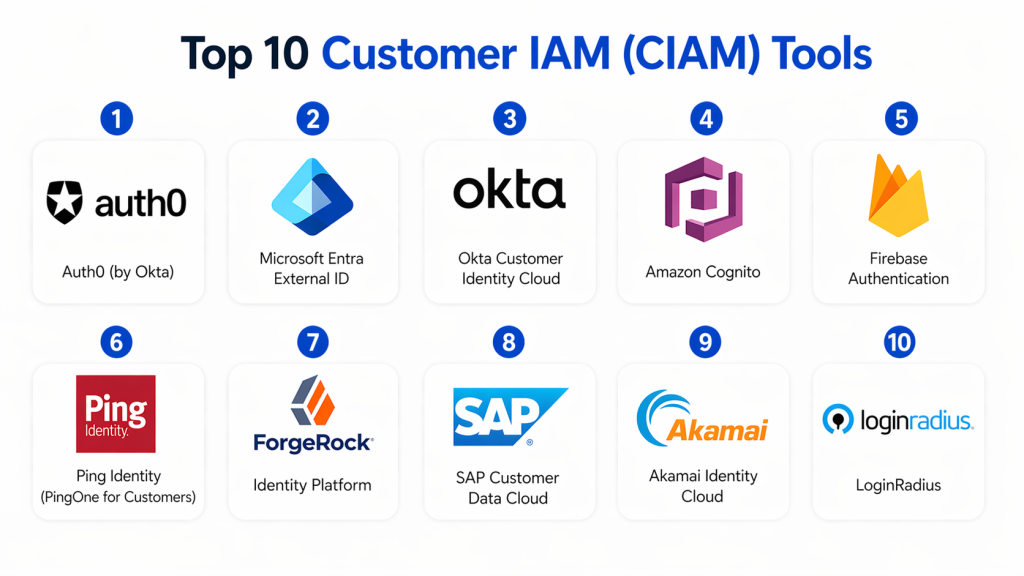
Top 10 Customer IAM (CIAM) Tools
#1 — Auth0 (by Okta)
Short description :
Auth0 is one of the most popular CIAM platforms offering flexible authentication and identity management. It supports social login, MFA, and passwordless authentication. It is highly customizable for developers. It integrates easily with applications. It is widely used by startups and enterprises. It offers strong scalability.
Key Features
- Social login
- MFA and passwordless
- API-first architecture
- Custom authentication flows
- Identity federation
Pros
- Developer-friendly
- Highly customizable
- Scalable
Cons
- Pricing can increase with scale
- Requires technical setup
Platforms / Deployment
- Cloud
Security & Compliance
- MFA, RBAC, encryption
- Compliance: Not publicly stated
Integrations & Ecosystem
Works with modern applications and APIs.
- APIs
- SaaS apps
- Mobile apps
Support & Community
- Strong community
- Developer support
#2 — Microsoft Entra External ID
Short description :
Microsoft Entra External ID is a CIAM solution designed for customer identity management. It supports authentication, access control, and integration with Microsoft ecosystem. It is scalable for large enterprises. It enables secure login experiences. It supports customization. It is widely used.
Key Features
- Identity management
- Access control
- MFA
- Policy enforcement
- Integration
Pros
- Strong Microsoft integration
- Scalable
- Secure
Cons
- Complex setup
- Limited outside Microsoft
Platforms / Deployment
- Cloud
Security & Compliance
- MFA, RBAC
- Compliance: Not publicly stated
Integrations & Ecosystem
- Microsoft services
- SaaS apps
Support & Community
- Enterprise support
#3 — Okta Customer Identity Cloud
Short description :
Okta CIAM provides identity management for customer-facing applications. It supports authentication, authorization, and user management. It integrates with enterprise systems. It is scalable. It offers strong security features. It is widely used.
Key Features
- Authentication
- Authorization
- MFA
- User management
- API integration
Pros
- Scalable
- Secure
- Flexible
Cons
- Expensive
- Setup complexity
Platforms / Deployment
- Cloud
Security & Compliance
- MFA, RBAC
- Compliance: Not publicly stated
Integrations & Ecosystem
- APIs
- SaaS platforms
Support & Community
- Strong support
#4 — Amazon Cognito
Short description :
Amazon Cognito is a CIAM solution from AWS. It enables secure user authentication and identity management. It integrates with AWS services. It supports scalability. It is ideal for developers. It offers flexible authentication options.
Key Features
- User pools
- Identity federation
- MFA
- Social login
- Integration
Pros
- Scalable
- Developer-friendly
- AWS integration
Cons
- Complex configuration
- UI not user-friendly
Platforms / Deployment
- Cloud
Security & Compliance
- MFA, encryption
- Compliance: Not publicly stated
#5 — Firebase Authentication
Short description :
Firebase Authentication provides easy-to-use authentication for apps. It supports email, phone, and social login. It integrates with Firebase ecosystem. It is simple and scalable. It is widely used by developers. It offers fast setup.
Key Features
- Email/password login
- Social login
- Phone authentication
- Integration
- SDK support
Pros
- Easy setup
- Developer-friendly
- Scalable
Cons
- Limited enterprise features
- Google dependency
Platforms / Deployment
- Cloud
Security & Compliance
- MFA, encryption
- Compliance: Not publicly stated
#6 — Ping Identity (PingOne for Customers)
Short description :
Ping Identity offers CIAM capabilities for secure customer access. It supports authentication and identity management. It integrates with enterprise systems. It is scalable. It supports modern security practices. It is suitable for enterprises.
Key Features
- Authentication
- Access control
- MFA
- Identity federation
- API support
Pros
- Enterprise-grade
- Secure
- Scalable
Cons
- Complex setup
- High cost
Platforms / Deployment
- Cloud / Hybrid
Security & Compliance
- MFA, RBAC
- Compliance: Not publicly stated
#7 — ForgeRock Identity Platform
Short description :
ForgeRock provides CIAM with strong identity management capabilities. It supports authentication and access control. It integrates with enterprise systems. It is scalable. It supports complex use cases. It is widely used.
Key Features
- Identity management
- Access control
- MFA
- Federation
- APIs
Pros
- Flexible
- Enterprise-ready
- Scalable
Cons
- Complex
- Expensive
Platforms / Deployment
- Cloud / Hybrid
Security & Compliance
- MFA, RBAC
- Compliance: Not publicly stated
#8 — SAP Customer Data Cloud
Short description :
SAP Customer Data Cloud focuses on customer identity and consent management. It supports authentication and privacy compliance. It integrates with SAP ecosystem. It is scalable. It is suitable for enterprises. It offers governance features.
Key Features
- Identity management
- Consent management
- Authentication
- Compliance
- Integration
Pros
- Strong compliance
- SAP integration
- Scalable
Cons
- Limited outside SAP
- Complex
Platforms / Deployment
- Cloud
Security & Compliance
- RBAC, MFA
- Compliance: Not publicly stated
#9 — Akamai Identity Cloud
Short description :
Akamai Identity Cloud provides CIAM with strong security and performance. It supports authentication and identity management. It integrates with enterprise systems. It is scalable. It offers high performance. It is used globally.
Key Features
- Authentication
- Identity management
- MFA
- Integration
- Security
Pros
- High performance
- Scalable
- Secure
Cons
- Complex
- Expensive
Platforms / Deployment
- Cloud
Security & Compliance
- MFA, RBAC
- Compliance: Not publicly stated
#10 — LoginRadius
Short description :
LoginRadius is a CIAM platform designed for customer identity management. It supports authentication, social login, and user management. It is easy to integrate. It is scalable. It is suitable for SMBs and enterprises. It offers customization.
Key Features
- Social login
- MFA
- User management
- API integration
- Customization
Pros
- Easy integration
- Scalable
- Flexible
Cons
- Limited enterprise depth
- Smaller ecosystem
Platforms / Deployment
- Cloud
Security & Compliance
- MFA, encryption
- Compliance: Not publicly stated
Comparison Table
| Tool | Best For | Platform | Deployment | Feature | Rating |
|---|---|---|---|---|---|
| Auth0 | Devs | Cloud | Cloud | Custom flows | N/A |
| Microsoft | Enterprise | Cloud | Cloud | Integration | N/A |
| Okta | Enterprise | Cloud | Cloud | Flexibility | N/A |
| Cognito | Devs | Cloud | Cloud | AWS integration | N/A |
| Firebase | Devs | Cloud | Cloud | Easy setup | N/A |
| Ping | Enterprise | Multi | Hybrid | Security | N/A |
| ForgeRock | Enterprise | Multi | Hybrid | Flexibility | N/A |
| SAP | Enterprise | Cloud | Cloud | Compliance | N/A |
| Akamai | Enterprise | Cloud | Cloud | Performance | N/A |
| LoginRadius | SMB | Cloud | Cloud | Simplicity | N/A |
Evaluation & Scoring of CIAM Tools
| Tool | Core | Ease | Integration | Security | Performance | Support | Value | Total |
|---|---|---|---|---|---|---|---|---|
| Auth0 | 9 | 8 | 10 | 9 | 9 | 9 | 8 | 9.0 |
| Microsoft | 9 | 9 | 10 | 9 | 9 | 9 | 9 | 9.2 |
| Okta | 9 | 8 | 9 | 9 | 9 | 9 | 8 | 8.9 |
| Cognito | 8 | 7 | 9 | 9 | 9 | 8 | 9 | 8.6 |
| Firebase | 8 | 9 | 8 | 8 | 8 | 8 | 9 | 8.5 |
| Ping | 9 | 7 | 9 | 9 | 9 | 9 | 7 | 8.6 |
| ForgeRock | 9 | 7 | 9 | 9 | 9 | 8 | 7 | 8.5 |
| SAP | 8 | 7 | 8 | 9 | 8 | 8 | 7 | 8.0 |
| Akamai | 9 | 7 | 8 | 9 | 10 | 8 | 7 | 8.3 |
| LoginRadius | 8 | 8 | 8 | 8 | 8 | 8 | 9 | 8.3 |
Which CIAM Tool Is Right for You?
Solo / Freelancer
- Firebase Authentication
SMB
- LoginRadius
Mid-Market
- Auth0, Cognito
Enterprise
- Okta, Microsoft, Ping
Budget vs Premium
- Budget → Firebase
- Premium → Okta
Feature Depth vs Ease
- Easy → Firebase
- Advanced → Auth0
Integrations & Scalability
- Best → Auth0, Okta
Security & Compliance Needs
- High security → Ping, Akamai
Frequently Asked Questions (FAQs)
1. What is Customer IAM (CIAM)?
Customer IAM (CIAM) is a system used to manage customer identities and control their access to applications and services. It focuses on authentication, authorization, and user data protection. CIAM platforms also help deliver smooth login experiences. They are designed to handle large-scale user bases securely.
2. Why is CIAM important for businesses?
CIAM is important because it helps protect customer data while ensuring a seamless user experience. It reduces the risk of identity-based attacks and fraud. It also supports compliance with data privacy regulations. Businesses use CIAM to build trust and improve customer engagement.
3. How does CIAM work?
CIAM works by authenticating users through various methods like passwords, biometrics, or social login. It manages user identities and controls access based on defined policies. It also stores and protects user data securely. Many platforms include monitoring and analytics to detect suspicious behavior.
4. Who should use CIAM solutions?
CIAM solutions are used by businesses that manage large numbers of customer accounts. This includes SaaS companies, eCommerce platforms, fintech apps, and mobile applications. Any organization offering digital services benefits from CIAM. It is especially useful for customer-facing platforms.
5. Is CIAM scalable for large user bases?
Yes, CIAM platforms are built to handle millions of users efficiently. They use cloud-based architectures to scale automatically as demand grows. This makes them suitable for global applications. Scalability is one of the key advantages of CIAM solutions.
6. Does CIAM support multi-factor authentication (MFA)?
Yes, most CIAM platforms support MFA to enhance security. It adds an extra layer of protection beyond passwords. Users may verify their identity using OTPs, biometrics, or push notifications. This significantly reduces the risk of unauthorized access.
7. Is CIAM secure for handling customer data?
CIAM platforms are designed with strong security controls such as encryption and access policies. They help protect sensitive customer information from breaches. Proper configuration is important to ensure maximum security. Regular monitoring also helps detect potential threats.
8. What is the difference between CIAM and IAM?
CIAM focuses on managing customer identities, while IAM is used for internal users like employees. CIAM emphasizes user experience and scalability. IAM focuses more on internal security and access control. Both systems are complementary and often used together.
9. Is CIAM expensive to implement?
The cost of CIAM depends on the platform and scale of users. Some tools offer affordable plans for startups and SMBs. Enterprise-grade solutions can be more expensive. However, the investment is justified by improved security and user experience.
10. What are alternatives to CIAM?
CIAM works alongside IAM, SSO, and MFA solutions rather than replacing them. IAM manages internal identities, while SSO simplifies authentication. MFA adds an extra security layer. Together, these tools create a complete identity and access management strategy.
Conclusion
Customer IAM (CIAM) tools are essential for managing customer identities securely while delivering seamless user experiences. As digital platforms continue to grow, CIAM plays a key role in protecting user data, enabling personalization, and ensuring compliance.
The right CIAM solution depends on your business needs and scale. Tools like Auth0 and Okta provide flexibility and scalability, while Firebase and LoginRadius offer simplicity for smaller use cases. Organizations should evaluate their requirements, test platforms, and choose a solution that balances security, usability, and scalability.
