Introduction
Identity Governance & Administration (IGA) refers to a set of processes and tools used to manage digital identities, control user access, and ensure compliance across systems. It focuses on who has access to what, why they have it, and whether it is still appropriate. While Identity Management handles authentication, IGA ensures governance, visibility, and lifecycle control over identities and permissions.
In today’s environment—driven by cloud adoption, SaaS sprawl, remote work, and strict compliance requirements—IGA has become a critical pillar of cybersecurity and Zero Trust architecture. Organizations must continuously monitor and manage user access to prevent privilege creep, insider threats, and regulatory violations.
Real-world use cases:
- Managing user lifecycle (joiner, mover, leaver)
- Automating access provisioning and deprovisioning
- Conducting access reviews and certifications
- Ensuring compliance with regulatory standards
- Monitoring identity risks and access anomalies
What buyers should evaluate:
- Identity lifecycle management capabilities
- Access certification and review workflows
- Role-based access control (RBAC)
- Integration with IAM, SSO, and HR systems
- Automation and policy enforcement
- Reporting and audit capabilities
- Scalability across users and systems
- Ease of implementation
- Cloud vs hybrid deployment
- Pricing and licensing
Best for: Enterprises, compliance-driven industries, IT security teams, HR-integrated environments, and organizations with complex access needs
Not ideal for: Small businesses with simple access requirements and minimal compliance obligations
Key Trends in Identity Governance & Administration (IGA)
- Rise of AI-driven identity analytics and risk scoring
- Integration with Zero Trust security frameworks
- Cloud-native IGA platforms replacing legacy systems
- Automation of identity lifecycle management
- Continuous access certification instead of periodic reviews
- Identity threat detection and response (ITDR) integration
- API-first and microservices-based identity platforms
- Expansion into SaaS and multi-cloud environments
- Increased focus on user experience and automation
- Compliance-driven identity governance models
How We Selected These Tools (Methodology)
- Strong enterprise adoption and market presence
- Comprehensive IGA feature set
- Proven scalability and performance
- Security and compliance capabilities
- Integration with enterprise ecosystems
- Ease of deployment and usability
- Automation and AI capabilities
- Vendor reputation and maturity
- Support for hybrid and cloud environments
- Fit across industries and organization sizes
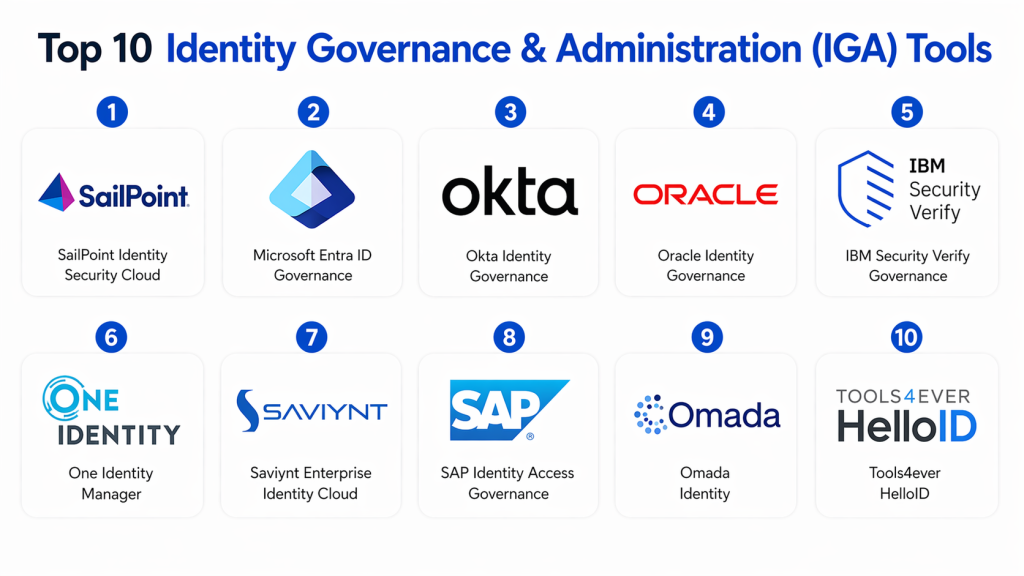
Top 10 Identity Governance & Administration (IGA) Tools
#1 — SailPoint Identity Security Cloud
Short description :
SailPoint is a leading IGA platform offering identity lifecycle management and governance. It provides strong access certification and policy enforcement. It supports cloud and enterprise environments. It is widely used in large organizations. It offers automation and AI-driven insights. It is known for scalability and compliance capabilities.
Key Features
- Identity lifecycle management
- Access certification
- Policy enforcement
- AI-driven analytics
- Role management
- Automation
Pros
- Industry leader
- Strong compliance features
- Scalable
Cons
- Complex implementation
- Expensive
Platforms / Deployment
- Cloud / Hybrid
Security & Compliance
- RBAC, MFA, audit logs
- Compliance: Not publicly stated
Integrations & Ecosystem
Supports enterprise integrations and identity systems.
- HR systems
- IAM tools
- APIs
Support & Community
- Enterprise support
- Strong ecosystem
#2 — Microsoft Entra ID Governance
Short description :
Microsoft Entra ID Governance provides identity governance capabilities within Microsoft ecosystem. It enables lifecycle management and access reviews. It integrates with Azure and Microsoft 365. It is widely used in enterprises. It supports automation. It is ideal for Microsoft-centric environments.
Key Features
- Access reviews
- Lifecycle workflows
- Entitlement management
- Role assignments
- Policy enforcement
Pros
- Strong integration with Microsoft
- Easy deployment
- Scalable
Cons
- Limited outside Microsoft ecosystem
- Requires configuration
Platforms / Deployment
- Cloud
Security & Compliance
- RBAC, MFA
- Compliance: Not publicly stated
Integrations & Ecosystem
- Microsoft services
- SaaS apps
Support & Community
- Enterprise support
#3 — Okta Identity Governance
Short description :
Okta Identity Governance extends Okta’s identity platform with governance features. It offers lifecycle management and access control. It integrates with SSO and IAM. It is suitable for enterprises. It supports automation. It is widely adopted.
Key Features
- Lifecycle management
- Access governance
- Policy enforcement
- Automation
- Integration
Pros
- Strong ecosystem
- Flexible
- Cloud-native
Cons
- Expensive
- Complex configuration
Platforms / Deployment
- Cloud
Security & Compliance
- MFA, RBAC
- Compliance: Not publicly stated
Integrations & Ecosystem
- SaaS apps
- APIs
Support & Community
- Strong support
#4 — Oracle Identity Governance
Short description :
Oracle Identity Governance provides enterprise-grade identity governance capabilities. It supports lifecycle management and compliance. It integrates with Oracle ecosystem. It is suitable for large organizations. It offers strong reporting. It is scalable.
Key Features
- Lifecycle management
- Access control
- Compliance reporting
- Automation
- Role management
Pros
- Enterprise-grade
- Strong compliance
- Scalable
Cons
- Complex
- Expensive
Platforms / Deployment
- Cloud / On-prem
Security & Compliance
- RBAC, MFA
- Compliance: Not publicly stated
#5 — IBM Security Verify Governance
Short description :
IBM Security Verify Governance offers identity governance capabilities with strong compliance focus. It supports lifecycle management and access reviews. It integrates with enterprise systems. It is suitable for large enterprises. It offers scalability. It supports hybrid environments.
Key Features
- Identity lifecycle
- Access reviews
- Compliance
- Automation
- Reporting
Pros
- Strong compliance
- Scalable
- Enterprise-ready
Cons
- Complex deployment
- High cost
Platforms / Deployment
- Cloud / Hybrid
Security & Compliance
- MFA, RBAC
- Compliance: Not publicly stated
#6 — One Identity Manager
Short description :
One Identity Manager provides identity governance with strong automation and lifecycle management. It supports role-based access control and compliance. It integrates with enterprise systems. It is suitable for large organizations. It offers flexibility. It supports hybrid environments.
Key Features
- Lifecycle management
- RBAC
- Automation
- Compliance
- Reporting
Pros
- Flexible
- Strong features
- Scalable
Cons
- Complex
- Requires expertise
Platforms / Deployment
- Cloud / Hybrid
Security & Compliance
- RBAC, MFA
- Compliance: Not publicly stated
#7 — Saviynt Enterprise Identity Cloud
Short description :
Saviynt offers cloud-native identity governance with strong compliance and analytics. It supports access management and lifecycle automation. It is suitable for enterprises. It offers scalability. It focuses on cloud security. It integrates with SaaS platforms.
Key Features
- Identity governance
- Access control
- Analytics
- Automation
- Reporting
Pros
- Cloud-native
- Strong analytics
- Scalable
Cons
- Complex setup
- Learning curve
Platforms / Deployment
- Cloud
Security & Compliance
- RBAC, MFA
- Compliance: Not publicly stated
#8 — SAP Identity Access Governance
Short description :
SAP Identity Access Governance focuses on governance within SAP environments. It provides access control and compliance features. It supports role management. It integrates with SAP systems. It is suitable for enterprises. It is scalable.
Key Features
- Access governance
- Role management
- Compliance
- Reporting
- Integration
Pros
- Strong SAP integration
- Compliance-focused
- Scalable
Cons
- Limited outside SAP
- Complex
Platforms / Deployment
- Cloud / On-prem
Security & Compliance
- RBAC
- Compliance: Not publicly stated
#9 — Omada Identity
Short description :
Omada Identity provides identity governance with focus on automation and compliance. It supports lifecycle management and access reviews. It integrates with enterprise systems. It is suitable for mid-market and enterprise. It is scalable. It offers flexibility.
Key Features
- Lifecycle management
- Access reviews
- Automation
- Compliance
- Reporting
Pros
- Flexible
- Scalable
- Strong governance
Cons
- Less known
- UI improvements needed
Platforms / Deployment
- Cloud / Hybrid
Security & Compliance
- RBAC, MFA
- Compliance: Not publicly stated
#10 — Tools4ever HelloID
Short description :
HelloID provides identity governance and provisioning with automation. It supports lifecycle management and access control. It is suitable for SMBs and enterprises. It offers ease of use. It integrates with HR systems. It is scalable.
Key Features
- Provisioning
- Lifecycle management
- Access control
- Automation
- Reporting
Pros
- Easy to use
- Affordable
- Flexible
Cons
- Limited enterprise depth
- Smaller ecosystem
Platforms / Deployment
- Cloud
Security & Compliance
- RBAC
- Compliance: Not publicly stated
Comparison Table
| Tool | Best For | Platform | Deployment | Feature | Rating |
|---|---|---|---|---|---|
| SailPoint | Enterprise | Multi | Hybrid | AI governance | N/A |
| Microsoft | Enterprise | Cloud | Cloud | Integration | N/A |
| Okta | Enterprise | Cloud | Cloud | Flexibility | N/A |
| Oracle | Enterprise | Multi | Hybrid | Compliance | N/A |
| IBM | Enterprise | Multi | Hybrid | Governance | N/A |
| One Identity | Enterprise | Multi | Hybrid | Automation | N/A |
| Saviynt | Enterprise | Cloud | Cloud | Analytics | N/A |
| SAP | Enterprise | Multi | Hybrid | SAP integration | N/A |
| Omada | Mid-market | Multi | Hybrid | Governance | N/A |
| HelloID | SMB | Cloud | Cloud | Provisioning | N/A |
Evaluation & Scoring of IGA Tools
| Tool | Core | Ease | Integration | Security | Performance | Support | Value | Total |
|---|---|---|---|---|---|---|---|---|
| SailPoint | 10 | 7 | 9 | 10 | 9 | 9 | 7 | 8.9 |
| Microsoft | 9 | 9 | 10 | 9 | 9 | 9 | 9 | 9.2 |
| Okta | 9 | 8 | 9 | 9 | 9 | 9 | 8 | 8.9 |
| Oracle | 9 | 6 | 8 | 9 | 8 | 8 | 7 | 8.1 |
| IBM | 9 | 6 | 8 | 9 | 8 | 8 | 7 | 8.1 |
| One Identity | 9 | 7 | 8 | 9 | 8 | 8 | 8 | 8.4 |
| Saviynt | 9 | 7 | 8 | 9 | 8 | 8 | 8 | 8.4 |
| SAP | 8 | 6 | 8 | 9 | 8 | 7 | 7 | 7.9 |
| Omada | 8 | 7 | 7 | 8 | 8 | 7 | 8 | 7.9 |
| HelloID | 7 | 8 | 7 | 8 | 7 | 7 | 9 | 7.8 |
Which IGA Tool Is Right for You?
Solo / Freelancer
- Not required
SMB
- HelloID
Mid-Market
- Omada, One Identity
Enterprise
- SailPoint, Microsoft, Okta
Budget vs Premium
- Budget → HelloID
- Premium → SailPoint
Feature Depth vs Ease
- Easy → Microsoft
- Advanced → SailPoint
Security Needs
- High security → SailPoint
Frequently Asked Questions (FAQs)
1. What is Identity Governance & Administration (IGA)?
Identity Governance & Administration (IGA) is a framework used to manage and control user identities and their access rights across systems. It ensures that users have the correct level of access based on their roles. IGA tools also help track and review permissions regularly. This improves visibility and reduces unauthorized access risks.
2. Why is IGA important for organizations?
IGA is important because it helps organizations maintain security and compliance. It prevents users from having excessive or outdated access permissions. It also ensures proper tracking of access across systems. This reduces insider threats and helps meet regulatory requirements.
3. How does IGA work?
IGA works by managing the entire identity lifecycle, including user onboarding, role assignment, and access removal. It automates access provisioning based on policies. It also conducts periodic access reviews. All activities are logged for auditing and compliance purposes.
4. Who should use IGA solutions?
IGA solutions are mainly used by enterprises and organizations with complex IT environments. They are especially useful in industries like finance, healthcare, and government. IT security teams and compliance officers rely on IGA tools. Any organization with large user bases benefits from it.
5. Is IGA difficult to implement?
IGA implementation can be complex, especially in large organizations. It requires planning, integration with existing systems, and role definition. However, modern cloud-based tools simplify deployment. Starting with phased implementation helps reduce complexity.
6. Does IGA support cloud environments?
Yes, most modern IGA tools support cloud and hybrid environments. They can manage access across SaaS, cloud platforms, and on-prem systems. This flexibility is essential for organizations using multi-cloud setups. Cloud-native IGA solutions are becoming increasingly popular.
7. What is access certification in IGA?
Access certification is the process of reviewing and validating user permissions regularly. Managers or administrators verify whether access is still needed. This helps remove unnecessary or risky access. It is critical for compliance and security.
8. What is the difference between IGA and IAM?
IAM focuses on authentication and access control, while IGA focuses on governance and compliance. IAM ensures users can log in securely. IGA ensures users only have the right level of access. Both are complementary and used together.
9. Can IGA help with compliance requirements?
Yes, IGA plays a major role in meeting compliance standards. It provides audit logs, reporting, and access reviews. These features help organizations demonstrate control over user access. It is commonly used for regulatory compliance.
10. What are the alternatives to IGA?
IGA works alongside IAM, SSO, and PAM solutions. IAM manages identities, SSO simplifies login, and PAM secures privileged access. These tools are not replacements but complementary solutions. Together, they create a complete identity security framework.
Conclusion
Identity Governance & Administration (IGA) tools are essential for managing identities, controlling access, and ensuring compliance in modern organizations. As digital transformation accelerates, the complexity of identity management continues to grow, making IGA a critical component of cybersecurity and Zero Trust strategies.
The best IGA solution depends on organizational size and requirements. Enterprise tools like SailPoint and Microsoft offer deep governance capabilities, while solutions like HelloID provide simpler and cost-effective options. Organizations should evaluate their needs carefully, test solutions, and adopt IGA as part of a broader identity security framework.
