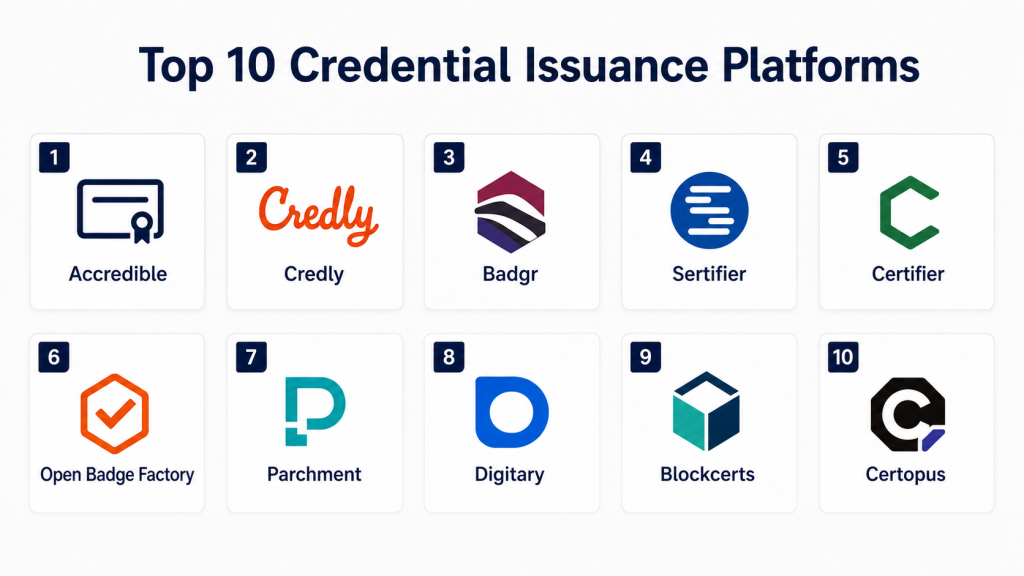
Introduction
Credential Issuance Platforms help organizations create, manage, distribute, and verify digital credentials such as certificates, badges, IDs, licenses, diplomas, training completions, and professional qualifications. These platforms replace manual certificate generation and fragmented verification processes with structured, secure, and scalable systems.
Credential issuance matters because education, workforce validation, compliance training, and professional certification are becoming more digital, global, and verifiable. Organizations need tamper-proof credentials, easy sharing, fraud prevention, and automated workflows to support learners, employees, partners, and institutions.
Real-world use cases include:
- Issuing digital certificates for courses, training, and education
- Managing employee certifications and compliance credentials
- Verifying professional qualifications and licenses
- Providing shareable credentials for job seekers and students
- Supporting digital identity and verifiable credential ecosystems
Buyers should evaluate:
- Credential design and customization
- Verification and anti-fraud capabilities
- Blockchain or secure credential standards support
- Integration with LMS and HR systems
- Bulk issuance and automation workflows
- User experience for recipients
- Analytics and reporting
- API and developer support
- Security and access controls
- Scalability for large credential volumes
Best for: Educational institutions, training providers, enterprises, HR teams, certification bodies, universities, bootcamps, online learning platforms, and compliance-driven organizations.
Not ideal for: Very small teams issuing occasional certificates manually or organizations without a need for verification, auditability, or digital credential sharing.
Key Trends in Credential Issuance Platforms
- Verifiable credentials and digital identity standards are gaining traction for secure and portable credential sharing.
- Blockchain-backed credentials are being adopted for tamper-proof verification and trust.
- Integration with LMS and HR systems is becoming standard to automate credential issuance after course completion or training.
- Micro-credentials and skill-based badges are growing as employers value specific skills over degrees.
- Global credential portability is becoming important for remote work and international education.
- Automated issuance workflows are reducing manual effort in large-scale credential programs.
- Mobile-friendly credential wallets are improving user experience and accessibility.
- Analytics and credential tracking are helping organizations measure program success.
- API-first platforms are enabling developers to embed credential issuance into apps and systems.
- Fraud prevention and verification tools are becoming essential to maintain trust.
How We Evaluated Credential Issuance Platforms
The Top 10 platforms were selected using practical buyer-focused criteria:
- Market adoption across education, enterprise, and certification ecosystems
- Credential issuance capabilities, including bulk issuance and automation
- Verification features, including anti-fraud and tamper-proof mechanisms
- Integration ecosystem, including LMS, HR, CRM, and APIs
- User experience for issuers and recipients
- Customization and branding flexibility
- Scalability for large credential programs
- Security posture, including access controls and audit logs
- Support for standards, including verifiable credentials
- Operational usability, including reporting and analytics
Top 10 Credential Issuance Platforms
#1 — Accredible
Short description: Accredible is a widely used digital credential platform that enables organizations to issue, manage, and verify certificates and badges.
It is commonly used by universities, training providers, and enterprises to provide verifiable credentials.
The platform supports branded certificates, automation workflows, and secure verification.
Accredible is especially useful for organizations that need scalable credential issuance with strong user experience.
Recipients can share credentials easily on professional networks and resumes.
The platform also includes analytics and reporting capabilities.
It is suitable for both SMBs and large institutions.
Accredible is a strong choice for organizations prioritizing credibility and usability.
Key Features
- Digital certificate and badge issuance
- Credential verification system
- Branding and customization tools
- Analytics and reporting
- Integration with LMS platforms
- Automation workflows
- Shareable credential links
Pros
- Easy to use and widely adopted.
- Strong credential verification capabilities.
- Good integration ecosystem.
Cons
- Advanced customization may require higher plans.
- Pricing varies by usage and volume.
- Enterprise features may require configuration.
Platforms / Deployment
Cloud / Web-based
Security & Compliance
Access controls and audit capabilities are expected.
Specific certifications: Not publicly stated.
Integrations & Ecosystem
Accredible integrates with LMS platforms, HR systems, and workflow tools to automate credential issuance and management.
- Learning management systems
- HR systems
- APIs
- Webhooks
- Automation tools
Support & Community
Vendor-led support with documentation, onboarding assistance, and customer success resources.
#2 — Credly
Short description: Credly is a digital credential platform focused on skills recognition, certifications, and professional achievements.
It is widely used by enterprises, certification bodies, and training organizations.
The platform allows organizations to issue badges that represent verified skills and accomplishments.
Credly emphasizes workforce development and skill validation.
Recipients can showcase credentials across platforms.
The system includes analytics for tracking credential usage.
It is suitable for global credential programs.
Credly is a strong option for skill-based credential ecosystems.
Key Features
- Digital badges and credential issuance
- Skill-based credentialing
- Credential sharing and verification
- Analytics dashboard
- Integration with training systems
- Workforce credential management
- Branding support
Pros
- Strong focus on skills and workforce validation.
- Widely recognized in enterprise ecosystems.
- Good analytics capabilities.
Cons
- May not suit all academic credential needs.
- Pricing may vary significantly.
- Custom workflows may require setup.
Platforms / Deployment
Cloud / Web-based
Security & Compliance
Standard platform controls expected.
Specific certifications: Not publicly stated.
Integrations & Ecosystem
Credly integrates with learning platforms, certification systems, and enterprise workflows.
- LMS platforms
- Certification systems
- APIs
- HR tools
- Workforce systems
Support & Community
Vendor-led support with enterprise onboarding and documentation.
#3 — Badgr
Short description: Badgr is a credentialing platform designed for issuing digital badges and verifiable credentials.
It is used by educational institutions, nonprofits, and training providers.
The platform supports open standards for credential portability.
Badgr allows organizations to create, issue, and verify credentials efficiently.
It includes tools for learner engagement and credential sharing.
Badgr supports integration with learning environments.
It is suitable for both small and large programs.
Badgr is a strong option for open credential ecosystems.
Key Features
- Digital badge issuance
- Open credential standards support
- Verification tools
- Learner engagement features
- LMS integration
- Credential pathways
- API support
Pros
- Supports open standards.
- Flexible and scalable.
- Good fit for education and training.
Cons
- Enterprise customization may vary.
- Advanced analytics may be limited.
- Setup may require planning.
Platforms / Deployment
Cloud / Web-based
Security & Compliance
Basic controls expected.
Specific certifications: Not publicly stated.
Integrations & Ecosystem
Badgr integrates with learning systems and credential ecosystems to support digital learning journeys.
- LMS platforms
- APIs
- Credential pathways
- Learning ecosystems
- Web integrations
Support & Community
Vendor support and community resources available for users.
#4 — Sertifier
Short description: Sertifier is a digital credential management platform that helps organizations issue certificates, badges, and achievements.
It is used by training companies, educational institutions, and enterprises.
The platform offers automation tools for credential issuance and management.
It includes verification features to prevent fraud.
Sertifier supports branding and customization.
It is designed for ease of use and scalability.
Organizations can track credential performance and engagement.
Sertifier is a practical option for credential automation.
Key Features
- Certificate and badge issuance
- Verification tools
- Automation workflows
- Branding customization
- Analytics and reporting
- API support
- Bulk issuance capability
Pros
- Easy to use.
- Good automation features.
- Suitable for various industries.
Cons
- Advanced enterprise features may vary.
- Integration depth depends on use case.
- Pricing details vary.
Platforms / Deployment
Cloud / Web-based
Security & Compliance
Platform controls expected.
Specific certifications: Not publicly stated.
Integrations & Ecosystem
Sertifier integrates with LMS and enterprise tools to automate credential workflows.
- LMS platforms
- APIs
- HR systems
- Automation tools
- Data integrations
Support & Community
Vendor-led support with onboarding and documentation.
#5 — Certifier
Short description: Certifier is a digital certificate platform focused on generating, issuing, and managing certificates efficiently.
It is suitable for educators, event organizers, and training providers.
The platform provides customization options for certificates.
It includes verification features to ensure authenticity.
Certifier supports bulk issuance and automation.
It is designed for simplicity and usability.
The platform helps streamline certificate workflows.
Certifier is a good choice for practical credential needs.
Key Features
- Certificate generation and issuance
- Verification system
- Custom templates
- Bulk issuance
- Automation workflows
- API support
- Reporting tools
Pros
- Simple and easy to use.
- Good for small to medium programs.
- Flexible template customization.
Cons
- May lack advanced enterprise features.
- Limited compared to large platforms.
- Integration capabilities may vary.
Platforms / Deployment
Cloud / Web-based
Security & Compliance
Basic controls expected.
Specific certifications: Not publicly stated.
Integrations & Ecosystem
Certifier integrates with common tools to support credential issuance.
- APIs
- LMS systems
- Event platforms
- Automation workflows
- Reporting tools
Support & Community
Vendor support available with documentation and onboarding assistance.
#6 — Open Badge Factory
Short description: Open Badge Factory is a credentialing platform that enables organizations to issue, manage, and share digital badges.
It supports open standards and interoperability.
The platform is used by educational institutions and enterprises.
It allows organizations to create structured credential pathways.
Open Badge Factory supports credential verification.
It is suitable for global credential ecosystems.
The platform emphasizes standardization and portability.
It is a strong option for open badge systems.
Key Features
- Digital badge issuance
- Open standards support
- Credential pathways
- Verification tools
- Integration support
- Analytics dashboard
- User management
Pros
- Strong support for open standards.
- Good for education and enterprise use.
- Flexible credential pathways.
Cons
- May require configuration.
- Advanced features may vary.
- Pricing details vary.
Platforms / Deployment
Cloud / Web-based
Security & Compliance
Standard controls expected.
Specific certifications: Not publicly stated.
Integrations & Ecosystem
Open Badge Factory integrates with learning systems and credential ecosystems.
- LMS platforms
- APIs
- Credential systems
- Learning workflows
- Data tools
Support & Community
Vendor support and community resources available.
#7 — Parchment
Short description: Parchment is a credential management platform used by educational institutions to issue transcripts, diplomas, and certificates.
It supports digital and traditional credential workflows.
The platform is widely used in education systems.
It allows secure credential sharing and verification.
Parchment helps institutions manage student records.
It supports global credential exchange.
The platform is designed for academic use cases.
Parchment is a strong choice for educational institutions.
Key Features
- Transcript and diploma issuance
- Credential verification
- Secure sharing
- Student record management
- Global exchange support
- Integration capabilities
- Reporting tools
Pros
- Strong education focus.
- Trusted for academic credentials.
- Secure sharing capabilities.
Cons
- Not ideal for non-education use cases.
- Customization may be limited.
- Enterprise workflows vary.
Platforms / Deployment
Cloud / Web-based
Security & Compliance
Security controls expected.
Specific certifications: Not publicly stated.
Integrations & Ecosystem
Parchment integrates with education systems and institutional workflows.
- Student information systems
- LMS platforms
- APIs
- Data systems
- Credential exchange networks
Support & Community
Vendor-led support with institutional onboarding.
#8 — Digitary
Short description: Digitary is a credential platform focused on secure digital credentials for education and professional institutions.
It supports verifiable credential standards.
The platform helps institutions issue and verify credentials globally.
Digitary emphasizes trust and security.
It is used by universities and credentialing bodies.
The platform supports credential sharing.
It is suitable for global credential ecosystems.
Digitary is a strong option for secure credential issuance.
Key Features
- Digital credential issuance
- Verification tools
- Secure credential storage
- Standards support
- Sharing capabilities
- API integrations
- Reporting tools
Pros
- Strong focus on security.
- Good for global credential use.
- Supports standards-based credentials.
Cons
- May require integration planning.
- Enterprise setup may vary.
- Pricing not publicly detailed.
Platforms / Deployment
Cloud / Web-based
Security & Compliance
Security controls expected.
Specific certifications: Not publicly stated.
Integrations & Ecosystem
Digitary integrates with academic and credential ecosystems.
- Education systems
- APIs
- Credential networks
- Data integrations
- Verification systems
Support & Community
Vendor support with onboarding and documentation.
#9 — Blockcerts
Short description: Blockcerts is an open standard for blockchain-based credentials that allows organizations to issue verifiable digital certificates.
It is used by institutions exploring decentralized credential systems.
The platform enables tamper-proof credential storage.
Blockcerts supports independent verification.
It is especially relevant for blockchain-based credential ecosystems.
Organizations can issue credentials that recipients control.
It is suitable for innovative credential programs.
Blockcerts is a strong option for decentralized credentialing.
Key Features
- Blockchain-based credential issuance
- Verifiable credentials
- Tamper-proof storage
- Decentralized control
- Open standards support
- API integration
- Credential verification tools
Pros
- Strong security and verification.
- Open standard approach.
- Suitable for innovative use cases.
Cons
- Requires technical understanding.
- Not as user-friendly as SaaS tools.
- Adoption may vary.
Platforms / Deployment
Varies / N/A
Security & Compliance
Blockchain-based security model.
Specific certifications: Not publicly stated.
Integrations & Ecosystem
Blockcerts integrates with blockchain and credential ecosystems.
- Blockchain platforms
- APIs
- Credential networks
- Verification tools
- Data systems
Support & Community
Open-source community support with documentation.
#10 — Certopus
Short description: Certopus is a certificate generation and management platform used by educators, event organizers, and training providers.
It helps create and distribute digital certificates efficiently.
The platform supports customization and branding.
Certopus includes automation for bulk certificate generation.
It is suitable for small to medium credential programs.
The platform is easy to use and accessible.
It helps streamline certificate workflows.
Certopus is a practical option for certificate issuance.
Key Features
- Certificate generation
- Bulk issuance
- Template customization
- Automation workflows
- Verification support
- API integration
- Reporting tools
Pros
- Simple and user-friendly.
- Good for smaller programs.
- Easy setup.
Cons
- Limited enterprise capabilities.
- Advanced features may be lacking.
- Integration depth may vary.
Platforms / Deployment
Cloud / Web-based
Security & Compliance
Basic controls expected.
Specific certifications: Not publicly stated.
Integrations & Ecosystem
Certopus integrates with common tools to support credential workflows.
- APIs
- LMS systems
- Event tools
- Automation workflows
- Reporting systems
Support & Community
Vendor support available with documentation and onboarding assistance.
Comparison Table
| Tool Name | Best For | Platform Supported | Deployment | Standout Feature | Public Rating |
|---|---|---|---|---|---|
| Accredible | Enterprises and education | Web | Cloud | Verified credentials | N/A |
| Credly | Skill-based credentials | Web | Cloud | Workforce credentialing | N/A |
| Badgr | Open credential ecosystems | Web | Cloud | Open standards support | N/A |
| Sertifier | Automated credential issuance | Web | Cloud | Automation workflows | N/A |
| Certifier | Simple certificate generation | Web | Cloud | Easy templates | N/A |
| Open Badge Factory | Badge ecosystems | Web | Cloud | Credential pathways | N/A |
| Parchment | Academic credentials | Web | Cloud | Transcript management | N/A |
| Digitary | Secure credential issuance | Web | Cloud | Verification focus | N/A |
| Blockcerts | Blockchain credentials | Varies | Varies | Decentralized verification | N/A |
| Certopus | Small credential programs | Web | Cloud | Easy certificate creation | N/A |
Evaluation & Scoring of Credential Issuance Platforms
| Tool Name | Core | Ease | Integrations | Security | Performance | Support | Value | Weighted Total |
|---|---|---|---|---|---|---|---|---|
| Accredible | 9 | 9 | 8 | 8 | 8 | 8 | 8 | 8.40 |
| Credly | 9 | 8 | 8 | 8 | 8 | 8 | 7 | 8.05 |
| Badgr | 8 | 8 | 7 | 7 | 8 | 7 | 8 | 7.75 |
| Sertifier | 8 | 9 | 7 | 7 | 8 | 8 | 8 | 8.00 |
| Certifier | 7 | 9 | 6 | 7 | 7 | 7 | 8 | 7.45 |
| Open Badge Factory | 8 | 8 | 7 | 7 | 8 | 7 | 7 | 7.70 |
| Parchment | 9 | 7 | 8 | 8 | 8 | 8 | 7 | 8.00 |
| Digitary | 8 | 7 | 7 | 8 | 8 | 7 | 7 | 7.70 |
| Blockcerts | 7 | 6 | 7 | 9 | 7 | 6 | 7 | 7.10 |
| Certopus | 7 | 9 | 6 | 6 | 7 | 7 | 8 | 7.35 |
Scores are comparative and help shortlist tools. Enterprise tools score higher on scalability and compliance, while simpler tools score higher on ease of use and value.
Which Credential Issuance Platform Is Right for You?
Solo / Freelancer
If you are an individual trainer, coach, or freelancer issuing certificates occasionally, you should focus on simplicity and ease of use. Tools like Certifier or Certopus are more than enough because they allow quick certificate creation without complex setup. You don’t need heavy automation or deep integrations at this stage. The key priority should be clean design, easy sharing, and basic verification. Avoid overcomplicated platforms that require technical configuration. A lightweight tool will save time and reduce operational overhead.
SMB
Small and medium businesses should look for platforms that balance automation, branding, and scalability. Tools like Sertifier, Accredible, and Badgr work well because they support bulk issuance, integrations with learning platforms, and better user experience. SMBs often run training programs, certifications, or internal employee development initiatives. You should choose a tool that reduces manual work and ensures consistent credential delivery. API support and reporting features become important as your program grows.
Mid-Market
Mid-sized organizations need stronger integrations, reporting, and credential lifecycle management. Platforms like Credly, Accredible, and Digitary are suitable because they support workforce credentialing, analytics, and global credential sharing. At this level, credentials are often tied to career growth, compliance training, or external certification programs. You should prioritize platforms that provide strong verification, branding, and tracking capabilities. Integration with HR systems and LMS platforms is also critical.
Enterprise
Large enterprises and universities require highly scalable, secure, and compliant platforms. Parchment, Credly, and Accredible are strong options because they support large-scale issuance, governance, and global credential distribution. Enterprises often need audit-ready records, role-based access, and system integrations across multiple departments. The platform should support high volumes, multiple credential types, and strict compliance requirements. Advanced analytics and reporting also become essential for decision-making.
Budget vs Premium
Budget tools are suitable for smaller programs or organizations just starting with digital credentials. These tools provide essential features like certificate creation and sharing without high costs. Premium platforms, on the other hand, offer advanced capabilities such as automation, analytics, integrations, and global scalability. If your credential program is strategic or revenue-generating, investing in a premium platform is usually worth it. The decision depends on how critical credentials are to your business model.
Feature Depth vs Ease of Use
Some platforms offer deep features like blockchain verification, analytics, and workflow automation but may require more setup. Others are simpler and easier to use but may lack advanced capabilities. If your team is small, prioritize ease of use and quick deployment. If you have a dedicated team and complex requirements, choose a platform with deeper functionality. The best platform is the one your team can actually use effectively on a daily basis.
Integrations & Scalability
Credential issuance platforms should integrate with LMS, HR systems, CRM tools, and APIs to automate workflows. If your organization is growing, scalability becomes critical. Choose a platform that can handle increasing volumes of credentials without performance issues. API-first platforms are especially useful for businesses that want to embed credentialing into their systems. Poor integration can lead to manual work and inefficiencies, so this should be tested before selection.
Security & Compliance Needs
Security is important because credentials represent trust, identity, and achievements. Look for features like verification systems, audit logs, role-based access, and secure credential storage. If you operate in regulated industries, ensure the platform supports compliance requirements. Even if certifications are not publicly stated, vendors should provide documentation on security practices. A secure platform helps prevent credential fraud and protects your brand reputation.
Frequently Asked Questions (FAQs)
1. What is a Credential Issuance Platform?
A Credential Issuance Platform is a system that allows organizations to create, distribute, and manage digital certificates, badges, and credentials. It replaces manual certificate generation with automated workflows. These platforms also provide verification features to ensure authenticity. They are widely used in education, training, and enterprise environments. The main goal is to make credentials secure, shareable, and easy to manage.
2. Who should use credential issuance platforms?
Educational institutions, training providers, enterprises, certification bodies, and HR teams benefit the most. Any organization that issues certificates, badges, or proof of achievement can use these tools. They are especially useful for scaling credential programs. Businesses with global audiences also benefit from digital credential sharing. Even small teams can use them for professional certification workflows.
3. How do digital credentials work?
Digital credentials are created using templates and issued to recipients through email or secure links. Each credential includes verification features that confirm its authenticity. Recipients can store and share them online. Some platforms use secure databases or blockchain for validation. The process is automated to reduce manual work and errors.
4. What is the difference between certificates and badges?
Certificates usually represent completion of a course or program, while badges often represent specific skills or achievements. Badges are more flexible and can show micro-skills. Certificates are more formal and widely used in academic or compliance settings. Both can be digital and verifiable. Many platforms support both formats.
5. Are digital credentials secure?
Most modern platforms include verification links, encryption, and access controls. Some also use blockchain for tamper-proof storage. Security depends on the platform’s design and features. Organizations should verify vendor security practices before adoption. A secure system helps prevent credential fraud.
6. Can credentials be shared online?
Yes, recipients can share credentials on professional platforms, resumes, and social media. This increases visibility and credibility. Many platforms provide one-click sharing options. Some also support digital wallets. Sharing is a key advantage of digital credentials.
7. Do credential platforms integrate with LMS systems?
Yes, most platforms integrate with learning management systems. This allows automatic issuance when a course is completed. Integration reduces manual work and errors. API support is common in modern tools. Buyers should confirm compatibility before selection.
8. What is blockchain credentialing?
Blockchain credentialing stores credentials on a decentralized network. This makes them tamper-proof and independently verifiable. It increases trust and transparency. However, it may require technical setup. Not all organizations need blockchain features.
9. How much do credential issuance platforms cost?
Pricing varies depending on features, users, and credential volume. Some platforms offer basic plans for small teams, while enterprise solutions use custom pricing. Additional costs may include integrations and support. Buyers should consider total cost of ownership. If pricing is not public, it should be treated as Varies / N/A.
10. What are common mistakes when choosing a platform?
Choosing based only on price is a common mistake. Ignoring integrations and scalability can create issues later. Some teams also overlook verification and security features. Not testing real workflows before purchase is another risk. The best approach is to evaluate based on long-term needs.
Conclusion
Credential Issuance Platforms have become essential for organizations that need to issue, manage, and verify digital credentials efficiently. From education and training to enterprise workforce development, these tools help streamline operations while improving trust and transparency. Platforms like Accredible, Credly, Badgr, and others offer a wide range of capabilities depending on your needs, scale, and technical requirements. Choosing the right tool requires understanding your goals, audience, and integration needs.
The best platform is not always the most feature-rich but the one that fits your workflow and team capabilities. Organizations should focus on usability, automation, verification, and scalability when making a decision. Testing a few shortlisted platforms with real use cases can provide better clarity. A well-chosen credential platform not only improves efficiency but also enhances credibility and long-term value for both issuers and recipients.
As digital credentials continue to grow in importance, investing in the right platform can future-proof your credentialing strategy. Whether you are a small training provider or a large enterprise, the right solution can help you deliver secure, verifiable, and globally recognized credentials. Start with a clear requirement list, run a pilot, and choose a platform that aligns with your long-term vision.
