Introduction
Academic Credentialing Platforms help educational institutions create, issue, manage, and verify academic records such as diplomas, transcripts, certificates, and digital badges. These systems replace manual processes and paper-based credentials with secure, digital, and verifiable formats that can be easily shared and validated across institutions, employers, and global networks.
These platforms matter because education is becoming increasingly digital, mobile, and global. Universities, colleges, certification bodies, and training institutions need scalable solutions to prevent credential fraud, improve student experience, and streamline administrative processes. Digital credentials also support faster verification for employers and reduce operational costs.
Real-world use cases include:
- Issuing digital diplomas and transcripts
- Managing student credential records
- Verifying academic achievements globally
- Supporting online and hybrid education models
- Enabling secure credential sharing with employers
Buyers should evaluate:
- Credential verification and anti-fraud features
- Integration with student information systems and LMS
- Automation for bulk issuance
- Security and compliance capabilities
- Digital wallet and sharing features
- Reporting and analytics
- API and system integration
- Scalability across institutions
- Branding and customization
- User experience for students and administrators
Best for: Universities, colleges, online education platforms, certification bodies, training institutes, and government education systems.
Not ideal for: Very small institutions with minimal credential volume or organizations that do not require digital verification and automation.
Key Trends in Academic Credentialing Platforms
- Digital-first credentials are replacing paper-based transcripts and diplomas
- Blockchain-based verification is gaining attention for tamper-proof records
- Global credential portability is becoming essential for remote work and international education
- Integration with LMS and SIS systems is now a standard requirement
- Micro-credentials and skill-based badges are rising in importance
- Student-controlled credential wallets are improving user ownership
- Automated issuance workflows are reducing administrative overhead
- Fraud prevention tools are becoming more advanced
- API-driven ecosystems are enabling seamless integrations
- Analytics and tracking are helping institutions measure outcomes
How We Evaluated Academic Credentialing Platforms
The Top 10 platforms were selected based on:
- Market adoption across universities and education systems
- Credential issuance and verification capabilities
- Integration with academic systems (SIS, LMS)
- Security posture and anti-fraud mechanisms
- Automation and workflow efficiency
- User experience for students and administrators
- Reporting and analytics features
- Scalability for large institutions
- Support for global credential standards
- Flexibility across academic and certification use cases
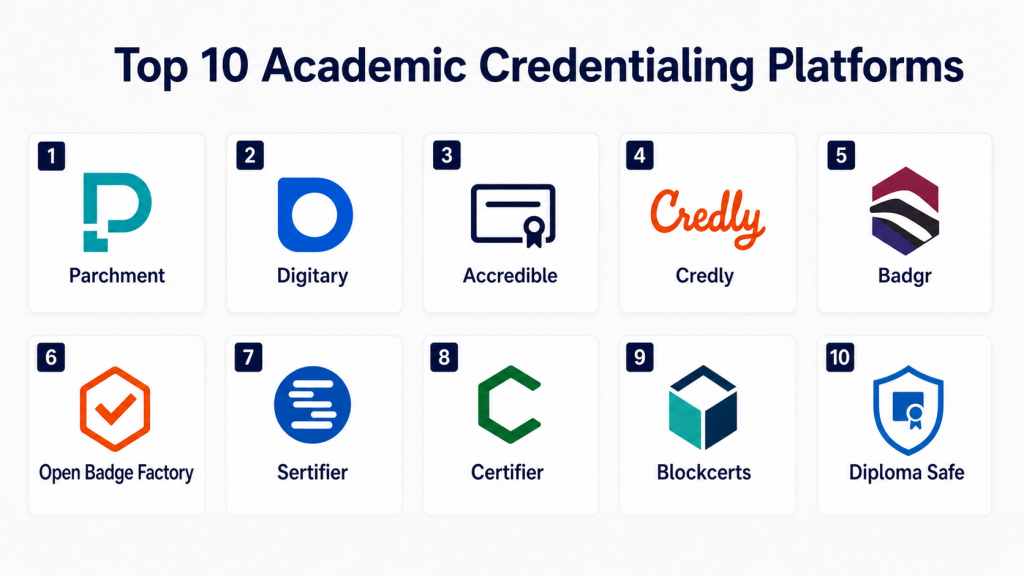
Top 10 Academic Credentialing Platforms
#1 — Parchment
Short description: Parchment is a widely used academic credential platform that helps institutions issue and manage transcripts, diplomas, and digital records. It is trusted by universities and education systems for secure credential delivery. The platform supports global credential exchange and verification. It simplifies student record management and reduces administrative burden. Institutions can automate credential issuance workflows. It also provides secure sharing options for students. Parchment is best suited for academic institutions with large student populations. It is a strong choice for standardized credential management.
Key Features
- Transcript and diploma issuance
- Credential verification tools
- Secure sharing capabilities
- Student record management
- Global credential exchange
- Integration support
- Reporting tools
Pros
- Strong academic focus
- Trusted by institutions
- Secure and scalable
Cons
- Limited use outside education
- Customization may vary
- Pricing varies
Platforms / Deployment
Cloud / Web-based
Security & Compliance
Standard security controls expected.
Specific certifications: Not publicly stated.
Integrations & Ecosystem
Parchment integrates with academic systems and student databases to streamline credential workflows.
- Student information systems
- LMS platforms
- APIs
- Data systems
- Credential networks
Support & Community
Vendor-led support with onboarding and institutional assistance.
#2 — Digitary
Short description: Digitary provides secure digital credentialing for universities and professional institutions. It focuses on verifiable credentials and global portability. The platform supports secure credential storage and sharing. It enables institutions to issue tamper-proof digital records. Digitary is widely used in higher education. It helps students share credentials globally. The platform supports standards-based credentialing. It is ideal for secure academic credential issuance.
Key Features
- Digital credential issuance
- Verification tools
- Secure storage
- Standards support
- Sharing capabilities
- API integrations
- Reporting tools
Pros
- Strong security focus
- Global credential use
- Standards-based approach
Cons
- Setup may require planning
- Pricing varies
- Integration depth varies
Platforms / Deployment
Cloud / Web-based
Security & Compliance
Security controls expected.
Specific certifications: Not publicly stated.
Integrations & Ecosystem
Digitary integrates with education systems and credential networks.
- Education systems
- APIs
- Credential networks
- Data integrations
- Verification systems
Support & Community
Vendor support with onboarding and documentation.
#3 — Accredible
Short description: Accredible enables institutions to issue digital certificates and badges with verification features. It is widely used in education and training. The platform supports automation and branding. It allows easy credential sharing. Accredible includes analytics for tracking usage. It is scalable for large programs. Institutions can integrate it with LMS systems. It is a strong option for digital credential management.
Key Features
- Certificate and badge issuance
- Verification system
- Branding tools
- Analytics
- LMS integration
- Automation workflows
- Shareable credentials
Pros
- Easy to use
- Scalable
- Strong verification
Cons
- Advanced features vary
- Pricing varies
- Custom workflows may require setup
Platforms / Deployment
Cloud / Web-based
Security & Compliance
Access controls expected.
Specific certifications: Not publicly stated.
Integrations & Ecosystem
Accredible integrates with learning platforms and enterprise systems.
- LMS platforms
- HR systems
- APIs
- Automation tools
- Web integrations
Support & Community
Vendor-led support with documentation.
#4 — Credly
Short description: Credly focuses on skill-based credentials and digital badges. It is widely used by universities and certification bodies. The platform supports workforce development programs. It allows credential sharing across platforms. Credly includes analytics and reporting. It is suitable for global credential ecosystems. The platform supports branding and customization. It is ideal for skill validation.
Key Features
- Digital badges
- Skill-based credentialing
- Verification tools
- Analytics dashboard
- Integration support
- Branding features
- Credential sharing
Pros
- Strong skill focus
- Widely recognized
- Good analytics
Cons
- Academic use cases may vary
- Pricing varies
- Custom workflows needed
Platforms / Deployment
Cloud / Web-based
Security & Compliance
Standard controls expected.
Specific certifications: Not publicly stated.
Integrations & Ecosystem
Credly integrates with training and certification systems.
- LMS platforms
- Certification systems
- APIs
- HR tools
- Workforce systems
Support & Community
Vendor support available.
#5 — Badgr
Short description: Badgr is a credential platform designed for issuing digital badges and verifiable credentials. It supports open standards and portability. It is widely used in education and nonprofit sectors. The platform enables credential pathways. It supports learner engagement. Badgr integrates with learning systems. It is scalable for programs. It is ideal for open credential ecosystems.
Key Features
- Digital badges
- Open standards support
- Verification tools
- Credential pathways
- LMS integration
- API support
- Engagement tools
Pros
- Flexible
- Open standards
- Good for education
Cons
- Advanced analytics vary
- Setup may require planning
- Enterprise features vary
Platforms / Deployment
Cloud / Web-based
Security & Compliance
Basic controls expected.
Specific certifications: Not publicly stated.
Integrations & Ecosystem
Badgr integrates with learning ecosystems and credential systems.
- LMS platforms
- APIs
- Credential pathways
- Learning systems
- Data tools
Support & Community
Community and vendor support available.
#6 — Open Badge Factory
Short description: Open Badge Factory enables institutions to issue and manage digital badges. It supports open standards and credential pathways. The platform is used by education providers. It allows structured credential systems. It includes verification tools. It is scalable for global programs. It supports integrations. It is a strong option for badge-based systems.
Key Features
- Badge issuance
- Open standards
- Credential pathways
- Verification tools
- Integration support
- Analytics dashboard
- User management
Pros
- Strong standards support
- Flexible
- Good for institutions
Cons
- Setup required
- Advanced features vary
- Pricing varies
Platforms / Deployment
Cloud / Web-based
Security & Compliance
Standard controls expected.
Specific certifications: Not publicly stated.
Integrations & Ecosystem
Integrates with learning systems and credential workflows.
- LMS platforms
- APIs
- Credential systems
- Data tools
- Learning workflows
Support & Community
Vendor support available.
#7 — Sertifier
Short description: Sertifier helps institutions issue certificates and badges with automation. It supports verification and analytics. The platform is easy to use. It is suitable for training and education. It allows customization. It supports bulk issuance. It integrates with systems. It is a practical credential solution.
Key Features
- Certificate issuance
- Verification tools
- Automation workflows
- Branding
- Analytics
- API support
- Bulk issuance
Pros
- Easy to use
- Automated workflows
- Flexible
Cons
- Enterprise features vary
- Integration depth varies
- Pricing varies
Platforms / Deployment
Cloud / Web-based
Security & Compliance
Controls expected.
Specific certifications: Not publicly stated.
Integrations & Ecosystem
Integrates with LMS and enterprise tools.
- LMS platforms
- APIs
- HR systems
- Automation tools
- Data systems
Support & Community
Vendor support provided.
#8 — Certifier
Short description: Certifier is a certificate generation platform focused on simplicity. It helps institutions create and distribute certificates. It supports verification. It includes automation features. It is suitable for smaller programs. It allows customization. It simplifies workflows. It is a practical option.
Key Features
- Certificate generation
- Verification system
- Templates
- Bulk issuance
- Automation
- API support
- Reporting
Pros
- Simple
- User-friendly
- Flexible
Cons
- Limited enterprise features
- Integration varies
- Scaling limitations
Platforms / Deployment
Cloud / Web-based
Security & Compliance
Basic controls expected.
Specific certifications: Not publicly stated.
Integrations & Ecosystem
Supports integration with basic systems.
- APIs
- LMS systems
- Event platforms
- Automation tools
- Reporting tools
Support & Community
Vendor support available.
#9 — Blockcerts
Short description: Blockcerts is an open standard for blockchain-based credentials. It enables secure and tamper-proof credential issuance. It supports decentralized verification. It is used by innovative institutions. It allows independent credential control. It is suitable for blockchain ecosystems. It requires technical understanding. It is ideal for advanced credential programs.
Key Features
- Blockchain credentialing
- Tamper-proof storage
- Verification tools
- Decentralized control
- Open standards
- API integration
- Credential sharing
Pros
- High security
- Transparent verification
- Open standard
Cons
- Technical complexity
- Not user-friendly
- Adoption varies
Platforms / Deployment
Varies / N/A
Security & Compliance
Blockchain-based security.
Specific certifications: Not publicly stated.
Integrations & Ecosystem
Integrates with blockchain systems and credential networks.
- Blockchain platforms
- APIs
- Credential systems
- Data tools
- Verification tools
Support & Community
Open-source community support.
#10 — Diploma Safe
Short description: Diploma Safe provides digital diploma and transcript issuance with secure verification. It is designed for educational institutions. It helps reduce credential fraud. The platform supports digital transformation. It enables secure sharing. It is scalable for institutions. It integrates with academic systems. It is a strong option for diploma management.
Key Features
- Digital diploma issuance
- Verification tools
- Secure sharing
- Integration support
- Automation workflows
- Reporting tools
- Data management
Pros
- Academic focus
- Secure credentialing
- Scalable
Cons
- Limited outside academia
- Customization varies
- Pricing varies
Platforms / Deployment
Cloud / Web-based
Security & Compliance
Security controls expected.
Specific certifications: Not publicly stated.
Integrations & Ecosystem
Integrates with academic systems and workflows.
- Student systems
- APIs
- Data systems
- Credential workflows
- Reporting tools
Support & Community
Vendor support available.
Comparison Table
| Tool Name | Best For | Platform | Deployment | Standout Feature | Rating |
|---|---|---|---|---|---|
| Parchment | Universities | Web | Cloud | Transcript management | N/A |
| Digitary | Secure credentials | Web | Cloud | Verification focus | N/A |
| Accredible | Digital certificates | Web | Cloud | Credential verification | N/A |
| Credly | Skill badges | Web | Cloud | Workforce credentialing | N/A |
| Badgr | Open credentials | Web | Cloud | Open standards | N/A |
| Open Badge Factory | Badge systems | Web | Cloud | Credential pathways | N/A |
| Sertifier | Automation | Web | Cloud | Workflow automation | N/A |
| Certifier | Simple certificates | Web | Cloud | Easy templates | N/A |
| Blockcerts | Blockchain | Varies | Varies | Tamper-proof credentials | N/A |
| Diploma Safe | Academic credentials | Web | Cloud | Diploma verification | N/A |
Evaluation & Scoring
| Tool | Core | Ease | Integrations | Security | Performance | Support | Value | Total |
|---|---|---|---|---|---|---|---|---|
| Parchment | 9 | 7 | 8 | 8 | 8 | 8 | 7 | 8.00 |
| Digitary | 8 | 7 | 7 | 8 | 8 | 7 | 7 | 7.70 |
| Accredible | 9 | 9 | 8 | 8 | 8 | 8 | 8 | 8.40 |
| Credly | 9 | 8 | 8 | 8 | 8 | 8 | 7 | 8.05 |
| Badgr | 8 | 8 | 7 | 7 | 8 | 7 | 8 | 7.75 |
| Open Badge Factory | 8 | 8 | 7 | 7 | 8 | 7 | 7 | 7.70 |
| Sertifier | 8 | 9 | 7 | 7 | 8 | 8 | 8 | 8.00 |
| Certifier | 7 | 9 | 6 | 7 | 7 | 7 | 8 | 7.45 |
| Blockcerts | 7 | 6 | 7 | 9 | 7 | 6 | 7 | 7.10 |
| Diploma Safe | 8 | 7 | 7 | 8 | 8 | 7 | 7 | 7.70 |
Which Academic Credentialing Platform Is Right for You?
Solo / Small Institution
If you are a small training institute or independent educator, you should focus on simplicity and ease of use. Tools like Certifier or Sertifier are suitable because they allow quick certificate creation and sharing. You don’t need complex integrations or enterprise workflows at this stage. The priority should be clean design and basic verification. Avoid platforms that require heavy setup or technical resources. A lightweight solution will save time and effort.
SMB / Training Organizations
Small to mid-sized institutions should look for platforms that support automation and branding. Accredible, Badgr, and Sertifier are good choices because they offer bulk issuance and LMS integrations. These organizations often manage multiple courses and need consistent credential delivery. Ease of use and reporting features are important for growth. A platform that reduces manual work will improve efficiency. Integration with existing systems is also a key factor.
Mid-Market / Universities
Mid-sized universities and institutions require stronger integrations and analytics. Platforms like Credly, Accredible, and Digitary are suitable for managing large credential programs. These tools support global credential sharing and verification. Institutions should prioritize scalability and data management. Integration with student information systems becomes essential. Choosing a platform that supports long-term growth is critical.
Enterprise / Large Education Systems
Large universities and education systems need scalable, secure, and compliant platforms. Parchment and Digitary are strong options for managing high volumes of credentials. These platforms support governance, audit trails, and global verification. Enterprises should focus on security, reporting, and integration depth. The system should handle multiple departments and credential types. Advanced analytics and compliance features are also important.
Budget vs Premium
Budget tools are ideal for small programs with limited needs. They provide essential features like certificate generation and sharing. Premium platforms offer advanced automation, analytics, and integrations. Organizations should invest in premium tools if credentialing is a core function. The choice depends on scale and long-term goals. Always evaluate total value rather than just cost.
Feature Depth vs Ease of Use
Some platforms offer advanced features like blockchain verification and analytics. However, these may require more setup and technical knowledge. Simpler tools are easier to use but may lack advanced capabilities. Small teams should prioritize usability. Larger teams can benefit from feature-rich platforms. The right balance depends on team expertise and requirements.
Integrations & Scalability
Credential platforms should integrate with LMS, SIS, and HR systems. This ensures automatic credential issuance and reduces manual work. Scalability is important as student numbers grow. API-based platforms are useful for customization and automation. Poor integration can create inefficiencies. Always test integration capabilities before selecting a tool.
Security & Compliance Needs
Security is critical because academic credentials represent trust and authenticity. Look for features like verification tools, access control, and audit logs. Institutions should confirm vendor security practices. Compliance may be important for regulated education systems. A secure platform protects both the institution and students. Always prioritize data protection and fraud prevention.
Frequently Asked Questions (FAQs)
1. What is an academic credentialing platform?
An academic credentialing platform is a system used to create, issue, and manage digital academic records like diplomas, transcripts, and certificates. It replaces manual processes with automated workflows. These platforms also provide verification features to confirm authenticity. They are widely used by universities and training institutions. Their main purpose is to ensure secure and scalable credential management.
2. Who should use academic credentialing platforms?
Universities, colleges, online education platforms, and certification bodies benefit the most. Any organization issuing academic credentials can use these tools. They are especially useful for large institutions with many students. Smaller institutions can also use them for efficiency. The need depends on scale and verification requirements.
3. How do digital academic credentials work?
Digital credentials are created using templates and issued through secure platforms. Each credential includes a verification mechanism such as a link or code. Students can access and share their credentials easily. Employers or institutions can verify them instantly. This reduces fraud and speeds up validation processes.
4. Are digital credentials secure?
Most platforms include verification tools, access controls, and encryption. Some also use blockchain for tamper-proof storage. Security depends on the platform’s features and implementation. Institutions should verify vendor security practices before adoption. A secure system ensures trust and credibility.
5. Can academic credentials be shared online?
Yes, digital credentials can be shared via email, social platforms, and professional networks. Many platforms provide one-click sharing options. This helps students showcase achievements easily. Sharing also improves visibility and recognition. It is one of the main advantages of digital credentialing.
6. Do these platforms integrate with existing systems?
Most academic credentialing platforms integrate with LMS and student information systems. This allows automatic issuance after course completion. Integration reduces manual work and errors. API support is common in modern platforms. Buyers should confirm compatibility before selection.
7. What is blockchain credentialing?
Blockchain credentialing stores credentials on a decentralized network. This makes them tamper-proof and independently verifiable. It increases trust and transparency. However, it may require technical setup. Not all institutions need blockchain features.
8. How much do academic credentialing platforms cost?
Pricing varies based on features, users, and credential volume. Some platforms offer affordable plans for small institutions. Enterprise solutions usually have custom pricing. Additional costs may include integrations and support. If pricing is not public, it is considered Varies / N/A.
9. What are common mistakes when choosing a platform?
Choosing only based on price is a common mistake. Ignoring integration and scalability can cause issues later. Some institutions also overlook security features. Not testing real workflows before purchase is another risk. A proper evaluation ensures better long-term results.
10. Can small institutions benefit from these platforms?
Yes, small institutions can benefit by improving efficiency and reducing manual work. Even simple tools can automate certificate issuance. They also provide verification features that increase credibility. Small teams should choose easy-to-use platforms. The right tool depends on their specific needs.
Conclusion
Academic Credentialing Platforms are transforming how institutions issue, manage, and verify credentials. They improve efficiency, reduce fraud, and enhance global accessibility. Choosing the right platform depends on scale, integration needs, and security requirements.
Institutions should evaluate their long-term credential strategy before selecting a tool. Testing real workflows and integrations is critical for success. The right platform will improve both operational efficiency and user experience.
As education continues to evolve digitally, credentialing platforms will play a key role in building trust and enabling global recognition of achievements.
