Introduction
Digital Identity Wallets are secure applications that let people store, manage, and share verified identity credentials digitally. Instead of repeatedly uploading passports, licenses, employee IDs, certificates, or KYC documents, users can present trusted digital credentials from a wallet when an organization needs proof. These wallets matter now because identity verification is moving toward reusable, privacy-preserving, mobile-first, and standards-based models. They support real-world use cases such as customer onboarding, workforce access, age verification, education credentials, travel identity, government services, and regulated financial verification. Buyers should evaluate credential standards, mobile usability, verification APIs, privacy controls, IAM integration, compliance posture, auditability, scalability, recovery workflows, and ecosystem acceptance.
Best for: enterprises, banks, fintech companies, governments, universities, healthcare organizations, marketplaces, travel companies, and security teams that need trusted, reusable identity verification. Not ideal for: teams that only need password management, simple SSO, or one-time document upload workflows without reusable credentials.
Key Trends in Digital Identity Wallets
- Reusable identity is becoming a priority because businesses want to verify users once and reuse trusted credentials across multiple workflows.
- Mobile-first digital ID adoption is expanding as users increasingly expect identity documents to work like payment cards or boarding passes.
- Privacy-preserving verification is gaining importance through selective disclosure, where users share only required data instead of full documents.
- Zero Trust strategies are strengthening demand for verified identity signals beyond passwords and static account records.
- Government-backed wallet ecosystems are growing, especially for citizen identity, public services, travel, licenses, and certificates.
- Enterprise IAM integration is becoming critical because wallets must connect with SSO, MFA, CIAM, HR systems, onboarding, and access control.
- Developer APIs and SDKs are now buying factors for teams embedding wallet verification into apps, websites, and onboarding flows.
- AI-driven fraud and deepfakes are increasing demand for stronger proof of personhood, credential authenticity, and secure verification.
- Hybrid deployment is gaining interest among regulated industries that need stronger control over data residency and governance.
- Interoperability is becoming a major concern because buyers want wallets that support multiple issuers, verifiers, platforms, and standards.
How We Selected Digital Identity Wallets
- Market recognition: Selected tools with strong visibility in identity wallets, verifiable credentials, IAM, KYC, or mobile digital ID.
- Feature completeness: Evaluated issuance, verification, credential storage, presentation, revocation, and lifecycle support.
- Enterprise relevance: Prioritized platforms useful for real business workflows, not only consumer storage.
- Security posture: Considered privacy, cryptographic verification, authentication, consent, and credential protection.
- Integration potential: Looked at IAM, CIAM, KYC, HR, mobile app, API, and developer ecosystem compatibility.
- Customer fit: Balanced enterprise platforms, developer-first infrastructure, government-focused tools, and consumer wallet ecosystems.
- Scalability: Considered whether each option can support real-world identity verification at organizational scale.
- Usability: Included wallets and platforms that can realistically support user-friendly identity experiences.
- Standards alignment: Favored solutions connected to verifiable credentials, mobile digital ID, and reusable identity patterns.
- Practical buyer value: Focused on tools that can reduce identity friction, improve security, and support modern trust workflows.
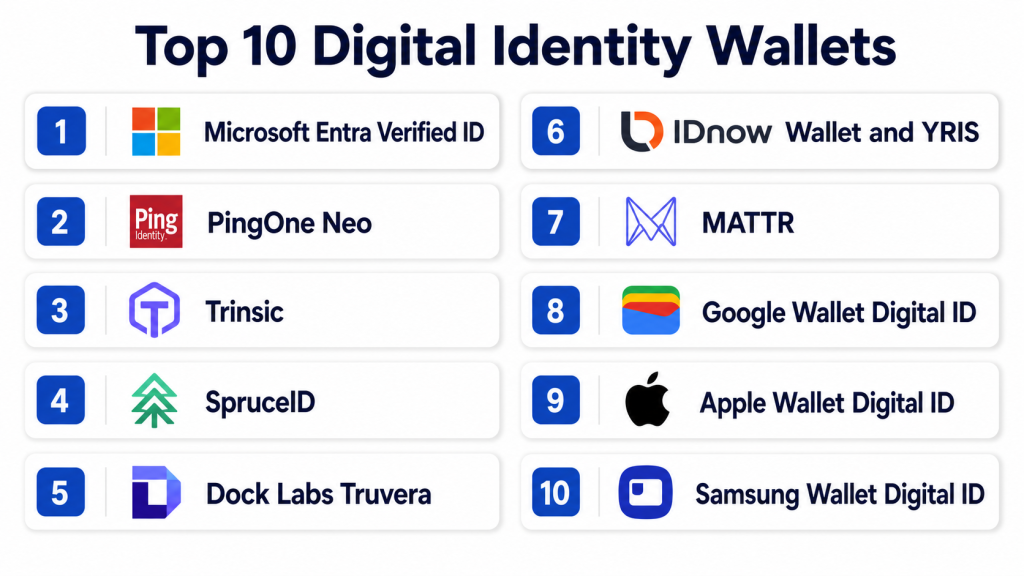
Top 10 Digital Identity Wallets
#1 — Microsoft Entra Verified ID
Short description:
Microsoft Entra Verified ID is an enterprise digital credential platform for issuing and verifying trusted identity claims. It is designed for organizations that want verifiable credentials connected to existing identity and access systems. The solution is especially useful for workforce identity, partner verification, education credentials, and customer proofing.
Key Features
- Verifiable credential issuance and verification
- Credential revocation and lifecycle support
- Enterprise identity ecosystem alignment
- Useful for workforce, partner, customer, and student credentials
- Cloud-based management model
- Credential customization options
- Strong fit for Microsoft-centered IAM environments
Pros
- Strong enterprise identity alignment
- Good fit for Zero Trust and access control use cases
- Useful for organizations already invested in Microsoft security
Cons
- Best value is usually inside the Microsoft ecosystem
- May require identity architecture planning
- Not ideal for simple consumer wallet-only use cases
Platforms / Deployment
Web / iOS / Android wallet-supported workflows
Cloud
Security & Compliance
Microsoft Entra supports enterprise identity controls such as authentication, access management, and administrative governance. Specific certifications for each deployment should be validated directly.
Integrations & Ecosystem
Microsoft Entra Verified ID fits naturally into Microsoft identity, cloud, security, and productivity environments. It is best suited for organizations that want digital credential workflows connected to access management and enterprise identity operations.
- Microsoft Entra ecosystem
- Azure environments
- Workforce identity workflows
- Partner verification
- Custom applications
- Enterprise security operations
Support & Community
Microsoft provides extensive documentation, enterprise support plans, onboarding resources, partner support, and a large identity community. Support strength is high for enterprise buyers already using Microsoft platforms.
#2 — PingOne Neo
Short description:
PingOne Neo is Ping Identity’s digital credential and decentralized identity capability for reusable proof.
It helps organizations issue and verify credentials that users can present across apps, devices, and partners. The platform is valuable for enterprises that already use Ping Identity for IAM, CIAM, MFA, or orchestration. It is useful for customer onboarding, workforce verification, privacy-preserving identity sharing, and access workflows.
Key Features
- Reusable verifiable digital credentials
- Credential issuance and verification
- Privacy-focused data sharing
- Integration with Ping identity ecosystem
- Customer and workforce identity support
- Identity orchestration compatibility
- Strong enterprise IAM alignment
Pros
- Strong enterprise IAM foundation
- Good for customer and workforce identity scenarios
- Supports reusable proof and privacy-preserving verification
Cons
- May be too complex for small teams
- Best suited for organizations with IAM maturity
- Pricing and packaging may vary by enterprise needs
Platforms / Deployment
Web / iOS / Android wallet-supported workflows
Cloud / Hybrid
Security & Compliance
Ping Identity is known for SSO, MFA, access management, and enterprise identity controls. Specific certifications and deployment-level compliance details should be validated during procurement.
Integrations & Ecosystem
PingOne Neo works best when connected with Ping’s broader IAM, CIAM, authentication, and orchestration stack. It can support digital credential use cases across customer, workforce, and partner identity flows.
- PingOne
- PingOne DaVinci
- PingOne Verify
- SSO and MFA systems
- CIAM workflows
- Enterprise applications
Support & Community
Ping Identity offers enterprise support, implementation partners, documentation, and professional services. Community strength is strongest among IAM architects, enterprise security teams, and identity practitioners.
#3 — Trinsic
Short description:
Trinsic is a digital identity acceptance and verification platform focused on reusable digital IDs.
It helps businesses accept verified identity credentials from different wallet and identity providers.
The platform is useful for fintech, marketplaces, onboarding teams, and regulated businesses that want faster verification. Trinsic is more of a digital ID gateway than a traditional consumer wallet.
Key Features
- Digital ID acceptance gateway
- API-first identity verification
- Reusable identity workflows
- Multi-provider digital ID support
- Verification configuration tools
- Useful for KYC and onboarding
- Developer-focused implementation model
Pros
- Strong for product and developer teams
- Helps reduce repeated identity checks
- Useful across multiple digital ID ecosystems
Cons
- Not a standalone consumer wallet
- Value depends on supported regions and ID providers
- Requires technical integration
Platforms / Deployment
Web / API
Cloud
Security & Compliance
Security and compliance details vary by implementation and identity provider coverage. Buyers should validate compliance, data handling, and regional requirements before deployment.
Integrations & Ecosystem
Trinsic is designed to connect business applications with reusable digital identity providers. Its strength is helping organizations accept trusted credentials without building every wallet connection separately.
- KYC systems
- Customer onboarding flows
- Web applications
- Mobile applications
- Developer APIs
- Fraud and trust workflows
Support & Community
Trinsic provides developer documentation, API resources, onboarding guidance, and support for implementation teams. Community strength is strongest among reusable identity builders and digital ID product teams.
#4 — SpruceID
Short description:
SpruceID provides digital identity wallet and credential infrastructure for trusted digital interactions.
It is especially relevant for government, public-sector, civic identity, permits, licenses, and resident services. The platform focuses on open standards, privacy, and secure credential exchange. SpruceID is useful for organizations designing wallet-based identity ecosystems rather than simple document storage.
Key Features
- Digital wallet infrastructure
- Verifiable credential support
- Government and public-sector identity use cases
- Privacy-preserving credential exchange
- Open standards orientation
- Support for permits, licenses, and passes
- Integration with agency and service workflows
Pros
- Strong fit for public-sector identity projects
- Good standards-focused approach
- Useful for complex trust ecosystems
Cons
- May require implementation planning
- Not ideal for simple business-user-only needs
- Some deployments may require customization
Platforms / Deployment
Web / iOS / Android wallet-supported workflows
Cloud / Hybrid
Security & Compliance
SpruceID emphasizes secure, privacy-preserving credential infrastructure. Specific compliance certifications should be confirmed based on deployment, region, and contract requirements.
Integrations & Ecosystem
SpruceID is useful when identity credentials must move securely between issuers, holders, and verifiers. It can support digital public services, resident identity, and standards-based credential acceptance.
- Government service platforms
- Digital credential systems
- Mobile identity workflows
- Verification services
- Agency systems
- Developer tools and APIs
Support & Community
SpruceID provides technical resources, project support, and digital identity expertise. Its community presence is strongest in digital trust, public-sector identity, and standards-driven identity ecosystems.
#5 — Dock Labs Truvera
Short description:
Dock Labs Truvera provides reusable identity infrastructure for issuing and verifying digital credentials.
It helps organizations convert verified identity data into reusable credentials that can be checked later.
The platform is useful for customer onboarding, KYC, mobile driver’s license verification, and fraud-resistant identity workflows. It offers APIs and SDKs for teams that want to embed reusable identity into existing products.
Key Features
- Reusable digital identity credentials
- Credential issuance and verification APIs
- Embedded wallet support
- Mobile driver’s license verification support
- Biometric-bound credential workflows where applicable
- REST API and mobile SDK support
- Fraud-resistant verification workflows
Pros
- Strong developer-first identity infrastructure
- Good for embedded reusable identity
- Useful for reducing repeated onboarding checks
Cons
- Requires technical implementation
- Less suitable for non-technical buyers
- Regional credential support should be verified
Platforms / Deployment
Web / iOS / Android SDK-supported workflows
Cloud / API
Security & Compliance
Truvera emphasizes fraud-resistant and reusable credential verification. Specific certifications, data protection controls, and compliance claims should be validated directly.
Integrations & Ecosystem
Truvera is designed to be embedded into business applications, onboarding journeys, and customer identity workflows. It works best when identity verification needs to become reusable across repeat interactions.
- KYC platforms
- Customer onboarding
- Mobile applications
- Web applications
- CRM systems
- IAM and CIAM workflows
Support & Community
Dock Labs provides documentation, API resources, and implementation support. Community strength is strongest among decentralized identity, reusable ID, and verifiable credential builders.
#6 — IDnow Wallet and YRIS
Short description:
IDnow Wallet and YRIS focus on reusable identity for regulated onboarding and verification workflows.
They are relevant for financial services, travel, eHealth, mobility, and businesses that need compliance-focused identity. The wallet approach helps users store verified identity information and reuse it across approved services. This can reduce onboarding friction while supporting regulatory expectations.
IDnow’s broader identity verification background makes it useful for organizations with KYC-heavy operations.
Key Features
- Reusable identity wallet workflows
- KYC and identity verification alignment
- Stored identity credential reuse
- Regulated onboarding support
- Fraud and compliance-oriented workflows
- Useful for fintech, travel, mobility, and eHealth
- API-enabled verification patterns
Pros
- Strong fit for compliance-heavy onboarding
- Useful for reducing repeated identity checks
- Relevant for regulated industries
Cons
- Regional availability may vary
- Not ideal for simple internal workforce use only
- Pricing and deployment may depend on use case
Platforms / Deployment
Web / iOS / Android wallet-supported workflows
Cloud
Security & Compliance
IDnow operates in identity verification and compliance-sensitive markets. Specific certifications, data residency, and regulatory controls should be validated by region and product package.
Integrations & Ecosystem
IDnow Wallet and YRIS are strongest when connected with onboarding, verification, and fraud prevention processes. They can help businesses reduce repeated checks while maintaining compliance workflows.
- KYC platforms
- Financial onboarding
- Travel identity workflows
- Mobility services
- eHealth verification
- API-based identity systems
Support & Community
IDnow provides enterprise support, onboarding assistance, and implementation guidance. Community strength is strongest in regulated digital identity and identity verification markets.
#7 — MATTR
Short description:
MATTR provides digital trust infrastructure for issuing, holding, presenting, and verifying credentials.
It is designed for organizations building wallet-based credential ecosystems and verified data exchange.
The platform is useful for government, education, workforce, customer identity, and compliance-related credential use cases.MATTR supports digital credential workflows where users can hold credentials and share required information.
Key Features
- Verifiable credential issuance and verification
- Wallet-compatible credential workflows
- Digital trust infrastructure
- APIs for credential lifecycle management
- Selective disclosure support where applicable
- Credential branding and verification workflows
- Developer resources for implementation
Pros
- Strong digital trust infrastructure focus
- Good for custom credential ecosystems
- Useful for standards-oriented identity projects
Cons
- Requires technical implementation expertise
- Not a simple plug-and-play consumer wallet
- Compliance details should be verified per deployment
Platforms / Deployment
Web / iOS / Android wallet-supported workflows
Cloud / API
Security & Compliance
MATTR focuses on cryptographic credential verification and trusted credential exchange. Specific certifications and compliance details should be validated during vendor review.
Integrations & Ecosystem
MATTR can connect with identity providers, credential issuers, verification APIs, and custom business applications. It is especially useful for organizations building trust frameworks or verified credential services.
- Identity providers
- Credential issuers
- Verification APIs
- Education systems
- Government services
- Custom web and mobile apps
Support & Community
MATTR offers documentation, developer support, and implementation resources. Community strength is strongest among digital trust, verifiable credential, and standards-focused identity professionals.
#8 — Google Wallet Digital ID
Short description:
Google Wallet Digital ID lets users store supported digital identity credentials on Android devices.
It supports selected digital IDs such as driver’s licenses, state IDs, passport-based ID passes, and region-specific credentials where available. For enterprises, Google Wallet is mainly important as a consumer identity presentation channel. Businesses can plan to accept digital IDs from users who already store identity credentials in Google Wallet.
Key Features
- Mobile digital ID storage
- Android-based wallet experience
- Supported driver’s license, state ID, passport ID, or regional credential workflows
- User-controlled data sharing
- Authentication before presentation
- Mobile identity verification support
- Consumer-friendly wallet experience
Pros
- Familiar experience for Android users
- Strong mobile ecosystem reach
- Useful for consumer identity presentation
Cons
- Credential support varies by country and issuer
- Not a full enterprise issuance platform
- Requires compatible verifier workflows
Platforms / Deployment
Android
Mobile wallet
Security & Compliance
Google Wallet supports encrypted digital ID storage, user review before sharing, and authentication before presentation. Buyers should validate accepted credential types and regional availability.
Integrations & Ecosystem
Google Wallet is useful for businesses that want to accept mobile digital IDs from Android users. It works best as part of a broader digital ID acceptance strategy.
- Android applications
- Mobile onboarding
- Age verification
- Travel identity workflows
- Supported government IDs
- Consumer-facing verification
Support & Community
Google provides user support, developer resources, and ecosystem documentation. Community strength is high because Android has broad global reach and a large developer ecosystem.
#9 — Apple Wallet Digital ID
Short description:
Apple Wallet Digital ID lets supported users store eligible identity credentials on iPhone and Apple Watch.
It is primarily a consumer wallet, but it matters for enterprises that need to accept trusted identity credentials from Apple users. Supported IDs and acceptance locations vary depending on region, issuer, and program availability. Apple Wallet is most relevant for travel, age verification, app-based verification, and in-person identity presentation.
Key Features
- Digital ID storage in Apple Wallet
- iPhone and Apple Watch support
- Supported driver’s license and state ID workflows where available
- Privacy-focused identity sharing
- User-controlled presentation
- Device-based authentication
- Consumer-friendly identity experience
Pros
- Strong user experience for Apple users
- Good device-level security model
- Useful for high-trust consumer presentation
Cons
- Availability depends on region and issuer
- Not an enterprise credential platform by itself
- Acceptance ecosystem is still developing
Platforms / Deployment
iOS / watchOS
Mobile wallet
Security & Compliance
Apple Wallet uses device-based security and user authentication for supported digital identity presentation. Buyers should validate accepted credentials, regional support, and verifier requirements.
Integrations & Ecosystem
Apple Wallet is useful for customer-facing digital ID acceptance scenarios. It fits well where identity presentation happens through mobile devices and supported Apple ecosystems.
- iOS applications
- In-person verification
- Travel identity workflows
- Age verification
- App-based verification
- Supported government ID programs
Support & Community
Apple provides platform documentation, user guidance, and developer resources. Community strength is high due to Apple’s large device ecosystem and strong consumer trust.
#10 — Samsung Wallet Digital ID
Short description:
Samsung Wallet Digital ID supports identity-related credentials on eligible Samsung devices where available. It is part of Samsung’s broader wallet ecosystem for payments, passes, keys, and digital credentials. For businesses, Samsung Wallet matters as a consumer wallet that may support digital identity presentation.
Key Features
- Samsung mobile wallet experience
- Digital ID support where available
- Driver’s license and state ID workflows in supported regions
- Face scan-based verification during setup where applicable
- Mobile-first identity presentation
- Integration with Samsung device ecosystem
- Consumer-friendly wallet interface
Pros
- Strong fit for Samsung-heavy user bases
- Useful for mobile identity acceptance planning
- Familiar wallet experience for consumers
Cons
- Availability varies by region and credential program
- Not a standalone enterprise identity platform
- Requires compatible verifier infrastructure
Platforms / Deployment
Android / Samsung devices
Mobile wallet
Security & Compliance
Samsung Wallet security depends on supported device security, wallet controls, and credential program requirements. Specific compliance details should be validated by region and use case.
Integrations & Ecosystem
Samsung Wallet is most useful when businesses support multiple mobile wallet identity options. It can complement Google Wallet and Apple Wallet in broader identity acceptance strategies.
- Samsung mobile ecosystem
- Digital ID workflows
- Consumer identity presentation
- Retail verification
- Travel and access scenarios
- Mobile onboarding
Support & Community
Samsung provides consumer support and product guidance. Enterprise support depends on the specific credential program, region, and verifier infrastructure involved.
Comparison Table Top 10
| Tool Name | Best For | Platform(s) Supported | Deployment | Standout Feature | Public Rating |
|---|---|---|---|---|---|
| Microsoft Entra Verified ID | Microsoft-centric enterprises | Web, iOS, Android wallet workflows | Cloud | Enterprise verifiable credential management | N/A |
| PingOne Neo | Enterprise IAM and CIAM teams | Web, mobile-supported workflows | Cloud / Hybrid | Reusable credentials connected to IAM | N/A |
| Trinsic | Digital ID acceptance and APIs | Web, API | Cloud | Digital ID gateway for reusable identity | N/A |
| SpruceID | Government and public-sector identity | Web, mobile, API | Cloud / Hybrid | Open standards wallet infrastructure | N/A |
| Dock Labs Truvera | Embedded reusable identity | Web, mobile SDK, API | Cloud | Embedded wallet SDK and verification APIs | N/A |
| IDnow Wallet and YRIS | Regulated onboarding and KYC | Web, mobile workflows | Cloud | Reusable identity for compliance-heavy verification | N/A |
| MATTR | Digital trust and credential ecosystems | Web, mobile, API | Cloud / API | Verifiable credential infrastructure | N/A |
| Google Wallet Digital ID | Android consumer digital ID | Android | Mobile wallet | Android digital ID presentation | N/A |
| Apple Wallet Digital ID | iOS consumer digital ID | iOS, watchOS | Mobile wallet | Privacy-focused Apple device ID presentation | N/A |
| Samsung Wallet Digital ID | Samsung mobile identity users | Samsung Android devices | Mobile wallet | Samsung ecosystem digital ID support | N/A |
Evaluation & Scoring of Digital Identity Wallets
| Tool Name | Core (25%) | Ease (15%) | Integrations (15%) | Security (10%) | Performance (10%) | Support (10%) | Value (15%) | Weighted Total (0–10) |
|---|---|---|---|---|---|---|---|---|
| Microsoft Entra Verified ID | 9 | 8 | 9 | 9 | 9 | 9 | 8 | 8.65 |
| PingOne Neo | 9 | 7 | 9 | 9 | 8 | 8 | 8 | 8.35 |
| Trinsic | 8 | 8 | 8 | 8 | 8 | 7 | 8 | 7.90 |
| SpruceID | 8 | 7 | 8 | 9 | 8 | 8 | 7 | 7.85 |
| Dock Labs Truvera | 8 | 8 | 8 | 8 | 8 | 7 | 8 | 7.90 |
| IDnow Wallet and YRIS | 8 | 8 | 7 | 8 | 8 | 8 | 7 | 7.70 |
| MATTR | 8 | 7 | 8 | 8 | 8 | 7 | 7 | 7.60 |
| Google Wallet Digital ID | 7 | 9 | 8 | 8 | 9 | 8 | 9 | 8.15 |
| Apple Wallet Digital ID | 7 | 9 | 7 | 9 | 9 | 8 | 8 | 8.00 |
| Samsung Wallet Digital ID | 6 | 8 | 7 | 8 | 8 | 7 | 8 | 7.25 |
The scores are comparative and should be used as a shortlist guide, not as a universal ranking.
Enterprise tools score higher on governance, issuance, IAM fit, and integration depth.
Consumer wallets score higher on usability and mobile adoption but lower on enterprise administration.
Developer-first platforms are strong for embedded workflows but require technical implementation.
Buyers should validate regional support, credential types, compliance, APIs, and user experience before selecting a final tool.
Which Digital Identity Wallets Is Right for You?
Solo / Freelancer
Solo users usually do not need a full enterprise digital identity platform. If the goal is personal digital ID storage, consumer wallets such as Google Wallet, Apple Wallet, or Samsung Wallet may be enough where supported. If the goal is learning or building a digital identity project, developer-friendly options like Trinsic, MATTR, Dock Labs Truvera, or SpruceID are more practical.
SMB
Small businesses should begin with a specific use case such as customer onboarding, age verification, or reusable KYC. Trinsic and Dock Labs Truvera are useful for API-driven identity acceptance. IDnow can be a strong fit for regulated onboarding. Microsoft Entra Verified ID may work well if the business already uses Microsoft identity tools.
Mid-Market
Mid-market companies usually need stronger integrations and better governance. Microsoft Entra Verified ID is suitable for Microsoft-centered identity environments. PingOne Neo is strong for companies with mature IAM or CIAM needs. Trinsic, Dock Labs Truvera, and MATTR are good options when product teams need custom wallet or credential workflows.
Enterprise
Enterprises should prioritize governance, security, auditability, standards support, integration depth, and scalability. Microsoft Entra Verified ID and PingOne Neo are strong choices for IAM-connected identity strategies. SpruceID and MATTR are strong for digital trust ecosystems, public-sector programs, and custom credential infrastructure. Enterprises should always run proof-of-concept testing before large-scale deployment.
Budget vs Premium
Budget-focused buyers should start with one high-value use case and avoid overbuilding. Developer-first platforms can help teams pilot reusable identity without replacing existing systems. Premium enterprise platforms are better when identity wallets must connect with SSO, MFA, CIAM, audit logs, compliance workflows, and access governance. The right budget depends on whether digital identity is a feature, a compliance requirement, or a strategic platform.
Feature Depth vs Ease of Use
Consumer wallets are easy for users but limited for enterprise control. Enterprise platforms provide deeper credential management, verification, governance, and IAM integration. Developer-first tools offer flexibility but require implementation work. Buyers should choose ease of use for simple presentation scenarios and feature depth for regulated, high-scale, or multi-system identity workflows.
Integrations & Scalability
Integration depth is critical for real-world success. Buyers should check APIs, SDKs, IAM compatibility, CIAM support, mobile app integration, KYC connections, HR workflows, and audit capabilities. Scalability should include credential volume, verification speed, regional support, recovery processes, user support, and multi-wallet acceptance. A pilot should test both technical performance and user adoption.
Security & Compliance Needs
Security-focused buyers should evaluate encryption, credential signing, key management, revocation, selective disclosure, consent, authentication, auditability, and data minimization. Regulated organizations should validate privacy obligations, data residency, compliance evidence, and verification proof. Digital identity wallets can support Zero Trust, but they should be combined with IAM, MFA, device trust, policy enforcement, and monitoring.
Frequently Asked Questions FAQs
1. What is a digital identity wallet?
A digital identity wallet is an app or platform that stores verified digital credentials.
These credentials can include government IDs, licenses, employee records, education certificates, or proof of eligibility.
Users can present selected credentials when a verifier asks for proof.
Modern wallets often use cryptographic methods to prove that credentials are authentic.
They reduce repeated document uploads and improve trust in digital interactions.
2. How is a digital identity wallet different from a password manager?
A password manager stores usernames, passwords, and login secrets.
A digital identity wallet stores verified claims about a person, organization, or status.
Password managers help users access accounts securely.
Digital identity wallets help users prove identity, eligibility, age, employment, education, or compliance status.
Both support security, but they solve different identity problems.
3. What pricing models are common for digital identity wallet platforms?
Pricing varies by vendor, deployment model, and use case.
Enterprise platforms may charge based on users, credentials issued, verifications, API usage, or custom contracts.
Developer-first tools may offer usage-based pricing or tiered packages.
Consumer wallets are usually free for end users, while businesses may pay for verifier infrastructure.
Buyers should request pricing based on expected credential volume and verification frequency.
4. How long does implementation usually take?
Implementation depends on complexity, integrations, and compliance requirements.
A simple API pilot can be faster than a full enterprise wallet rollout.
Large deployments involving IAM, KYC, mobile apps, revocation, and audit workflows require more planning.
Teams should start with one high-value use case before expanding.
A phased rollout helps reduce risk and measure real business impact.
5. What are common mistakes when buying digital identity wallets?
A common mistake is choosing a platform before defining the identity use case.
Another mistake is ignoring wallet acceptance and assuming all verifiers support all credentials.
Some buyers overlook recovery flows, consent, revocation, and user support.
Others underestimate integration work with IAM, KYC, HR, or customer onboarding systems.
The best approach is to validate business value, user experience, and compliance early.
6. Are digital identity wallets secure?
Digital identity wallets can be secure when designed and implemented correctly.
Strong wallets use encryption, secure device authentication, credential signing, and consent-based sharing.
However, security depends on the issuer, wallet, verifier, key management, and governance model.
Enterprises should review audit logs, revocation, data minimization, and recovery workflows.
Security must be assessed across the full credential lifecycle.
7. Can digital identity wallets support Zero Trust?
Yes, digital identity wallets can support Zero Trust by providing stronger proof of identity and eligibility.
They help systems move beyond static usernames, passwords, and account records.
Verified credentials can support onboarding, privileged access, partner verification, and high-risk transactions.
However, wallets do not replace Zero Trust architecture.
They should work alongside IAM, MFA, device trust, policy engines, monitoring, and access governance.
8. What integrations matter most?
The most important integrations depend on the use case.
For workforce identity, IAM, SSO, MFA, HR, and access control integrations matter most.
For customer onboarding, KYC, CRM, fraud prevention, mobile app, and web app integrations are important.
For regulated sectors, audit, compliance, and data governance systems may also be required.
Buyers should validate APIs, SDKs, documentation, and integration support before purchase.
9. Can digital identity wallets scale for large enterprises?
Yes, but scalability depends on the platform architecture and implementation.
Enterprises need reliable APIs, high verification capacity, admin controls, audit evidence, and strong support.
They should test credential issuance, verification latency, mobile usability, and recovery flows.
Regional support and credential acceptance are also critical at scale.
A real-user pilot is the best way to validate readiness before full rollout.
10. Is it difficult to switch digital identity wallet platforms?
Switching can be difficult if credentials, APIs, trust frameworks, and verifier relationships are tightly connected to one vendor.
Standards-based architectures can reduce migration risk.
Buyers should review export options, credential portability, API compatibility, and data ownership.
User adoption and support processes also need careful migration planning.
Before switching, map all credentials, issuers, verifiers, and dependent workflows.
Conclusion
Digital Identity Wallets are becoming an important layer in modern identity management, cybersecurity, Zero Trust, and access control strategies. The best option depends on whether an organization needs enterprise credential issuance, reusable customer onboarding, public-sector trust infrastructure, developer APIs, or consumer wallet acceptance. Microsoft Entra Verified ID and PingOne Neo are strong enterprise identity options, while Trinsic, SpruceID, Dock Labs Truvera, IDnow, and MATTR serve more specialized reusable identity and credential infrastructure needs. Google Wallet, Apple Wallet, and Samsung Wallet are important because consumer mobile wallets are becoming part of real-world identity presentation.
There is no single best digital identity wallet for every buyer. The right choice depends on region, credential type, compliance needs, IAM integration, user experience, ecosystem acceptance, and long-term scalability. Buyers should shortlist two or three tools, run a focused pilot, validate integrations and security controls, test real user journeys, and then scale the platform only after it proves measurable trust, usability, and operational value.
