Introduction
Business Process Management (BPM) Suites are platforms that help organizations design, automate, monitor, and continuously improve business processes across departments. Instead of managing workflows through emails, spreadsheets, and disconnected tools, BPM suites provide a structured system for approvals, case management, rules, task routing, reporting, and optimization.
These platforms are especially important now because companies need faster operations, better compliance, lower costs, and more consistent customer experiences. BPM suites help standardize how work gets done while still allowing flexibility for changing business needs.
Real-world use cases:
- Employee onboarding and HR processes
- Loan approvals and financial operations
- Claims management in insurance
- Procurement and vendor approvals
- Customer service case routing and escalation
What buyers should evaluate:
- Process modeling tools
- Workflow automation depth
- Case management features
- Rules engine capabilities
- Reporting and analytics
- Low-code app development
- Security and governance
- Integration options
- Scalability
- Pricing and implementation complexity
Best for: Enterprises, operations teams, finance, healthcare, insurance, government, and companies managing complex multi-step processes.
Not ideal for: Very small teams with simple task automation needs or startups needing lightweight no-code workflows only.
Key Trends in Business Process Management (BPM) Suites
- AI-assisted process design and optimization
- Process mining built into BPM suites
- Hyperautomation combining BPM + RPA + AI
- Low-code application development expansion
- Real-time KPI dashboards for operations
- Stronger compliance and audit automation
- Mobile-first approvals and task actions
- Event-driven case management growth
- Better citizen developer experiences
- Cloud-native BPM adoption accelerating
How We Selected These Tools (Methodology)
- Enterprise market recognition
- Depth of BPM capabilities
- Workflow and case management strength
- Low-code innovation
- Integration ecosystem quality
- Security and governance maturity
- Reliability for mission-critical workloads
- Support and implementation ecosystem
- Fit across industries
- Overall long-term value
Top 10 Business Process Management (BPM) Suites
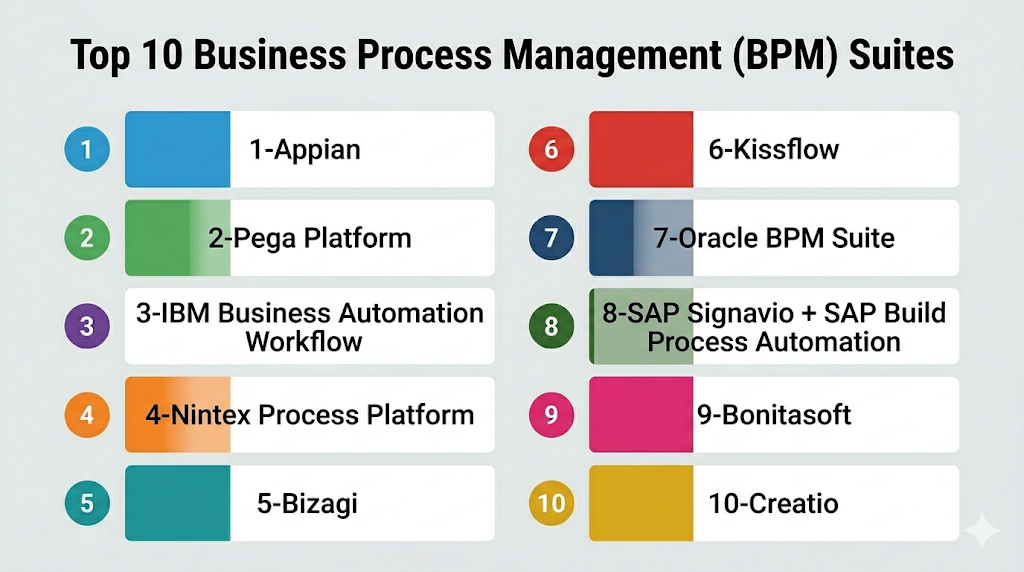
Top 10 Tools List
- Appian
- Pega Platform
- IBM Business Automation Workflow
- Nintex Process Platform
- Bizagi
- Kissflow
- Oracle BPM Suite
- SAP Signavio + SAP Build Process Automation
- Bonitasoft
- Creatio
#1 — Appian
Short description: Leading low-code BPM suite combining workflow automation, case management, and app development for enterprises.
Key Features
- Process modeling
- Case management
- Low-code apps
- AI automation tools
- Workflow orchestration
- Analytics dashboards
- Integration connectors
Pros
- Strong end-to-end platform
- Excellent low-code speed
- Enterprise-ready controls
Cons
- Premium pricing
- Best for larger programs
- Skilled implementation often needed
Platforms / Deployment
Web / iOS / Android
Cloud / Hybrid
Security & Compliance
SSO, RBAC, encryption, audit logs.
Integrations & Ecosystem
- Salesforce
- SAP
- Databases
- APIs
- Microsoft tools
Support & Community
Strong enterprise support and partner network.
#2 — Pega Platform
Short description: Powerful BPM and case management suite known for decisioning, customer workflows, and enterprise scale.
Key Features
- Dynamic case management
- Workflow automation
- AI decisioning
- Rules engine
- Omnichannel processes
- Reporting tools
- Low-code development
Pros
- Excellent for complex processes
- Strong customer service use cases
- Enterprise scale proven
Cons
- Complex implementations possible
- Premium pricing
- Requires trained teams
Platforms / Deployment
Web / Mobile
Cloud / Hybrid
Security & Compliance
Enterprise IAM, encryption, RBAC.
Integrations & Ecosystem
- CRM systems
- Contact center tools
- APIs
- Databases
Support & Community
Strong global enterprise services ecosystem.
#3 — IBM Business Automation Workflow
Short description: Enterprise BPM suite combining workflows, case management, and automation for regulated industries.
Key Features
- Workflow orchestration
- Case management
- Rules support
- Content workflows
- Analytics
- Governance controls
- Enterprise integrations
Pros
- Strong enterprise reliability
- Good governance capabilities
- Broad IBM ecosystem fit
Cons
- Can be complex
- Premium enterprise pricing
- Best for larger organizations
Platforms / Deployment
Cloud / Self-hosted / Hybrid
Security & Compliance
Encryption, SSO, RBAC, audit controls.
Integrations & Ecosystem
- IBM tools
- ERP systems
- Databases
- APIs
Support & Community
Strong enterprise support model.
#4 — Nintex Process Platform
Short description: BPM-focused platform known for workflow, forms, document automation, and process mapping.
Key Features
- Workflow builder
- Forms automation
- Document generation
- Process mapping
- eSignature workflows
- Analytics
- Connectors
Pros
- Strong business-user usability
- Good document-heavy workflows
- Mature product suite
Cons
- Broad suite can feel complex
- Premium tiers for advanced use
- Less developer-centric than some rivals
Platforms / Deployment
Web / Hybrid
Security & Compliance
SSO, access controls, encryption.
Integrations & Ecosystem
- Microsoft 365
- SharePoint
- Salesforce
- APIs
Support & Community
Good onboarding and enterprise support.
#5 — Bizagi
Short description: BPM platform focused on process modeling, automation, and digital transformation programs.
Key Features
- BPMN modeling
- Workflow automation
- Low-code apps
- Rules engine
- Process analytics
- Integrations
- Case management
Pros
- Strong modeling tools
- Good balance of power and usability
- Suitable for transformation projects
Cons
- Smaller ecosystem than top leaders
- Advanced scaling may need expertise
- Pricing varies by deployment
Platforms / Deployment
Cloud / Self-hosted
Security & Compliance
RBAC, encryption, admin controls.
Integrations & Ecosystem
- ERP tools
- APIs
- Databases
- CRM systems
Support & Community
Good training resources.
#6 — Kissflow
Short description: Modern BPM and workflow platform for business teams needing no-code process automation.
Key Features
- No-code workflows
- Forms
- Approvals
- Dashboards
- Process tracking
- Role permissions
- App builder
Pros
- Easy for business users
- Fast deployment
- Good SMB to mid-market fit
Cons
- Less deep enterprise complexity handling
- Smaller connector ecosystem
- Advanced custom logic may need workarounds
Platforms / Deployment
Web
Cloud
Security & Compliance
Access controls, encryption, admin permissions.
Integrations & Ecosystem
- Google Workspace
- Microsoft tools
- APIs
- CRM apps
Support & Community
Strong onboarding focus.
#7 — Oracle BPM Suite
Short description: Oracle’s BPM platform for enterprise process orchestration and workflow management.
Key Features
- Process modeling
- Workflow automation
- Rules management
- Oracle integrations
- Monitoring dashboards
- Enterprise security
- High availability
Pros
- Strong Oracle ecosystem fit
- Mature enterprise tools
- Reliable for large workloads
Cons
- Best for Oracle customers
- Licensing complexity
- Specialized expertise often required
Platforms / Deployment
Self-hosted / Hybrid
Security & Compliance
Enterprise IAM, encryption, access controls.
Integrations & Ecosystem
- Oracle ERP
- Oracle DB
- Java apps
- APIs
Support & Community
Strong vendor support.
#8 — SAP Signavio + SAP Build Process Automation
Short description: SAP-focused suite combining process intelligence, workflow automation, and optimization.
Key Features
- Process mining
- Workflow automation
- SAP connectors
- Forms
- Analytics
- Governance tools
- Continuous improvement tools
Pros
- Excellent for SAP environments
- Strong process visibility
- Good modernization path
Cons
- Best value inside SAP ecosystem
- Premium enterprise pricing
- Multi-product complexity possible
Platforms / Deployment
Cloud / Hybrid
Security & Compliance
SAP enterprise security controls.
Integrations & Ecosystem
- SAP ERP
- SuccessFactors
- Ariba
- APIs
Support & Community
Strong global support network.
#9 — Bonitasoft
Short description: Open-source oriented BPM suite with workflow and application development capabilities.
Key Features
- BPMN process modeling
- Workflow engine
- UI development tools
- API-first architecture
- Case management
- Customization options
- Open-source flexibility
Pros
- Good flexibility
- Lower licensing pressure options
- Developer-friendly
Cons
- Requires technical ownership
- Smaller market presence
- Less plug-and-play than premium suites
Platforms / Deployment
Cloud / Self-hosted
Security & Compliance
Depends on deployment configuration.
Integrations & Ecosystem
- REST APIs
- Databases
- Internal systems
Support & Community
Community + commercial support options.
#10 — Creatio
Short description: Low-code BPM suite with strong CRM and process automation orientation.
Key Features
- Workflow automation
- Low-code apps
- CRM process templates
- Case management
- Analytics
- Rules engine
- Integrations
Pros
- Strong CRM-centric BPM value
- Easy low-code development
- Good user experience
Cons
- Best fit for customer-facing teams
- Smaller ecosystem than giants
- Premium tiers for advanced needs
Platforms / Deployment
Web / Mobile
Cloud / Hybrid
Security & Compliance
SSO, encryption, RBAC.
Integrations & Ecosystem
- CRM tools
- Marketing apps
- APIs
- Databases
Support & Community
Growing ecosystem and commercial support.
Comparison Table (Top 10)
| Tool Name | Best For | Platform(s) Supported | Deployment | Standout Feature | Public Rating |
|---|---|---|---|---|---|
| Appian | Enterprises | Web/Mobile | Hybrid | Low-code BPM | N/A |
| Pega | Complex cases | Web/Mobile | Hybrid | Dynamic case management | N/A |
| IBM BAW | Regulated firms | Web | Hybrid | Enterprise governance | N/A |
| Nintex | Process teams | Web | Hybrid | Docs + workflows | N/A |
| Bizagi | Transformation projects | Web | Cloud | BPMN strength | N/A |
| Kissflow | SMB/Mid-market | Web | Cloud | No-code BPM | N/A |
| Oracle BPM | Oracle users | Web | Hybrid | Oracle integration | N/A |
| SAP Suite | SAP customers | Web | Hybrid | Process mining + workflow | N/A |
| Bonitasoft | Technical teams | Web | Self-hosted | Open-source BPM | N/A |
| Creatio | CRM teams | Web/Mobile | Hybrid | CRM + BPM | N/A |
Evaluation & Scoring of Business Process Management (BPM) Suites
| Tool Name | Core | Ease | Integrations | Security | Performance | Support | Value | Weighted Total |
|---|---|---|---|---|---|---|---|---|
| Appian | 9 | 8 | 8 | 9 | 8 | 8 | 7 | 8.15 |
| Pega | 10 | 6 | 8 | 9 | 9 | 8 | 6 | 7.95 |
| IBM BAW | 9 | 6 | 8 | 9 | 9 | 8 | 6 | 7.80 |
| Nintex | 8 | 8 | 8 | 8 | 8 | 8 | 7 | 7.90 |
| Bizagi | 8 | 8 | 7 | 7 | 8 | 7 | 8 | 7.65 |
| Kissflow | 7 | 9 | 7 | 7 | 8 | 7 | 8 | 7.65 |
| Oracle BPM | 8 | 6 | 8 | 8 | 8 | 8 | 6 | 7.40 |
| SAP Suite | 9 | 7 | 8 | 8 | 8 | 8 | 6 | 7.75 |
| Bonitasoft | 7 | 7 | 7 | 7 | 7 | 6 | 9 | 7.15 |
| Creatio | 8 | 8 | 7 | 8 | 8 | 7 | 7 | 7.60 |
How to interpret scores:
These scores compare BPM suites within the category. Enterprise leaders often score highest in governance and scale, while lighter platforms may score better in ease of use and value.
Which Business Process Management (BPM) Suite Is Right for You?
Solo / Freelancer
Usually unnecessary. Lightweight workflow tools may be better.
SMB
Choose Kissflow, Bizagi, or Creatio.
Mid-Market
Choose Nintex, Appian, or Bizagi.
Enterprise
Choose Appian, Pega, IBM, SAP, or Oracle.
Budget vs Premium
- Budget: Bonitasoft, Kissflow
- Premium: Appian, Pega, IBM
Feature Depth vs Ease of Use
- Depth: Pega, Appian, IBM
- Ease: Kissflow, Nintex, Creatio
Integrations & Scalability
- Enterprise scale: Appian, Pega, IBM, SAP
Security & Compliance Needs
Choose Appian, IBM, Pega, SAP, Oracle.
Frequently Asked Questions (FAQs)
1. What is a BPM suite?
A BPM suite helps design, automate, and improve business processes.
2. Is BPM the same as workflow automation?
Not exactly. BPM is broader and includes governance, analytics, optimization, and case management.
3. Do BPM suites require coding?
Many are low-code, but advanced implementations may need developers.
4. Which BPM suite is best for enterprises?
Appian, Pega, IBM, and SAP are common enterprise choices.
5. Can BPM suites include RPA?
Yes. Many modern BPM platforms integrate RPA capabilities.
6. Are BPM tools expensive?
Enterprise suites can be premium-priced, while lighter tools may be more affordable.
7. How long does implementation take?
Simple workflows can be quick, enterprise programs may take months.
8. What common mistakes should buyers avoid?
Automating broken processes without redesigning them first.
9. Can BPM suites scale globally?
Yes, many are built for enterprise-wide deployment.
10. What are alternatives to BPM suites?
Workflow automation tools, RPA platforms, iPaaS, or custom internal systems.
Conclusion
Business Process Management suites remain highly valuable for organizations that need structure, visibility, and continuous improvement across complex operations. Smaller teams may prefer easier tools like Kissflow or Creatio, while enterprises often benefit from Appian, Pega, IBM, or SAP. Companies already invested in Oracle or SAP ecosystems may gain extra value from stack-aligned platforms. The best choice depends on process complexity, compliance needs, internal skills, and budget. Start by mapping one high-impact process, shortlist 2–3 platforms, and run a pilot before wider rollout.
