Introduction
Business Rules & Decision Management Systems help organizations automate decisions using configurable logic, policies, rules engines, scoring models, and decision workflows. Instead of hard-coding every rule inside software applications, these platforms allow teams to update pricing rules, approvals, fraud checks, eligibility logic, compliance rules, and customer decisions without rebuilding core systems.
These systems matter more now because companies need faster responses, consistent policy enforcement, regulatory agility, and scalable automation. Modern platforms also combine AI, analytics, and decision orchestration to improve outcomes.
Real-world use cases:
- Loan approval and credit policy decisions
- Insurance underwriting rules
- Pricing and discount eligibility logic
- Fraud detection decision flows
- Claims routing and customer service escalations
What buyers should evaluate:
- Rules engine flexibility
- Decision modeling support
- No-code rule editing
- Performance at scale
- Auditability and version control
- AI/ML integration options
- Governance and approvals
- Integration APIs
- Simulation/testing tools
- Pricing and implementation effort
Best for: Banks, insurers, telecoms, healthcare, enterprises, operations teams, compliance teams, and organizations making frequent rule-based decisions.
Not ideal for: Very small teams with basic approval workflows or businesses with only a few static rules.
Key Trends in Business Rules & Decision Management Systems
- AI-assisted rule authoring
- Decision intelligence dashboards
- Real-time personalization decisions
- Low-code rule management for business teams
- Better explainability for automated decisions
- DMN standard adoption increasing
- Hybrid AI + rules decisioning
- Event-driven decision engines
- Stronger compliance audit trails
- Cloud-native decision services growth
How We Selected These Tools (Methodology)
- Market credibility and enterprise adoption
- Strength of rules engine capabilities
- Decision automation depth
- Ease of maintaining rules
- Security and governance maturity
- Performance and scalability reputation
- Integration ecosystem quality
- Documentation and support quality
- Industry use-case fit
- Overall business value
Top 10 Business Rules & Decision Management Systems
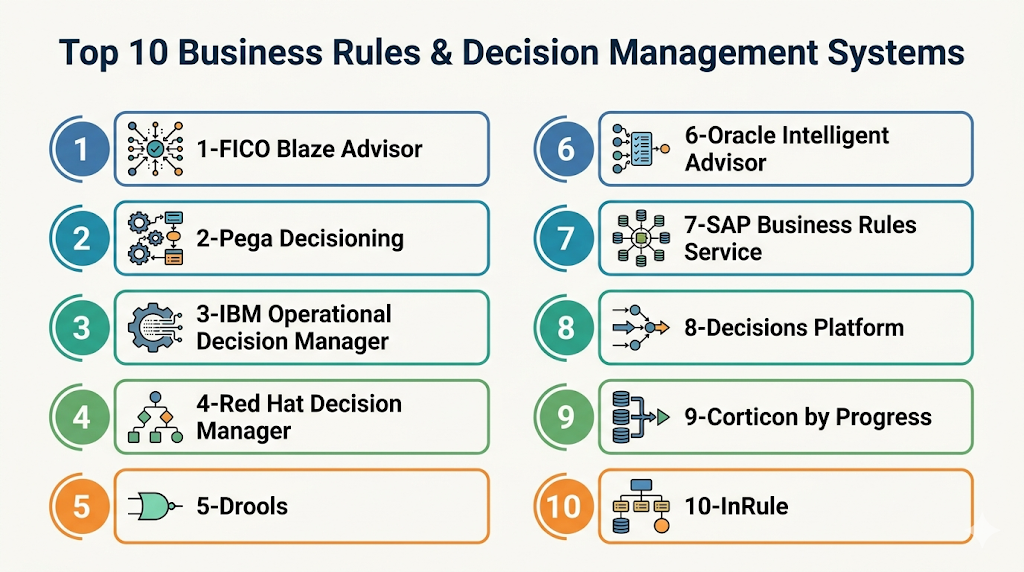
Top 10 Tools List
- FICO Blaze Advisor
- Pega Decisioning
- IBM Operational Decision Manager
- Red Hat Decision Manager
- Drools
- Oracle Intelligent Advisor
- SAP Business Rules Service
- Decisions Platform
- Corticon by Progress
- InRule
#1 — FICO Blaze Advisor
Short description: Enterprise-grade decision management platform widely used in financial services for credit, fraud, and policy automation.
Key Features
- High-performance rules engine
- Decision strategies
- Risk scoring support
- Real-time decisions
- Governance controls
- Testing and simulation
- Enterprise integrations
Pros
- Strong financial services reputation
- Excellent scale and performance
- Mature decision tooling
Cons
- Premium enterprise pricing
- Specialized implementations
- Best suited for larger organizations
Platforms / Deployment
Cloud / Self-hosted / Hybrid
Security & Compliance
Enterprise access controls, encryption, auditability.
Integrations & Ecosystem
- Banking systems
- Fraud platforms
- APIs
- Data warehouses
Support & Community
Strong enterprise consulting and support model.
#2 — Pega Decisioning
Short description: AI-powered decision management platform focused on next-best-action and customer engagement decisions.
Key Features
- Real-time decisioning
- AI recommendations
- Rules engine
- Customer journey logic
- Decision arbitration
- Analytics
- Workflow integration
Pros
- Excellent customer decisioning
- Strong AI + rules combination
- Enterprise scale proven
Cons
- Premium pricing
- Best for larger deployments
- Requires expertise
Platforms / Deployment
Cloud / Hybrid
Security & Compliance
SSO, RBAC, enterprise logging.
Integrations & Ecosystem
- CRM tools
- Contact center systems
- APIs
- Data platforms
Support & Community
Strong enterprise support network.
#3 — IBM Operational Decision Manager
Short description: Mature business rules platform for enterprises needing scalable, governed rule automation.
Key Features
- Central rules repository
- Rule authoring tools
- Decision services
- Governance workflows
- Audit trails
- Simulation testing
- High scalability
Pros
- Trusted enterprise option
- Strong governance controls
- Reliable performance
Cons
- Complex implementations possible
- Premium pricing
- UI may feel enterprise-heavy
Platforms / Deployment
Cloud / Self-hosted / Hybrid
Security & Compliance
Encryption, IAM integration, audit controls.
Integrations & Ecosystem
- IBM systems
- Java apps
- APIs
- Databases
Support & Community
Strong enterprise support.
#4 — Red Hat Decision Manager
Short description: Enterprise decision automation platform based on open-source technologies with workflow support.
Key Features
- Rules engine
- DMN support
- Process automation
- Case management
- Container deployment
- Developer tooling
- Monitoring tools
Pros
- Strong open-source foundation
- Kubernetes-friendly
- Good developer flexibility
Cons
- More technical than no-code tools
- Requires internal expertise
- Smaller business-user appeal
Platforms / Deployment
Cloud / Self-hosted / Hybrid
Security & Compliance
RBAC, enterprise Linux security ecosystem.
Integrations & Ecosystem
- OpenShift
- APIs
- Databases
- Java systems
Support & Community
Good enterprise + open-source support mix.
#5 — Drools
Short description: Popular open-source business rules engine for Java-based applications and custom decision systems.
Key Features
- Rules engine
- DMN support
- CEP/event processing
- Java integration
- Flexible rule authoring
- Open-source ecosystem
- High customization
Pros
- No license cost options
- Very flexible
- Strong developer community
Cons
- Requires technical skills
- Less business-user friendly
- Self-management responsibility
Platforms / Deployment
Self-hosted / Cloud
Security & Compliance
Depends on implementation.
Integrations & Ecosystem
- Java apps
- APIs
- Databases
- Custom platforms
Support & Community
Large technical community.
#6 — Oracle Intelligent Advisor
Short description: Decision automation platform focused on policy automation, interviews, and guided decisions.
Key Features
- Policy rule automation
- Guided interviews
- Compliance logic
- Decision services
- Workflow triggers
- Audit trails
- Oracle ecosystem integration
Pros
- Strong policy-heavy use cases
- Good compliance workflows
- Oracle customer fit
Cons
- Best in Oracle environments
- Premium pricing
- Niche awareness outside Oracle base
Platforms / Deployment
Cloud / Hybrid
Security & Compliance
Enterprise IAM, encryption, logging.
Integrations & Ecosystem
- Oracle systems
- CRM
- APIs
- Databases
Support & Community
Strong vendor support.
#7 — SAP Business Rules Service
Short description: SAP-focused rules platform used to externalize decision logic across SAP processes.
Key Features
- Business rules authoring
- SAP workflow integration
- Policy management
- Approval logic
- Versioning
- Governance
- Cloud integration
Pros
- Strong SAP ecosystem value
- Good process consistency
- Useful for ERP decisions
Cons
- Best for SAP customers
- Narrower standalone use case
- Enterprise pricing levels
Platforms / Deployment
Cloud / Hybrid
Security & Compliance
SAP enterprise security controls.
Integrations & Ecosystem
- SAP ERP
- SuccessFactors
- Ariba
- APIs
Support & Community
Strong SAP support network.
#8 — Decisions Platform
Short description: Low-code business rules and workflow platform with visual designers.
Key Features
- Visual rule designer
- Workflow automation
- Decision tables
- Forms
- Integrations
- Analytics
- No-code tooling
Pros
- Business-user friendly
- Fast implementation
- Strong low-code usability
Cons
- Smaller enterprise footprint
- Less brand recognition
- Complex global scale less proven than leaders
Platforms / Deployment
Cloud / Self-hosted
Security & Compliance
RBAC, admin controls, encryption.
Integrations & Ecosystem
- APIs
- Databases
- Internal apps
Support & Community
Responsive commercial support.
#9 — Corticon by Progress
Short description: Decision automation platform known for model-driven rule authoring and compliance logic.
Key Features
- Rules modeling
- Decision services
- No-code rule updates
- Simulation tools
- Policy automation
- APIs
- Governance tools
Pros
- Strong explainable logic
- Good compliance scenarios
- Business-user accessible tools
Cons
- Smaller market mindshare
- Premium commercial pricing
- Less ecosystem breadth than leaders
Platforms / Deployment
Cloud / Self-hosted
Security & Compliance
Access controls, auditability, encryption.
Integrations & Ecosystem
- APIs
- Enterprise apps
- Databases
Support & Community
Commercial support available.
#10 — InRule
Short description: Rules management platform focused on explainable decision automation and embedded decisions.
Key Features
- Rules authoring
- Decision tables
- APIs
- Version control
- Testing tools
- Explainability
- Embedding options
Pros
- Good usability
- Strong explainability
- Useful embedded scenarios
Cons
- Smaller ecosystem
- Less global scale than leaders
- Premium SMB pricing possible
Platforms / Deployment
Cloud / Self-hosted
Security & Compliance
RBAC, encryption, admin controls.
Integrations & Ecosystem
- CRM tools
- .NET environments
- APIs
- Databases
Support & Community
Good commercial support focus.
Comparison Table (Top 10)
| Tool Name | Best For | Platform(s) Supported | Deployment | Standout Feature | Public Rating |
|---|---|---|---|---|---|
| FICO Blaze Advisor | Financial services | Web | Hybrid | Credit/fraud decisions | N/A |
| Pega Decisioning | Customer engagement | Web | Hybrid | Next-best-action | N/A |
| IBM ODM | Enterprises | Web | Hybrid | Governed rules engine | N/A |
| Red Hat DM | Developers | Web | Hybrid | Open-source enterprise base | N/A |
| Drools | Technical teams | Web | Self-hosted | Free flexible rules engine | N/A |
| Oracle IA | Policy automation | Web | Hybrid | Guided decisions | N/A |
| SAP Rules | SAP users | Web | Hybrid | ERP rule logic | N/A |
| Decisions | Mid-market teams | Web | Cloud | Visual low-code rules | N/A |
| Corticon | Compliance teams | Web | Cloud | Model-driven rules | N/A |
| InRule | Embedded decisions | Web | Cloud | Explainable decisions | N/A |
Evaluation & Scoring of Business Rules & Decision Management Systems
| Tool Name | Core | Ease | Integrations | Security | Performance | Support | Value | Weighted Total |
|---|---|---|---|---|---|---|---|---|
| FICO Blaze Advisor | 10 | 6 | 8 | 9 | 9 | 8 | 6 | 8.00 |
| Pega Decisioning | 9 | 7 | 8 | 9 | 8 | 8 | 6 | 7.80 |
| IBM ODM | 9 | 6 | 8 | 9 | 9 | 8 | 6 | 7.85 |
| Red Hat DM | 8 | 7 | 7 | 8 | 8 | 7 | 8 | 7.65 |
| Drools | 8 | 5 | 7 | 6 | 8 | 6 | 10 | 7.20 |
| Oracle IA | 8 | 7 | 7 | 8 | 8 | 7 | 6 | 7.30 |
| SAP Rules | 8 | 7 | 7 | 8 | 8 | 8 | 6 | 7.40 |
| Decisions | 7 | 8 | 7 | 7 | 7 | 7 | 8 | 7.30 |
| Corticon | 8 | 7 | 7 | 8 | 8 | 7 | 7 | 7.45 |
| InRule | 7 | 8 | 7 | 7 | 7 | 7 | 7 | 7.10 |
How to interpret scores:
These scores compare tools within the decision management category. Enterprise leaders score high on scale and governance, while open-source or mid-market tools may score better on value and usability.
Which Business Rules & Decision Management System Is Right for You?
Solo / Freelancer
Usually unnecessary unless embedding advanced rule logic into products.
SMB
Choose Decisions, InRule, or lightweight workflow alternatives.
Mid-Market
Choose Red Hat Decision Manager, Corticon, or Decisions.
Enterprise
Choose FICO, IBM ODM, Pega, Oracle, or SAP.
Budget vs Premium
- Budget: Drools, Decisions
- Premium: FICO, IBM, Pega
Feature Depth vs Ease of Use
- Depth: FICO, IBM, Pega
- Ease: Decisions, InRule, Oracle IA
Integrations & Scalability
- Enterprise scale: IBM, FICO, Pega, SAP
Security & Compliance Needs
Choose IBM, FICO, Oracle, SAP, Pega.
Frequently Asked Questions (FAQs)
1. What is a business rules management system?
It is software used to define, manage, and automate decision logic outside application code.
2. Why use a rules engine?
It allows faster policy changes without rebuilding software.
3. Is this different from workflow automation?
Yes. Workflow tools manage tasks; rules tools automate decision logic.
4. Can non-developers manage rules?
Many platforms offer low-code or visual rule editors.
5. Which industries use these tools most?
Banking, insurance, healthcare, telecom, and government.
6. Are these tools expensive?
Enterprise platforms can be premium priced, while open-source options reduce licensing costs.
7. Can AI replace rules engines?
Usually not fully. Many organizations combine AI with rules for governance and explainability.
8. What common mistake should buyers avoid?
Embedding too much logic in custom code instead of centralized rule management.
9. Can rules engines scale in real time?
Yes, many enterprise platforms support high-volume decisioning.
10. What are alternatives?
Custom-coded logic, workflow tools, BPM suites, or application-native rules.
Conclusion
Business Rules & Decision Management Systems are highly valuable for organizations that need consistent, scalable, and auditable decision automation. Financial institutions often prefer FICO or IBM, customer engagement teams may benefit from Pega, and SAP or Oracle customers often gain value from native ecosystem tools. Technical teams can choose Drools or Red Hat for flexibility, while mid-market buyers may like Decisions or InRule. The best choice depends on rule complexity, governance needs, integration environment, and budget. Start by identifying one high-impact decision process, test 2–3 tools, and validate speed, transparency, and maintainability before wider rollout.
