Introduction
AI Red Teaming Tools are platforms designed to evaluate, test, and stress-test artificial intelligence systems for vulnerabilities, biases, and safety risks. By simulating attacks and adversarial scenarios, these tools help organizations identify weaknesses in AI models, enhance robustness, and ensure compliance with ethical and regulatory standards.
AI Red Teaming has become essential for organizations deploying high-stakes AI models in finance, healthcare, autonomous systems, and cybersecurity. These tools allow AI teams to proactively uncover vulnerabilities, assess model behavior under adversarial conditions, and validate model reliability before deployment.
Real-world use cases include: adversarial testing of NLP models, stress-testing computer vision systems, detecting bias in predictive analytics, evaluating autonomous vehicle AI safety, auditing AI-powered recommendation engines, and assessing robustness in cybersecurity AI models.
Buyers evaluating AI Red Teaming Tools should consider:
- Support for adversarial attacks and simulations
- Compatibility with multiple AI/ML frameworks
- Model auditing and behavior analysis
- Bias detection and fairness evaluation
- Reporting and compliance documentation
- Real-time testing and monitoring
- Integration with AI development pipelines
- Collaboration and workflow management
- Deployment flexibility (cloud, on-prem, hybrid)
- Ease of use and analyst support
Best for: AI/ML teams, security researchers, data scientists, compliance officers, enterprises deploying mission-critical AI, and organizations in regulated industries.
Not ideal for: Small-scale AI projects with low-risk models or teams without AI/ML deployment.
Key Trends in AI Red Teaming Tools
- Integration with adversarial AI and attack libraries
- Real-time monitoring and stress-testing capabilities
- Multi-model support (NLP, CV, structured data)
- Automated bias and fairness detection
- Simulation of ethical and adversarial scenarios
- Cloud-native and hybrid deployment options
- API and ML pipeline integration
- Collaborative workflows for cross-functional teams
- Enhanced reporting for regulatory compliance
- AI-assisted vulnerability detection
How We Selected These Tools (Methodology)
- Support for diverse AI model types
- Adversarial testing and attack capabilities
- Integration with AI/ML pipelines and deployment platforms
- Bias, fairness, and ethics evaluation
- Cloud, on-prem, and hybrid deployment flexibility
- Reporting, dashboards, and analytics
- Collaboration and workflow management
- Security and governance compliance
- Ease of use and documentation quality
- Vendor support and community engagement
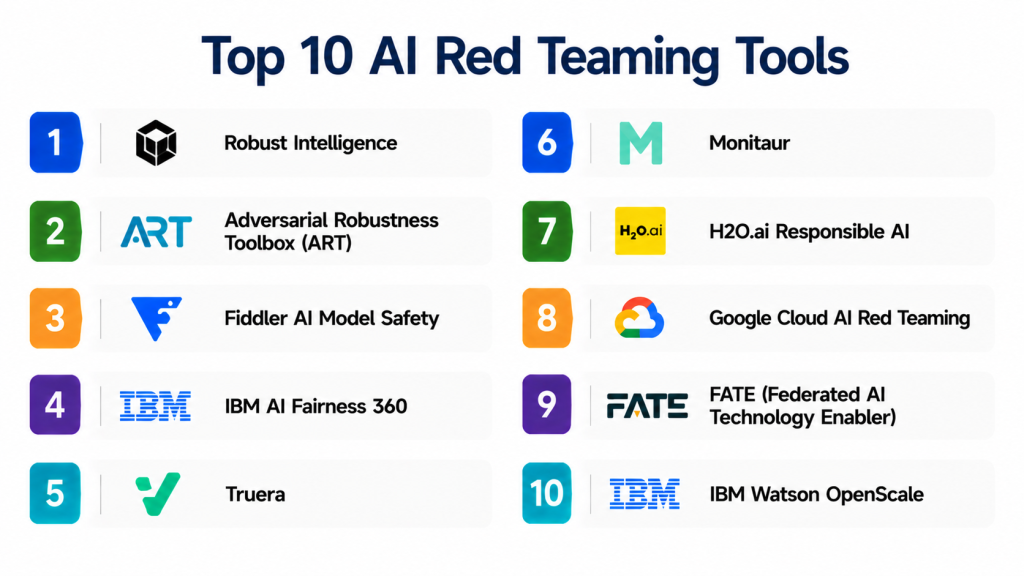
Top 10 AI Red Teaming Tools
1- Robust Intelligence
Short description:
Robust Intelligence provides AI Red Teaming for detecting vulnerabilities, adversarial attacks, and model weaknesses across multiple AI systems.
Key Features
- Automated adversarial attack simulations
- Model vulnerability assessment
- Bias and fairness evaluation
- Integration with ML pipelines
- Real-time monitoring dashboards
- Cloud-native deployment
- Reporting and compliance support
Pros
- Enterprise-grade AI testing
- Scalable for multiple models
- Continuous monitoring
Cons
- Commercial pricing
- Cloud-focused
- Requires AI expertise
Platforms / Deployment
Cloud / Hybrid
Security & Compliance
RBAC, encryption, audit logging, SOC 2, GDPR
Integrations & Ecosystem
- TensorFlow, PyTorch
- Cloud storage
- ML pipelines
- Analytics platforms
Support & Community
Enterprise vendor support
2- Adversarial Robustness Toolbox (ART)
Short description:
ART is an open-source Python library providing tools for adversarial testing and robustness evaluation of AI models.
Key Features
- Adversarial attack methods for images, text, and structured data
- Defense and robustness evaluation
- Model-agnostic
- Python-based integration
- Visualization of attack results
- Open-source and extensible
Pros
- Flexible and open-source
- Supports multiple data modalities
- Strong academic and research adoption
Cons
- Requires Python expertise
- No enterprise dashboards
- Limited managed support
Platforms / Deployment
Linux / macOS / Windows / Cloud / On-prem
Security & Compliance
Varies / Not publicly stated
Integrations & Ecosystem
- TensorFlow, PyTorch, scikit-learn
- Jupyter notebooks
- ML development pipelines
Support & Community
Open-source community
3- Fiddler AI Model Safety
Short description:
Fiddler AI provides AI Red Teaming tools for model safety, bias detection, and adversarial evaluation in enterprise ML workflows.
Key Features
- Model vulnerability testing
- Bias and fairness evaluation
- Real-time monitoring and alerting
- Integration with ML pipelines
- Reporting and dashboards
- Cloud and hybrid deployment
- Collaboration workflows
Pros
- Enterprise-ready features
- Compliance and governance support
- Supports multiple ML frameworks
Cons
- Enterprise pricing
- Cloud-focused deployment
- Complex setup for small teams
Platforms / Deployment
Cloud / Hybrid
Security & Compliance
RBAC, encryption, audit logging, GDPR, SOC 2
Integrations & Ecosystem
- TensorFlow, PyTorch, XGBoost
- Cloud storage
- BI and analytics pipelines
Support & Community
Vendor enterprise support
4- IBM AI Fairness 360
Short description:
IBM AI Fairness 360 is an open-source toolkit for detecting and mitigating bias in AI models and red-teaming AI systems.
Key Features
- Bias detection metrics
- Preprocessing, in-processing, and post-processing mitigation
- Model evaluation and auditing
- Python integration
- Support for tabular, text, and image data
- Documentation and tutorials
Pros
- Open-source and well-documented
- Supports multiple bias mitigation strategies
- Flexible for research and enterprise use
Cons
- Python expertise required
- No built-in enterprise dashboards
- Limited real-time monitoring
Platforms / Deployment
Linux / macOS / Windows / Cloud / On-prem
Security & Compliance
Varies / Not publicly stated
Integrations & Ecosystem
- TensorFlow, PyTorch, scikit-learn
- Jupyter notebooks
- ML pipelines
Support & Community
Open-source community
5- Truera
Short description:
Truera provides AI model evaluation and red-teaming tools for bias, explainability, and robustness assessment.
Key Features
- Model bias detection
- Robustness testing and stress scenarios
- Explainability and transparency dashboards
- Integration with ML pipelines
- Real-time monitoring
- Cloud and hybrid deployment
Pros
- Enterprise-grade dashboards
- Supports multiple model types
- Integrates with AI pipelines
Cons
- Commercial pricing
- Cloud-focused
- Setup complexity for small teams
Platforms / Deployment
Cloud / Hybrid
Security & Compliance
RBAC, encryption, audit logging, GDPR, SOC 2
Integrations & Ecosystem
- TensorFlow, PyTorch, scikit-learn
- Cloud storage
- ML and AI pipelines
Support & Community
Enterprise vendor support
6- Monitaur
Short description:
Monitaur provides AI red-teaming, monitoring, and robustness evaluation for deployed models, with emphasis on bias and safety.
Key Features
- Real-time model evaluation
- Bias and fairness monitoring
- Adversarial attack simulations
- Integration with ML pipelines
- Dashboard reporting
- API-based access
- Cloud deployment
Pros
- Continuous monitoring
- Supports multiple ML frameworks
- Enterprise-ready
Cons
- Cloud-only deployment
- Enterprise pricing
- Limited offline options
Platforms / Deployment
Cloud
Security & Compliance
RBAC, encryption, audit logging
Integrations & Ecosystem
- TensorFlow, PyTorch, scikit-learn
- Cloud storage
- AI/ML pipelines
Support & Community
Vendor enterprise support
7- H2O.ai Responsible AI
Short description:
H2O.ai Responsible AI provides model evaluation, bias detection, and red-teaming features for H2O AutoML and AI pipelines.
Key Features
- Bias and fairness metrics
- Model robustness evaluation
- Explainability dashboards
- Integration with H2O AutoML pipelines
- API access
- Cloud and on-prem deployment
Pros
- Tight integration with H2O AI
- Enterprise-ready reporting
- Supports AutoML models
Cons
- Tied to H2O ecosystem
- Enterprise pricing
- Cloud-focused
Platforms / Deployment
Cloud / On-prem / Hybrid
Security & Compliance
RBAC, encryption, audit logging, GDPR
Integrations & Ecosystem
- H2O AutoML pipelines
- ML frameworks
- Cloud storage
Support & Community
Enterprise support available
8- Google Cloud AI Red Teaming
Short description:
Google Cloud provides AI red-teaming tools for testing models deployed on Vertex AI for robustness, fairness, and compliance.
Key Features
- Adversarial testing
- Bias detection
- Global and local explainability
- Integration with Vertex AI pipelines
- Cloud-native monitoring dashboards
- Reporting and compliance tools
Pros
- Integrated with Google Cloud AI ecosystem
- Scalable and managed
- Enterprise-grade compliance
Cons
- Cloud-only deployment
- Google Cloud dependency
- Enterprise pricing
Platforms / Deployment
Cloud / Google Cloud
Security & Compliance
IAM, encryption, audit logging, GDPR, SOC 2
Integrations & Ecosystem
- Vertex AI
- Cloud Storage
- ML pipelines
Support & Community
Google Cloud enterprise support
9- FATE (Federated AI Technology Enabler)
Short description:
FATE provides AI red-teaming tools for federated learning environments, emphasizing model security, privacy, and robustness.
Key Features
- Federated model evaluation
- Adversarial testing
- Bias and fairness metrics
- Privacy-preserving model assessment
- Multi-party collaboration
- Cloud and hybrid deployment
- API integration
Pros
- Supports federated learning
- Privacy-preserving model testing
- Enterprise-ready
Cons
- Setup complexity
- Requires federated learning infrastructure
- Limited GUI for non-technical users
Platforms / Deployment
Cloud / Hybrid / On-prem
Security & Compliance
RBAC, encryption, audit logging, privacy-preserving compliance
Integrations & Ecosystem
- TensorFlow, PyTorch
- Federated learning pipelines
- Cloud storage
Support & Community
Vendor and community support
10- IBM Watson OpenScale
Short description:
IBM Watson OpenScale provides AI red-teaming and model monitoring for bias, explainability, and compliance in enterprise AI deployments.
Key Features
- Model monitoring and drift detection
- Bias detection and mitigation
- Explainability dashboards
- Integration with Watson AI pipelines
- Cloud and hybrid deployment
- Regulatory compliance reporting
Pros
- Enterprise-grade monitoring
- Integrated with IBM AI ecosystem
- Compliance and governance support
Cons
- IBM ecosystem dependency
- Enterprise pricing
- Cloud-focused
Platforms / Deployment
Cloud / Hybrid
Security & Compliance
RBAC, SSO/SAML, encryption, audit logging, GDPR, SOC 2
Integrations & Ecosystem
- Watson ML pipelines
- IBM Cloud services
- Analytics platforms
Support & Community
IBM enterprise support
Comparison Table
| Tool Name | Best For | Platform(s) Supported | Deployment | Standout Feature | Public Rating |
|---|---|---|---|---|---|
| Robust Intelligence | Enterprise AI pipelines | Cloud/Hybrid | Cloud/Hybrid | Adversarial attack simulations | N/A |
| ART | Research & open-source | Linux/macOS/Windows | Cloud/On-prem | Python adversarial toolkit | N/A |
| Fiddler AI | Enterprise ML safety | Cloud/Hybrid | Cloud/Hybrid | Model monitoring & bias detection | N/A |
| IBM AI Fairness 360 | Bias detection | Linux/macOS/Windows | Cloud/On-prem | Open-source fairness toolkit | N/A |
| Truera | Enterprise AI models | Cloud/Hybrid | Cloud/Hybrid | Model explainability dashboards | N/A |
| Monitaur | AI monitoring | Cloud | Cloud | Real-time model evaluation | N/A |
| H2O.ai Responsible AI | AutoML explainability | Cloud/On-prem/Hybrid | Cloud/On-prem/Hybrid | Responsible AI integration | N/A |
| Google Cloud AI Red Teaming | Cloud AI models | Cloud | Google Cloud | Vertex AI integration | N/A |
| FATE | Federated learning | Cloud/Hybrid/On-prem | Cloud/Hybrid/On-prem | Federated model testing | N/A |
| IBM Watson OpenScale | Enterprise AI compliance | Cloud/Hybrid | Cloud/Hybrid | Bias & drift monitoring | N/A |
Evaluation & Scoring
| Tool | Core (25%) | Ease (15%) | Integrations (15%) | Security (10%) | Performance (10%) | Support (10%) | Value (15%) | Weighted Total |
|---|---|---|---|---|---|---|---|---|
| Robust Intelligence | 9.3 | 8.5 | 8.9 | 8.7 | 9.0 | 8.7 | 8.5 | 8.84 |
| ART | 9.0 | 8.2 | 8.8 | 8.3 | 8.9 | 8.5 | 8.4 | 8.68 |
| Fiddler AI | 9.2 | 8.3 | 8.9 | 8.7 | 9.0 | 8.8 | 8.5 | 8.83 |
| IBM AI Fairness 360 | 8.9 | 8.0 | 8.7 | 8.5 | 8.7 | 8.4 | 8.3 | 8.53 |
| Truera | 9.0 | 8.2 | 8.8 | 8.6 | 8.9 | 8.6 | 8.5 | 8.69 |
| Monitaur | 8.8 | 8.0 | 8.6 | 8.5 | 8.8 | 8.5 | 8.3 | 8.50 |
| H2O.ai Responsible AI | 9.1 | 8.2 | 8.9 | 8.6 | 8.9 | 8.6 | 8.5 | 8.74 |
| Google Cloud AI Red Teaming | 9.2 | 8.3 | 8.9 | 8.7 | 9.0 | 8.7 | 8.5 | 8.83 |
| FATE | 8.9 | 8.0 | 8.7 | 8.5 | 8.7 | 8.4 | 8.3 | 8.53 |
| IBM Watson OpenScale | 9.1 | 8.3 | 8.9 | 8.7 | 8.9 | 8.7 | 8.5 | 8.80 |
Which AI Red Teaming Tool Is Right for You?
Solo / Freelancer
ART or IBM AI Fairness 360 for small-scale bias and adversarial testing
SMB
Fiddler AI or Truera for model monitoring and enterprise readiness
Mid-Market
Robust Intelligence, Monitaur, or H2O.ai Responsible AI for scalable AI red-teaming
Enterprise
IBM Watson OpenScale, Google Cloud AI Red Teaming, or FATE for multi-model, multi-cloud, and federated AI systems
Budget vs Premium
Open-source ART and IBM AI Fairness 360 for cost-effective testing; Fiddler AI, Robust Intelligence, and Watson OpenScale for enterprise-grade pipelines
Feature Depth vs Ease of Use
Enterprise tools provide dashboards and compliance; open-source tools provide flexibility and custom integrations
Integrations & Scalability
Fiddler AI, H2O.ai Responsible AI, and Google Cloud scale for large models and pipelines
Security & Compliance Needs
Enterprise platforms offer RBAC, SSO, encryption, audit logs, and compliance features
Frequently Asked Questions
1- What is an AI Red Teaming tool?
A platform that tests AI models for vulnerabilities, adversarial robustness, and bias to ensure safe and reliable deployment.
2- Can these tools simulate adversarial attacks?
Yes, ART, Robust Intelligence, and FATE provide adversarial testing frameworks.
3- Are open-source options available?
Yes, ART and IBM AI Fairness 360 are open-source for research and small-scale testing.
4- Can enterprise pipelines integrate these tools?
Most enterprise platforms offer APIs and connectors for ML and AI pipelines.
5- Do these tools detect bias?
Enterprise and research platforms provide bias metrics and fairness evaluation.
6- Which model types are supported?
Tabular, text, images, video, NLP models, and computer vision models.
7- Are these tools cloud-native?
Many are cloud-native, while open-source options can run on-prem or hybrid.
8- How complex is deployment?
Enterprise tools provide dashboards and managed services; open-source requires coding expertise.
9- Can these tools support federated AI models?
FATE provides federated model evaluation for distributed AI environments.
10- What factors should guide tool selection?
Model complexity, dataset size, deployment scale, cloud strategy, security, and compliance requirements.
Conclusion
AI Red Teaming Tools are critical for ensuring the robustness, fairness, and reliability of AI models. Open-source frameworks like ART and IBM AI Fairness 360 provide flexibility for research and small projects, while enterprise platforms such as Fiddler AI, H2O.ai Responsible AI, Robust Intelligence, and IBM Watson OpenScale offer comprehensive testing, monitoring, and compliance capabilities. Organizations should evaluate model types, deployment scale, integration needs, and regulatory requirements before selecting a tool. Running pilot evaluations with platforms helps validate robustness, bias detection, and overall safety before full-scale deployment.
