Introduction
Adversarial Robustness Testing Tools are platforms designed to evaluate the resilience of AI and ML models against adversarial attacks. These tools simulate malicious inputs or perturbations to identify vulnerabilities, helping organizations ensure their models are secure, reliable, and trustworthy.
As AI models are deployed in high-stakes environments—such as finance, healthcare, autonomous vehicles, and security—robustness testing is crucial to prevent errors, data manipulation, or malicious exploitation.
Real-world use cases include
- Testing computer vision models against adversarial image attacks
- Evaluating NLP models for robustness to input perturbations
- Ensuring fraud detection and financial AI models resist manipulation
- Strengthening AI-powered security and authentication systems
- Benchmarking AI models for regulatory compliance
What buyers should evaluate
- Support for multiple model types (CV, NLP, tabular)
- Coverage of common adversarial attack types
- Integration with AI/ML pipelines and MLOps workflows
- Automated testing and reporting
- Ease of use and interface clarity
- Scalability for large datasets and complex models
- Deployment flexibility (cloud, on-prem, hybrid)
- Metrics and analytics for model vulnerability
- Security and access control
- Cost and licensing model
Best for: AI teams, ML engineers, security-focused AI teams, enterprises deploying models in critical applications
Not ideal for: Small experimental models or low-risk AI projects
Key Trends in Adversarial Robustness Testing Tools
- Integration with ML pipelines for continuous robustness testing
- Growing support for multi-modal AI models (text, image, audio)
- AI-assisted attack simulation and automated perturbation generation
- Cloud-native tools for scalable testing
- Enhanced reporting for regulatory and compliance requirements
- Open-source frameworks for research and experimentation
- Low-code interfaces for non-technical evaluation
- Real-time monitoring of deployed model vulnerabilities
- Standardized benchmarking metrics for model robustness
- Collaboration features for multi-team evaluation
How We Selected These Tools
- Coverage of adversarial attack methods
- Support for multiple AI/ML model types
- Integration with MLOps and AI pipelines
- Scalability for enterprise-scale models
- Ease of use and interface usability
- Reporting and analytics capabilities
- Automation and AI-assisted testing features
- Security and compliance support
- Vendor reputation or open-source community adoption
- Practical relevance for model deployment and enterprise AI
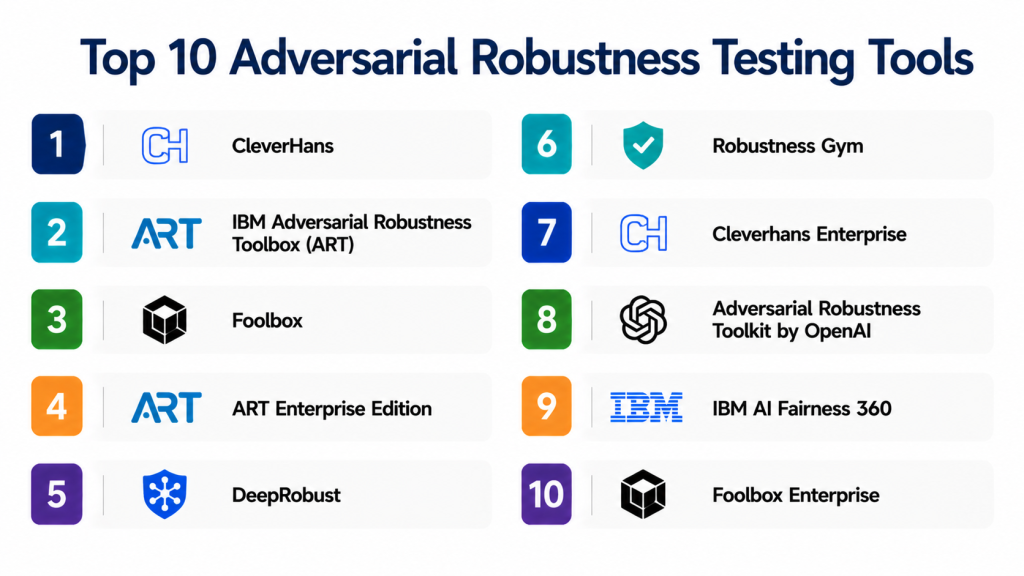
Top 10 Adversarial Robustness Testing Tools
1- CleverHans
Short description: CleverHans is an open-source Python library for adversarial attacks and robustness evaluation, widely used in AI research and enterprise testing.
Key Features
- Implements multiple adversarial attack algorithms
- Benchmarking for model robustness
- Supports deep learning frameworks (TensorFlow, PyTorch)
- Evaluation metrics and reporting
- Integration with ML pipelines
- Continuous community updates
- API for automated testing
Pros
- Open-source and widely adopted
- Supports a variety of attack methods
- Easy integration with existing ML frameworks
Cons
- Requires coding expertise
- Research-focused; limited enterprise support
Platforms / Deployment
- Cloud / Self-hosted
Security & Compliance
- Not publicly stated
Integrations & Ecosystem
- TensorFlow, PyTorch
- Python ML pipelines
- REST API for automation
Support & Community
Active open-source community with research publications
2- IBM Adversarial Robustness Toolbox (ART)
Short description: ART is an open-source framework from IBM for evaluating and improving ML model robustness against adversarial attacks.
Key Features
- Adversarial attack simulation
- Defense strategies and mitigation
- Supports multiple model types
- Integration with ML frameworks
- Metrics and reporting
- API for automated workflows
- Security-focused evaluation
Pros
- Research-backed and enterprise-ready
- Supports a broad range of AI models
- Integrates with MLOps pipelines
Cons
- Requires technical expertise
- Cloud/on-premises deployment options vary
Platforms / Deployment
- Cloud / Self-hosted / Hybrid
Security & Compliance
- Not publicly stated
Integrations & Ecosystem
- TensorFlow, PyTorch, Keras
- Python SDK, APIs
- ML pipeline integration
Support & Community
Open-source community and IBM enterprise support
3- Foolbox
Short description: Foolbox is a Python library for benchmarking model robustness against adversarial attacks with simplicity and flexibility.
Key Features
- Implements common adversarial attacks
- Supports multi-framework models
- Evaluation metrics and model scoring
- Integration with Python ML pipelines
- Automated testing scripts
- Visualization tools
- Continuous updates
Pros
- Easy to use and lightweight
- Supports TensorFlow, PyTorch, JAX
- Flexible for experimentation
Cons
- Research-focused
- Limited enterprise-scale features
Platforms / Deployment
- Cloud / Self-hosted
Security & Compliance
- Not publicly stated
Integrations & Ecosystem
- Python ML frameworks
- API and CLI automation
- Integration with evaluation pipelines
Support & Community
Active open-source community
4- ART Enterprise Edition
Short description: Enterprise version of IBM ART providing enhanced support, dashboards, and automated workflows for adversarial robustness.
Key Features
- Advanced adversarial attack simulation
- Defense and mitigation automation
- Reporting dashboards
- Multi-model support
- Integration with enterprise AI pipelines
- API and SDK support
- Governance and auditing
Pros
- Enterprise-grade support
- Scalable for multiple teams
- Integrated dashboards
Cons
- Enterprise licensing cost
- Cloud-focused deployment
Platforms / Deployment
- Cloud / Hybrid
Security & Compliance
- Not publicly stated
Integrations & Ecosystem
- TensorFlow, PyTorch
- REST APIs
- ML pipelines
Support & Community
Enterprise vendor support
5- DeepRobust
Short description: DeepRobust is an open-source library focusing on evaluating model robustness for deep learning networks against adversarial attacks.
Key Features
- Graph and neural network robustness evaluation
- Multiple attack methods
- Metrics and visualization tools
- Python integration
- Supports research and experimentation
- API-based testing
- Continual updates
Pros
- Strong for academic and research use
- Open-source flexibility
- Supports graph-based networks
Cons
- Requires technical expertise
- Limited enterprise support
Platforms / Deployment
- Cloud / Self-hosted
Security & Compliance
- Not publicly stated
Integrations & Ecosystem
- PyTorch, TensorFlow
- Python ML pipelines
- REST API support
Support & Community
Active research community
6- Robustness Gym
Short description: Robustness Gym provides a framework for systematic evaluation of NLP model robustness against adversarial and distributional shifts.
Key Features
- NLP-focused model evaluation
- Supports multiple attack types
- Integration with Hugging Face models
- Automated testing workflows
- Metrics and reporting dashboards
- Python API for automation
- Multi-dataset evaluation
Pros
- Strong NLP model focus
- Flexible and extensible
- Supports large-scale evaluation
Cons
- Limited CV support
- Requires Python knowledge
Platforms / Deployment
- Cloud / Self-hosted
Security & Compliance
- Not publicly stated
Integrations & Ecosystem
- Hugging Face Transformers
- Python ML pipelines
- API support
Support & Community
Open-source community
7- Cleverhans Enterprise
Short description: Enterprise edition providing enhanced dashboards, enterprise support, and integration for CleverHans adversarial testing.
Key Features
- Multi-modal attack simulation
- Real-time dashboards
- Automated evaluation workflows
- Enterprise support
- Model benchmarking
- API integration
- Multi-team collaboration
Pros
- Enterprise-ready features
- Scalable monitoring
- Multi-team collaboration
Cons
- Licensing required
- Cloud-focused
Platforms / Deployment
- Cloud
Security & Compliance
- Not publicly stated
Integrations & Ecosystem
- Python SDK
- ML pipelines
- REST APIs
Support & Community
Enterprise vendor support
8- Adversarial Robustness Toolkit by OpenAI
Short description: OpenAI toolkit for benchmarking model robustness against adversarial inputs in NLP and vision tasks.
Key Features
- Adversarial input simulation
- Multi-model evaluation
- Metrics and reporting
- API integration
- Python SDK
- Automated testing pipelines
- Supports CV and NLP models
Pros
- Research-grade performance
- Multi-modal support
- Open-source and accessible
Cons
- Requires technical expertise
- Limited enterprise support
Platforms / Deployment
- Cloud / Self-hosted
Security & Compliance
- Not publicly stated
Integrations & Ecosystem
- TensorFlow, PyTorch
- Python APIs
- ML pipelines
Support & Community
Open-source community
9- IBM AI Fairness 360
Short description: IBM AI Fairness 360 is a responsible AI toolkit with adversarial robustness evaluation and fairness metrics.
Key Features
- Bias and fairness evaluation
- Adversarial testing support
- Model interpretability
- Metrics and reporting
- Python SDK integration
- ML pipeline compatibility
- Multi-modal model support
Pros
- Enterprise-grade fairness tools
- Scalable and research-backed
- Integrates with AI pipelines
Cons
- Limited visualization
- Requires Python expertise
Platforms / Deployment
- Cloud / Self-hosted
Security & Compliance
- Not publicly stated
Integrations & Ecosystem
- Python SDK, REST APIs
- TensorFlow, PyTorch
- ML pipelines
Support & Community
Enterprise support and open-source community
10- Foolbox Enterprise
Short description: Enterprise edition of Foolbox providing dashboards, API integration, and multi-team collaboration for adversarial robustness testing.
Key Features
- Advanced attack simulations
- Reporting dashboards
- Multi-model evaluation
- API and SDK integration
- Enterprise support
- Automated testing workflows
- Collaboration tools
Pros
- Enterprise-ready features
- Scalable for multiple teams
- Integrated dashboards
Cons
- Licensing required
- Cloud-focused
Platforms / Deployment
- Cloud
Security & Compliance
- Not publicly stated
Integrations & Ecosystem
- Python SDK, REST APIs
- ML pipelines
- AI frameworks
Support & Community
Enterprise vendor support
Comparison Table
| Tool | Best For | Platform(s) | Deployment | Standout Feature | Public Rating |
|---|---|---|---|---|---|
| CleverHans | Research & ML | Cloud/Self-hosted | Hybrid | Multi-attack simulations | N/A |
| IBM ART | Enterprise ML | Cloud/Hybrid | Hybrid | Bias & fairness detection | N/A |
| Foolbox | Benchmarking ML | Cloud/Self-hosted | Hybrid | Lightweight attack testing | N/A |
| ART Enterprise | Enterprise AI | Cloud/Hybrid | Hybrid | Dashboards & automation | N/A |
| DeepRobust | Research AI | Cloud/Self-hosted | Hybrid | Graph & neural network robustness | N/A |
| Robustness Gym | NLP models | Cloud/Self-hosted | Hybrid | Systematic NLP evaluation | N/A |
| Cleverhans Enterprise | Enterprise ML | Cloud | Cloud | Multi-team collaboration | N/A |
| OpenAI Toolkit | Research-grade AI | Cloud/Self-hosted | Hybrid | Multi-modal adversarial testing | N/A |
| IBM AI Fairness 360 | Responsible AI | Cloud/Self-hosted | Hybrid | Bias & fairness evaluation | N/A |
| Foolbox Enterprise | Enterprise ML | Cloud | Cloud | Dashboards & collaboration | N/A |
Evaluation & Scoring of Adversarial Robustness Testing Tools
| Tool | Core (25%) | Ease (15%) | Integrations (15%) | Security (10%) | Performance (10%) | Support (10%) | Value (15%) | Weighted Total |
|---|---|---|---|---|---|---|---|---|
| CleverHans | 9 | 7 | 8 | 7 | 8 | 7 | 8 | 7.9 |
| IBM ART | 9 | 8 | 8 | 8 | 8 | 7 | 8 | 8.2 |
| Foolbox | 8 | 8 | 7 | 7 | 8 | 7 | 7 | 7.6 |
| ART Enterprise | 8 | 8 | 8 | 8 | 8 | 8 | 8 | 8.0 |
| DeepRobust | 8 | 7 | 7 | 7 | 8 | 7 | 7 | 7.5 |
| Robustness Gym | 8 | 7 | 7 | 7 | 8 | 7 | 7 | 7.5 |
| Cleverhans Enterprise | 8 | 7 | 8 | 7 | 8 | 7 | 7 | 7.7 |
| OpenAI Toolkit | 8 | 8 | 8 | 7 | 8 | 7 | 8 | 7.9 |
| IBM AI Fairness 360 | 8 | 7 | 8 | 7 | 8 | 7 | 7 | 7.8 |
| Foolbox Enterprise | 8 | 7 | 8 | 7 | 8 | 7 | 7 | 7.7 |
Which Adversarial Robustness Tool Is Right for You?
Solo / Freelancer
- CleverHans, DeepRobust
Lightweight and open-source options for research and experimentation
SMB
- Foolbox, Robustness Gym, OpenAI Toolkit
Balanced features with Python SDKs for integration
Mid-Market
- IBM ART, ART Enterprise, Foolbox Enterprise
Enterprise-ready monitoring and dashboards
Enterprise
- IBM AI Fairness 360, Cleverhans Enterprise, ART Enterprise
Scalable, multi-team workflows for enterprise AI compliance
Budget vs Premium
- Budget: CleverHans, DeepRobust
- Premium: IBM ART, ART Enterprise, IBM AI Fairness 360
Feature Depth vs Ease of Use
- Ease: Robustness Gym, OpenAI Toolkit
- Depth: IBM ART, ART Enterprise, Foolbox Enterprise
Integrations & Scalability
- Best: IBM ART, ART Enterprise, Foolbox Enterprise
Security & Compliance Needs
- Enterprise-ready: IBM AI Fairness 360, ART Enterprise, IBM ART
Frequently Asked Questions
1- What is adversarial robustness testing?
Tools to simulate malicious inputs and evaluate AI model resilience against attacks.
2- Do these tools support multiple AI model types?
Yes, most support NLP, CV, tabular, and multi-modal models.
3- Can these tools integrate with ML pipelines?
Yes, APIs and SDKs allow seamless integration into MLOps workflows.
4- Are there open-source options?
CleverHans, Foolbox, DeepRobust, and Robustness Gym are open-source.
5- Do they provide automated testing?
Many platforms offer automation to generate attacks and assess model performance.
6- Are these tools cloud-only?
Some are cloud-native, while others support self-hosted or hybrid deployments.
7- How do they handle enterprise compliance?
Enterprise editions include dashboards, reporting, and monitoring aligned with governance standards.
8- Can these tools detect bias and fairness issues?
Yes, several platforms include fairness evaluation alongside robustness testing.
9- How scalable are these tools?
Enterprise tools like IBM ART and Foolbox Enterprise scale for multi-team, multi-model evaluation.
10- How should I choose the right tool?
Consider model type, scale, integration needs, deployment preference, and enterprise compliance requirements.
Conclusion
Adversarial Robustness Testing Tools are essential for ensuring AI models are resilient, secure, and reliable in production. They protect against adversarial attacks, performance degradation, and ethical risks, particularly in high-stakes applications.
Choosing the right tool depends on your model complexity, deployment scale, integration requirements, and team expertise. A practical approach is to shortlist run pilot testing, and validate robustness, monitoring, and compliance before enterprise-wide adoption.
